Regular readers here know that I choose my Library of America offerings for various reasons: for authors I haven’t read before but would like to (such as Edgar Allan Poe and Sherwood Anderson), for authors I love and am always happy to read more of (such as Willa Cather, Kate Chopin and Edith Wharton), or for topics that interest me (like slavery and civil rights). Mary Austin’s “The land” fits into this latter: it’s about the American southwest which is a region I love. I have in fact reviewed another Austin story about that region, “The scavengers”.
In “The scavengers”, Austin described the scavenging animals of the American deserts, the buzzards, vultures, ravens, coyotes and Clark’s crows, and promoted the idea of nature’s balance. In “The land” her focus is the landscape itself, and its hard, unforgiving nature. It’s the first story (essay) in her collection Lost borders, and works partly as an introduction to the collection, in which she sets down, she writes, “what the Borderers thought and felt”.
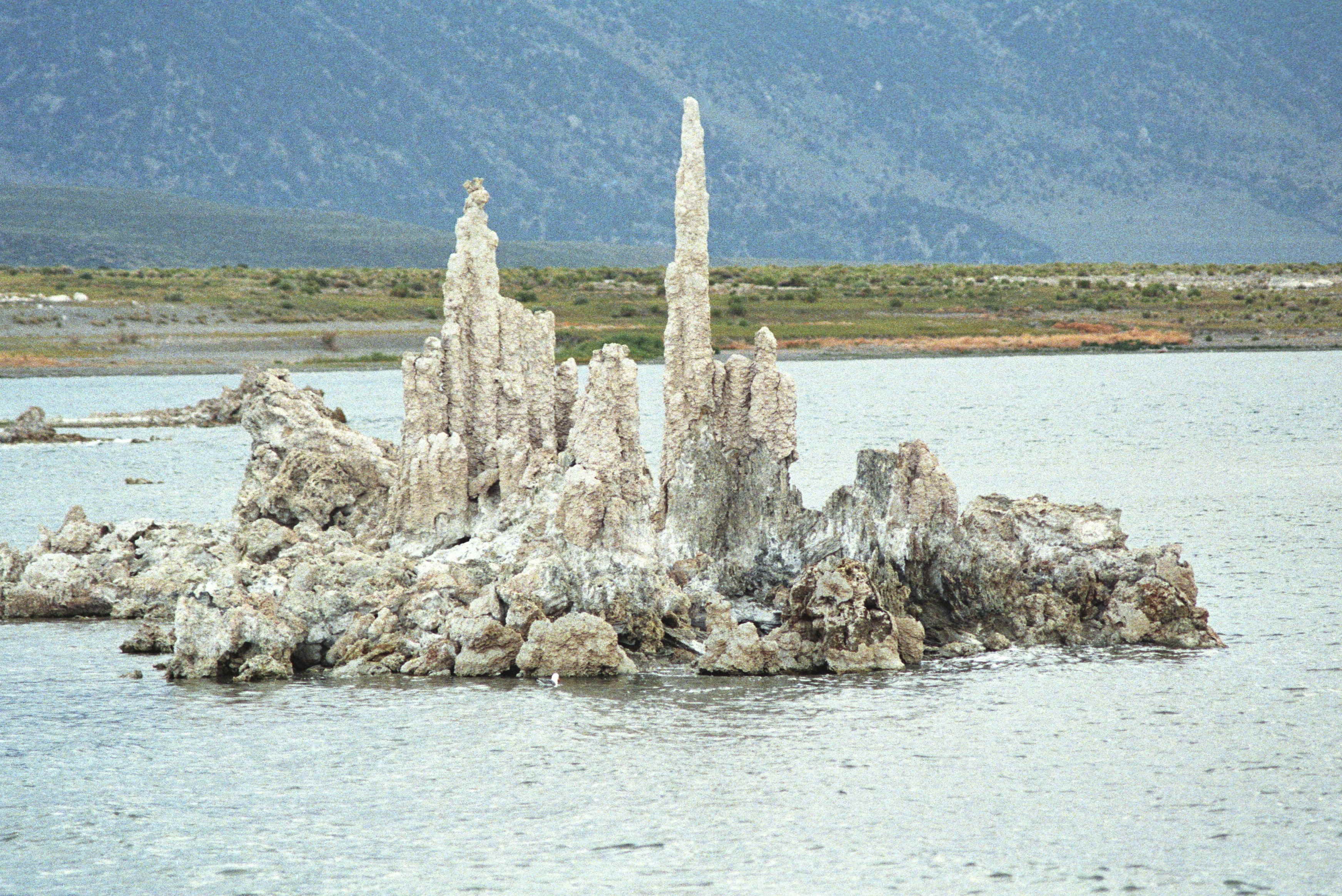
Tufa or “man-deep crystals of pure salt”, Mono Lake
Indeed, LOA’s notes quote scholar Esther F. Lanigan statement that the story introduces “the motley collection of drifters, prospectors, explorers, entrepreneurs, and sheepherders [about whom she will write], most of whom demonstrate an astonishing insensitivity in their dealings with the women closest to them”.
The “lost borders” region she explores in the collection is what I’d call the eastern part of central California*. We are talking country that stretches from the east of the Sierra Nevadas to Death Valley in Nevada. It is remote, hot and very dry. It is country, in other words, that Australians would understand. Driving through this region, as I did in 1983 and a few times in the 1990s, reminded me, in fact, of my road trips in outback Australia – particularly western Queensland and northern South Australia.
“The land” is about story and myth. She writes that “curiously … you can get anybody to believe any sort of a tale that had gold in it”. She’s “sore” that she’s not believed “in some elementary matters, such as that horned toads are not poisonous, and that Indians really have the bowels of compassion”. So, when she is brought a potsherd from Shoshone Land and told she could probably find “a story about it somewhere”, she responds that she’ll “do better than that”, she’ll “make a story”. And so she does, and is amused over time to see her story take on the mantle of truth. She has “a spasm of conscience” on at least one occasion, but doesn’t ‘fess up. Instead, she suggests that there only has to be another similar potsherd found for the tale to be fixed “in the body of desert myths”. Beware, methinks, you oral historians!
“The land” is also about men and women. Austin respects Indian (as she described them back then) knowledge, saying:
Out there, a week’s journey from everywhere, the land was not worth parcelling off, and the boundaries which should logically have been continued until they met the cañon of the Colorado ran out in foolish wastes of sand and inextricable disordered ranges. Here you have the significance of the Indian name for that country— Lost Borders. And you can always trust Indian names to express to you the largest truth about any district in the shortest phrases.
“Largest truth” in “the shortest phrases”. Love that. There’s a lovely, irregular, repetition of “out there” throughout the piece, reinforcing the sense of remoteness and desolation. The unforbidding nature of the land is conveyed in other ways too: by experience, “I have seen things happen that I do not believe myself”, and in description, “the senses are obsessed by the coil of a huge and senseless monotony; straight, white, blinding, alkali flats, forsaken mesas …”.
While Austin respects the Indian inhabitants, she is less impressed by men (and I mean here the male of the species, not mankind). Men are seen as “small”. She describes them as making “law for the comfortable feel of it”. They “pinch themselves with regulations to make sure of being sentient …”. Their “boast of knowledge is likely to prove as hollow as the little yellow gourds called apples of Death Valley”. It is the
men who mostly go into the desert, who love it past all reasonableness, slack their ambitions, cast off old usages, neglect their families because of the pulse and beat of a life laid bare to its thews and sinews. Their women hate with implicitness the life like the land.
Indeed, she concludes this essay with:
If the desert were a woman, I know well what like she would be: deep-breasted, broad in the hips, tawny, with tawny hair, great masses of it lying smooth along her perfect curves, full lipped like a sphinx, but not heavy-lidded like one, eyes sane and steady as the polished jewel of her skies, such a countenance as should make men serve without desiring her, such a largeness to her mind as should make their sins of no account, passionate, but not necessitous, patient—and you could not move her, no, not if you had all the earth to give, so much as one tawny hair’s-breadth beyond her own desires. If you cut very deeply into any soul that has the mark of the land upon it, you find such qualities as these—as I shall presently prove to you.
Austin belongs, I think, to the tradition of nature writers that includes Henry David Thoreau and John Muir (whom I’ve reviewed), but it seems to me that her gender adds quite a different perspective to what she sees.
Mary Austin
“The land”
First published: In Lost borders, 1909.
Available: Online at the Library of America
* This region is at the centre of the California Water Wars (dramatised in the film, China Town)

 Whispering Gums