Sparrow-Folk and Tara Moss want to Ruin Your Day

This year, as I like to do, I went to the National Folk Festival, albeit for only one day instead of my usual two. I love the music, but I also love the singer-songwriters for whom the lyrics are at least as important at the music. I came to folk through the protest songs of the Civil Rights era and so love to hear songs addressing contemporary concerns – political, social, global, local, they all have a place in the folk singer-songwriter repertoire.

For this post I’m just going to talk about one song, because it illustrates the point and it enables me to refer again to a book I read and reviewed earlier this year, Tara Moss’s The fictional woman. But first, the song. Seems like I’m late to the party, because it apparently made quite a splash early last year, not only in Australia, whence it originates, but overseas. It was even picked up by Huffington Post. The song’s title is “Ruin your day” and it satirises those who frown upon/are disgusted by/want to ban mothers breastfeeding in public. I must say, I’ve been astonished recently to realise that instead of breastfeeding in public becoming more acceptable since my time in the 1980s, it’s actually become less so. We 1980s mothers did not furtively cover ourselves with shawls or disappear into some dark nether regions of wherever we happened to be. No, we did what comes naturally, not brazenly but naturally. Well, at least my friends and I did, and while there were some demurs from some quarters, we fully expected the world to become more enlightened and tolerant as time moved on. Not so, it seems.

Anyhow, here’s the video:

As I listened to the gorgeous, locally-based “glam-rock” duo, Sparrow-Folk, perform this song over Easter, I was reminded of Tara Moss’s chapter on the topic. As you can imagine, she, a new mother in her late 30s, and a card-carrying feminist, had plenty to say on the subject. Her chapter, “The Mother”, is the longest chapter in the book, because there are many “fictions” attached to motherhood – and several have to do with breastfeeding, with the can-and-can’ts, the for-and-againsts, and of course the hide-or-go-publics. These “fictions” tend to be accompanied by a lot of either-or discussions which put women in boxes, and, worse, pit women against each other, creating what she calls “false divides”. I’m not going to go into all that now, but I will briefly discuss her section on public breastfeeding.

Moss beautifully unpacks society’s ongoing discomfort with breastfeeding, with the fact that “the very sight of breastfeeding remains inexplicably controversial”. “Images of breastfeeding”, she writes, “are still routinely flagged as offensive on Facebook and banned, accompanied by this message: ‘Shares that contain nudity, pornography, or sexual content are not permitted on Facebook … refrain from posting abusive material in future'”. Breastfeeding, pornographic? abusive? What is all this about? There has been some official relaxation of the “rule” she says, but reports still come in of photos of breastfeeding being banned on Facebook.

Confirming my 1980s memories, she writes that it wasn’t always like this. Sesame Street “once routinely showed breastfeeding, but since the 1990s it has reportedly only shown babies being fed by bottle”. These days, it is ok for magazines and advertising to feature “a sea of exposed female upper body flesh” but not ok for that breast to be seen doing what it was designed for. She argues this is “learned bias [and asks] since when did the natural way of feeding your child come to be seen as offensive or controversial?”

Moss continues:

Our choices are influenced by what we see and what society portrays as normal or aspirational. In a very real way, visibility is acceptance. Unfortunately, while we have become accustomed to seeing the fertile female body used to sell us all kinds of products, we are not longer accustomed to seeing it perform this most natural task. But though anti-discrimination laws protect women’s right to breastfeed in all public places, without normalising the sight of breastfeeding in our society we have little hope of making more mothers comfortable enough to engage in the practice of publicly feeding their children naturally.

I love that Sparrow-Folk’s you-tube went global:

I’m not going to retreat
To the comfort of a toilet seat
No, no, I’m happy to stay out here where everybody else eats

Everyone knows new mothers are exhibitionists
Taking every chance they get to ruin your day with tits.

Go Sparrow-Folk, go Tara Moss – and go all you breastfeeding women brave enough to stare down pursed-mouth looks and abuse. This regressive tide must be turned.
If you like puns …

Puns make me laugh … and living in Canberra, as I do, I’m regularly confronted by them. How, do you ask? Well, via a local lawn/turf business called Canturf, a family business which started in 1966. They have, for many years now, been promoting their product – even, and it must have been hard, throughout our recent long drought that saw stringent water restrictions result in many a dead lawn – through signs based on puns.

The puns keep changing, so much so that I have often wondered whether they can keep it up, but it seems they can. Do they have a wonderful ad agency? Or is it their own staff? The answer is on the FAQ page. The answer to “Who thinks of your funny signs?” is: “You do. If you come up with an original saying and think it would be a good Canturf sign, send it in to us via email or fax along with your contact details. If your idea is original and gets used you will be paid $250 for your efforts.” Now, there’s a challenge!

Anyhow, today, as we were driving into the country for our annual Easter Sunday lunch, we saw a couple of their latest:

  • It’s been nice mowing you

and

  • It’s a lawn way to the top if you want a grassy knoll.

Honestly! How can you drive past signs like that and not smile. (You certainly don’t forget the name of the company behind them!)

Previous signs have included:

  • Looks good mown eh Lisa
  • Lawngerie modelled here
  • We’re easy to get a lawn with
  • Fifty shades of green
  • It’s sexy and you grow it
  • It’s greener than brown

This last is a political pun probably only understood by Aussies. It’s a little daring for a business to use but I suppose it can be read in multiple ways. And, anyhow, this is Canberra, and we have a reputation for being Green.

I’m sorry that I haven’t photographed these signs but, you know, we’ve always been going places at the time …

And, since we are talking about puns, I’d like to give a plug here for a young ensemble I heard this weekend at the National Folk Festival. Calling themselves the Miss Chiefs they admitted loving puns. Their name, they said, gives it away. Just one year old, this group first performed at the 2012 festival’s Infinite Song Contest for which performers present their version of a song relating to the year’s contest theme. Last year’s theme was Leonard Cohen, and the just-formed trio performed “Hallelujah”. Here is a You Tube recording of that event:

The lead singer, Vendulka Wichta is 14 (at the time of the recording!), and she’s accompanied by Laura Zarb (24) and Amelia Gibson (17). From what I saw this year, one year on from the above performance, the Miss Chiefs is a group to watch.

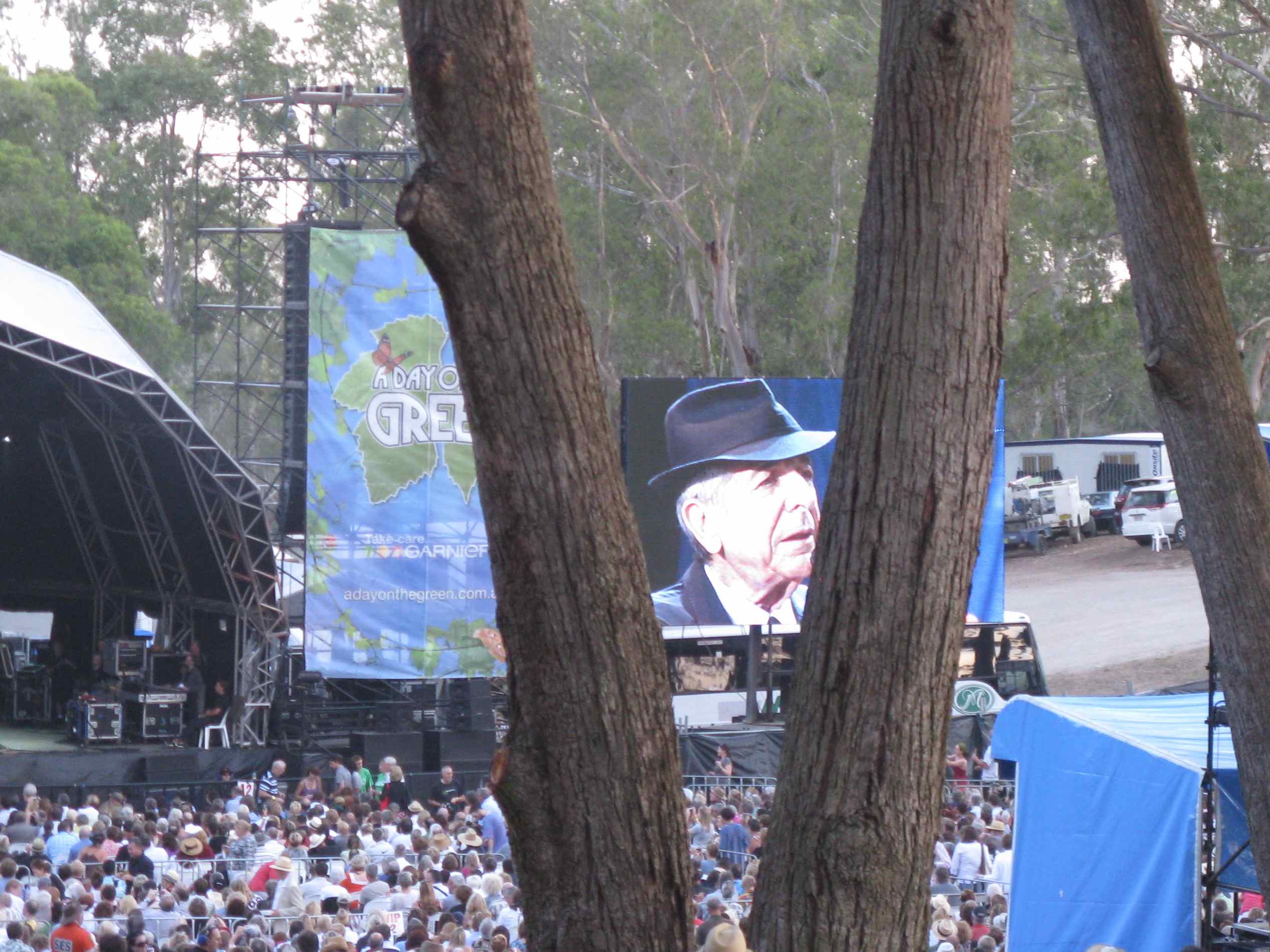
Every folkie knows … Leonard Cohen

Leonard Cohen at Centennial Vineyards

Leonard Cohen at Centennial Vineyards, 2009

I recently wrote about the National Folk Festival in relation to Australian stories and history, but I can’t resist also writing a little post about “the man” because he was, it seemed, everywhere. I’m exaggerating of course but he – Leonard Cohen, of course – did seem to keep popping up.

There were performers who sang his songs, such as Ami Williamson who commenced her show with “Hallelujah”. You might think that is a little cliched but nothing about Ami is cliched … she put her own stamp on the song and got us in the mood for an energy-packed show that ranged through pop, folk, country and opera, both covers and her own original creations. Her “Daughter-in-law’s lament” is a hoot. She is a versatile gal.

Ruth Roshan, with Tango Noir, also did a Cohen song, though her choice was “Everybody knows”. The ambience was more 1930s French salon, and the dusky, sensual mood of the tango, but somehow Cohen fit right in there and Ruth pulled it off, despite her gentle voice and inviting smile.

Other performers though struck out into something different – into songs inspired by and/or featuring Cohen. Margret RoadKnight sang a whimsical song by Canadian singer songwriter, Nancy White, titled “Leonard Cohen’s never gonna bring my groceries in”. In case you don’t know it, here are a few lines to give you a flavour:

I’ve a husband and a baby, there’s another on the way.
And, like Leonard, I am aching in the place I used to play.
But really, I’m enjoying all this domesticity.
Hey, I never have to deal with Warren Beatty’s vanity.
But there is one thing I regret, and my regret is genuine.
Leonard Cohen’s never gonna bring my groceries in.

Since RoadKnight – and most of her audience – were of a certain age, this song went down very well!

And finally, it wasn’t only Australian performers who paid homage to the man. There was also (the rather lovely, I must say) English performer, Martha Tilston. She spoke of her envy of Cohen’s songwriting ability and said his line from “The stranger song”, “He was just some Joseph looking for a manger”, made her feel like hanging up her songwriting hat”. Instead though, she wrote a song about her inspiration, “Old Tom Cat”. Its opening lines are:

The tilt of your hat
Old tom cat
You wear truth like a necklace
It hangs around your poetry.

… and it includes references to Suzanne, Maryanne, Hallelujah and, of course, Joseph.

Funny how all these performers all women! That’s how it goes …

Monday musings on Australian literature: Literary Folk

Jason and Chloe Roweth perform

Local folkies Chloe and Jason Roweth, in the Trocadero venue, 2011

As I attended my 13th or 14th (losing count now), National Folk Festival* this Easter weekend, I started to think about the relationship between folk music and literature. Some folk music is purely instrumental – think Celtic fiddling and bluegrass picking, for example – but, as a reader, it’s the storytelling side of folk that most draws me in. From traditional English folk songs to bush ballads, from the love songs of singer-songwriters to protest music, folkies tell stories that are sad, romantic, tragic, funny or angry, so  I thought that for today’s Monday Musings I’d write about a very select few Aussie folk musicians whose stories I’ve enjoyed.

Eric Bogle (b. 1944)

Bogle, though Scottish born, is now one of the grand old men of Australian folk. His most famous song is the antiwar song “And the band played Waltzing Matilda“. Another antiwar song, “No man’s land” (also known as “The green fields of France”) was, he told us at this year’s Festival, described by Tony Blair as his favourite war poem. Here’s the last verse:

And I can’t help but wonder, now Willie McBride
Do all those who lie here know why they died?
Did you really believe them when they told you ‘The Cause’?
Did you really believe that this war would end wars?
Well the suffering, the sorrow, the glory, the shame
The killing, the dying, it was all done in vain,
For Willie McBride, it all happened again,
And again, and again, and again, and again.

Not all Bogle’s songs, by any means, are about war, but this seemed a particularly appropriate one for today’s Monday Musings which happens to fall on ANZAC Day.

Margret RoadKnight (b. 1943)

If Bogle is one of the grand old men of Australian folk, Margret Roadknight is a grand old dame. Each year I think I won’t go see her this time because I saw her last year and there are no many to see, but I usually find myself gravitating yet again to one of her concerts, and I’m never disappointed. The woman just keeps on keeping on the way folkies – like Bogle, Pete Seeger (with whom she’s performed), Joan Baez and ilk – do. She sings her own compositions and those of others. Like most folkies she tells stories about her songs, about why she wrote them or sings them. She’s a social justice activist, but the lyrics I’ll excerpt today come from her “big” hit of the 1970s, “Girls in our town” (written by Bob Hudson):

Girls in our town get no help from their men
No one can let them be sixteen again
Things might get better but it’s hard to say when
If they only had someone to talk to…

The Fagans

If Eric is the grand … well you get the drift … the Fagans have to be Australia’s royal family of folk. It’s a rare festival that you don’t find them together, and/or subsets thereof, performing. They regularly appear in the Union Concert so you can guess that a major theme for them is justice for workers. But, just to be perverse, I’m going to give you an excerpt from Kate Fagan’s plaintive depression era waltz, “Old station sisters”:

Another year passed, we were sweethearts by then,
The government came and they called up our men
To work in the cities, the factories and mines,
The country had no time for dancing.
With three younger sisters, parents to feed
And land that was broken from drought and disease,
Well he had no choice …

Jason and Chloe Roweth

Husband-and-wife team, Jason and Chloe Roweth are folklorists. They research and present Australian folklore, as well as perform original songs. For this year’s festival, which encompassed ANZAC Day, they reprised their show The riderless horse about the First World War. It is the result of significant research into the letters and diaries, not to mention the music and poems, of the era – and finds a good, if traditional, balance, between humour, tragedy and patriotism. The focus is the humanity of war – rather than the history and the deeds. One of the themes that runs through any stories of Australians at war is their anti-authoritarian/egalitarian stance (which was often at loggerheads with the British way of doing things). Here is an excerpt from “The army song”:

Now they give us chicken, they say it is the best,
But we get the neck and the arsehole.
The officers get the rest…

You need to have a laugh every now and then, or you’d be crying…

William Barton at the National Folk Festival, 2011

William Barton, in the Budawang, 2011

The Song Company and William Barton

The Song Company (with indigenous musician-didgeridoo player William Barton) is, really, the “odd man out” in this line-up – but they demonstrate what a wonderfully broad church the NFF is. The Song Company is a classically trained a capella group which, as their website describes, “is equally at home in medieval songs and chants, 16th-century polyphony, 20th-century classics and [which] creates innovative programs that cross the old divide between high-art and low-brow and old/new”. I’ve seen them in a few of these guises and enjoy their eclecticism (not to mention the quality of their execution). What they presented at the NFF was, I think, a version of their show Kalkadunga** Man which they toured with Barton a couple of years ago. Their program included an evocative piece, which Barton called a favourite, “Out there on the dry creek bed”, but I can’t find any lyrics online to excerpt for you. They also performed one of the best known (in white Australia) traditional Aboriginal songs, the “Maranoa Lullaby”:

Mumma warrunno
Murra wathunno,
Mumma warrunno
Murra wathunno.

You can hear a clip from a very scratchy 1950 recording sung by Australia’s first recognised classical indigenous singer, Harold Blair. This recording was among the first chosen for Sounds of Australia (the National Registry of Recorded Sound) developed and maintained by the National Film and Sound Archive …

… of course there’s more, but this seems a fitting way to conclude my little intro to the literary aspects of Folk.

*Folk is defined broadly … as I think it should be … by the National Folk Festival.
** Kalkadunga being the indigenous people from the Mt Isa region of NW Queensland.