Given this is primarily a litblog, I like my travel posts to have some literary or, at least, linguistic interest. And so in this first post about our current trip to Japan, literary and linguistic observations and thoughts will be my focus.
Linguistic challenges
Japanese language has a pitch-accent system which can provide particular challenges for English-speaking foreigners who try to use some Japanese words when communicating. For example:
- Kaki: Oyster or Persimmon, depending on, to me, a very slight difference in intonation
- Sake: Salmon or, well, Sake, with the same proviso as above
- Hana: Flower, Nose or a Girl’s name with, I think, no variation in pronunciation. So, when you see a shop, as we did the other day, called Hana No Hana (‘no’ denoting ‘possession’), you wonder whether it means ‘Hana’s Flower’ or’ Hana’s Nose’ or ‘Flower’s Nose’ or, Flower’s Flower’, or … well, you can see where I’m going can’t you? You can have fun playing word games with Japanese people.
Japlish
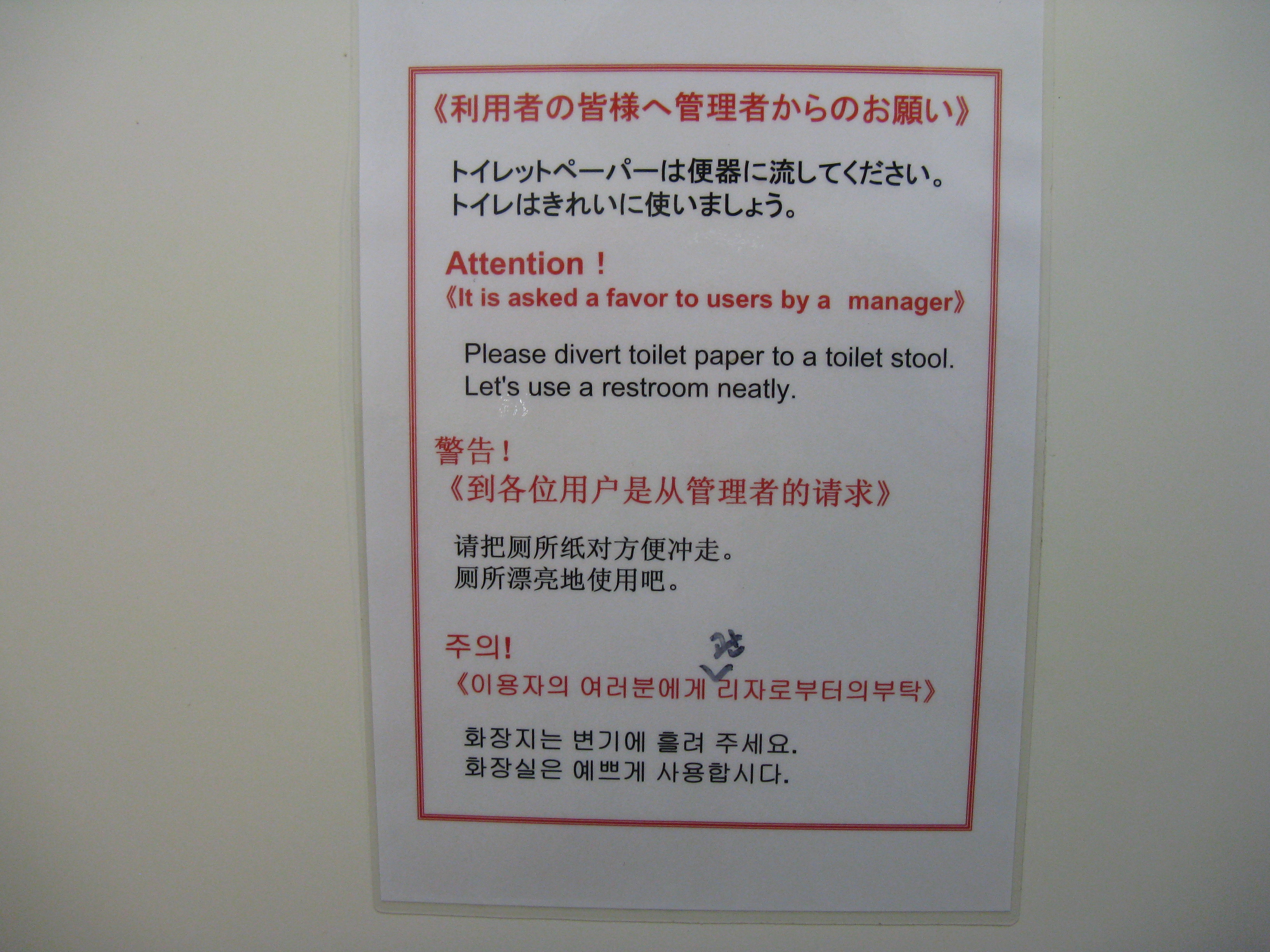
Sign in toilet, Japan
English-speaking foreigners, as you probably know, love to “catch” Japanese out in their English usage … and so for fun I’ll share just a couple that we’ve come across to date with you. But, please note that these are shared in a sense of fun not ridicule. After all, most Japanese know more English than I do Japanese, and at least they try.
- On a special English menu in an izakaya that I shall leave unidentified to protect the innocent:
It is necessary to enjoy oneself over meal after it acknowledges though it is thought that the mistake of the word is somewhat found in the menu.
- Inside a toilet door. For some reason, hotels and tourist venues often feel the need to tell you what to do with your used toilet paper. This one is particularly (unconsciously, we presume) entertaining:
Attention!
(It is asked a favour to users by a manager)
Please divert toilet paper to a toilet stool. Let’s use a restroom neatly.
Literature
I like to read Japanese writers, and have reviewed a couple on this blog to date, but here I’ll share something different.
A little haiku written by the poet Koyabashi Issa (1763-1827), one of Japan’s four haiku masters. It was inspired by a frog mating battle at Gansho-in Temple in the lovely little town of Obuse, and was written to encourage his sickly son. (Unfortunately, his son died a month later. In fact, Issa was pre-deceased by all his children and his wife).
Yase-gaeru,
Makeru na! Issa,
Kore ni ari.
It roughly translates to:
Skinny Frog,
Don’t give up! Issa
Is here.
English traveller-explorer Isabella Lucy Bird‘s* letters, titled Unbeaten tracks in Japan, published in 1880 about her trip to Japan. I downloaded an eBook version and have been dipping into it during our trip. In Letter XVIII she talks about her travels in the alpine region of Central/Western Honshu through which we travelled a day or so ago. Here is an excerpt:
It is an enchanting region of beauty, industry, and comfort, mountain girdled, and watered by the bright Matsuka. Everywhere there are prosperous and beautiful farming villages, with large houses with carved beams and ponderous tiled roofs, each standing in its own grounds, buried among persimmons [kaki, remember!] and pomegranates, with flower-gardens under trellised vines, and privacy secured by high, closely-clipped screens of pomegranate and cryptomeria.
She then names a number of villages, including the gorgeous Takayama which we have now visited on two occasions. She describes the farms as “exquisitely trim and neat”, and nothing has changed today.
I was also struck by a comment on food from the same letter. When she asked her hosts whether they drank milk from their cow, she learnt that they didn’t, that they thought it was “most disgusting” the way foreigners put into their tea something “with such a strong smell and taste”. Tea is of course a significant part of Japanese culture, but from a country which eats the oddest things to our western minds – salmon nose anyone? – this did make me laugh. Each to her own, as they say!
And here ends, my first little travel piece. More to come (probably).
*In the interests of full disclosure, I must add that according to Wikipedia, her first adventure was to Australia but she apparently didn’t like it.
 Whispering Gums