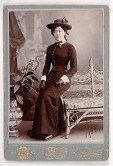
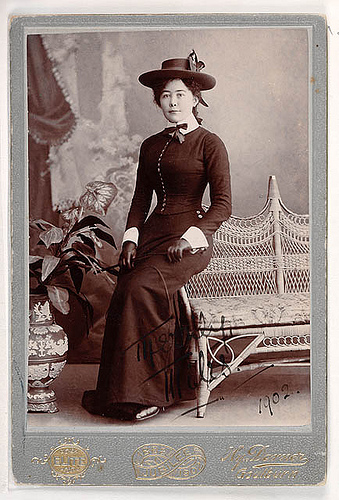
Miles Franklin, 1902, by H.Y. Dorner (Presumed Public Domain)
In last week’s Monday Musings I discussed an article by Canadian-born author Aidan de Brune on the novelist Bernard Cronin in his West Australian series on Australian Authors. The now little-known Bernard Cronin was no. 3 in his series. Number 4, though, was one of the giants of Australian literature – then, and still now – Miles Franklin. Most of you will know that she bequeathed our most significant literary prize, the Miles Franklin Award, and you probably have also heard of her most famous book, My brilliant career. But, Miles Franklin did have a secret …
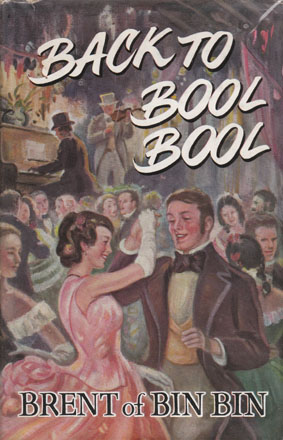
This secret, as we now know, is that in addition to several other novels published under her name, she wrote a series of six novels using the pseudonym “Brent of Bin Bin”. They were completed by 1933 but not all had been published by her death in September 1954. According to Paul Brunton, editor of The diaries of Miles Franklin, Franklin saw this as “a publicity device”. She wrote in 1929 that “hiding under a pen-name … will be more fruitful of publicity”. Her plan was to retain the mystery until the last book was published at which time she would reveal her identity. Unfortunately, she died before they were all finished. Nonetheless, Brunton says, she “enjoyed the speculation on Brent’s identity”. In 1941 she chaired, “with a straight face”, a meeting of the Fellowship of Australian Writers at which Brent of Bin Bin’s identity was discussed. Brunton continues:
She had no scruples about praising Brent’s books publicly as though she had nothing to do with them, as she does in her diaries. She even praised them in her Commonwealth Literary Fund lectures in 1950.
She also wrote to others, including the critic Nettie Palmer, as Brent of Bin Bin. I should add here that the current theory is that she used “Brent of Bin Bin” (and her other pseudonyms) because she feared not being able to repeat her My brilliant career achievement.
Anyhow, back to Aidan de Brune writing in 1933. He commences his article with:
Thirty years ago literary circles in Australia were astounded by the publication of an extraordinary book, written by a girl of sixteen, Stella Miles Franklin. The title of the book was audacious — “My Brilliant Career.”
He praises the book saying:
It throbs with a passionate love of the Australian bush, and particularly of horses, and with an equal passionate hatred of the cruelties of life endured by the people on the land, particularly by the women. It is the first statement, and to this day it remains the greatest statement, of the case for Australian bush womanhood.
He also quotes Henry Lawson’s praise in the book’s preface for its “painfully real” depiction of “bush life and scenery”. De Brune is concerned that in 1933 it, like many “fine” Australian books had been allowed to go out of print, with copies being hard to come by. He then gives a little of Franklin’s biography – her twenty years abroad working for the Feminist Movement in the USA, in the Scottish Women’s Hospital in Salonika, and for a housing committee in London. But now, he tells his readers, she is back and in 1932 had published a book, Old Blastus of Bandicoot, “under her name”. (Hmm … !) It was highly praised by many critics including John Dalley in The Bulletin. He also advises that another book, a detective story, would be published in 1933.
But, he asks:
Is that, then, the whole story of Miles Franklin? We shall see. Is it likely, or possible, that a writer of such power and sheer genius as the author of “My Brilliant Career” should have been silent for more than twenty years?
Fair questions! He goes on to tell his readers that “Miles Franklin will not admit it” but many people are identifying her with
the mysterious “Brent of Bin Bin,” whose books (published by Blackwood, of Edinburgh, be it noted) are acknowledegd to be the finest presentation in fiction of the Australian outback epic which have yet been written. “Brent of Bin Bin” loves the bush and understands horses, and hates injustice to bush women, as only the author of “My Brilliant Career” and “Old Blastus of Bandicoot” could love, and understand, and hate.
Brent of Bin Bin’s books are now Australian classics he says but, like My brilliant career, are hard to come by. How lucky we are that publishers like Text Publishing, Allen & Unwin, and others, are bringing back Australian classics in our times, eh?
Anyhow, I did love the conclusion to his article:
If Miles Franklin is also “Brent of Bin Bin,” then she is the greatest Australian bush novelist alive. And if she is only Miles Franklin of “My Brilliant Career” and “Old Blastus of Bandicoot” she takes second place to one writer alone — the tremendously gifted and mysterious author who writes in Miles Franklin’s manner under the pseudonym of “Brent.”
Ha ha … I bet he had fun writing that! I’m intrigued though that the praise is qualified, that she is “the greatest bush novelist”. I sense though that he doesn’t intend to diminish her achievement but to simply describe the milieu she was writing in. What I hear is that the bush continued to be a significant concern in 1930s Australia and was therefore seen as a worthy topic for our literature.
POSTSCRIPT: In an article written after her death, Murray Tonkin asks whether her death will finally solve the literary mystery. So, although many were confident they knew the identity, Franklin clearly kept up the pretence to the end. Tonkin says that he will “gladly eat his hat” if Franklin is not identified as “at least a close collaborator”. Love it!
 Whispering Gums