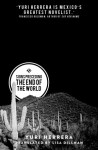
 While I was travelling in the USA last month, I wanted to read at least one book relating to the regions we were visiting. I started by looking for a novel set in/about the northwest, but then Yuri Herrera’s Signs preceding the end of the world, set in the southwest, popped out at me, and I knew I had my book.
When you live in the southwest, as we did in the 1990s, you can’t help but be aware of the issue of migration, “illegal” or otherwise, across the border from Mexico. I’d seen the film El Norte (about two Guatemalan youths fleeing to the US via Mexico) and read T. Coraghessan Boyle’s The tortilla curtain, but I hadn’t read a Mexican author on the subject – until now.
Signs preceding the end of the world tells the story of Makina, who is sent to “the other side” by her mother to carry a message to her brother who’d gone and not returned. To obtain the help she needs to make the crossing, she also agrees to take a message from Mexican gangster, Mr Aitch. This synopsis would suggest to most readers an adventure story – a thriller perhaps – or at least some sort of plot-driven drama, but that’s not what this is at all. Yes, it follows a traditional linear journey narrative, but the tone is more mythical, which means that it works on two levels, the literal Mexican-American border story and something more universal about crossings and transitions.
Herrera achieves this by keeping details to a minimum. Places aren’t named, but just described. Chapter titles like “The place where the hills meet” and “The place where people’s hearts are eaten” exemplify this beautifully. Most people aren’t named, either, and, where they are, the names are minimal (such as Chucho who helps her cross the border) or enigmatic (such as the alphabetical three, Mr Double-U, Mr Aitch and Mr Q!) It is in this shadowy context that Makina makes her journey.
He also achieves it by starting the novel with a surprising scene that isn’t critical to the literal plot, but which provides a thematic or symbolic link to the ending. We meet Makina walking in the street, when, suddenly, a sinkhole opens up and a man is swallowed up. Makina manages to pull herself back and survive, but we learn in the opening paragraph the tenuousness of life and, perhaps, that Makina is either lucky or has good survival instincts. Meanwhile, the sinkhole itself, while a literal geographic phenomenon, also conjures up the underworld, the murky sub-legal world that Makina must traverse to make it to, and survive in, “the other side”.
Herrera evokes the dangers of the journey vividly, but having already set up Makina as a resourceful young woman, he convinces us of her ability to survive the crossing – and she does, despite being accosted by a young thug, nearly drowning in the river, being shot at near a mountain pass. She locates her brother too, even though the information she has regarding his whereabouts is minimal.
What really makes this book, though, besides the strength and heart of Makina, is Herrera’s language (albeit in translation). It’s written in the sort of spare language I like. Here’s Makina’s experience of the city:
The city was an edgy arrangement of cement particles and yellow paint. Signs prohibiting things thronged the streets, leading citizens to see themselves as ever protected, safe, friendly, innocent, proud, and intermittently bewildered, blithe, and buoyant; salt of the only earth worth knowing. They flourished in supermarkets, cornucopias where you could have more than everyone or something different or a new brand or a loaf of bread a little bigger than everyone else’s. Makina just dented cans and sniffed bottles and thought it best to verse …
Yes, “verse”. Dillman in her translator’s note discusses the challenges of translating the book, which she says is about “bridging cultures and languages”. One way Herrera conveys this theme is to use neologisms, signifying the idea of a new language for the potentially new people forged out of migration. One of his neologisms is “jachar” which he uses to mean “to leave”. Dillman needed to create/choose an English word that would play the same role, and came up with “to verse”, because it refers to poetry and is also part of “several verbs involving motion and communication (traverse, reverse, converse) as well as the ‘end’ of uni-verse”.
As I implied earlier, this is a road novel, a journey to another place as well as to the self. Here’s Makina looking for her brother:
It had taken everything she had just to pronounce the eight tundras. To cleave her way through the cold on her own, sustained by nothing but an ember inside; to go from one street to another without seeing a difference; to encounter barricades that held people back for the benefit of cars. Or to encounter people who spoke none of the tongues she knew: whole barrios of clans from other frontiers, who questioned her with words that seemed traced in the air. The weariness she felt at the monuments of another history. The disdain. The suspicious looks. And again, the cold, getting colder, burrowing into her with insolence.
And when she arrived and saw what she’d come to find it was sheer emptiness.
Here and elsewhere, Mexican-born Herrera, who now lives in the USA, is clear about the materialistic, insular reality of “the other side”.
As I read this book, I was reminded of other journeys and crossings, specifically crossing the Styx (it’s no accident I’m sure that the first chapter is titled, simply, “The earth”), Dante’s journey to hell, and even Alice’s fall down the rabbit-hole. Herrera, though, while invoking these journeys in Signs preceding the end of the world, has created his own, one that addresses the politics of borders and boundaries (and dare I say “walls) between countries, while exposing the personal, psychological and spiritual implications of traversing these borders. Its ending is unsettling – but perfect for all that.
Yuri Herrera
Signs preceding the end of the world
(Trans. by Lisa Dillman)
London: And Other Stories, 2015 (Orig. lang. ed. 2009)
114pp.
ISBN: 9781908276421
 Whispering Gums