
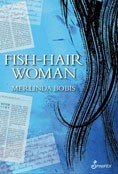
Courtesy: Spinifex Press
How do you classify a book like Fish-hair woman by Filipino-Australian writer, Merlinda Bobis? Darned if I know, but I’ll have a go. It’s part war story, murder mystery, political thriller, romance, and historical epic. It draws on the magical realist tradition of writers like Isabel Allende, but overarching all this, it is a book about stories – about the stories we cleave to ourselves and the stories we tell others, the stories that convey the truth and the ones that hide it, the stories that change with time and those that never change.
But enough preamble, let’s get to the action. The book is set in the Philippines, with the core story taking place in a village called Iraya in 1987. It is a time of civil unrest: government soldiers fight communist insurgents (the historical New People’s Army), with privately-controlled armies added to the mix. The villagers are caught in the middle, struggling to survive under
violence dressed as salvation. What hopeful word, the sibilants a gentle hush: salvacion. The soldiers and the rebels spoke of this same cause, even as they remained in opposite camps and our village festered in between.
The central characters are Estrella, the fish-hair woman who uses her 12-metres-long hair like a net to retrieve the dead from the river (“trawl another victim of our senseless war”); her older “sister”, Pilar, who joins the communist insurgents; and Tony, the Australian journalist whom both had loved. These relationships are complicated by the fact that Estrella, whose mother died at the birth, is the illegitimate daughter of the most powerful man in the village, Mayor Kiko Estraderos (aka Doctor Alvarado), the man who runs the private army.
While the main action occurs in 1987, the time-frame moves between 1977, 1987 and 1997, with the story being mostly told from the perspective of 1997. By this time Pilar and Tony are among the dead or disappeared and Tony’s 19-year-old son Luke has been lured to the Philippines, on the pretext that his father is alive, by Kiko who wishes to “sanitise history and facilitate his return to politics”.
It’s a multi-layered story of political unrest, complicated village loyalties, and familial and romantic love. It is told in first person and third person, with changing points of view. Sometimes we see through Estrella’s eyes, sometimes Luke’s, sometimes an omnipotent narrator’s or another character’s, and occasionally through newspaper clippings. Woven through it are recurring images and smells – the sweet lemongrass tainted by the corpse-laden river, the fireflies that light the dead so they can be found, and Estrella’s long hair that magically grows each time she senses violence and pain.

Australian Women Writers Challenge (Design: Book’dout – Shelleyrae)
This is one of those books that requires you to go with the flow. Its structure mimics the way we layer stories, the way we weave history and myth, stories and memories, so that at any one time we may or may not know where we are or who we are. Estrella, the fish-hair woman, and Stella, Doctor Kiko’s daughter, for example, are different facets of the same person, each with different stories.
There are simpler characters, too. One is Pay Inyo, the village gravedigger. He reminded me a little of the grandfather in Lianke’s Dream of Ding Village. He’s the peaceful man, the wise one who urges a humane path, who says it’s about perspective, “about how and from where you look … how far … and what you will to see”. But even he is unsure about the story:
But who is the hero in this story? Pay Inyo is not sure anymore, nor is he sure about what the story is in the first place. There are too many stories weaving into each other, only to unweave themselves at each telling, so that each story can claim prominence. Stories are such jealous things. The past and the present, ay, what wayward strands.
There were times, as I read, when I thought that Bobis may have created a few too many “wayward strands”. Some stories may not have been critical to tell, but her voice is so compelling and the language so expressive that I didn’t really begrudge her these, because by then I was well and truly along for the ride.
This is a novel set during war and yet it is not really about war. It is about people, “those whom we love and hate”, about how we use and manipulate stories to “save” or ” kill”, and, as Pay Inyo would like us to see, about collective grieving, collective responsibility:
This is the wake of the world: each of us standing around a pool that we have collected for centuries. We are looking in with our little pails … We try to find only what is ours. We wring our hands. Ay, how to go home with only my undiluted pail of grief? To wash my rice with or my babies, to drink? But the water is my dead kin, an enemy, a beloved, a stranger, a friend, someone who loved me or broke my heart. How to tell them apart? How to cleave water from water?
For all the sadness and brutality in this book, it has a big heart. And its message is clear. We are all in this together. How much better if we see it sooner rather than later.
Merlinda Bobis
Fish-hair woman
North Melbourne: Spinifex Press, 2011
303pp
ISBN: 1876756977
(Review copy supplied by Spinifex Press)

 Whispering Gums