Monday musings on Australian literature: A letter from Mary Gilmore

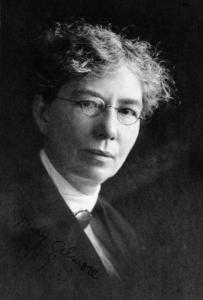
Gilmore, by May Moore, 1916 State Library of New South Wales (Public Domain)

Mary Gilmore (1865-1962) is, I suspect, not well-known outside of Australia, but she was (is) a significant Australian poet – so significant that she earned herself a dame-hood! Wikipedia describes her as “an Australian writer and journalist known for her prolific contributions to Australian literature and the broader national discourse. She wrote both prose and poetry.” If you are interested in her, check out W.H. Wilde’s excellent entry in the Australian Dictionary of Biography.

Given my recent posts featuring AG Stephens, I will share though that Wilde tells us “she had a long-sustained correspondence with Alfred George Stephens of the Bulletin and was delighted to have her life and work featured in the ‘Red Page’ on 3 October 1903″. I have often thought about writing more about her because she was a mover and shaker in the literary world, as well as being politically radical. In fact, she was a member of the Australian Utopian colony that was established in Paraguay in 1893, about which I’ve written a Monday Musings post. I will write more about her – but today’s post is more personal.

As some of you know, I am in the throes of serious downsizing from a large family home to a three-bedroom apartment. With all of our nearest family now in Melbourne, we are making more trips there, so need to simplify our lives here. It’s a painful process, but there are delights along the way – and today I’m sharing one of them.

Way back in the 1990s, when my lovely mother-in-law downsized to a retirement village, we became the custodians of some family papers which included some from her father-in-law, Mr Gums’ grandfather. He was William Farmer Whyte, a journalist and author of some standing in his time. He wrote a biography of the controversial Australian prime minister, William Morris (Billy) Hughes. He was active in the literary scene of the day – and knew Mary Gilmore. Mary Gilmore was, apparently, a prodigious correspondent, and we have a letter from her to him. I read this letter when those papers were passed to us, but it came to light again during my current sorting. I thought I’d share it with you.

Hotel Wellington
Canberra, F.C.T.
5.12.1929

Dear Mr Farmer Whyte,

How kind of you! And what’s more the article is a good one. I hate the sloppy or the feeble, and there is so much of that. Consequently, yours is doubly appreciated.

While I think of it I would like you to see Mr Watt’s letter on Hugh McCrae in the “S.M.H”. If you wanted a good subject Hugh is one indeed. We are pushing him forward into lectures of remembrances of other writers. So it might serve you something if you were to cut out Watt’s or any other letter on him just now. I have just posted one to the “S.M.H” which shd appear in a few days – unless they sit down on it. I had suggested to the Literature Society here that Hugh be asked up as their guest speaker, as they asked Brereton and me. They ought to ask you to give a pressman’s talk! I will suggest it if you will let me – or whether or no, as you can only refuse if you do not want to talk.

Am just awaiting Mrs Scullin and must hurry to end or be unpunctual.

Again thanking you

Yours gratefully

Mary Gilmore

A poem was also included with the letter, but I’ll save that for another time. I have tried to find the (non-sloppy, non-feeble) “article” Farmer Whyte wrote but so far no luck, even though the date is presumably late 1929.

Notes on names in the letter:

  • S.M.H.: The Sydney Morning Herald newspaper.
  • Hugh McCrae: Australian poet, 1876-1958.
  • Literature Society: possibly refers to the Fellowship of Australian Writers of which she was a co-founder in 1928 (see my Monday Musings on that).
  • (John Le Gay) Brereton: Australian poet, critic and Professor of English (1871-1933).
  • Mrs Scullin: wife (1880-1962) of Australian Labor Prime Minister, James Scullin.

The reference to Mrs Scullin is interesting but not surprising. Less than two months before Mary Gilmore wrote this letter, James Scullin had led the Labor Party into power, and Gilmore was a Labor Party stalwart. Regarding her dame-hood, Wikipedia says that “in spite of her somewhat controversial politics, Gilmore accepted appointment as a Dame Commander of the Order of the British Empire in 1937, becoming Dame Mary Gilmore. She was the first person to be granted the award for services to literature.”

A significant person and one I will return to.

Meanwhile, do any of you have any knowledge or experience of Mary Gilmore? Or, any letter treasures you’d like to share?
The Griffyns experiment with Utopia

In a recent Monday Musings, I referred to the fact that the Griffyn Ensemble’s last concert for 2015 would be about the New Australia Movement’s Utopia experiment in Paraguay. That concert took place this last weekend, and what a concert it was. The Griffyns – yes, I’m a fan – just keep getting better. Well, actually, they’ve always been good musicians, but the concerts are becoming tighter, more coherent perhaps, while still retaining the freshness, inventiveness and intimacy that we members so enjoy about them.

Mary Gilmore, 1927 (Public Domain, at State Library of QLD, via Wikipedia)

Mary Gilmore, 1927 (Public Domain, at State Library of QLD, via Wikipedia)

The Griffyns do like to move around town, so this concert was held in the foyer of the National Portrait Gallery. Not surprisingly, there were a couple of portraits of Dame Mary Gilmore on the wall behind the performers. The venue worked nicely (even though we do like the Belconnen Arts Centre’s friendly little bar!) The acoustics – to my ears – were excellent, and the natural, early evening light coming in through the big windows was just delightful.

But now, the music, which, appropriately, all came from Australian and South American composers. At the start, musical director Michael Sollis announced a change in the program, swapping the third piece, Gerardo Dirié’s Ti xiuhtototl, with the fifth piece, Eric Gross’s Rondino Pastorale. I wondered why – and whether it might become evident as the concert went on. It did, because Gross’s work and the piece preceding it, George Dreyfus’ Mary Gilmore goes to Paraguay, are lyrical, pastoral pieces evoking idyllic scenes appropriate to the ideals of the new Utopia. By contrast, Gerardo Dirié’s piece is more plaintive, sombre, even a little discordant. In terms of the story being told, it fit better towards the end of the concert as the Utopian dream is starting to fail. The story, in other words, was conveyed musically as well as through words spoken and sung by Susan Ellis who, with a twinkle in her eye, played an older Dame Mary Gilmore looking back on her Paraguayan experience.

The program was, at roughly one-hour, shorter than many Griffyn programs, but it ran without a break, transitioning seamlessly from piece to piece. The concert opened with Sollis speaking a promo for New Australia – “Start your life afresh”, he exhorted. This was followed by Laura Tanata on harp and Chris Stone on violin playing Nigel Westlake’s Beneath the midnight sun. It was beautiful, with Tanata’s gentle, lyrical harp offset by the more plaintive violin, suggesting to me a little uncertainty (for the new colony, I mean, not the musicians. Their playing was mesmerising, and set a high standard, which was fortunately maintained).

Ellis then took up the story from Gilmore’s point of view, and we heard the ensemble play Dreyfus’ accessible, melodic piece which, with its hints at times of a rousing, western movie theme, conveyed the excitement and enthusiasm of pioneers. I loved Kiri Sollis’ flute and Stone’s violin here. It’s a crowd-pleasing sort of piece, and was played with a verve which carried us all along. Gross’s piece continued this positive tone, while Ellis, as Gilmore, told us nostalgically that “I wish I was back in Cosme” (Cosme being the name of Lane’s second settlement in Paraguay).

This was followed by the central piece of the concert, Vincent Plush’s “The Paraguay songs” from The plaint of Mary Gilmore. It’s a rather tricky piece requiring Ellis to sing words from Gilmore’s letters. Yes, you’ve read correctly, from letters – that is, not from verse, but from prose. I sat up. Good prose, of course, does have rhythm, but these were letters, not crafted fiction. Here are a few lines from the program:

Communism as we have it is alright, Harry*, and we are getting on — slowly, of course, but in a year or two what is now is, will have gone, so beautiful, so rich in bird-life, and plants. And the history! And the story of the war. If you were only here Henry.

See what I mean? It takes some singer and composer to make that work. I was impressed by how well and expressively Ellis, not to mention the full ensemble, rose to the challenge.

The aforementioned rather sombre Dirié work followed this, and was performed, with a melancholic soulfulness, by the four female Griffyns who sang some lovely harmony, in addition to playing their instruments. Really moving. This was preceded by Gilmore telling us about some of the troubles in the colony, and was followed by another sombre-sounding piece, The freedom of silence by Alcides Lanza.

The concert concluded with Gilmore expressing sadness that Cosme did not turn out to be what she expected. She left in 1900, five years after she arrived, because of the pettiness and squabbles. Nonetheless, she never regretted the experience, arguing that while it was not a success, neither was it a complete failure:

… we failed the harshly scornful say … [but] we sowed a seed.

Villa-Lobos’s wistfully sad Song of the black swan (with hints, if my ears didn’t mistake me, of Swan Lake), played by Tanata and Downes, concluded what was a satisfying, well-performed and nicely conceived concert. Roll on 2016 I say … if you are in Canberra, and would like to know more (and even buy tickets), check out their website.

You can hear different versions of two of the pieces online:

Griffyn Ensemble: Michael Sollis (Musical Director and Mandolin), Susan Ellis (Soprano), Kiri Sollis (Flutes), Chris Stone (Violin), Laura Tanata (Harp) and Holly Downes (Double Bass).

* Henry Lawson

Monday musings on Australian literature: Utopia, Paraguay and Australian writers

The workingman's paradise (Courtesy: Sydney University Press)

The workingman’s paradise (Courtesy: Sydney University Press)

Utopia, Paraguay, Australia? I’m referring, of course, as many Australians will know, to the Utopian colony, New Australia or Colonia Nueva Australia, which was established in Paraguay in 1893 by the New Australia Movement, with the support of the Paraguayan government. This movement was founded by William Lane, whose novel The workingman’s paradise I reviewed quite early in this blog. The settlement did not succeed. According to Wikipedia (linked to above), conflict started early “over prohibition of alcohol, relations with the locals and Lane’s leadership”. Colonist Tom Westwood is quoted as saying, “I can’t help feeling that the movement cannot result in success if that incompetent man Lane continues to mismanage so utterly as he has done up to the present”. Oh dear.

The settlement has been written about by historians (Gavin Souter’s A Peculiar People and Anne Whitehead’s Paradise Mislaid) and at least one novelist, Michael Wilding‘s The Paraguayan Experiment. Australian travel writer Ben Stubbs has written about his trip to talk to “remnants” of that settlement in his Ticket to paradise: A journey to find the Australian colony in Paraguay among Nazis, Mennonites and Japanese beekeepers. Several musicians have also written songs about it, according to Wikipedia.

Mary Gilmore, 1927 (Public Domain, at State Library of QLD, via Wikipedia)

Mary Gilmore, 1927 (Public Domain, at State Library of QLD, via Wikipedia)

So why am I mentioning all this now? Well, it has to do with those creative Griffyns and their last concert for the year, titled The Utopia Experiment, which is inspired by this settlement. I’ve known, of course, all year that it was coming up, but an article in today’s Canberra Times, which reminded me of other (contemporary) literary links besides Lane, encouraged me to write this post. The main link is Dame Mary Gilmore (née Mary Jean Cameron) who, in the first half of the twentieth century, was regarded Australia’s greatest woman poet. According to NSW’s Migration Heritage Centre website, she said of Lane’s The workingman’s paradise that:

 the whole book is true and of historical value as Lane transcribed our conversations as well as those of others.

Gilmore, in fact, became one of the 200-odd settlers, but returned after 5 years. She said in an interview over 60 years later that:

It was purely communistic. I wouldn’t say it was a success, but I certainly wouldn’t say it was a failure. The reason it had to break up, or disappear, is because William Lane would only have British people in it…

The aforementioned Anne Whitehead has written a book specifically on Gilmore’s Paraguayan story, Bluestocking in Patagonia: Mary Gilmore’s quest for love and Utopia at the world’s end, suggesting, says reviewer Sarah Macdonald, that Gilmore joined the settlers as much in search of a prospective husband as for the socialist ideal. Perhaps so, but she must have been looking for a particular type of husband to take such a trip!

A 1911 newspaper article quotes Renmark Pioneer editor, who knew Gilmore at the time, as stating that she:

joined the Cosme Colony in Paraguay, where a number of us, under the leadership of William Lane, were giving communism a trial. We were at that time a very happy family, and Mary Gilmore entered into the life whole-heartedly. She rendered good service to the colony, not only taking charge of the school (thereby releasing the former teacher, John Lane, for work in the fields), but doing much to add to the success of the social gatherings that were a marked feature in the life of our little community.

Mary Gilmore went on to live a long and highly productive life, dying in 1962 when she was 97. She was a socialist and activist, a poet and journalist, who argued for better conditions for working women, children and indigenous Australians. (Critic A.G. says in the Age in 1941 that “Her association with the early days of the Australian Labor movement has deepened and widened her social outlook … she speaks especially for the “little” people”).

Her Paraguay experience followed her for the rest of her life, as the National Library of Australia’s Trove reveals. Here is a description of her in a 1923 newspaper, Melbourne’s Advocate, when she would have been 58:

Mrs. Gilmore, who was one of the band that went to Paraguay with the late William Lane on the New Australia adventure, is a proven Irish sympathiser as well as a good Australian.

“A proven Irish sympathiser as well as a good Australian”. What I love about reading old newspapers is the insight they give into the thinking and values of the times.

The literary links don’t end here, however, because Gilmore was very keen for that other great Australian poet-writer of the time, Henry Lawson, to join the settlers. Certainly Lawson had the appropriate socialistic leanings. In 1893, he wrote a poem, “Something better” supporting the Paraguayan vision:

Give a man all earthly treasures – give him genuine love and pelf* —
Yet at times he’ll get disgusted with the world and with himself;
And at times there comes a vision in his conscience-stricken nights,
Of a land where “Vice” is cleanly, of a land of pure delights;
And the better state of living which we sneer at as “ideal”,
Seems before him in the distance — very far, but very real.

However, he didn’t join the settlers.

I could explore these two writers more, but life is busy right now – and, you never know, I might return to the subject after the Griffyns have presented their musical version.