Marion on Marion (Halligan)

A few days ago I posted a review of Marion Halligan’s latest book, Valley of Grace, and mentioned that Halligan had attended my bookgroup meeting at which we discussed the book. I didn’t, however, share in that post all of the things that Halligan told us – and I won’t in this post either. Some things are just not meant to be shared! Nonetheless, there are things we asked her that are of general interest to readers interested in writers and writing, and these I will share…

As readers often ask writers, we asked her about her writing process. She started off by saying that she never says she has writer’s block. This doesn’t mean she doesn’t get stumped at times but that when she does she just moves on to other writing she has on the go. Valley of Grace was, she said, written essentially over 20 years. She made notes for it back in 1989 when she was living in that apartment in Paris that overlooked the Val de Grâce church. And then, when she got a little stuck in her novel The point, which was published in 2004, she took out the notes she’d made back then and worked them up into a short story. Sometime later, she realised that it was more than a short story and voilà, we now have the book (though it took perhaps a little more than voilà for her to get from short story to book!).

Hand and pen, from Clker.Com

Hand and pen, from Clker.Com

Now, here’s the interesting bit: Halligan writes by hand! She says that the slowness of the eye-hand-paper process makes you think harder and results, for her anyhow, in fewer drafts. Essentially, she writes the story out by hand and then reads it over crossing out and adding in, etc. She then reads it again – often reversing the changes she’d made! It is only then that she types it into her computer, and the sense we got was that at this point it’s pretty much ready to go. We didn’t – silly us – ask her much about the publisher’s editors.

We talked a bit about the use of imagery, including metaphors. She says that much of this is unconscious, that if you are an experienced writer and you get into your story’s mode, the imagery seems to just come (such as the use of light, yellow etc in Valley of Grace). She talked specifically about the challenge of using metaphor and how writers often don’t think them through. Her example of a poorly thought through metaphor was  one writer’s description of a person’s bottom during lovemaking as “white dunes of sand”! The mind boggles rather. Anyhow, this brought to my mind a statement she makes in one of her more self-conscious books, The fog garden:

That is the trouble with metaphor, it may take you to places you don’t want to go.

She had more to say on writing, such as to beware of using too many adjective and adverbs, and that for her books are not about answers but about questions. In Valley of Grace the over-riding question, really, is about the soul, about what makes us human. Now, it’s hard to get a bigger question than that!

We also talked a little about reading and what we like. Halligan is not keen on issue(ideas)-based fiction: she doesn’t think it’s interesting. This is an issue I have referred to briefly in a couple of my reviews, specifically in This earth of mankind and The workingman’s paradise.

Finally, we couldn’t let her go without asking her about her literary influences. Not surprisingly, given that she’s been writing for a long time now, she couldn’t really say, but she did name some of her favourite writers. These included Margaret Drabble, William Trevor, and John Banville. Interesting, eh, that they are all Irish or English! Clearly, I really must read that William Trevor languishing my TBR pile!

Anyhow, you can probably tell from all this that Halligan was generous with her ideas and her time. It was a real treat having her there…
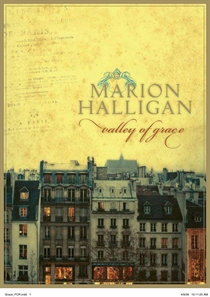
Marion Halligan, Valley of grace

Valley of Grace book cover (Courtesy: Allen & Unwin)

Valley of Grace book cover (Courtesy: Allen & Unwin)

Delicious but sly are the first words that come to mind when I think about Marion Halligan’s latest novel, Valley of Grace. Take this for example:

You know, people think flowers are pretty. Sentimental. Frivolous even. But the fact is, everything begins in the garden. Humans. Society. Civilisation. Evil. Things bud, bloom, weather, age, die. There is as much decay as there is burgeoning. Gardens offer emblems of our passage through the world.

Sly because you know she is alluding to the Garden of Eden here but, without the snakes, apples or trees, the garden symbolism is wider, more encompassing than the simple biblical Fall of Man. Delicious because the language flows so beautifully – and it’s typical of the sure writing that’s found throughout the book. The style is relaxed and flowing, even when it is staccato (if that makes sense). It feels conversational, and yet it is not colloquial. And, it contains Halligan’s hallmarks – wonderful descriptions of food and wine, of home and gardens.

The novel is set in contemporary Paris and chronicles a few years in the life of Fanny and her family and friends. At the beginning of the novel she is 25, single, and working with the gay Luc in his antiquarian bookshop, but very soon she marries builder and restorer of old buildings, Gérard, who is 38. There’s no mystery about this – you can see it coming and it comes. What doesn’t come after that is a baby.

There are no big dramas in this book so if that’s what you like, this is not for you. It is however the book for me, because while I can enjoy a book with drama, that’s not what I read books for. I read them for the very things that I got out of this book: astute observation of humans and how we think and behave, combined with writing that delights, inspires and grabs. Valley of Grace explores all the sorts of things that make up human experience – love and friendship, betrayals, secrets, appearance versus reality, and more besides – but most of all it is about babies and children. The having of them, the not having of them, the healthy and the damaged, the child and the god-child, and the wild child are all covered in this neat little book.

And, in fact, as Halligan told us at our bookgroup meeting tonight (to which we’d invited her and she’d wonderfully accepted), children were a major inspiration for the book. She lived in Paris in 1989 and, from her apartment window, could see the church, Val de Grâce, which was built by Anne of Austria as her part of a bargain with God to give her a child (Louis XIV, no less). This story fed into Haligan’s thinking about fertility (the presence of it and the absence of it) and about how in the past women came to “a bad end” if they didn’t have a baby or had a baby at the wrong time. She said that in the 1960s we thought this would all change but in fact it hasn’t quite turned out that way because women are having babies later and the result is more problems (such as infertility, increased miscarriages, “damaged” babies). This book is, then, her meditation on children – who they are, what they mean to us. And the following will show you just what Halligan thinks they mean:

Taking an angry or maybe anguished baby and changing it from a stiff protesting awkward bundle into a relaxed kitten-like creature seems to Fanny as important a thing as anybody could ever do.

The novel is told in third person but from different perspectives in different chapters – with some wonderful set-pieces, such as the story of Sabine and her arrogant philosopher husband Jean-Marie to whom she delivers “the pavilion girls”. Halligan said that telling the story this way replicates the way life goes – we are the heroes of our own stories, but bit-players in those of others. This makes sense – and certainly works well in the book.

There is a luminous quality to the book, conveyed largely through imagery to do with light and colour (mainly yellows). Mostly it is comforting, but sometimes it is not. Here is Fanny in the Val de Grâce:

She looks up at the immensity of the pale grey stone. Even with all the decoration, the cherubs, the frescos, the marble and gilt columns, it has a bareness, a coldness. It’s the colour of concrete, There’s no stained glass. The light is silvery; when the sun shines, lemony. There is no comfort in it, as there is in her house.

And then in her apartment:

She looks at the graceful space of the apartment. At the light, greenish gold today with summer sun and the fresh leaves on the chestnut trees, their milky white flowers buzzing with bees.

It’s a short book – just under 250 pages – and a rather gentle one. It’s sometimes a little sad, but other times it has a wry humour.  It’s well researched, but the research hangs lightly on it. Its ending is one of the most inspired I’ve read for a long time – but you’ll have to read it yourself to see if you agree.

I have read a few Halligans over the years – Lovers knots, The golden dress, The fog garden and The point – and have enjoyed them all. I’ll close this post with a favourite line from The fog garden because I think it describes this book to a T:

Read a wise book and lay its balm on your soul.