Sydney Writers Festival 2021, Live and Local (Session 2)

My second Sydney Writers Festival’s Live and Local event for 2021 was an hour after the first one. This left me time to fill in. It was disappointing that the National Library’s Bookplate Cafe was closed by then, which I think has happened in previous years. It would have been nice to sit down with a cuppa, or a cool drink. However, there was the bookshop, so I did business there instead!

Richard Flanagan and Laura Tingle: Conversation, Saturday 1 May, 4pm

If I hoped that this second session would not be as demanding on my ability to simultaneously take notes and absorb the discussion as the first, I was to be disappointed. This session featured multi-award-winning writer Richard Flanagan and the also award-winning journalist Laura Tingle, and I think I took even more notes. In fact, once again, Karen Viggers, who was also taking notes, nudged me a few times to say “get that down”! What a hoot!

Flanagan is always entertaining, which doesn’t mask the thinking and humanity in what he says. Tingle proved, not surprisingly, to be up to the task of interviewing – conversing with – this man. The topics ranged far, but stemmed mostly from Flanagan’s latest two books, his non-fiction exposé, Toxic: The rotting underbelly of the Tasmania salmon industry, and his latest novel, The living sea of waking dreams. Flanagan also referenced Tingle’s writing, particularly her latest Quarterly Essay (#80), The high road: What Australia can learn from New Zealand. Flanagan has appeared several times on my blog.

Tingle started the traditional way by introducing Flanagan through his oeuvre. She noted its breadth of subject matter, then turned to Toxic. Read it, she said, if you want to be depressed, and horrified, and, oh yes, informed. It spoiled her breakfast, she said, wryly.

Flanagan, ever the humorist, suggested he is creating a new genre, Tasmanian non-fiction horror! Then, in one of his several compliments to Tingle, he said that in the last year Australian journalism has become stronger, better, and that this has been largely due to our women journalists, particularly Laura Tingle.

Flanagan then read, as requested, from Toxic – a particularly unappealing description of the physical matter involved in the industry – before answering Tingle’s obvious question regarding how Tasmania has responded to it.

Apparently, Toxic is “the fastest-selling book ever” in Tasmania, going to three print runs in its first week. Flanagan and his publisher had kept the project secret until the day it was placed in bookshops, without pre-publicity, with just his name and title. It has had immense support in Tasmania, but the government and salmon industry have been silent.

His plan had been to write a short article, but he just kept discovering patterns of intimidation and violence. Ultimately, he said, companies run rogue when there are no rules, and there is no proper governance in the salmon industry. There’s a lot we don’t know about the food industry, he added. He wrote the book for the public. He wants it to help people make decisions in supermarket aisles. (And, perhaps, Tingle for her breakfast!!). Responding to Tingle’s question about its impact on the state election that day, Flanagan said that exit polls were showing a stronger result for the Greens.

Tingle asked about Tasmania’s history of “f*****g up its water supplies”, about the confluence of business and bureaucracy in this. Flanagan talked of Tasmania’s particular history – the near genocide and the convictism which encompassed slavery. Many pathologies persist when you see mass trauma, he said. Most Tasmanians are the issue of the first quarter of its history. He commented on the abuse of power, and the use of silence and fear to retain power. He also quoted Chekhov:

Write about this man who, drop by dropsqueezes the slave’s blood out of himself until he wakes one day to find the blood of a real human being–not a slave’s–coursing through his veins.

Flanagan added “word by word” after “drop by drop”! (As Jim noted in his comment on my previous post, the subtitles frequently got tricky words and names wrong. I didn’t note them down, but I do remember Chekhov becoming “check cover”)

Tingle then turned to his books in general, suggesting that there are about people shaped by greater tides, people who have no control over their destinies. She was eloquent, and drew out a typical, somewhat self-deprecating Flanagan response that this “sounds plausible”.

Every writer, he said, belongs to both their birthplace and the universe of letters. Like many writers, he seeks the universal in the particular, and his particular is “this strange island”. All his books come out of the wonder of his original world in the western Tasmanian rainforests. He suggested that the history of novels is not made in the great centres. Joyce wrote in that tucked-way place of Dublin, Marquez in his fictional place, Macondo, and so on.

Tingle returned to her question, reframing it somewhat, to reference power. His characters she said are not authors of their own fate. Power doesn’t have to be at the centre of literature, he replied. Yet, in his latest book, The living sea of waking dreams, the characters are trying to control the mother. Her life is about people trying to control others.

Flanagan then made a point that made me sit up. He said there’s a potent and poisonous myth that everything is about power. He talked about how identity politics is a zero-sum game. The truth is, he said, that most things are not political. He quoted that grim poet, Larkin, who said that ”what survives of us is love”. Flanagan’s characters are about love, he said. This is the nub of what life is about. Seeing life through power is a “false compass”. This bears more thinking, though there is truth in what he says about love.

Tingle turned to time, to the linear time in European thinking versus Indigenous circular time. Does fiction free us of linear time, she asked? Flanagan talked of identifying two ideas underpinning European art: everyone is alone, and time is linear. BUT, he’d come to realise that no one is alone, that you only exist in others, and that time is circular. Stories go back and forth, in and out. Yolngu people, he said, have a tense that combines past-present-future. This is more what he grew up with.

There was more talk about Tasmania, but the next point I want to share is his idea – one Indigenous people understand – that “Bush is freedom, City is oppression”. We need our political leadership to open up to Indigenous heritage and ways of thinking.

Tingle then threw in a statement made by past conservative New Zealand PM, Jim Bolger, who, when asked “why the Waitangi Tribunal”, responded “because the country’s honour was at stake”! Imagine this from a contemporary Australian politician?

Flanagan’s response was that not thinking Bolger’s way led to “the slow corrosion of us as a just and democratic society”. He said that the “battle to be a good people and a good society matters”, but we are losing this as we continue to allow such things as Aboriginal deaths in custody. He said that the battle for the soul of nation is the battle for a nation worth living in. (Karen whispered to me, “so eloquent”!)

Then he referred to one of my all-time favourite books, Camus’ The plague (my review). The plague is always there. It’s deeply disturbing, he said, how out of their comfort zone many of our politicians are.

We then moved to Australian literature. Flanagan noted that there’s been a great surge in Indigenous and women’s writing, though he’s “annoyed” that women from the past are not getting the credit they should. Women – such as publishers Beatrice Davis and Hilary McPhee – have shaped a different literature here compared with American and Europe. He barely tipped the surface, though, of the depth of women’s contribution to Australian literature from its beginning.

Moving right along, Tingle asked Flanagan whether he was moving more into non-fiction. Not a bit of it, was, essentially, the reply. But, he did say that non-fiction gets you out of the door which is good for novelists. In the end, it’s story that’s important and fiction has a “profound spiritual aesthetic and intellectual tradition”.

The conversation then moved the challenges confronting writing stories (fiction and non-fiction), today: libel laws, not to mention the “wall of noise” and “multiple strands”, which Tingle said make it hard to pull stories together.

For Flanagan, there’s one simple story – rapidly growing inequality. He spoke of how the richest and most powerful have connections with politics, and act in ways that cloak the state’s withdrawal from where it should be, like education, health, environment. They manufacture identity wars in ways that shroud real needs.

He said his latest book looks at how words can create a wall between people rather than a bridge, and then talked about politicians lying in the morning, then again in the afternoon. This is the tactic of totalitarians. It creates a situation in which truth has no value, leaving you with opinion. When that’s all you have, “society moves into darkness”.

After all this, and a little more on politics and writing, the session ended with Flanagan reading a lovely piece from Toxic about an octopus. Flanagan said that despite it all, he’s not despairing: there’s hope in beauty and wonder.

It was hard to cut much out of this!

Sydney Writers Festival 2021, Live and Local (Session 1)

This is the third year I’ve attended Sydney Writers Festival’s Live and Local live-streamed events at the National Library of Australia.

More often than not, I attend these events alone, but I was lucky to find that one of our wonderful local authors, Karen Viggers, was also attending alone, so I had company in my note-taking and we did manage a little debrief after each session too. We had both booked two sessions – the same two. Karen has appeared a few times on my blog.

Sarah Krasnostein and Maria Tumarkin: Conversation, Saturday 1 May, 2pm
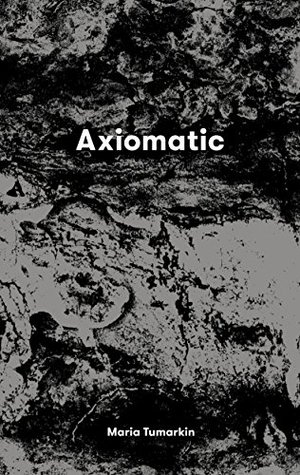
Maria Tumarkin, Axiomatic

This session was to be Sarah Krasnostein with Helen Garner. However, on Friday, an email announced that Garner was unable to attend and would be replaced by Maria Tumarkin. I was a little disappointed, of course, but I was very happy with Maria Tumarkin as replacement. I’ve read and reviewed her impressive book, Axiomatic, which won the Melbourne Prize for Literature’s Best Writing Award and was shortlisted for several other awards.

Writers festival conversations are interesting beasts. They are, formally, interviews, with one person’s role being to talk to the other about their latest work, in this case, Sarah Krasnostein and her book, The believer. But, what often happens, and what happened here, is that although it was clear that the focus was Krasnostein’s book, the session did feel more like a conversation with Tumarkin actively engaged in sharing ideas. Some of her questions were almost as long as Krasnostein’s answers. Indeed, at one point she admitted that she was taking a long time to ask her question and that “Helen would never do this”! She got a friendly laugh.

Here is how the Festival program described the session:
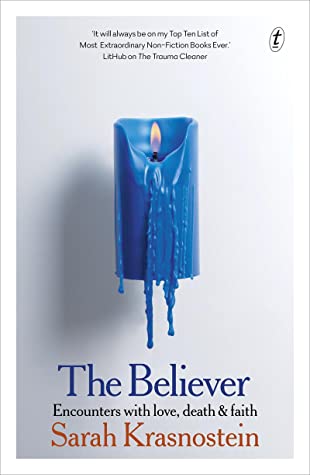
Sarah spent time in Australia and the US talking to six extraordinary people who held fast to a belief even though it rubbed against the grain of conventional wisdom. Her research culminated in The Believer: Encounters with Love, Death & Faith, a deeply humane and deftly drawn enquiry into the power of belief.

The program continued:

Sarah is joined by Maria Tumarkin to explore what we believe in and why – from ghosts and UFOs to God and the devil, dying with autonomy and beyond.

This is not, in fact, how it came out but, I’m not sorry, because what we got was something far more interesting. No, let me rephrase that. I don’t know how interesting the suggested topics might have been but I loved what they did talk about – because they spoke to matters that interest me.

With a nod to Helen Garner, Tumarkin started by quoting Garner who has apparently said that her first lines “come as music from some other place”. She wondered if that’s how Krasnostein’s books start.

“Not anything like that!” said Krasnostein, and she talked about her research and writing processes which topics interest me. She basically, as Tumarkin reframed it, “squirrels material without having a particular idea” about where it’s going. With The believer, Krasnostein “stumbled across the Mennonites” and went from there. She holds her material close, she said, “until it tells you what it is”. (A bit like Michelangelo finding the sculpture that’s already in the block of marble?)

Tumarkin asked what inspires Krasnostein. She replied that it’s the wonder of what she finds in a day, and telling story of that. In other words, she’s driven by curiosity, and finding the story under the surface.

Tumarkin then asked how Krasnostein fixes or anchors her stories. How she finds their core, I guess she meant. Krasnostein said it’s not about what she likes but what is “interesting”, about finding different versions of the world. She didn’t know exactly what she wanted to know about belief when she started.

However, she knew she didn’t want to write magazine pieces or a book of essays. She wanted to “articulate the commonality”, to know the stories we tell about our “interior vulnerabilities”. She talked about her book comprising a “house of unlike things”. Tumarkin liked this – because it mirrors her own way of thinking – and asked her to explain further. Krasnostein paraphrased German sociologist-philosopher-critic, Theodor Adorno, saying “that harmony in art is not achieved by forcing components into resolution but making space for dissonance”. [I hope I got that down right, Karen!]

Then she said something that interested me. She wanted to come up with a structure that would demonstrate (mirror? reflect?) what she wanted to express philosophically. I love writing in which the structure informs or reflects or enhances the meaning.

This clearly also interests Tumarkin, who feels that much Australian non-fiction is formulaic in argument and structure. This is paradoxical, perverse, she said, because books are where “very different things can live together”, where you can practise dissonance and find unlike things.

This led to voice. Krasnostein said she prefers first person but you have to balance being in there too little against too much. She argues that third person is the most narcissistic because it means acting like God. All non-fiction is subjective, involves selection; a first person voice recognises this. Regarding how and where you put yourself in, she said that sometimes it’s for ethical reasons (to provide context, say), sometimes practical (such as reporting conversations), and sometime technical (such as to move the narrative along). However, while Krasnostein prefers first person, she is “never comfortable” about putting herself in!

Krasnostein mentioned Tumarkin’s writing about memoir vs confession (such as here), saying she doesn’t like memoir so much. She thinks it’s hard to see out of one’s own life.

Tumarkin asked about her approach to developing relationships during her research, suggesting that you can’t really see or know another person’s world, but you can connect on, say, an axis of fear or wonder. (I’m reminded of EM Forster’s Howard’s End theme, “Only connect”)

Krasnostein talked about doing the research to find the “right” people. Then it’s case-by-case, and depends on each person’s physical and emotional availability. For her, duration is a dimension of the story, as people change over time. Consequently, some relationships take 2-3 years to develop. In factual writing, it’s not about friendship. She said that Janet Malcom (whom I know Garner also admires) writes about this. Her ultimate contract is with the reader.

Tumarkin teased this out, suggesting there are other ethical responsilbilities besides to the reader, including to the subject matter. She commented that people are unreliable narrators of their own lives, and asked how Krasnostein balances responsibility to the person (the subject) and the reader (who needs the truth). You know the person in front of you is an unreliable narrator but you cannot undercut them.

Krasnostein said it’s partly about context. If you unpack the context – if you show the situation the person is in, and you honour their truth – you can respect everyone’s humanity and meet your ethical obligations. (This made sense to me. I would probably use the word “respect” too: you respect their story, their truth, which writers can do, at least partly, with tone.) She referred to Dorothea Lange, and the Frances Bacon quote on her darkroom door:

The contemplation of things as they are, without error or confusion, without substitution or imposture, is in itself a nobler thing than a whole harvest of invention. 

Krasnostein said she is interested in “bearing witness”, in seeing different views of same world rather than in making judgements.

The conversation continued, with Tumarkin asking Krasnostein about whether her legal training helps her work. Krasnostein identified the positives as being the story (context, character, evidence) and the training in writing directly, boldly. It taught her to “be frank on the page”. Somehow, this led to a discussion about resolutions – about how “resolution” is for fiction and the law, but not for non-fiction. Resolution is unsatisfying, they agreed.

Interestingly, Krasnostein described herself as a “pointillist”, as someone who only sees detail, which, she said, was “good for a writer, terrifying for a person”! However, I’d say that to write what she does, she is also able to see the forest.

There was a little more, but I’ll close by sharing Tumarkin’s essay on “wildness” that Krasnostein referenced, because it shows their mutual interest in “not following formula”. Tumarkin writes that

the essay moves by sway and swagger, not always but often enough. What it never does is march toward a preordained horizon. You can never give an essay its marching orders.

I love the way these women think, so it was a real pleasure to see them both in action.
Maria Tumarkin, Axiomatic (#BookReview)

Maria Tumarkin, Axiomatic

A couple of weeks ago, I posted a guest post by Amanda for Maria Tumarkin’s book of essays, Axiomatic. At the time that post was negotiated, I had no immediate plans to read the book myself, but that changed when Brother Gums and family gave me a copy for Christmas …

Now, if you are a regular reader here, you may remember that Amanda had mixed feelings about the book. She liked the writing, and found the analysis was “at its best in the first three sections when dealing with complex social issues”. But, she found the book “unrelenting”, “not balanced or fair”, and ultimately nihilistic in not offering hope or, to put it simply, ways forward. She concluded by asking what Tumarkin wanted to achieve with the book. Having now read the book, all of these comments make sense to me, but my response is more positive. Perhaps it’s because this Ukrainian-born Australian Tumarkin reminds me of Helen Garner whose bold, clear-eyed writing about tricky subjects I greatly appreciate. Indeed, Garner is quoted on the back of my edition, describing Tumarkin as charging “headlong into the worst and best of us, with an iron refusal to soften or decorate…” That’s Garner, and that’s Tumarkin.

Axiomatic comprises five long essays, each interrogating an axiom:

  • time heals all wounds
  • those who forget the past are condemned to re–––––
  • history repeats itself
  • give me a child before the age of seven and I will show you the woman
  • you can’t enter the same river twice

As you’ve probably worked out by now, Tumarkin doesn’t unquestionably accept these axioms, showing them instead to be simplistic or misguided, if not, false.

In the first essay, she explores the notion that “Time heals all wounds” through the prism of teenage suicide. At one point she references psychologist Erminia Colucci’s study of “attitudes to suicide and suicidal thoughts among young people in Italy, Australia, India”, and adds, in parentheses:

(There are intellectually rigorous reasons for her choice of countries. There are lovely simple ones too: ‘I am Italian. I love Australia. I am fascinated by India.’)

This description could also be applied to Tumarkin’s rather idiosyncratic approach to her book. There is intellectual rigour – at least to the best of my knowledge and experience – but it also frequently feels personal, subjective, drawing on stories that interest her, that relate to her experiences, and that may not, initially anyhow, seem the most obvious choices. A lot of names – like Colucci’s, for example – are given, but this is not a foot-noted academic book, so you need to use your search engine if you want to check out the authorities she invokes. All this suggests that the book belongs to the creative non-fiction genre, one for which Garner, too, is well recognised. Amanda described Tumarkin’s writing as “a powerful composite of investigative journalism, analytical thinking and literary technique”. I’d agree, and add “personal reflection”.

But, now, how to discuss this complicated, rather slippery book? Discuss each of the essays, teasing out the ideas Tumarkin explores? Choose just one essay, and use it to discuss Tumarkin’s approach? Or, just focus on some specific aspects of the book that stood out for me? I’m opting for the latter.

What most appealed to me is the iconoclastic way Tumarkin thinks, the way she looks behind the assumptions we make, confronting the platitudes, or the way she asks questions from different (but often logical) angles. Regarding adolescent suicide in “Time heals all wounds”, for example, she identifies the nature of adolescence itself:

… one of adolescence’s constants is not knowing what’s happening inside you. And by extension not knowing what you’re capable of.

How do schools, society, handle this inherently unstable nature of adolescence? Then there’s the current “untreated depression” model of suicide causation, an explanation more common, Colucci tells her, in Australia than in Italy and India. What are the implications of this? This is a powerful essay – offering no resolution or answers. Just questions. I’d argue, though, that there’s value in that. Without asking the right questions, there can be no answers?

In “History repeats itself”, Tumarkin applies her pen to the justice system and the way it treats “offenders”, the way it assumes that they’ll re-offend, and then behaves, treats them, accordingly. It’s devastating – and certainly discomforts those of us, including herself she admits, living “cushy middle-class” lives.

Tumarkin discusses how offenders fall through the cracks. For example, she writes:

It’s a real issue, how to keep people real. And not make them into catchphrases for banners, appendixes to principles … Many of those who advocate on behalf of others don’t want a connection with those they are advocating for.

And yet, there are paradoxes, she sees, in connecting. Beware what you start if you can’t see it through. What, for example, does giving up drugs do to a person whose whole life is bound up in that community? What indeed? Do you have an answer?

(An aside: I can’t resist mentioning here that the idea of “connecting” recurs several times in the book, reminding me of EM Forster’s Howards End and its theme, “only connect”.)

Then there’s the notion of “knowing [my emphasis] your life is precious” and the assumption that that is “the default state of the human psyche”. But

How about all those people for whom their life does not feel precious? Why not is often the easy bit to get [and she then catalogues the reasons why not]. A harder question is can the feeling your life’s worth shit be fixed, whether from outside in, or inside out? Can it? All the services offering legal aid, food, counselling, employment (tedious employment), shelter, they cannot get close to this worth-shit feeling … I mean this feeling’s impervious to being messed with, it is too deep and diffused … And when this feeling is there it skews the survival instinct  …

“History repeats itself” also provides examples of another feature of the book – its writing. There are perfect (often gut-wrenching) descriptions like this:

Perhaps one way of putting it is that many of Vanda’s [her main “guide” in this essay] clients live their lives on a highway where they are repeatedly hit by passing trucks. As they are bandaging their wounds, cleaning them out with rainwater, putting bones back into sockets, another truck’s coming.

Beyond this, the writing is varied, and rather eccentric, slipping from formal perfection, dialogue and narrative, to, at times, idiosyncratic syntax and punctuation that stop you in your tracks, forcing you to think about what she is saying. Compounding this are digressions and odd juxtapositions which also keep the grey matter exercised.

There is so much more to say about the content, style, thought processes, and inspirations for the book, not to mention the ‘yes’ moments – so many of those – but I’ll close with what I see as a unifying idea running through the five essays – the past. How the past affects us, how we perceive and deal with it. I’m not sure I fully grasped her meaning on one reading – and maybe there is no one meaning. But I sense she’s saying that although the past is significant, although it doesn’t “disappear”, we are not – to quote one of her contacts – “all sum totals of our histories.” That idea is too simplistic – and yet is the way it is too often viewed, which limits us, repeatedly, in our interactions with each other, personally, politically and systemically.

Axiomatic is, for me, a compassionate work. While Amanda sees it as lacking hope, I see it as realistic. True, it doesn’t offer answers. As Vanda says, “there are no fairytale endings.” Why not, Tumarkin asks. “Because,” replies Vanda, “people are people.” And that, I’d say, is the fundamental humanity of this slippery, uncomfortable, provocative book.

AWW Challenge 2019 Badge

Maria Tumarkin
Axiomatic
Brow Books, 2018
201pp.
ISBN: 9781925704051

Maria Tumarkin, Axiomatic (Guest post by Amanda) (#BookReview)

I am thrilled to host this post by Amanda who responded to my call on the Australian Women Writers Challenge for a review of Maria Tumarkin’s Axiomatic, which won the Best Writing Award in this year’s Melbourne Prize for Literature awards. However, Amanda does not have a place to post reviews on-line, so we agreed that I would post it here so it can then be added to the AWW database. Thanks very much Amanda!

Amanda notes that Tumarkin has her own web page, and that Axiomatic has also been shortlisted for the Victorian Premier’s Literary Awards to be announced at the end of Jan 2019.

Amanda’s review

Maria Tumarkin, AxiomaticHaving lived outside Australia for several decades I had not heard of Tumarkin.  A professor in Creative Writing at Melbourne University, she is the author of several non-fiction titles, Axiomatic being her 4th and her first with Brow Books publishing – an independent, not-for-profit publisher dedicated to innovative writing at about marginalised topics.

At the time of this review, Axiomatic had won the Melbourne Prize for Literature’s 2018 Best Writing Award. And Axiomatic is great writing but it is also flawed.

More like a compilation of long essays, the title is derived from 5 axioms which are the themes driving each section of the book. The writer then goes on through the essays to dispel the axiom through a collection of real life case studies and experiences.

She opens with her strongest and most heart-wrenching piece “Time Heals All Wounds” about teenage suicide in Australia. Tumarkin’s writing is a powerful composite of investigative journalism, analytical thinking and literary technique. Brutal and unflinching – delivering a  punch to the gut – Tumarkin is able to conjure in the mind’s eye all the complexities and nuances of grief, love and survival  through snippets of conversation and quotidian details. She includes numerous references to contemporary writers, classical literature, Greek mythology and philosophers, deftly combining both fiction and non-fiction.

In terms of critiques – and there are a few – the writing never lets up. There is no pause, no distraction, no break in the narrative for the reader apart from what is self-imposed. Sentences have been meticulously crafted and her writing sings, but it’s hard to appreciate it all because Axiomatic is so unrelenting.

Tumarkin’s arguments are also often convoluted. She veers off on tangents at the slightest provocation and then expands these into auxiliary sections. Her analysis is at its best in the first three sections when dealing with complex social issues, and is less effective and more self-indulgent when focusing on her personal friendships and relationships. (The last section – “You Can’t Enter the Same River” – seems out of place). The book is uneven in quality.

Axiomatic is not balanced nor fair in its judgments. Some would question Tumarkin’s right to take a position on any of these subject but, as she states herself, this has never stopped her in the past, and it certainly doesn’t now. She likes “to kick the floorboards out from under her readers”, so are the shock techniques of her writing her key selling points? If so, she is selling short the stories of these survivors.

Reasoning aside, what Axiomatic lacks from a visceral perspective is hope. Fictitious happy endings are overrated, but hope is not. Tumarkin puts forth unattainable Utopian standards both for society and its participants in order to fix its ills, and therefore Axiomatic is ultimately nihilistic.

As a reader, the one question I have is – what does Tumarkin wish to achieve with this book? She paints in grim detail an Australian society bereft with failings. The unsung heroes rallying against the system and circumstances are alone. But these problems of teenage suicide, poverty, abuse ,corruption and inadequate systems are perennial and  can be made about many countries.

There are no easy solutions to these problems. Tumarkin does not have the answers. Most readers will be both devastated and frustrated with the pieces – is it meant to serve as a rally cry for the rest of us to do more to rectify these issues? You can’t read Axiomatic and not be moved – but then what do you do with this awareness?

If you’ve read Axiomatic, Amanda and I would love to know what you think about it, and Tumarkin’s intentions?

AWW Badge 2018Maria Tumarkin
Axiomatic
Brow Books, 2018
201pp.
ISBN: 9781925704051