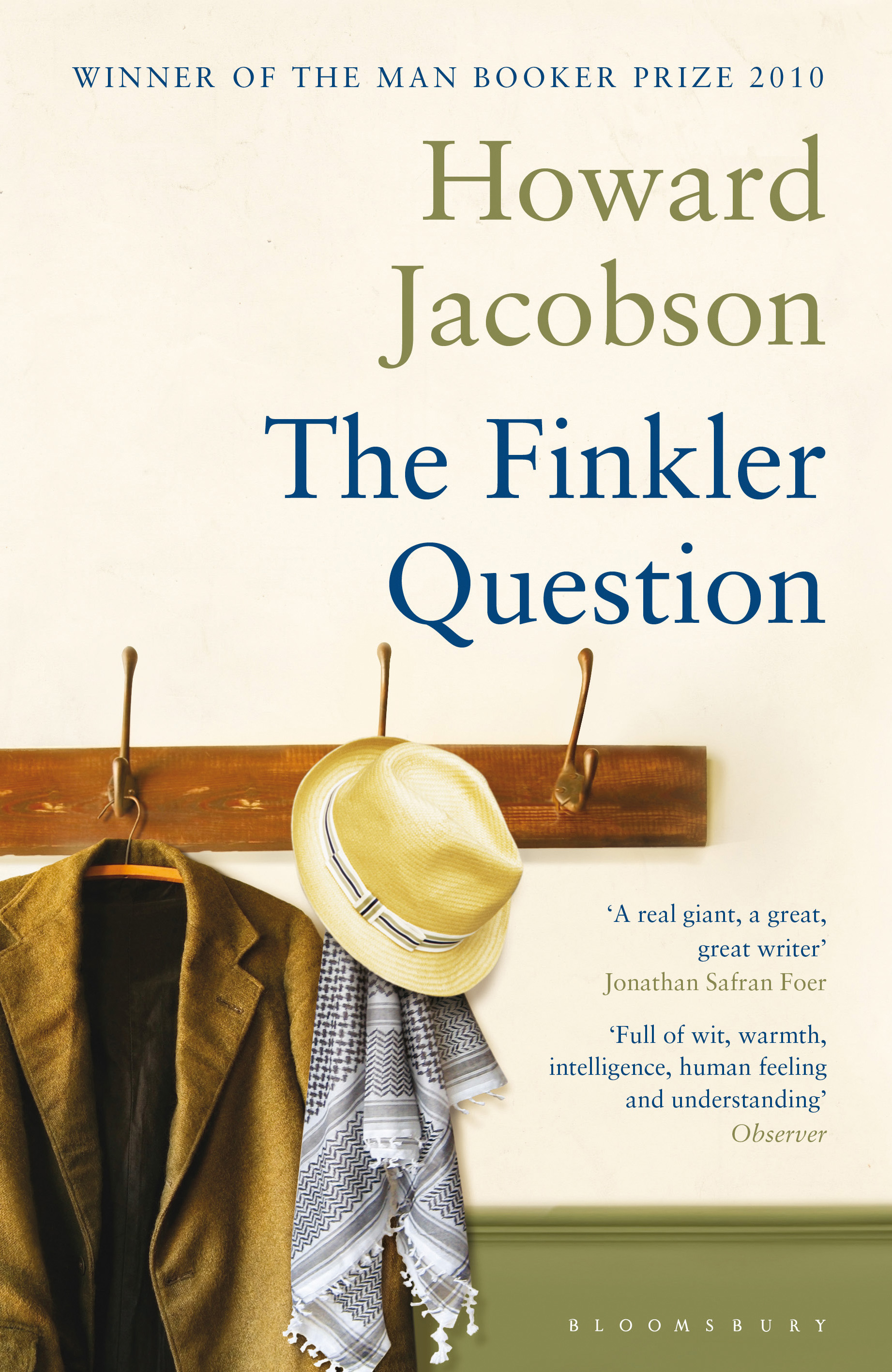
Howard Jacobson’s The Finkler question (Courtesy: Bloomsbury Publishing)
Whispering Gums, as you would expect, writes erudite marginalia and so you’d be in for a treat if you ever obtained my copy of Howard Jacobson‘s 2010 Booker award winning novel, The Finkler question. The margins are peppered with my reactions, like, you know, “Ha!” and “Oh dear”. Riveting stuff … and yet, what comments would you make in this book? Ah yes, “stereotyping” is another one, because that, really, is the springboard from which this rather funny book is written.
Do I need to summarise the plot? I feel that I’m about the last blogger to read this book, but just in case I’m not, here goes … It concerns three longstanding friends: Julian Treslove and Sam Finkler who have been friends since schooldays, and Libor Sevcik who was their teacher at school. At the beginning of the book, Finkler and Libor, both Jews, have been recently widowed. Treslove, the non-Jew, is the “honorary third” widower because he is single (yet again). The novel’s premise is that Treslove would like to be a Jew …
Why, you might ask, would Treslove want to be a Jew (or, a Finkler, as he privately calls them – and hence the title)? It is not an accident that Treslove’s occupation when the novel opens is to be a paid double (or “lookalike”) of famous people at parties, conferences, corporate events:
Treslove didn’t look like anybody famous in particular, but looked like many famous people in general, and so was in demand if not by virtue of verisimilitude, at least by virtue of versatility.
And that’s pretty much how his Jewishness goes too. He might look and play the part but, deep down, can a non-Jew ever really be Jewish? Treslove is about to find out.
Jacobson has a way with words. It was this, together with the endless discussion, using every Jewish stereotype going, of what makes a Finkler (a Jew, remember!) a Finkler, that kept me going through a book that I wasn’t really sure was going anywhere. I laughed at Treslove’s incomprehension of Finkler (the character, this time):
“Do you know anyone called Juno?” Treslove asked.
“J’you know Juno?” Finkler replied, making inexplicable J noises between his teeth.
Treslove didn’t get it.
“J’you know Juno? Is that what you’re asking me?”
Treslove still didn’t get it. So Finkler wrote it down. D’Jew know Jewno?
Treslove shrugged. “Is that supposed to be funny?”
Oh dear! “Julian Treslove knew he’d never be clever in a Finklerish way” but, despite this, he continues with his goal to be Jewish. Meanwhile, Finkler, grieving for his wife and a marriage he still doesn’t understand, tries to dissociate himself from Jews (particularly Zionists) through membership of the ASHamed Jews. And Libor, grieving heavily for his true love, tries to dissuade Treslove from his ambition.
The book chronicles a year or so in the life of these three as each confronts his particular challenge. Treslove falls in love with Libor’s (Jewish) great-niece, Hephzibah, furthering, he hopes, his path to Jewishness; Finkler starts to fall out with the ASHamed Jews though not with their anti-Zionist principles; and Libor starts to fall out of life itself. All of this is told with both warmth and humour. The humour is always there, and yet is never pushed so far that the humanity of the characters is lost. You feel for them, despite their flaws and foibles. You want Julian, the hopeless father and failed lover, to make a go of it this time. You want Finkler to make peace with his Jewishness. And you want old Libor to get over his grief and join the world again. But through all this, you wonder, why? Why is Jacobson writing this story?
I have a few ideas. One may simply be to capture the diversity of Jewishness. Through all the stereotypes that made me laugh (Jews are musical, brokenhearted, rich, clever, comic, and so on), Jacobson shows that Jews, like any other group, are not all the same, cannot all be put in the one basket. Another reason, though it’s depressing to think it’s needed, may be to defend Jews in an anti-Semitic world, to show their humanity. You care for these characters whose troubles with identity, love and loss are universal. And another may be to explore Zionism, safely. Can Zionism be defended? Has it changed into something more ugly, something that undermines its original conception?
In the end I did like this book because, while I was contemplating the “why”, I was engaged by the characters and their stories. The novel commences with Treslove, the would-be Jew, but it concludes with Finkler, the troubled Jew. Here he is, towards the end:
He was a thinker who didn’t know what he thought, except that he had loved and failed and now missed his wife, and that he hadn’t escaped what was oppressive about Judaism by joining a Jewish group that gathered to talk feverishly about the oppressiveness of being Jewish. Talking feverishly about being Jewish was being Jewish.
Ha! You said it, Mr Jacobson, I’m tempted to say. But that would be too smart-alecky of me because the book is, in fact, as much about humanity as it is about being Jewish.
Howard Jacobson
The Finkler question
London: Bloomsbury, 2011
370pp.
ISBN: 9781408818466
 Whispering Gums