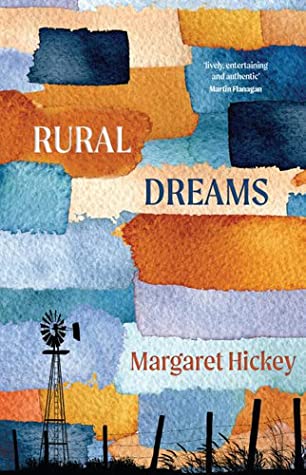
Rural dreams is another collection of short stories from small independent publisher MidnightSun, and it’s another good one. I hadn’t heard of Margaret Hickey before, but her website says that she’s won a number of awards and is a performed playwright. Relevant to this book is that Hickey grew up in small country towns in Victoria and currently lives in that state’s northeast. In other words, in this book about rural lives, she knows whereof she speaks.
Like most short story collections, Rural dreams comprises stories told in different voices and points-of-view. The narrators, male and female, range from teens to the middle-aged, and the stories are told in first person and third person voices, with one told second person. The tone varies from funny to sad, from reflective to scary, and the subject matter represents a wide gamut of rural lives, from those who have left to those who want to leave, from those who are farmers to those who are sea-changers. And, of course, it encompasses a range of rural issues, to do with farming, dying land and dying towns, for example, as well as those more universal human issues involving love and loss, joy and fear.
I greatly enjoyed most of the stories – there’s usually one or two in a collection that doesn’t quite connect. The opening story, “Saturday morning”, fired the perfect opening salvo. Told third person, it’s about a young engineering student named Simon who now lives in a share house in Melbourne but who gets up early every Saturday morning, through winter, to drive about three hours home to play football. Even he wonders why he does it, given the way it disrupts his weekend, but, as he hits “the shire boundaries”
… there it comes, that big ball of a sun, that big ball of orange rising up over the horizon. It jolts him every time. Rays light up the stone fences, hit the trees and illuminates the paddocks. The old gums shimmer green and grey in the early morning light and world appears golden quiet. It’s like it is every Saturday, a new era.
They might have a chance today.
He’s home.
“This place, it gets to you”, says the old coach, in “Coach”. And place, of course, underpins most of these stories, whether it’s the Wimmera or Mallee or Ninety Mile Beach in Gippsland.
Counterpointing our narrator in “Saturday morning” is the young Year 12 student in the next story, “Glory days”. Living in the dry Wimmera, he is sweating his ATAR score, dreaming of escape to the city where there’ll be “no more discussions about rain and cows, it will be all about novels and films and experience”.
And so the stories continue, wending across the state, and further afield. “A bit of scrapbooking” promotes the joys of living in the oft-maligned Surfers Paradise in southeast Queensland. Reminiscent a little of Kath and Kim, this story contrasts our narrator’s life in Surfers with her son’s and his partner’s in Melbourne. She just can’t understand his move there for, he told her, “a bit of culture”:
Well, I’ve never understood that. We’ve got culture all around us up here.
Take Jupiter’s Casino–it’s full of all sorts! You’ve got your Sheiks, your Maoris, your South Australians. And you can buy your sushi, your ravioli and your chicken schnitzel in every dining establishment. Every kweezeen you like.
A first person voice is the perfect choice for this story. It made me laugh. Its humour combined with a warm touch at the end makes it just the right antidote – can an antidote come first? – to the darker story, “Desolate”, which follows. This story, and the longest one in the collection “The Precipice”, are the darkest stories here. In “Desolate” our sea-changing narrator from St Kilda, whose “barely disguised air of yuppiedom did little to hide the threat of violence that lurked beneath”, finds that beautiful deserted beaches harbour their own issues. The opening to this story is deliberate:
It’s one of those days that almost kills you; it’s that beautiful.
In “The precipice” and “The Renovation” the titles are pointedly metaphorical, with the former being about domestic violence which is clearly not confined to cities. This story builds up slowly from a therapeutic bushwalk to one of horror for the three women involved. The end, though, is perfect. Hickey, who clearly loves rural living, is realistic rather than rosy about it. She references violence, drought, and issues like the potentially damaging health impact of chemicals, without being didactic or polemical. She know the characters too, like the middle-aged man still living at home who just “likes birds” of the feathered variety (“Twitcher”) or “town weirdo” Joe who cares about the land regardless of the locals (“Overcoat Joe”) or the single-mum who stands up for her scholarship-winning son at his hoity-toity private school (“Mind your language”).
As many contemporary Australian writers are increasingly doing, Hickey also incorporates references to Indigenous Australian lives and culture. She doesn’t attempt to speak for them, but these references suggest an awareness that’s important. Anna, in “The precipice”, remembers a place called “the Leap for the stories of Aboriginal families herded there by whites in the early days of settlement”; Ruby in “The renovation” is told about the middens in the community she’s moved to; Peter remembers the scar trees in “Binky”.
Finally, while the stories are stand-alone, a few are subtly linked. Kate Brunt, a netball player from the town mentioned by Simon (“Saturday morning”), is one of the young travellers in “The wanderer”. The coach (“Coach”) briefly mentions Simon. These links have no overall narrative significance, but they have a nice grounding effect.
Rural dreams is a love letter to rural Australia, one that recognises the tensions and challenges, as well as the warmth and community. Hickey gently mocks Australia’s ongoing romance with the bush, giving us instead an image that is real and human. A truly engaging read.

Margaret Hickey
Rural dreams
Adelaide: MidnightSun, 2020
232pp.
ISBN: 9781925227680
(Review copy courtesy MidnightSun)
 Whispering Gums