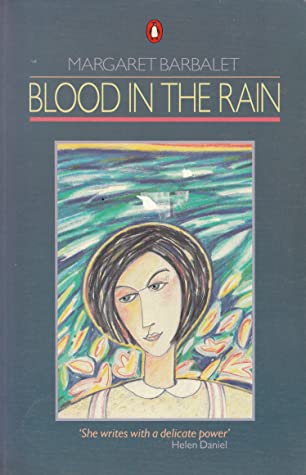
When I thought about Bill’s AWW Gen 4 week, I knew I’d have some hard choices to make as I have many eligible novels on my TBR shelves. However, the choice wasn’t too hard because there was one author who just doesn’t seem to be talked about and I wanted to include her on my blog. Little did I know that Lisa had a similar idea, so this week you have not one but two posts on Margaret Barbalet’s Blood in the rain.
I am a bit embarrassed about it, though, because I must have bought my copy around the time it was published, as the “Aust. recommended” price sticker on my Penguin says $7.95! Indeed, I referred to this book, albeit not by title, when I wrote about Canberra’s Seven Writers of which Barbalet was a member. This is another reason I’ve been keen to read this novel.
Barbalet might have been part of the Canberra Seven, but she was born in Adelaide, grew up in Tasmania, and went to university back in Adelaide, before living in Canberra for many years. Blood in the rain is set in Adelaide and environs, and its descriptions of place reminded me at times of Barbara Hanrahan’s The scent of eucalyptus (my review), although the style is different. It might be just me, but I had a strong sense of Patrick White’s intensity in Barbalet’s book, particularly in the weight of her descriptions.
And this is probably a good time to tell you what the novel is about. The back cover tells us that it’s “about Jessie … a young girl growing up and reaching for maturity in the Australia of the Great War and the Depression, as she moves from country town to country town and eventually to Adelaide”. It also says that her life is “in may ways, ordinary” but that Barbalet “follows Jessie’s odyssey with a perception and compassion that reveals a person who is quite extraordinary”. This is accurate, but it misses a few salient points.
“she feels everything”
For example, the novel starts when Jessie, 4 years old, and her brother Stephen, 8, are living with their parents in a small coastal town. In the first chapter, their mother walks out, and we never hear from her again. Jessie adores her brother, but with their father deemed incapable of raising them – in the eyes of the local churchgoing women – the two children are taken in by different relatives. And through one of those twists of fate, Jessie is taken into a loving family, the Whaites, while Stephen goes to the home of a stern maternal uncle Theodore, and his cowed unmarried daughter. There is no affection here, and, indeed, there’s disdain from Theodore, because Stephen’s father was an Irishman – “Of course, Catholics, Irish, what can you expect”. In his opinion, Stephen “had never been checked”.
We spend a little time with Stephen – just enough to realise that his youth was miserable, and for us to see the contrast with Jessie’s life – but the book is Jessie’s. The war comes, and with the death of Mr Whaite in that war, Mrs Whaite can no longer afford to keep her, so Jessie is moved on to an unmarried relation, Miss Symes. Miss Symes doesn’t have the motherly warmth of Mrs Whaite but Jessie realises early on that she “would not be unkind”. A major theme of the book concerns, as Jessie ponders in adulthood, “what made a life good or bad”. One factor, this novel shows, is a secure, loved childhood, something Jessie had well enough, but not Stephen.
Anyhow, the story progresses from here, with Jessie going off to work as a domestic when she’s around 14 years old … and we move into the Depression. Meanwhile, Stephen, with whom she manages to stay in contact, goes to war, and returns with an injured arm, but it’s clear that Stephen’s greatest injury is emotional. The siblings reconnect after Stephen returns to Adelaide with a wife, Pamela, and baby – and some time after, Jessie moves in with them. I’ll leave the story there.
Since I read this for Bill’s week, I want to comment on how this book might or might not fit into his ideas about Gen 4. I’ll start with style, and return to my point about Patrick White. A little research into Barbalet uncovered that she was a fan of DH Lawrence. Guess who was also a fan of DH Lawrence? Yes, Patrick White. I rest my case!
Seriously though, White writes in his autobiography, Flaws in the glass, about missing Australia, and says “I could still grow drunk on visions of its landscape”. Well, you get the sense that Barbalet could too, as her descriptions of place – whether city, country, or coast – are so intensely evocative:
There was no one about but the smell of poverty remained.
The dew on the grass looks dirty, she thought, glancing through the pinched paling fence on the vacant block at the corner. Yellow light leant at corners, streaking the walls with new angles the colour of old flannel. Fingers of sun lifted new dirt in the glare.
There is also intensity in her descriptions of humanity, a Whitean (sorry!) sense of tough, hard lives that need resilience to survive. Jessie has resilience, seeking and enjoying, whenever she can, “manna in the dry waste of life”.
None of this is specifically Gen 4, but Blood in the rain does also embody its era. Barbalet, for example, plays with point of view, something that seems to start once Jessie is sentient. In other words, the novel is told third person, but at moments when Jessie’s feelings are likely to be strong we slip into second person. It begins when she is taken to live with Miss Symes, sister-in-law to her brother’s guardian. The mention of Stephen brings out feelings:
Your brother Stephen. If you skipped and walked even your feet would say the words. That dear face might suddenly slide in front of your eyes … You said the name over and over.
As does the awareness that, while Mrs Whaite had loved her, it wasn’t enough to keep her:
But, you, you, were someone who could be left.
It’s an intriguing technique, and a bit disconcerting at first, but it gives intensity to Jessie’s emotional self.
Besides style, though, is genre and subject matter. Blood in the rain is historical fiction, which was not particularly common in literary fiction, and it’s historical fiction about ordinary people, about ordinary women in fact. It’s a domestic story with little dramas, the sort of story that Gen 4 women made particularly their own.
Domestic, however, doesn’t mean trivial. This novel is about important ideas – about women’s resilience and stoicism in the face of poverty, about the raising of children, and in fact about love. Love, Jessie decides, is what makes the difference between a good life and a bad one. If that’s women’s fiction, it’s fine by me.
Margaret Barbalet
Blood in the rain
Ringwood, Vic: Penguin Books, 1986
204pp.
ISBN: 9780140089448
 Whispering Gums