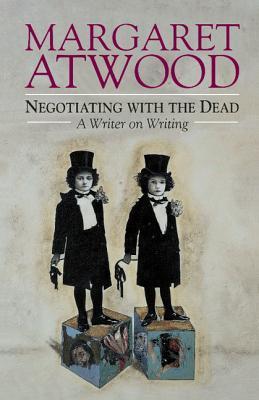
Margaret Atwood, Negotiating with the dead: A writer on writing (#BookReview)

My reading for Buried in Print Marcie’s annual MARM month has been both sporadic and minimal, to say the least, but this year I finally got to read a book that has been on my TBR shelves for a long time and that I have planned to read over the last few MARMs. It’s Atwood’s treatise (or manifesto or just plain ponderings) on writing, Negotiating with the dead. Interestingly, in 2003 it won the Independent Publisher Book Award (IPPY) for Autobiography/Memoir. I hadn’t quite thought of it that way, though on reflection I can see it does have a strong element of memoir.

Its origins, however, are not in memoir but in the series of lectures she delivered at the University of Cambridge in 2000, the Empson Lectures, which commemorate literary critic, William Empson. (I recently – and sadly – downsized his most famous book, Seven types of ambiguity, out of my library). Atwood turned those lectures into this set of essays that was published by Cambridge University Press in 2002 (and that I leapt on when I saw it remaindered in 2010).

Subtitled “A writer on writing”, this book is probably not quite what most of us would expect, unless we really know Atwood. As she says in her Introduction, it is not so much about writing as about something more abstract, more existential even, about what is writing, who is the writer, and what are the writer’s relationships with writing, with the reader, with other writers, and with themself. It’s also about the relationship between writing and other art forms, like painting and composing. She says in her Introduction that “it’s about the position the writer find himself in; or herself, which is always a little different”. (Love the little gender reference here.) It’s about what exactly is the writer “up to, why and for whom?”

I rarely do this, but I’m sharing the table of contents for the flavour it gives:

  • Introduction: Into the labyrinth
  • Prologue
  • Orientation: Who do you think you are? What is “a writer,” and how did I become one?
  • Duplicity: The jekyll hand, the hyde hand, and the slippery double Why there are always two?
  • Dedication: The Great God Pen Apollo vs. Mammon: at whose altar should the writer worship?
  • Temptation: Prospero, the Wizard of Oz, Mephisto & Co. Who waves the wand, pulls the strings, or signs the Devil’s book?
  • Communion: Nobody to Nobody The eternal triangle: the writer, the reader, and the book as go-between
  • Descent: Negotiating with the dead Who makes the trip to the Underworld, and why?

There is way too much in the book for me to comment on, but I don’t want to do a general overview either, so I’m just going to share a couple of the ideas that interested me.

One of her main threads concerns “duality” and “doubleness” in writers’ lives. There’s a fundamental duality for a writer – a novelist anyhow – between “the real and the imagined”. She suggests that an inability to distinguish between the two may have had something to do with why she became a writer. This interested me, but it’s not what interested me most in this book. Rather, it was the idea of the writer’s “doubleness”, which she introduces in chapter 2, “Duplicity”, the idea that there is the person who writes and the other person who lives life (walking the dog, eating bran “as a sensible precaution”, and so on). She explains it this way:

All writers are double, for the simple reason that you can never actually meet the author of the book you have just read. Too much time has elapsed between composition and publication, and the person who wrote the book is now a different person.

It’s obvious, of course, but we don’t often think about it. Writers do, though. Take Sofie Laguna, for example. In the recent conversation I attended, she said she wished she’d kept a diary when she was writing her novel to capture the “dance” she’d had between the conscious and the subconscious as she worked through the issues she was confronting. In other words, the Sofie in front of us was not the Sofie who had written that book. In chapter 5, “Communion”, Atwood addresses this issue from a different angle when she talks about the relationship between writers and readers.

Back to the writer, though, Atwood talks about, gives examples of, how different writers handle this doubleness, the degree to which they consciously separate their two selves or don’t. This brought to my mind Brian Castro’s Chinese postman (my review) in which he regularly – consciously of course – shifts between first person and third for the same character, a character who owes much to Castro himself but is not Castro. This may be similar to the example she gives, Jorge Luis Borges’ short story “Borges and I”. It’s also something Helen Garner has often discussed, such as in her essay “I” published in Meanjin in Autumn 2002. Even in her nonfiction works, she “creates a persona”, one that “only a very naive reader would suppose … is exactly, precisely and totally identical with the Helen Garner you might see before you”. My point in saying all this is that I think Atwood is exploring something interesting here. Is it new? I don’t know, but it captures ideas I’m seeing both in statements like those of Laguna and Garner, and in recent fiction where I’m noticing an increasing self-consciousness in writers who are explicitly striving for new forms of expression.

Another double Atwood discusses – one related to but also different from the above – is that between the writer and the writing. The writer dies, for example, but the writing lives on. It brought to mind that murky issue concerning posthumous publication (which was discussed on 746 Books Cathy’s Novellas in November post about Marquez’s Until August). It’s a bit tangential, I guess, but Atwood’s separation of the writer and the writing, her sense of the doubleness of writers, puts another spin on this conundrum.

She discusses other issues too, including that of purpose, to which she gives two chapters (3 and 4), setting the art-for-art’s sake supporters against the moral purpose/social relevance proponents, and which of course touches on that grubby issue of writing to earn money!

It’s an erudite book, in that she marshals many writers, known and unknown to me, to illustrate her ideas, but the arguments are also accessible and invite engagement. I did have questions as I read, but she managed to answer most of them. A good read.

Read for Marcie’s #MARM2025

Margaret Atwood
Negotiating with the dead: A writer on writing
Cambridge: Cambridge University Press, 2002
219pp.
ISBN: 9780521662604
Margaret Atwood, Widows (#Review)

Marcie’s (Buried in Print) MARM (Margaret Atwood Reading Month) event is now seven years old, but this is only my second contribution. I read a reasonable amount of Atwood before blogging, and since then have let her slide somewhat, though I have reviewed a couple of books here. You can’t read it all – but, I do like her voice …

So, I decided to join in again this year, as I knew I had a collection of short stories in my TBR pile. The only problem is that my non-Australian TBRs are still in boxes somewhere. What to do? Maybe, I thought, there’s a short story online somewhere, and sure enough I found one in The Guardian. Titled “Widows” it features Nell and (the late) Tig. From Marcie’s blog I learnt that this couple first appeared in Atwood’s collection of linked stories titled Moral disorder, and appeared again in her recent collection Old babes in the wood, from which this story comes. However, I’ve not read either of these collections, and I didn’t recollect those characters or their names.

Then a strange thing happened. According to Wikipedia, Moral disorder contains eleven connected short stories, the second last one being “The Labrador fiasco”. This is the story I read for last year’s MARM, but it was in a 1996-published Bloomsbury Quid edition. I had no idea it was later included in the 2006-published Moral disorder. Oh these writers can be tricksy. Did she change it in any way – such as to name the then unnamed character – for version in the collection? Anyhow, moving on, Wikipedia tells me that the 2023-published Old babes in the wood comprises fifteen stories in three parts: “Tig & Nell” (three), “My Evil Mother” (eight), and “Nell & Tig” (four). “Widows” is the thirteenth story in the collection, so presumably the second one in that last group of four.

I won’t rehash “The Labrador fiasco”, except to say that it is a “story-within-a-story” story, and that the framing story concerns the unnamed narrator (who is apparently Nell) visiting her aging father and mother. The father, in particular, is declining, having experienced a stroke six years before the story’s opening. It is told first person by the daughter, who regularly visits her parents and is becoming aware of aging and our inevitable decline. Some years have clearly passed, and in “Widows” Nell has recently lost her husband “Tig”. It’s an epistolary story, I guess you could say, though it contains only two letters, both by Nell to a friend named Stevie.

The first, and main, letter is a delight – and pure Atwood. It’s partly in what she covers, as this short short story manages to encompass Atwood’s recurring themes – women (their position in society, and their relationships), language, aging, social conventions, and the state of the world. But it’s also in the sly way she makes her sharp little points. For example, talking about widows, she has a dig at the modern penchant for creating increasingly complicated gender-neutral descriptions:

I’m hanging out with a clutch of other widows. Some of them are widowers: we have not yet got around to a gender-neutral term for those who have lost their life partners. Maybe TWHLTLP will appear shortly, but it hasn’t yet. Some are women who have lost women or men who have lost men, but mostly they are women who have lost men.

Similarly, there is a sly reference to world politics and climate change, when she says to Stevie, who is much younger, that:

if you live another thirty years and are still enjoying it, or most of it – if anyone will be enjoying, or indeed living, considering the huge unknown wave that is already rolling toward us – I expect you will look at a picture of yourself as you are today, supposing your personal effects have survived flood, fire, famine, plague, insurrection, invasion, or whatever …

Of course, Nell talks about grief, about the forms, assumptions and cliches that surround it. She’s quietly scathing about “checking the boxes of the prescribed grief process” and eschews the well-intended offers of casseroles and suggestions that she go on a cruise.

When I read writing like this, I can’t help being reminded of Jane Austen, because both have the ability to see through our conventions and pretensions to the truths beneath, and to make us chuckle as they do so.

However, for all the cheeky barbs and social commentary, there is also something heartfelt in her discussion of grief. She speaks of how it skews one’s experience of time, how it affects one’s relationship with the person who has died, and what grieving people really talk about and deal with. Atwood knows whereof she speaks having lost her husband of 46 years in 2019.

If I thought this first letter was both clever and moving, the second letter just nailed it. In fact, if I were writing criticism and not a review, I would discuss what Atwood does here, but that would spoil the whole experience, and I don’t want to do that because you can read it yourself at the link below. Suffice it to say that, while “Widows” is a short story, it does a lot in its few words, and its ending signs off with aplomb.

Read for MARM 2024

Margaret Atwood
“Widows”
The Guardian, 25 February, 2023 (also pub. Old babes in the wood, 2023)
Available online at The Guardian, 2023

Margaret Atwood, The Labrador fiasco (#Review)

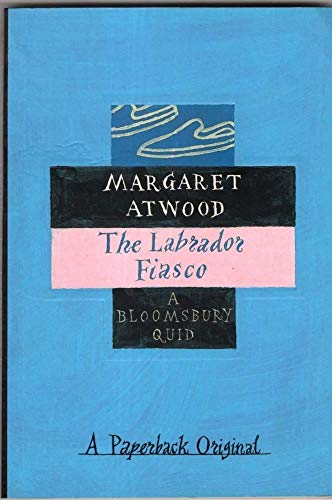
Although I am an Atwood fan from way back, I haven’t, to date, taken part in Marcie’s (Buried in Print) MARM (Margaret Atwood Reading Month) event. But I promised her I would this month, albeit with just one little short story probably, this one. I have had The Labrador fiasco on my “little book” TBR shelf since it was produced as a Bloomsbury Quid back in the 1996. I have no idea why I have not read all my little books, but, there you go!

Most of you will know Margaret Atwood (b. 1939). I read several of her books before blogging – including her dystopian novel, The handmaid’s tale; her historical fiction novels, Alias Grace and The blind assassin; and her more contemporary novels Cat’s eye and The robber bride – and I have more on my TBR. But, I have only reviewed her twice here, her novella, The Penelopiad (my review), and her recent poetry collection, Dearly (my review). Now, I bring you a short story. This woman is versatile.

As far as I can tell, “The Labrador fiasco” was first published in this edition. Many of my “little books” comprise previously published short prose works, but this doesn’t seem to be the case here. I have three other Bloomsbury Quids, two of which were previously published, with the other, Nadine Gordimer’s Harald, Claudia and the son Duncan (my review), also seeming to have been first published as a Quid. Interesting, but not relevant to my discussion of Atwood’s story, so let’s move on. The Quids, though, are gorgeous little books.

“The Labrador fiasco” is a “story-within-a-story” story. (Ha!) The framing story concerns the narrator and her aging father and mother. (The narrator’s sex is not provided, but let’s go with female as Atwood is female.) The father, in particular, is declining, having experienced a stroke six years before the story’s opening. It is told first person by the daughter, who regularly visits her parents.

The story within comes from Dillon Wallace’s The lure of the Labrador wild, published in 1905. Wallace was, says Wikipedia, “an American lawyer, outdoorsman, author of non-fiction, fiction and magazine articles” and this, his first book, was a bestseller. It tells of an exploratory trip through Labrador undertaken by Wallace and a man called Leonidas Hubbard, with their Cree Indian guide, George. The Cree bit is important as the Cree are not from the region they were travelling in. Anyhow, the aim was to explore a part of Labrador that hadn’t been explored by Europeans, with Hubbard wanting to “make his name”. However, as Wikipedia (and Atwood’s story) explains, they took the wrong river from the start, with tragic consequences.

Atwood’s story opens with:

It’s October; but which October? One of those Octobers, with quick intensities of light, their diminuendos, their red and orange leaves. My father is sitting in his armchair by the fire. He has on his black and white checked dressing gown, over his other clothes, and his old leather slippers, with his feet, propped up on a hassock. Therefore it must be evening.

There’s so much going on here, besides the gorgeously structure sentences. We are immediately put on the back foot with “which October”, and “it must be evening”, but at least the father is very much present. The uncertainty suggests that the story is being told from a later time. Whichever October it is, however, it is autumn – or fall – and that means the season of decline. Within a couple of paragraphs, we learn of the father’s stroke, and know he is declining. But, the question, “which October”, also hints at the October in the Wallace-Hubbard story when things have really started to sour – because not only is it cold of course, but our explorers have taken the wrong route and are running out of supplies.

This is the set up. As the story progresses, the narrator’s father, who was an experienced outdoorsman himself in his day, provides a running commentary on the explorers, with the narrator adding her own layer. “They took the wrong supplies”, the father says, pleased because he would have known what to take. However, our narrator wonders “what supplies could they have taken other than the wrong ones” … “No freeze-drying then” or “nylon vests”, for example.

“harsh and unmarked and jumbled”

What Margaret Atwood does in this story, then, is parallel the deterioration in the condition of the explorers as their expedition goes awry, with the narrator’s father’s decline as he ages. The explorers leave things behind, their feet suffer because they don’t have effective footwear. The father leaves hobbies behind, and says his feet are too sore to walk. The father thinks he would have done the expedition better, but he faces his own “forest” and in fact, like the explorers, he and his supporters are not fully equipped to deal with it.

And so it goes. In under 40 (very small) pages, Atwood combines commentary on a failed (colonial) expedition, conveying the poor planning and hubris of those involved, with a tender family story of an adult child and mother coping with a failing father. To do this she calls on her obvious love and knowledge of Canada’s history and “wilderness” (a contested term now, I know), and her keen interest in humans and how our lives play out.

We are all explorers, I think Atwood is saying, and the way, at least some of the time, can be “harsh and unmarked and jumbled”. It takes all our energy to traverse it. Good planning and the help of others can ease the way, but in the end, we each have to do it on our own. A clear-eyed, clever and tight story with an ending that encompasses genuine warmth with an acceptance of life’s realities. Beautiful.

Read for MARM 2023

Margaret Atwood
“The Labrador fiasco”
London: Bloomsbury, 1996 (A Bloomsbury Quid)
64pp.
ISBN: 9780747528890
Available online at Independent, 1996

Margaret Atwood, Dearly (#BookReview)

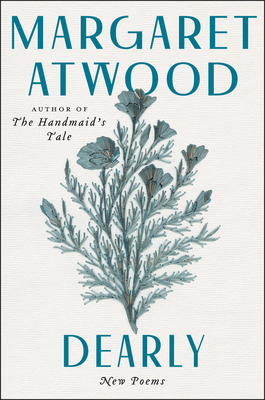
Earlier this year, I decided to try audiobooks more regularly – and thought short stories would be a good way to go. Julie Koh’s Portable curiosities was my choice. It was, overall, a positive experience. Then I thought poetry might be worth trying given it’s such an aural form. I chose Margaret Atwood’s latest collection Dearly for my first foray into audio poetry since, although I’ve been an Atwood fan, I’ve only reviewed her once on my blog. Also, Atwood was a poet before she was a novelist. An added benefit was that the audio version was read by her. 

It worked really well – as a reading experience. For blogging, it was tricky. I found it difficult to capture the details I like to have for a review, much harder than remembering the plot, characters and themes of a novel experienced in audio form. Short stories fall somewhere in the middle. Anyhow, all this is to say that this post will share my overall thoughts, and a little about a few poems that I managed to jot down notes about or find online.

Overall, the collection came across as melancholic in tone, which is not to say the poems are uniformly grim, as there’s also plenty of Atwood’s cheeky humour. The worldview tends to the dystopian, reflecting Atwood’s concerns, but it felt realistic rather than hopeless. The subject matter is both political, dealing with issues like climate change and war, and personal, exploring ageing, grief and mortality. All of these speak to me.

Many of the poems draw on nature for their imagery, if not their subject matter. There’s a sense that nature is bearing the brunt of our wilfulness, that it shows evidence of our wilfulness, and, conversely, that it may also provide the answer. But, there are other poems which explore her themes through worlds I know nothing about, like zombies, aliens and werewolves.

And, of course, there’s Atwood’s love of language. The poems are accessible rather than obscure, but they’re not simple, because Atwood understands the weight of words and loves to play with them. This comes across really well in the audio version.

The collection is broken into five parts, starting, perhaps counter-intuitively, with “Late poems”. Many of the ideas here appealed to me, such as the idea in “Salt” that we don’t recognise the past was good until later. But, the poem that most touched me in this part was “Blizzard” in which Atwood talks about her nearly centenarian mother, asking “why can’t I let her go”? I could tell her why.

I enjoyed poems in Part 2, like “Health class (1953)” and “A genre painting”, but in Part 3, we find many poems inspired by nature. “September mushrooms” talks of fungi bringing “cryptic news of what goes on down there”. Halloween is the ostensible subject of “Carving the jacks”, which concludes with such a great line, “After we’re gone, the work of our knives survive us”. Atwood can do last lines.

In “Update on werewolves” (read it online), Atwood riffs on the masculine threat inherent in werewolves, then expands it to explore the empowerment of women. “Zombie” is prefaced by a lovely epigraph by Rilke, that “poetry is the past that breaks out in our hearts”. In “The aliens arrive”, Atwood runs through various movie aliens and their actions:

We like the part where we get saved.
We like the part where we get destroyed.
Why do those feel so similar? 

I love these pointed, paradoxical lines.

“At the translation conference” toys with language and culture, and how different cultures have words (or don’t) for different things. Some languages have “no word for him her … have no future tense”. There’s a wry reference to women and the word “no”, and, more scarily, to translation as a dangerous activity where punishment can result if the translation is “wrong”.

Part 4 also contains many nature-inspired poems. It continues the concerns and questions about where we are going, particularly regarding the environment. Finding a “Feather” causes Atwood to think of the “calligraphy of wrecked wings” and of the feather’s owner being “a high flyer once as we all were”. (This is one of many references to birds, which are a particular passion of Atwood’s.) “Improvisation on a first line by Yeats” continues the exploration of our rapacious attitude to land, as does “Plasticine Suite” with its word play on ages – the Pleistocene, the Myocene, now the Plasticine, “evidence of our cleverness, our thoughtlessness”. It addresses the arrogance of proselytising developed nations disregarding the needs of the less rich. “Oh children” ends with “Oh children … will you grow up in a world without ice … will you grow up?”

The collection concludes on the personal, with Part 5 devoted to ageing and loss, largely inspired by the death of Atwood’s husband in 2019 from dementia. There are some really lovely meditations here. In “Sad utensils” she writes of “the word reft/ who says that anymore?” despite its being honed over years and used by many. As words pass, so do our own lives, and the people we love. In “Silver slippers” she reflects on ageing and the things we give up along the way, “no dancing anymore … all my wishes used up … where did you go and when/ it wasn’t to Kansas”.

The second last poem is the titular poem, and it speaks directly to her loss of her husband, starting with the loss of the word “dearly”:

It’s an old word, fading now:
Dearly did I wish.
Dearly did I long for:
I loved him dearly.

Moving, and to the point – as is the final line of the book, from the poem “Blackberries”: “the best ones grow in shadow”. More paradox. I will leave my thoughts there and pass you over to Margaret Atwood herself in her essay for The Guardian on this collection. She says it all far more eloquently than I ever could.

Margaret Atwood
Dearly
(Read by Margaret Atwood)
Bolinda Audio, 2020 (Orig. pub. 2020)
1hr 48mins (Unabridged)
ISBN: 9781867504009

Margaret Atwood, The Penelopiad

Margaret Atwood, The Penelopiad

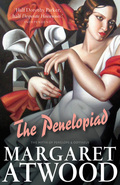
The Penelopiad bookcover (Courtesy: Text Publishing)

This is the second time I have read Margaret Atwood’s The Penelopiad. Much as I enjoyed it the first time around, I probably wouldn’t have read it again if it hadn’t been scheduled for one of my online bookgroups. However, given that scheduling and the fact that I had recently listened to Simon Armitage’s dramatisation of The odyssey, I didn’t mind reading it again – and it is short! My rereading though ended up being a little disjointed as I was trying to finish off a number of competing contracts at the time as well as prepare for a ten-day trip to our warm Top End. This review may be similarly disjointed!

The book is part of Canongate’s Myths series in which recognised writers were asked to retell well-known myths. At the time of publication, Atwood said that she tried a number of myths and had nearly given up when she suddenly recollected the story of Penelope and her hanged maids – and her childhood reaction to it. The result is a rather fresh – and cheeky – look at the story told through Penelope’s and the hanged maids’ eyes, from, not surprisingly, a feminist (or at least female) perspective.

The story is told through a large number of short chapters in Penelope’s voice, and these are interspersed with commentary from the hanged maids, emulating, appropriately enough, the idea of a Greek chorus. The way Atwood uses it, the chorus provides a satiric perspective on Penelope’s view of the story. The story is told in flashback, with the narrators all speaking from Hades, where they now reside. It is not a standard revisionist feminist treatise that simplifies the world to one of gender power discrepancies (even though that is what underlies it all). We get to “feel” what it might have been like to have lived then. Atwood’s characters are “real” and operate in a complex world where game-playing and manipulation are de rigueur if you are going to survive.

In Homer, Penelope is presented as “the quintessential faithful wife” (Atwood’s introduction) who brings up their son and cleverly fends off suitors while waiting patiently for Odysseus’ return. When he returns, he kills the suitors and twelve of Penelope’s maids. Atwood, again in her introduction, says that in choosing to tell the story through Penelope and the maids she wanted to focus on “what led to the hanging of the maids, and what was Penelope really doing?”. Her Penelope is something rather more than the constant wife of The odyssey. She, the part daughter of a watery Naiad, is a slippery character to pin down. She is highly jealous of her beautiful cousin Helen (she of Troy fame) and she is capable of making her own power plays. She is of high birth, contrasting her with the twelve maids who, by their own admission “were born to the wrong parents. Poor parents, slave parents, peasant parents, and serf parents…”.

What I enjoyed most about this book – besides the story Atwood tells – is its sly humour. It is genuinely funny, albeit in a dark or sometimes gruesome way. Much of the humour arises out of Penelope’s playing with the truth. In fact the book plays continually with the idea of “stories”. In the first chapter, Penelope says:

Now that all the others have run out of air, it’s my turn to do a little story-making. I owe it to myself. I’ve had to work myself up to it; it’s a low art, tale-telling … So, I’ll spin a little thread of my own.

A little further on in the book, she says, when reporting one of the prevailing stories about her, that “there’s some [my emphasis] truth to this story”. And so, as we read we need to remember that she too is telling us a story, and that there’s no guarantee that her story is any more “true” than another’s. This idea is reinforced by the fact that the maids comment on what Penelope tells us. Their and Penelope’s perspectives are not always the same. That is, their truths are different. This notion of stories versus stories is made even more clear in the chapter titled “Waiting” in which Penelope recites all the opposing stories and rumours about what Odysseus was doing/what was happening to him during the 10 years of his return. Reader beware, I say. In fact, at one point in the book where Penelope questions whether the “maids were making some of this up”, I wrote in the margin “Where is the truth”? I love the way Atwood plays with myth-making in a book about a myth – and, in doing so, also calls into question her own storytelling. Very postmodern!

I won’t go on. It’s a little uneven, with the maids’ story in particular being not quite as well integrated as it perhaps could. And yet, I’d recommend it, if you haven’t already read it. It’s clever, funny and compassionate – but its compassion is not a naive one. Rather, it has wide open eyes and knows that nothing is ever as simple as it looks – particularly when you find yourself in a situation where there is imbalance of power. Games will be played – and the powerless, such as women and particularly poor maids, will usually lose. And this, in the end, is Atwood’s (somewhat heavy-handed) point. As Penelope says in her last chapter:

Even with my limited access I can see that the world is just as dangerous as it was in my day, except that the misery and suffering are on a much wider scale. As for human nature, it’s as tawdry as ever.

Margaret Atwood
The Penelopiad
Melbourne: Text Publishing, 2005
199pp.
ISBN: 9781920885953
NB: Cover image used above is from the new 2007 edition.