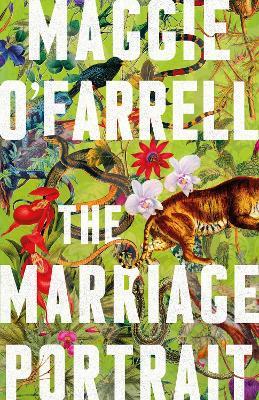
Maggie O’Farrell, The marriage portrait (#BookReview)

I have mentioned Author’s Notes a few times recently, because I have read a few works of historical fiction. Maggie O’Farrell’s latest novel, The marriage portrait, is another historical novel and so here I am again talking Author’s Notes. The marriage portrait, as you probably already know, is based on the life of Lucrezia de’ Medici, who lived from 1545 to 1561. Her death was ascribed at the time to “putrid fever” (or pulmonary tuberculosis). However, very soon after she died, rumours started that she had been poisoned by order of her husband, Alfonso II, Duke of Ferrara. That suspicion inspired English poet Robert Browning to write his dramatic monologue, “My Last Duchess“. It was this poem and a portrait of Lucrezia that inspired the novel.

O’Farrell writes in her Author’s Note that “I have tried to use what little is known about her short life but I have made a few alterations, in the name of fiction” and goes on to explain some of those alternations and why she made them. I have always argued that historical fiction is just that, fiction. We should not read it as history, that is, we should not rely on it for the facts. However, good historical fiction will provide some truths, and we do find some in O’Farrell’s novel.

The marriage portrait is told in two alternating chronological strands, one starting with Lucrezia’s conception in 1544, and the other a day or so before her death in 1561. In these two strands we are given the whole of Lucrezia’s life. We see her growing up as a resourceful, intelligent but needy middle child in a large family where she felt different from her younger and older siblings. Presumably this is O’Farrell’s invention to enhance her isolation. And we see the last year of her marriage: its deterioration as she fails to bear an heir (to a man who went on to marry twice more without issue) and her realisation that he means to kill her. Not surprisingly, we quickly become engaged in Lucrezia and her plight. O’Farrell knows how to tug our heart strings.

“The ladies . . . are forced to follow the whims …” (Boccaccio)

When I read novels, I believe in reading everything, which here included some matter before the story starts. First is a small paragraph headed Historical Note, telling us of Lucrezia’s death and the rumours concerning it. This is followed by two epigraphs, one from Browning’s poem referring to the portrait, and one from Boccaccio’s The decameron which commences with “The ladies . . . are forced to follow the whims, fancies and dictates of their fathers, mothers, brothers and husbands …” Hence some of the aforementioned truths.

I’m not going to spend a lot of time on the novel but, overall, I found it a readable and immersive story about what was a brutal time period, particularly for women and the serving classes. (I use “serving” rather than “servant” to encompass a wider group of people.) There’s nothing particularly new here, but O’Farrell shows very clearly how women and the serving classes were pawns in the political power plays of the time, with little or nothing to protect them except, sometimes, luck – or the courage of another.

There is more, though, to the novel, than politics and power, gender and class. O’Farrell also looks at that aspect of Renaissance life that we all love, art and artists. Admittedly, politics and class have a hand here too, but Lucrezia herself (the fictional one, anyhow) is depicted as a skilled artist, and her work, materials and technique are described in loving detail. It is through her art that Lucrezia most often can assert herself, albeit that assertion must be hidden from others.

I could argue, too, that the novel suggests the way politics and power can destroy love, loyalty and affection between, in this case, marriage partners and siblings. This could be a modern reading of the situation, but I’m not completely averse to us “moderns” understanding the past through our own lens.

As for the writing itself, it’s gorgeously lush, though verges on the overdone at times. Cosimo’s tigress is described as moving “like honey dropping from a spoon”; she doesn’t “so much pace as pour herself, as if her very essence was molten, simmering, like the ooze from a volcano”. Lucrezia’s husband Alfonso is depicted as “an aquatic creature, half man, half fish, crawling up out of the shores of a river, silvered tail glistening in moonlight”. However, despite this, the rich, descriptive writing seemed appropriate for the opulence of the period. And, there is some more restrained, to-the-point writing, such as this introduction of the man whom those versed in historical fiction will recognise as the likely villain:

The man emerges, shoulder first from the branches, the papers still clutched in his hand. He makes his way through the garden but, unlike Alfonso, he doesn’t pick his way along the paths: he walks through the flowerbeds as if they aren’t there, striding over the low green hedges, through the blooms, scattering bees and petals in his wake. Here is a man, Lucrezia thinks, as she eyes his progress, who waits on no one, who lets nothing get in his way.

His name is Leonello, and Lucrezia recognises him for what he is.

O’Farrell is an experienced writer, so the novel is carefully plotted and structured. I enjoyed her use of parallels to foreshadow later actions. The strangling of the guard Contrari, for example, heralds a later strangling, and our tigress is described by Lucrezia as “a creature captured against its will, a creature whose desires have all been disregarded”, which mirrors her own experience later.

The marriage portrait is not a subtle novel, and it does play somewhat with the historical record, as discussed in the Author’s Note. It’s also excruciatingly brutal at times. But, I did become engrossed in the era and invested in Lucrezia’s plight. A moving read. 

Note: This book was my reading group’s April selection, but due to a COVID-risk I did not attend the meeting.

Maggie O’Farrell
The marriage portrait
London: Tinder Press, 2022
438pp.
eISBN: 9781472223869
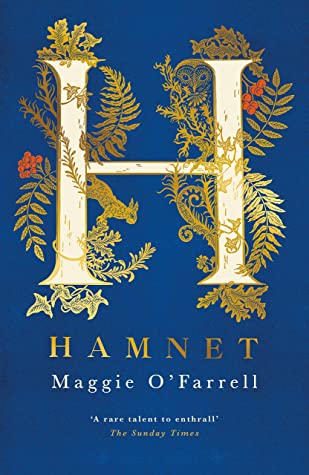
Maggie O’Farrell, Hamnet (#BookReview)

Book cover

Not unusually, I’m late to this book that was all the talk in 2020 – and, I may not have read it at all if it hadn’t been for my reading group. I’m talking, as you will have guessed from the post title, of Maggie O’Farrell’s Hamnet.

As most of you will know, Hamnet’s plot draws from the life of Shakespeare (never named in the novel) and Anne Hathaway, and the death of their son Hamnet at the age of 11. There was an older sister, Susanna, and Hamnet’s twin sister, Judith. O’Farrell explains her interest in her Author’s Note:

Lastly, it is not known why Hamnet Shakespeare died: his burial is listed but not the cause of his death. The Black Death or ‘pestilence’, as it would have been known in the late sixteenth century, is not mentioned once by Shakespeare, in any of his plays or poetry. I have always wondered about this absence and its possible significance; this novel is the result of my idle speculation.

Because this book has been well-covered already online, I’m going to take a slightly different tack with this post, and focus on a couple of questions.

“She herself might tell a different story”

With all books, but particularly with historical fiction, one of my questions is, why did the author choose to write their story. O’Farrell partly answers it in her Author’s note. However, there is also, surely, a feminist reading, because, although the novel is titled Hamnet, it is primarily about his mother Agnes (as Anne is named in Shakespeare’s will). Early in the novel, O’Farrell writes “This is the story, the myth of Agnes’s childhood. She herself might tell a different story”.

The thing is, we don’t know a lot about Agnes Hathaway which makes her ripe for historical fiction. What we do know is that women’s stories were – and too often still are – rarely told, but that that doesn’t mean their lives were unimportant. It means that importance hasn’t been placed on them. Whoever Agnes really was, O’Farrell has created a wonderful, eccentric character, who is perceptive, warm, independently-minded, a little flawed but engaged in the life of her family and community. She is fun to read about.

Besides telling a story about her, though, O’Farrell also presents, through her, a story about grief, and this, for me, was one of the strongest aspects of the novel. Agnes’ thoughts about burying her son, her astonishment that people can complain about their children, her utter discombobulation were so real:

Agnes is not the person she used to be. She is utterly changed. She can recall being someone who felt sure of life and what it would hold for her …

This person is now lost to her for ever. She is someone adrift in her life, who doesn’t recognise it. She is unmoored, at a loss. … Small things undo her. Nothing is certain any more.

So real …

Hamlet?

Warning: Spoiler of sorts

Given the novel is titled for Hamnet, rather than for its main protagonist, Agnes, it’s worth considering why, and this leads us to the play Hamlet. The novel ends with Agnes attending a performance of her husband’s play, which confirms the significance of this play to the novel. The epigraph to the novel’s second part is a quote from Hamlet (V:ii): “Thou livest;/ . . . draw thy breath in pain,/ To tell my story”. But, Hamlet could scarcely be seen to be Hamnet’s story, though I did have a little laugh at the point in the novel where Hamnet chooses to die:

They cannot both live: he sees this and she sees this. There is not enough life, enough air, enough blood for both of them. Perhaps there never was. And if either of them is to live, it must be her. He wills it. He grips the sheet, tight, in both hands. He, Hamnet, decrees it. It shall be.

Eleven-year-old Hamnet seems, here, to be far more decisive than his namesake who is known for his prevarication. This, however, is not what we are expected to take away from the novel I’m sure!

So, what else? Well, there’s the grief theme, which Hamlet can be seen to “resolve” in the novel. Agnes, devastated after her son’s death, can’t understand her husband returning to work – and writing comedies:

His company are having a great success with a new comedy. They took it to the Palace and the word was that the Queen was much diverted by it.

There is a silence. Judith looks from her mother, to her sister, to the letter. 

A comedy? her mother asks.

She is even more devastated though to learn that her husband has gone on to write a play using their son’s name – Hamnet and Hamlet being interchangeable – so she goes to London to confront him. What happens is something else. Initially, she feels eviscerated:

How could he thieve this name, then strip and flense it of all it embodies, discarding the very life it once contained? 

But then, as she sees the ghost father and living son, she starts to see something else:

He has, Agnes sees, done what any father would wish to do, to exchange his child’s suffering for his own, to take his place, to offer himself up in his child’s stead so that the boy might live.

My reading group discussed the question of the play a little, though we didn’t come to any particular conclusion, which I rather like. However, we did talk about how Shakespeare wrote his darkest, strongest plays, including the four great tragedies, after Hamnet’s death, which suggests that his son’s death had a big impact on him. A member also raised the play’s existential nature, seeing it exploring the fragility of life – “to be or not to be” – and how you go on in the face of bleakness.

Now, I could go on and talk about the style (language, use of present tense, symbolism), the decision not to name Shakespeare, and the dual storyline structure, as I normally would, but I’m sure they’ve been discussed elsewhere, so I’m leaving it this time. There were aspects of the novel that I question, but the truth is that I fell for Agnes and her story.

So, I’m going to leave you with two quotes, one from the husband, one from the wife.

It is so tenuous, so fragile, the life of the playhouses. He often thinks that, more than anything, it is like the embroidery on his father’s gloves: only the beautiful shows, only the smallest part, while underneath is a cross-hatching of labour and skill and frustration and sweat. 

Gardens don’t stand still: they are always in flux. 

These relate to their spheres of activity, but they also say something about life, don’t you think?

Maggie O’Farrell
Hamnet
London: Tinder Press, 2020
310pp.
eISBN: 9781472223814