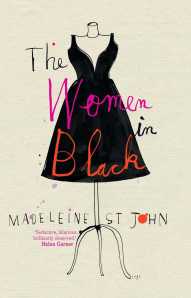
The women in black bookcover (Courtesy: Text Publishing)
One thing mystified me as I started reading Madeleine St John‘s The women in black and that is why she would write a book in 1993 about 1950s? It seemed an odd choice. And then, as I read further, it started to become clear. The time period represents one of those cultural watersheds that nations experience. In this particular case, it was a time of social change: not only were things starting to change for women, but the “reffos” or “Continentals” (as the post-war European refugees were disparagingly called) were beginning to impact Australian culture.
St John chronicles these changes lightly, with warmth and gentle humour, but also with determination. It’s not a coincidence, I think, that St John, born in 1941, would have been around the age of the youngest character, Lisa/Lesley Miles, at the time the book is set.
Hmm … having introduced a character now, I’d better talk briefly about the plot. It centres around the women who work in the Ladies’ Cocktail Frocks and the more exclusive Model Gowns sections of a fictional (but thinly veiled DJs) upper crust department store in Sydney called Goode’s, and takes place over the few weeks before and after Christmas. Model Gowns is staffed by one woman, the Continental or reffo, Magda, while Ladies’ Cocktail is staffed by the middle-aged Miss Jacobs, the 29-year-old almost-on-the-shelf Fay Baines, the 31-year-old married-but-so-far-childless Patty Williams. There is also the buyer Miss Cartwright. Overseeing them all is, of course, a man, Mr Ryder. Into this mix is thrown 17-year-old Lesley (who changes her name to Lisa) Miles, who has just finished her Leaving Certificate.
The story is told in short chapters, each one devoted to one or more of these characters. The tone is (almost conspiratorially) conversational, which invites the reader in. St John draws her characters effectively through brief sections of perfectly caught dialogue and succinct but apt descriptions. The style is witty, with light wordplay and irony. Here are some excerpts from Chapter 2:
Mrs Williams was a little, thin, straw-coloured woman with a worn-out face and a stiff-looking permanent wave. Her husband Frank was a bastard, naturally. [ …]
At the weekends she visited her mother or one of her sisters; Frank drove her there and fetched her, and while she was ‘jaw, jaw, jawing’ he played golf on the public course at Kingsford or drank in the pub. He was a bastard of the standard-issue variety, neither cruel nor violent, merely insensitive and inarticulate.
[…] as she left the surgery, the physician looking idly at her back view thought, she’d clean up quite well with a new hairdo, some paint on her face and a black nightie; but the husband probably wouldn’t notice, the bastard …
By the end of chapter 2 I was hooked. In three and a bit pages we were told all we needed (and probably more than we wanted) to know about poor little Patty Williams and her bastard of a husband. But Patty’s is just one story. There’s also Fay Baines who’s desperate to be married but meets all the wrong men through her well-meaning night club manager friend, Myra; and Lisa Miles who expects to do well in her end-of-school results but whose father thinks women have no business at university. Into this mix are thrown the outgoing, confident (but “god awful” to the women in black) Magda and her also Continental/reffo husband Stefan.
Magda takes an interest in Lisa and invites her home. She also tries a little matchmaking with Fay. Meanwhile, Patty does try that black nightie, with consequences she would never have foreseen. It could all go horribly wrong but, without spoiling anything too much, I’ll simply say that St John’s book follows, loosely and more lightly, the Jane Austen tradition, that is, it’s a comedy of manners. Unlike Austen though, she’s writing in an historical, rather than contemporary, time-frame, and so has a slightly different goal in mind – and that is documenting the social change I mentioned in my opening paragraph.
Two simple examples of this are “kissing” between friends, and food. Here is Lisa on “kissing”:
And she [Magda] kissed her on the cheek. Lisa smiled shyly at her. I’ve heard she thought, that Continentals kiss each other much more than we do: it means nothing. They do it all the time, even the men. The men even kiss each other. But how strange I feel.
This little paragraph struck me; I realised that my friends and I kiss each other in greeting but it was not, I think, the norm among my parents’ generation. In one or two generations, in fact, the often-maligned (in the book and in reality at the time) Continentals had effected quite a change. And then there’s the food. By the end of the book, Lisa, Fay, and even Lisa’s father had tasted and enjoyed such exotic foods as salami. And again I reflected on the immense change in diet from my parents’ to my generation.
I won’t tell you more of the story. It’s a gentle one, but there is a drama concerning Patty, and some little tensions surrounding Fay and Lisa, that keep the book moving while it observes a society in change. There are some perfect descriptions of Sydney, such as this of the women coming to do their last minute Christmas shopping:
From the wooded slopes of the salubrious North Shore to the stuccoed charm of the Eastern Suburbs, from the passé gentility of the Western ditto to the terra incognita of the Southern had they travelled by train, bus, tram and even taxi cab to this scene of final frantic activity.
It’s a book almost of vignettes than of fully realised stories, and there’s the odd clumsy or heavy-handed bit, but St John has nonetheless managed to convey a convincing picture of Australian society at the time, while also telling an engaging and generous tale. And, just to show she has a sense of humour, St John, who was a libertarian at university, injects near the end her own little in-joke. Here is Lisa’s father on the possibility of her going to university:
But I’ll tell you one thing: if I decide you can go, and you do go, if I ever hear of you being mixed up with any of those libertarians they have there, you’re out of this house like a shot and I never want to see you again, is that understood? Right then. If you go, no libertarians, not even one.
I wonder what St John’s father – the prickly politician Edward St John – said to her!
Lisa at ANZLitLovers has also reviewed the book.
Madeleine St John
The women in black
Melbourne: Text Publishing, 2010 (orig. 1993)
234pp.
ISBN: 9781921656798
(Review copy courtesy Text Publishing)


 Whispering Gums