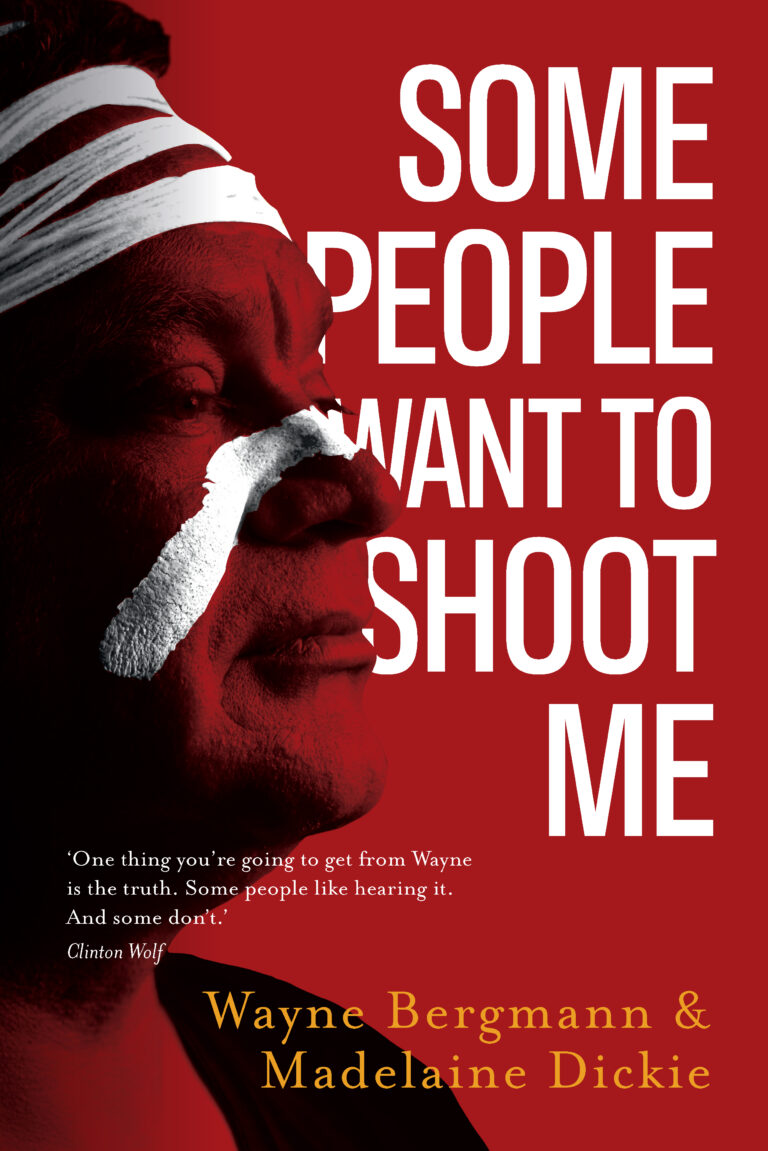
Wayne Bergmann and Madelaine Dickie, Some people want to shoot me (#BookReview)

Having finally read Wayne Bergmann and Madelaine Dickie’s Some people want to shoot me, I am not surprised that it has been shortlisted in the Nonfiction category of this year’s Western Australian Premier’s Book Awards. It is moving; it is clearly written; and it is informative about big issues. Wayne Bergmann is a Nyikina* man and Madelaine Dickie a kartiya (white) woman, making this one of those collaborative novels I wrote about recently.

Before I continue, a little on its form. This is a work of nonfiction. It is essentially memoir, written in third person by Bergmann and his collaborator, Dickie. And, being a memoir, it has a specific focus. In this case, it is one underpinned by a powerful sociopolitical message concerning the right of First Nations people to survive and prosper on their own land.

“walking in two worlds”

So … Some people want to shoot me is about a man who realised he must walk in two ways – the kartiya way and the old people’s way, that is the white way and the way of his traditional culture. For his heart and soul he needed to walk the traditional ways, but in his head, seeing the suffering and the social and economic dysfunction caused by dispossession and powerlessness, he had to walk the kartiya way. The book exposes just what a tough balancing act this was – and is. It demanded (demands) strength, bravery, nous, clarity of purpose – and the support of family.

The book opens with a Prologue which sets the scene. It’s 2011 and Bergmann, who is at breaking point after years of negotiating on behalf of Kimberley Traditional Owners, walks out of a meeting with a mining company and heads, with his wife and children, back to country:

to the mighty Martuwarra, the Fitzroy River – lifeblood of Nyikina country, Wayne’s country, his children’s country – made by Woonyoomboo when the world was soft.

From here, the book starts in Chapter 1 the way memoirs usually do – at the beginning. For Bergmann, the beginning is Woonyoomboo who tasked the Nyikina people to look after country. This they did, until the arrival of white settlers in the late 19th century, when things “radically changed”. The first two chapters chronicle some of this change through the lives of Bergmann’s forbears. It depicts a world where the legacy of nuns, monks, ethnographers, pastoralists and miners “was still felt acutely”, where “frontier massacres had occurred within living memory”, and “where justice, under whitefella law, didn’t often grace Kimberly Aboriginal People”. Bergmann, who was born in 1969, saw this, felt this, and took on the pastoralists, mining companies and governments to “upend the status quo”.

Of course, such upending doesn’t come easily, and the people doing this upending aren’t always understood and appreciated, which is where we came in at the Prologue. The book details, chronologically, Bergmann’s work, from his early work with the KALACC (Kimberley Aboriginal Law and Culture Centre) and his realisation that for Aboriginal people to be empowered under Western law and able to make systemic changes, “they needed to understand the kartiyas’ law system inside out”. So, he did a law degree, and then, at the age of 33, became CEO of KLC (Kimberley Land Council) and here is where the really hard work started, and it was not pretty. It demanded every ounce of energy, intelligence and resilience, he could muster.

Bergmann had to be clear about the role, which was, as a native title representative body, “to facilitate a process and follow procedure in accordance with native law to allow Traditional Owners (TOs)” to make decisions “about their country”. This meant consulting with the TOs and ensuring they understood what they were being asked for and what was being offered. When stakes are high, emotions also run high. Some environmentalists, for example, would turn against TOs (and thus the KLC) when their views diverged, but sometimes TOs believed that some development was advantageous to their people. Then, of course, there were times TOs didn’t agreed with each other, or when there was disagreement between TOs and others in their communities. This is to be expected, of course. Do all kartiyas agree? But, it makes for very difficult times, and Bergmann was at the centre. As well as working with the relevant Kimberley TOs, Bergmann was also negotiating with the Western Australian government and, for example, the Woodside mining company, negotiating not only the actual agreements, but for money and resources to carry out consultations so that the TOs could come to the table well informed. All this is explained clearly in the book, making it well worth reading for anyone who has not followed native title cases closely. It’s both enlightening and chastening.

Bergmann made some significant deals, but it was a bruising time, so after a decade, wiser and with a clear view ahead, he moved on to establish KRED Enterprises. A charitable business, wth the tagline of “walking in two worlds”, its aim was (and is) to support cohesive Aboriginal economic development in the Kimberley, to encourage businesses run by and for Aboriginal people. The rest of the book covers Bergmann’s work – under the KRED umbrella and in other areas (including buying a newspaper, the National Indigenous Times) – all focused on the one goal, to pull his people out of poverty and disadvantage, to ensure they have the opportunities available to all Australians, and in so doing to improve their lives and outcomes. Nothing less will do.

We had to create some wealthy Aboriginal organisations, and wealthy Aboriginal people, so we could shape our own future, on our own country.

Woven through the accounts of Bergmann’s work are stories about his personal life, some good times but also the egregious attacks his wife and children faced at the height of his KLC work. We come to see the truth of Dickie’s description of him in her Introduction, as “demanding, smart, intensely political and visionary”. This is a man who puts himself on the line because he is driven to see First Nations Australians prosper.

Some people want to shoot me packs a lot into its 223 pages. That it covers so much, with great clarity and readability, is due to the writing. It’s well structured, and employs some narrative techniques, including evocative chapter titles and the occasional foreshadowing, which keep the story moving. At the end of the book is an extensive list of Works Cited and a Select Bibliography, which provide authority for what has gone before, if you need it.

Meanwhile, here are some words by another First Nations leader, Clinton Wolf:

One thing you’re going to get from Wayne is the truth. Some people like hearing it. And some don’t.

This book tells Wayne’s story, and I did like hearing it. It’s a great read about a great Australian, telling truths we all need to hear.

* First Nations cultures are orally-based, which results in inconsistent spellings when their languages are written. This post uses the spellings that Bergmann and Dickie use in their book.

Wayne Bergmann and Madelaine Dickie
Some people want to shoot me
North Fremantle: Fremantle Press, 2024
223pp.
ISBN: 9781760992378
Delicious descriptions: Madelaine Dickie on Indigenous language and Uranium

Book coverMy recent post on Madelaine Dickie’s Red can origami was getting too long – and I just couldn’t cover in detail all that I wanted to, so I’ve decided to do one of my rare Delicious Descriptions posts to expand some ideas from the book.

Concluding my post, I commented that the novel is an effective consciousness-raiser as well as a great read. One of the many points Dickie makes concerns the intrinsic significance of language to cultural identity. (This issue, in fact, was discussed much during last year’s International Year of Indigenous Languages.) Here is Dickie in Red can origami (and do note the second person style – “you’re invited to sit …”):

You’re invited to sit in on a Burrika language session at Gubinge District High. It’s the first week of term one and the session’s being funded through the community benefits package. The language teacher is fishing-club-Keith’s wife Kylie, an intimidating, bearded old girl, with a deep wrinkle line between her eye. She stands in front of a class of teenagers. She explains that in Burrika, there are six words to describe anger, four words to describe jealousing and that there’s even a word for someone who’s a serial liar. Here, she looks pointedly at a young woman wearing heavy eyeliner. Then she says some people think the Burrika language is only used to describe things like berries and barramundi. Here, she looks pointedly at you.

Language comes from country, she tells the kids. Language comes from the rocks, the desert waterholes, from the creeks that twist through the mangroves. Language comes from the sky. When you don’t know your language, you can’t tell country you are coming, and you can’t look after your country. (p. 195)

With Indigenous language revival programs popping up around the country, some of which I’ve mentioned in my blog, Dickie was spot on to make this point in her book.

The issue of uranium mining and its potential for problems, if not disaster, underpins the novel’s plot. It also provides a good example of how Dickie teases out different attitudes from the various stakeholders – the Indigenous people, protesters, the people of Gubinge, the mining company employees, and Ava herself as she navigates spin versus facts and reality. And as Ava ponders the issue, the second person voice brings us on her journey with her. Whenever we hear “you”, there’s that little initial reaction, “who, me?” Anyhow, Burrika leader Noah patiently tells a radio presenter,

No-one wants to see a uranium mine on their country. Not the mob at Jabiluka, not the mob in South Australia, and not the people in Gubinge. But when you’re under duress, when you are given a choice between something and nothing, you choose something.

These are the sorts of real-world challenges that are posed by the novel.

At the book’s launch, Dickie referred to Japan’s involvement in uranium mining in Australia, and mentioned the Fukushima disaster. She quoted from the letter written in 2011 by Yvonne Margarula of Kakadu’s Mirarr people to UN Secretary General Ban Ki Moon concerning the Fukushima disaster:

Given the long history between Japanese nuclear companies and Australian uranium miners, it is likely that the radiation problems at Fukushima are, at least in part, fuelled by uranium derived from our traditional lands. This makes us feel very sad.

The sense of extended community responsibility expressed in this letter is surely something we could all learn from – and this, I’m sure, is what Dickie hopes her book will encourage its readers to consider.

Madelaine Dickie, Red can origami, Fremantle Press, 2019.

Madelaine Dickie, Red can origami (#BookReview)

Book coverSome writers, I understand, suffer from a thing called “second novel syndrome”, which describes the fear of writing a second novel after a successful first one. Well, it’s clear that Madelaine Dickie, who won the TAG Hungerford with her first novel Troppo (my review), hasn’t suffered from this particular disorder, because her second novel, Red can origami, is not only another good read but it presents as a confident work from an author who knows exactly what she wants to do.

A confident work

Let’s start with the plot. Red can origami is set primarily in a town in Australia’s north-west called Gubinge, to which Melbourne-based journalist Ava has gone for a job as a reporter. Fairly soon, though, she is offered a significantly better paid job as an Aboriginal Liaison Officer by the Japanese uranium mining company, Gerro Blue, who wants someone to help them negotiate an exploration licence with the local native title owners. Already you can see, I’m sure, some red flags, because this plot is going to require Dickie to create Indigenous Australian characters and, thus, to speak for them. This, of course, raises once again that thorny question of who can write what.

Now, I attended this novel’s New South Wales launch at the south coast just before Christmas (and just before the bushfire situation got out of control). I hadn’t met Dickie before, but her mother-in-law, who held the launch, is a good friend and one of my reading group’s original members. Dickie gave a wonderful speech in which she addressed this question head-on. She quoted Anita Heiss’s statement that the Australian novel needs to be inclusive; she reminded us that there were many Indigenous writers, like Alexis Wright in Carpentaria and Tara June Winch in The yield, who are telling their stories well; and she quoted non-Indigenous author Stephen Hawke who writes Indigenous characters and argues that you need to write well and be respectful. In addition, she, who has lived in the Kimberleys where the novel is set, described some of the work she’s done in recent years for traditional owners, including going “on country with old people”. Her arguments and credentials seem fair enough to me – though of course, in the end, it’s up to each reader, Indigenous and non-Indigenous, to decide for themselves.

The other point I want to make about the confidence of this work is its voice, because it is told second person. This too Dickie confronted in her speech. She was leaving no stone of potential contention unturned. I was impressed. Anyhow, essentially, she said that she’d tried writing it third person but it flowed better when she switched to second. That was her writerly judgement – and certainly I found it easy to read. However, she also had a political reason for this choice, and it’s this, she wanted to involve if not implicate the reader in what’s happening. Second person does this very effectively – at least it does in this book. I won’t spoil the ending, but I’ll just say that the second person voice makes the last line an inspired one.

About the book

So now, I’ve talked a lot around the book, but not a lot about it. Another thing Dickie said in her speech was that she wanted the book to be a page-turner – and that it is. The novel moves at a good pace, as did Troppo, and covers a lot of ground in its 220 pages. It starts with Ava arriving in town and building up a little band of both Indigenous and non-Indigenous friends and aquaintances. These characters include Lucia, an Indigenous reporter on the same paper as she; Ash, a non-Indigenous local TAFE lecturer who is soon attracted to Ava, and who shows her the ropes, taking her fishing and to the local bars in particular; and Noah, an Indigenous station-manager and local Indigenous leader, to whom Ava is attracted. Ava quickly falls in love with the land and the life of the Kimberleys, but equally quickly she becomes aware of local politics – and, with her reporter’s eyes, she notices some suss things going on. Is Gerro Blue already working on the land they haven’t yet obtained the licence to do? What are those bones they’ve disturbed?

It is in this environment that Ava, who has already shown sympathy towards the Indigenous owners, is wooed by Gerro Blue’s smooth CEO, Yuma Watanabe, to be their Aboriginal Liaison Officer. If there is a plot fault in the novel, it could be this – why would she take such a job – but Dickie makes us believe. Not only is Watanabe a shrewd employer, but Ava genuinely, albeit uncertainly, believes she can help the local Burrika people. After all, she thinks, “better you, with your olive-green heart, than someone else”. However, she also admits that being paid real money rather than a reporter’s salary, would set her up. She is, then, a real or flawed character, just as we like our characters to be.

As the book progresses, conflict increases. The traditional owners disagree over whether to grant Gerro Blue the licence, particularly given it’s for uranium mining, with all its implications. (Dickie has specifically set her novel around 2011, the year of the Fukushima disaster.) They don’t all trust Ava either. Protesters, from within and without the Indigenous community, make their own waves. Dickie navigates well this tricky, but real – and not at all unusual – situation in native title negotiations. She clearly knows whereof she speaks. Anyhow, while all this is going on, Ash is keeping an eye out for Ava, while Ava is keeping her eye on Noah. It all, of course, comes to a head, with a powerful ending that is entirely appropriate to the story being told.

And then there’s the writing. This is a novel written in the voice of a young woman living in remote Australia. The voice is, thus, earthy, but also fresh and authentic. Dickie’s writing is expressive, and has been pared to the essential, which is not the same as saying it is bare and plain. It is anything but. Here is Ava describing her sophisticated Melbourne sister:

Imogen’s voice is all sparks. It holds the drunken sequin shine of a Melbourne night.

And here a boab tree in Perth, far from its home (like Ava):

The boab’s bark is cracked, its leaves are withered, and its roots strain from the soil, as if it’s planning on splitting town, hitching north.

So, Red can origami is a good read, as Dickie intended, but it also has an underlying purpose. Dickie is passionate about northwest Australia, and about the challenges faced by Indigenous Australians – and she wants all Australians to understand this better. Red can origami sits within that contemporary literature space comprising works which explore Indigenous and non-Indigenous Australian relationships and interactions. Like Lucashenko’s Too much lip, and similar novels, Red can origami works beautifully as a consciousness-raiser, because it wraps authentic situations and issues in an engaging, page-turning story. In doing so, it teaches us about the beauty of northwest Australia, about the complexities of native title legislation and practice, about the nastiness that happens when politics and business get together, about direct and indirect racism, about dispossession, and, above all, about the diversity of human beings and the challenges we face in getting along together. A book for now.

Lisa (ANZLitLovers) was also impressed by the book, and teases out some different angles.

Challenge logoMadelaine Dickie
Red can origami
Fremantle: Fremantle Press, 2019
221pp.
ISBN: 9781925815504

Madelaine Dickie, Troppo (Review)

Madelaine Dickie, Troppo“Write what you know” is the advice commonly given to writers, and this is exactly what Madelaine Dickie has done in her debut novel, Troppo, which won the City of Fremantle TAG Hungerford Award. For readers, on the other hand, the opposite could be true, as in “read what you don’t know.” This is certainly what I’ve done by reading Dickie’s novel because I’ve barely travelled in southeast Asia, where the novel is set, and all I know about that risky business of surfing, which frames the novel, comes from Tim Winton’s Breath (my review).

So, where to start? Well, to begin with, it’s a while since I’ve read what I might call a “youth culture” novel. I’ve read novels by young authors, such as Hannah Kent’s Burial rites (my review), Brooke Davis’ Lost & found (my review) and Tara June Winch’s Swallow the air (my review), but these novels have different drivers. One is historical fiction, one was inspired by grief over a mother’s death, and the other explores indigenous identity issues. The closest to Troppo that I can recollect reading is Andrew O’Connor’s The Australian/Vogel Award-winning Tuvalu, about a young Australian teaching English in Japan, but I read that long before blogging.

I say all this to give Troppo a context – a sort of sub-genre, if you will – of young writers writing about a young person’s experience of the world, an experience that is post-coming-of-age but encompasses a degree of uncertainty about one’s place. I don’t intend this to mean, though, that the novel is autobiographical. While it obviously draws on Dickie’s knowledge of southeast Asia and surfing, for example, I wouldn’t presume to say protagonist Penny is she. Indeed, in an interview on the publisher’s website, Dickie says that:

Some of the anecdotes are almost true, certainly stemming from my own experiences as a traveller and surfer … The texture of Troppo is also very true, the intoxicating smell of kretek cigarettes, the nights bleary on Bintang beer, and the way the call to prayer from the mosques drift down through mountain valleys.

Further, “the characters are entirely fictional”, she says, as is the setting, Batu Batur.

But now, preamble done, let’s get to the book. Set in southwest coastal Sumatra, it starts a couple of months after the bombing of the Australian Embassy in Jakarta in September 2004 and ends just after the tsunami hit Aceh on 26 December 2004. Penny, around 22 years old, had lived in Indonesia as a teen, but is returning to have “a break” from her significantly older boyfriend Josh. She has lined up a job on a surfing resort run by expat Shane, but arrives early to have a holiday. That’s the set up. The novel then explores the personal and political relationships that develop (or pre-exist) between the locals and the expat community, and within the expat community itself, in a tense situation where corruption and bullying is rife, and fundamentalist Islam is on the rise, threatening a culture that has traditionally accommodated different values and beliefs.

Troppo is a good read that gets you in quickly. Its fresh, lively but also reflective, first-person voice is engaging, and the various supporting characters are well-drawn. They include Ibu Ayu, the manager of the tourist bungalows where Penny stays in the beginning; young Cahyati, her niece; Penny’s soon-to-be-boss, Shane; and the “hot” but somewhat mysterious expat Matt. We soon sense mystery, with the locals not liking Shane, and the expats suggesting he won’t be around much longer. There’s a thriller element to the novel, but it’s not “just” thriller.

The novel’s over-riding concern is Penny’s uncertainty about her life. She’s not sure, exactly, why she’s fled Josh (except that his routine stultifies her), or why she’s “always jerked along by whim and the conviction there’s something better just ahead”. And yet, we readers know why, just as Belle in Disney’s (original and recently remade) Beauty and the Beast does!

I want much more than this provincial life,
I want adventure in the great wide somewhere.
(lyrics by Howard Ashman)

It’s not our culture (Matt)

In addition to the personal, however, the novel also explores social and political themes. One concerns tourists and cultural differences, expats and First World guilt. Penny sees “men whose bodies are halved over new rice” and “old women buckled under bundles of sticks” while she and friends are “off to surf, off to play and play and play, for months if we want.” It’s two-edged of course: the tourists bring money but their lives can inspire resentment.

Another theme concerns changing politics in Indonesia. When asked in the interview (linked above) about the novel’s timing, Dickie responded that:

Troppo is set two years after the Bali bombings, a year after the bombing outside the JW Marriott Hotel, and two months after the bombing of the Australian embassy in Jakarta. This context is important for Troppo, as some of the themes explored are the rise of fundamental Islam and the coexistence of Islam and traditional beliefs. … I was also aware of the two dimensional depictions of Islam in the media, and wanted to create rounded characters and discussions based on some of the stickier topics I liked to discuss with my Muslim friends. Has the relationship changed? Of course, things are always in a state of flux. However, our news media is now less concerned with Jemaah Islamiyah, and more concerned with the rise of Islamic State, which no one had heard of ten years ago. So the shape of fundamental Islam has also changed.

This theme pervades the novel through a growing sense of menace, not only against the corrupt expat, Shane, but against the “bule” (foreigner) in general. Moreover, Marika, a young New Zealander who runs an internet cafe, tells Penny that “the vibe has changed”, Matt tells her “there are bigger issues at play”, and locals in a bar tell her of imams “only wanting mosques, not churches”. Dickie handles this well. Suspense builds slowly – in fits and starts – and the plotting is sure. The crisis, when it comes, is swift but believable because the groundwork has been done.

Overall, in fact, Dickie proves to be a skilled writer. The novel feels tight and honed. Sometimes first-time novelists can overdo imagery, but Dickie keeps it under control, mixing up evocative descriptions with dialogue and action. It’s the lovely little descriptions that pop out of nowhere which delight the most, like this of a middle-aged expat’s hands being “like sea-creatures that have been left out on the sand. Dried out and peppered with sunspots”. Or this, “The night is young. The mozzie coil has only just begun its inward inch.”

Dickie also handles well that challenge of writing a story about a place whose language is different from her own. Her strategy is to sometimes translate Indonesian words and phrases, but other times to let the context make it clear. This can be an effective approach, and Dickie makes it work, using enough local language to convey place, but not enough to stall our reading.

Partway through the book, Penny says that “Risk always makes things sharper, throws into contrast the highs and lows, gives clarity”. Troppo, in the end, is about this. Yes, it comments on tourist and expat life, and yes, it exposes the beginnings of a dark political underbelly in the region, but the main point, really, is the personal. Penny recognises by the end that she is “living, by choice, on a fault line”. She finds living in “extreme places, among extreme people”, “intoxicating”. The challenge, I’d say, is how to live such a life authentically and respectfully. I’d love to see Dickie explore this theme further.

aww2017 badge

Madelaine Dickie
Troppo
Fremantle: Fremantle Press, 2016
263pp.
ISBN: 9781925163803

DISCLOSURE: I have not met Madelaine Dickie, but her fiancé is the son of one of the founding members of my bookgroup (not to mention of my now long-past playgroup and babysitting groups).