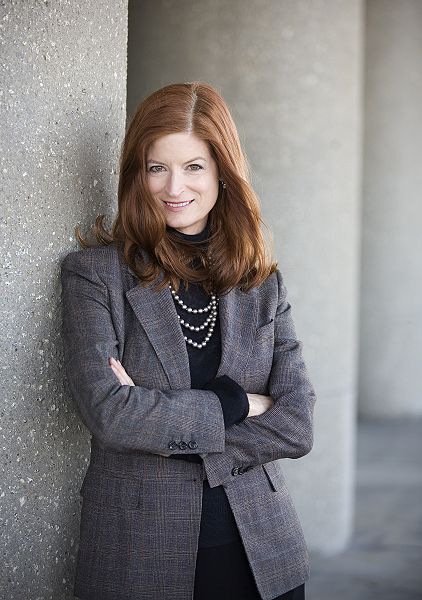
Louann Brizendine, 2009 (Image: Andy Feinberg released into the Public Domain, via Wikipedia)
Beware – the F-word is coming! Yes, Feminism. It might be a dirty word in some quarters, but I regard myself as a feminist – 1970s style – and so I approached Brizendine’s best-selling book, The female brain, with my cautionary antennae out. It’s not the sort of book I would necessarily have chosen myself but it was a bookgroup read and my number one reading priority is my bookgroup’s schedule. And, really, I’m glad I read it because it is good to keep up with the various arguments and debates going on.
The way I see it – and it’s pretty obvious really – the influences on our behaviour are threefold:
- biological/biochemical
- genetic
- environmental/social
The BIG question is, then, in what proportion do these play out in our lives? Clearly men and women are not the same – you just have to look at us to see that – but as a young woman I believed that environmental factors were the strongest in determining the course of women’s lives. And I still think that’s largely the case. Environmental (or socio-cultural) factors may not necessarily be the determining factors in our individual behaviours but I believe they still do play a major role in the trajectory of women’s lives. As I’m sure they do for men too – but I believe that women still tend to draw the shortest straw.
And yet, there’s a niggle. Statistics – and the obvious evidence around us – show that the proportion of women in leadership roles, for example, in boardrooms, in politics, and so on, is way below what would be pro rata. Why is this? Is it the glass ceiling? Or, is there something else going on? Brizandine suggests women have “superior brain wiring for communication and emotional tones”. Does this discourage us from seeking these leadership roles which, in our current western capitalistic environment at least, tend to be adversarial if not downright aggressive. And then, the thinking and the niggles get murkier. What happens in non-western-capitalist societies? And in indigenous societies? In these (with some notable matriarchal exceptions), women also tend not to be the leaders. Why? Is human society inherently adversarial and aggressive – or is it just that men have made it so. If the latter, can women – with their superior emotional wiring! – change the nature of society? You see, what happens? Round and round in circles.
And this brings me back to Brizendine, neuropsychiatrist and founder of the Director of the Women’s Mood & Hormone Clinic (which rather suggests where she is coming from). Her book focuses pretty much exclusively on biology. The backcover blurb describes the book in these terms: Brizendine “reveals how the uniquely flexible structure of the female brain determines not only how women think and what they value, but how they communicate and whom they will love”. It’s all in the biology you see! We are “programmed” to seek out the most symmetrical (yes, really, or so she says) good-looking male because it is all about reproduction of the species. Occasionally she qualifies her statements, such as “Humans are not quite so biologically determined [as Syrian hamsters, for example!]” (p. 132) but the qualifications are minor and infrequent.
It all reads a little simplistically. Like any good non-fiction work, the book is comprehensively referenced with 23 pages of citations/notes and nearly 80 pages of references. However, she herself agrees that it is difficult to properly research the workings of the brain and so many of her arguments are made using either anecdotes, drawing conclusions from the animal world, or based on one-off studies. I don’t have the resources to check all her citations but the Nature magazine reviewer found them wanting in terms of “scientific accuracy and balance”*. A quick search of the ‘net brings up counter arguments, such as those of Insitut Pasteur neurologist Catherine Vidal, who states that “the differences [in brain development] between individuals of one and the same gender are so great as to outweigh any differences between the genders”. And regarding male versus female test results in, say, mathematics, she says that the main factor is socio-cultural:
The second study, conducted last year with a sample of 300,000 in 40 countries, showed that the current socio-cultural environment is conducive to gender equality. ‘More girls are getting good test scores in maths,’ Dr Vidal highlighted. ‘In Norway and Sweden, the results are comparable, and in Iceland, the girls beat the boys.’ It should be noted, however, that the boys beat the girls in Korea and Turkey.
Of course, she’s talking more about intellectual/academic skills/achievement rather than behaviour which is more Brizandine’s focus – but it serves nonetheless to sound a warning about ascribing causes too simply.
I’m late reading this book which apparently caused quite a flurry when it was published in 2006. I’ll end with Deborah Tannen’s conclusion to her review in the Washington Post (2006):
Paleontologist Stephen Jay Gould once said he despaired of the constant question “Is it nature or nurture?” because “biology and environment are inextricably linked.” Ideally, readers will sift through the case studies, research findings and scientific conjectures gathered in this non-technical book and be intrigued by some while questioning others, bearing in mind the caution that hormones and brain structure play a role in gender differences but are not the whole story. And if this book joins a “nature” chorus that has swelled as a corrective to the previous pendulum swing toward “nurture,” we can assume that another corrective will follow. But given the character — and rancor — of our dichotomous approach to the influences of biology and culture, readers likely will be fascinated or angered, convinced or skeptical, according to the positions they have staked out already. That would be a pity.
Fair enough … and meanwhile, for me, the bottom-line remains: regardless of how similar or different we are, and why, all humans deserve to be respected and treated equally regardless of gender, race or religion.
*Nature, Vol. 443, 12 October 2006.
Louann Brizendine
The female brain
London: Bantam Books, 2007 (First pub. 2006)
352pp.
ISBN: 9780553818499
 Whispering Gums