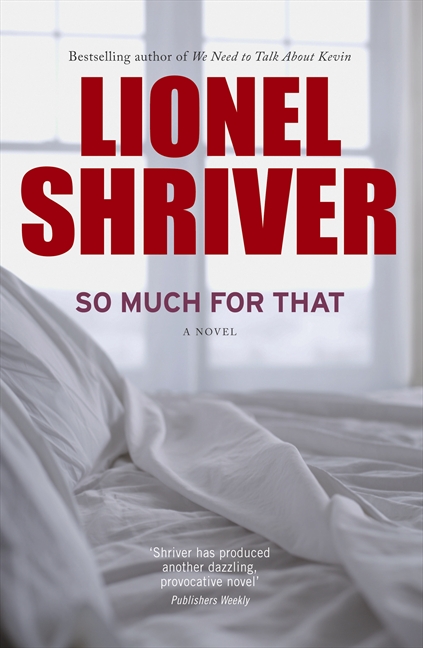
Book cover (Courtesy: HarperCollins Australia)
Having had my own rather traumatic experience of the American healthcare system back in the 1980s I was rather keen to read Lionel Shriver‘s latest offering, So much for that. And, I wasn’t disappointed – or, let me rephrase that, I found it an interesting and engaging page-turner though not a top-ten-of-the-year one.
First a quick plot summary. The book starts with 48-year-old nice-guy Shep Knacker planning to escape the American rat-race to his dreamed of, and as it turns out ironically named, AfterLife in Pemba off Zanzibar. Unfortunately, his plans turn sour with his wife’s announcement that she has a rare aggressive cancer called peritoneal mesothelioma and will need him to continue working, for his health insurance. Paralleling Shep and Glynis’ experience of health service and insurance – and told in roughly alternating chapters – is that of their good friends Jackson and Carol whose 16-year-old daughter, Flicka, was born with the degenerative disease, familial dysautonomia.
So, at the start we have a terminal cancer diagnosis and a child with a disease that is not likely to see her making old bones. Through the course of the novel, two more health issues are thrown in to round out the mix – aged care for Shep’s father after he falls and breaks his femur, and elective shall-we-say “vanity” surgery undertaken with disastrous results by Jackson. This all felt a little contrived to me – as did the occasional preachy dialogue that seemed to be there to make sure we got it. (Shriver is not a taker-outer I think!)
But, somehow, Shriver made it all work – right through to the rather surprising and, thus, risky ending. I liked the fact that she balanced the health care polemics with some wider issues such as the psychology and language of illness and the soul-destroying nature of the American (in particular) rat-race. And I liked the way she offset the plot and structural contrivances with a warm but unsentimental regard for her characters. Glynis and Flicka are not “pin-up” patients but “real” people who are angry with their lot and exhibit selfishness and petulance more often than meek forbearance. Glynis, like the character in Helen Garner‘s The spare room, is in denial about her fate pretty much to the end, and Flicka sees little value in living the sort of life she does. Both consequently feel little need to make it easier for those around them.
Most of Shep’s chapters commence with a statement of his net worth, which at the beginning of the novel is around $730K but which decreases with alarming rapidity as the months wear on and his poor insurance cover doesn’t begin to meet the costs of Glynis’ treatment. If you knew nothing before about co-payments, deductibles, co-insurers, out-of-network providers and lifetime payment caps, you’ll know all about them by the time you finish the book. (Apparently the most common cause of personal bankruptcy in the USA is medical debt.) But this is just the background – the polemics if you will – because the more interesting story is that of Shep and Glynis’ complicated but loving relationship, and of how friends and family react to the diagnosis. We feel Shep’s pain as he realises “he couldn’t fix things”. We understand Glynis’ eventual epiphany that “her husband had misguidedly hoarded his pennies, when the only currency they spent that had ever counted was time”. We cringe when we recognise ourselves in the friends who don’t visit often enough, who offer lip-service assistance rather than actual help. And we start to understand the real implications of cancer-speak that encourages an unrealistic belief in positive thinking, that suggests you can win the battle if you fight hard enough:
I know you mean well [says Shep to the oncologist], but after all this military talk she now equates – dying – with dishonor. With failure. With personal failure.
Near the end Shep asks the doctor what the $2 million spent on Glynis’ treatment (to date) had bought:
“Oh, I bet we’ve probably extended her life a good three months.”
“No, I’m sorry, Dr Goldman,” Shep said on the way out. “They were not a good three months”.
… leaving the real question, which Shep had previously asked his father, hanging:
“is there also a limit to how much you should pay to keep any one person alive?”
Lionel Shriver does not specifically answer this question in the novel but – despite the ending – you know exactly what she thinks.
There is more I could say about the novel. The story of Jackson and Carol, for example, offers the book more than a simple confirming parallel. There are some genuinely funny moments, particularly those between Shep and his free-loading sister Beryl, and those when Jackson pronounces yet another long-winded title for the book on “mugs and moochers” that he never will write. And there are some interesting discussions about art and artists, and about parenting in modern USA. But I’ve said enough I think to give a sense of what this book is about.
Shep says at the end that he’d “rather live a good story than read one”. I’ll leave you to ponder the implications of a novelist writing that line … and simply say that while this is not a perfect novel, I don’t begrudge having given up a bit of my good life to read it!
Lionel Shriver
So much for that
Sydney: Fourth Estate, 2010
433pp.
ISBN: 9780732287030
 Whispering Gums