
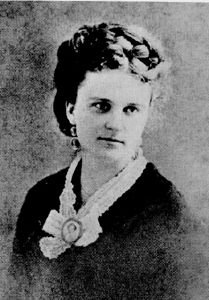
Edith Wharton (Presumed Public Domain via Wikipedia)
I am a fan of Edith Wharton and have read around seven of her novels, some of which are part of my personal canon. However, I have only read a couple of her short stories, and she wrote quite a few of those too. In fact, she was a prolific writer. And so, when last week’s Library of America story turned out to be one of hers, I decided to read it.
“A journey” was written, according the brief introductory notes, in the 1890s when Wharton was in her late 20s to early 30s. It was written during the time when she was married – unhappily – to Edward Wharton, from whom she was eventually divorced in 1913. The notes say that three of the stories written during the 1890s explore marital misery, and that the journey in this story “becomes a metaphor for an unhappy marriage”.
That could be so, but let’s get to the story. It describes a train journey in which a young woman is accompanying her terminally ill husband back to their home in the East after having spent some time, under doctor’s orders, in Colorado. The story starts with:
As she lay in her berth, staring at the shadows overhead, the rush of wheels was in her brain, driving her deeper and deeper into circles of wakeful lucidity. The sleeping car had sunk into its night silence. Through the wet window-pane she watched the sudden lights, the long stretches of hurrying blackness …
The next paragraph briefly chronicles their short marriage and the sudden disparity between them as his health collapses:
a year ago their pulses had beat to one robust measure; both had the same prodigal confidence in an exhaustless future. Now their energies no longer kept step …
And then here is the entire third paragraph:
When they married, she had such arrears of living to make up: her days had been as bare as the white-washed school-room where she forced innutritious facts upon reluctant children. His coming had broken in on the slumber of circumstance, widening the present till it became the encloser of remotest chances. But imperceptibly the horizon narrowed. Life had a grudge against her: she was never to be allowed to spread her wings.
Oh dear … methinks the note-makers at the Library of America are right. It’s not what is said so much as what is not said and how what is said is said. What is not said is anything about true love and empathy (though we are told in the fourth paragraph that “she still loved him of course”). In other words, there is no sense of the looming tragedy of the loss of a soul-mate. As for how it is all said, the language is heavy and gloomy. It’s clearly raining, and there are “shadows” and the “hurrying blackness” (a metaphor, presumably, for his coming death, as well as being a literal description of night). The paragraph describing his appearance in her life and their marriage is not exactly joyful either. The focus here is more on where she’d been, so the language is negative (“arrears”, “slumber”). And even the description of the possibilities opening up to her through marriage – “the encloser of remotest chances” – is not what you’d call expansive. No wonder she thinks life has a “grudge against her”. I would too.
The rest of the story is about a rather self-focused young woman. She goes through the motions of caring for her husband – and occasionally “warm gushes of pity [not “sympathy” or “love”, note!] swept away her instinctive resentment of his condition” – but her thoughts are all for herself. Here is her reaction to being in Colorado:
Nobody knew about her, or cared about her; there was no one to wonder at the good match she had made, or to envy the new dresses …
This is early Wharton. The hallmarks of her writing style are here – the careful choice of words to convey meaning that may be opposite to what’s expected, the development of character through those words, the build up of atmosphere and tension through a well-sustained tone – but it doesn’t quite have the tightness and singularity of purpose of her later works. We don’t get to understand the young woman well enough to be able to respond to her on anything more than a superficial level. I suspect that Wharton would want us to extend her some sympathy but I think we are more likely to see her as a little pathetic, and we really know almost nothing about the husband (except that he had been “strong, active, gently masterful”) so our reaction to his predicament is more intellectual than emotional.
As the journey proceeds, our heroine is faced with a moral dilemma, but she doesn’t take full responsibility for what is happening: “it seemed to be life that was sweeping her on with headlong inexorable force – sweeping her into darkness and terror”. The story, in fact, takes on some elements of horror fiction but that is not its intent and it doesn’t develop along those lines.
I particularly like Wharton when she tackles the intersection between societal expectations and character. This story has glimmers of that – but it’s not really elaborated. Nonetheless, it’s a good story that grabs you from the start with its oppressive atmosphere and foreboding tone. Even early Wharton, I’ve found, has much to offer her readers.
Edith Wharton
“A journey”
The Library of America
Originally published in a collection in 1899?
Available: Online
Note: Stef at So many books has recently reviewed Hermione Lee‘s biography of Wharton, and Kevin at Interpolations has extensively reviewed some of her novels.




 Whispering Gums