Regular readers here may be surprised to see this subject for a Monday Musings given I’m not known as a crime aficionado, but never let it be said that I’m not open-minded. I came across June Wright last year in my role as convener of the Literary and Classics area of the Australian Women Writers Challenge, and was reminded of her again when I wrote my 2015 wrap-up for the challenge. It occurred to me then that she was worth introducing to you!
Dorothy June Wright, née Healy, was born in 1919, and died only recently in 2012. She wrote six crime novels in the middle of the twentieth century. According to the Sydney Morning Herald‘s obituary, she was born in Melbourne, and went to school at Kildara Brigidine and Vaucluse convents, Loreto (in Adelaide), and Mandeville Hall (in Toorak). She worked from 1939 to 1941 as a telephonist at Melbourne’s central exchange – a significant fact as you will soon see – before marrying Stewart Wright in 1942. They had six children.
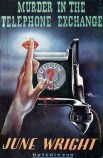 Now, here comes the significance of her job: her first novel, published in 1948, was Murder in the telephone exchange. Wright told a reporter at Melbourne’s Advocate that one of her co-telephonists at the Exchange had once said to her “‘You know you could write a book about this place!” The Advocate goes on to tell her publication story:
June Wright wrote her novel in the midst of busy household duties and a toddling, growing family. When the English publishers, Hutchinsons, announced a £1000 detective story competition Mrs. Wright sent along her manuscript, with a sceptical and open mind on its chances. The competition closed on June 30, 1944, but no manuscript, of the thousands submitted, was awarded the prize. Several, however, were recommended for publication by the judges … Among them was June Wright’s “Murder in the Telephone Exchange”. The publishers are evidently so impressed with her gifts as a story-teller that they have not only signed a contract with her for the immediate publication of the competition manuscript, but have also signed options on her next two novels.
Hmmm … not good enough for a prize but they chose to publish? Still, I’m sure the authors were happy to be published. The next two novels were So bad a death and The devil’s caress. Wright went on to be, apparently, more popular in Australia than Agatha Christie – and yet died pretty much unknown.
Reissued in 2015
The reason Wright has come to our attention now is that her novels are being reissued by US publisher Verse Chorus Press under their Dark Passage imprint, with three published in 2015. That’s not how I learnt about them, though, as I don’t have my ear to the crime genre ground. I heard about Wright through Karen Chisholm’s article on her in The Newton Review of Books.
However, before I tell you about Chisholm’s article, I want to share an excerpt from an article in Perth’s The Daily News. It describes an address June Wright made to the Housewives’ Association:
‘Yes, I have four small children, do my own house-work, and am now writing my third book,’ she told association members. ‘I began my telephone exchange murder story when my first child was a year old, entered the novel for an English competition and was delighted when it was selected for publication.’ Mrs. Wright thinks that housewives are well qualified for writing. They are naturally practical, disciplined and used to monotony — three excellent attributes for the budding writer.
Haha, love it!
I shared this first because it provides a good lead-in to Chisholm’s article. Chisholm, unlike fraudulent me, has read the three reissued novels, and she makes some interesting comments. She says, for example, of Murder in the telephone exchange that the protagonist, Maggie Byrnes “is the first of Wright’s strong female protagonists and we can’t help but assume that there is much of the author herself in Byrnes”. Nagaisayonara, writing at the Crime Fiction Lover website, argues that “it’s a complex, dark novel with a female detective who was far ahead of her time”, and believes that Wright is more like Dorothy L Sayers than Christie. Moving on to So bad a death, Chisholm tells us that Maggie is now married and looking for housing. She writes:
Wright’s family of six children is often remarked upon in interviews when she talks about the workload of writing she maintained, as are the connections between the life of her first character, Maggie, and her own life. Certainly that search for housing during the post-war shortage, and the slightly desperate search for distraction from the day-to-day sameness of childraising and housekeeping, is informed by experience.
Chisholm adds that the new Foreword for So bad a death states that Wright “would joke with interviewers how writing bloody murders was a good way to avoid infanticide”! She sounds like a woman with confidence and presence, doesn’t she?
Adelaide’s The Mail reviewer writing in 1952 about her third novel, The devil’s caress, says that
Mrs. Wright’s new and third work, which concerns odd doings on a Victorian peninsula, is outstanding in one respect. It has a powerful character study of a woman doctor — a commanding, aloof, and in some ways completely misunderstood person, who is married to a surgeon, the antithesis of herself. … Mrs. Wright’s reportage is as ever brisk and competent. But I eagerly await the day when she concentrates more upon genuine, plausible detection and less upon melodramatic situations.
I wonder if this is why this book was not the third to be re-released last year, although I understand all will be eventually?
Meanwhile, Chisholm writes that in all the three books released so far, the third being the previously unpublished Duck season death, “there has been an underlying sense of fun being poked” and “hints at a wicked, very Australian sense of humour”. She concludes that June Wright was “one of the writers who forged the way for an Australian crime fiction scene that’s vibrant, varied and extremely engaging” and argues that she deserves to be “better remembered and more accessible”.
I must say I’m tempted … are you?
 Whispering Gums