Canberra Writers Festival 2025: 4, Finding Elizabeth Harrower

Susan Wyndham with Julieanne Lamond
The program described the session as follows:

A literary biography can be a truly fascinating exploration of the life of an author beyond their pages, and so it is with Susan Wyndham’s Elizabeth Harrower: The woman in the watch tower. Harrower wrote some of the most original and highly regarded psychological fiction of the twentieth century. Then she abruptly stopped writing in the 1970s and became one of the most puzzling mysteries of Australian literature. Why didn’t she continue? What part did her circle of famous friends play? Why is her work now enjoying a remarkable renaissance? Join ANU Associate Professor of English, Julieanne Lamond and writer, journalist and former literary editor of The Sydney Morning Herald, Susan Wyndham for this conversation.
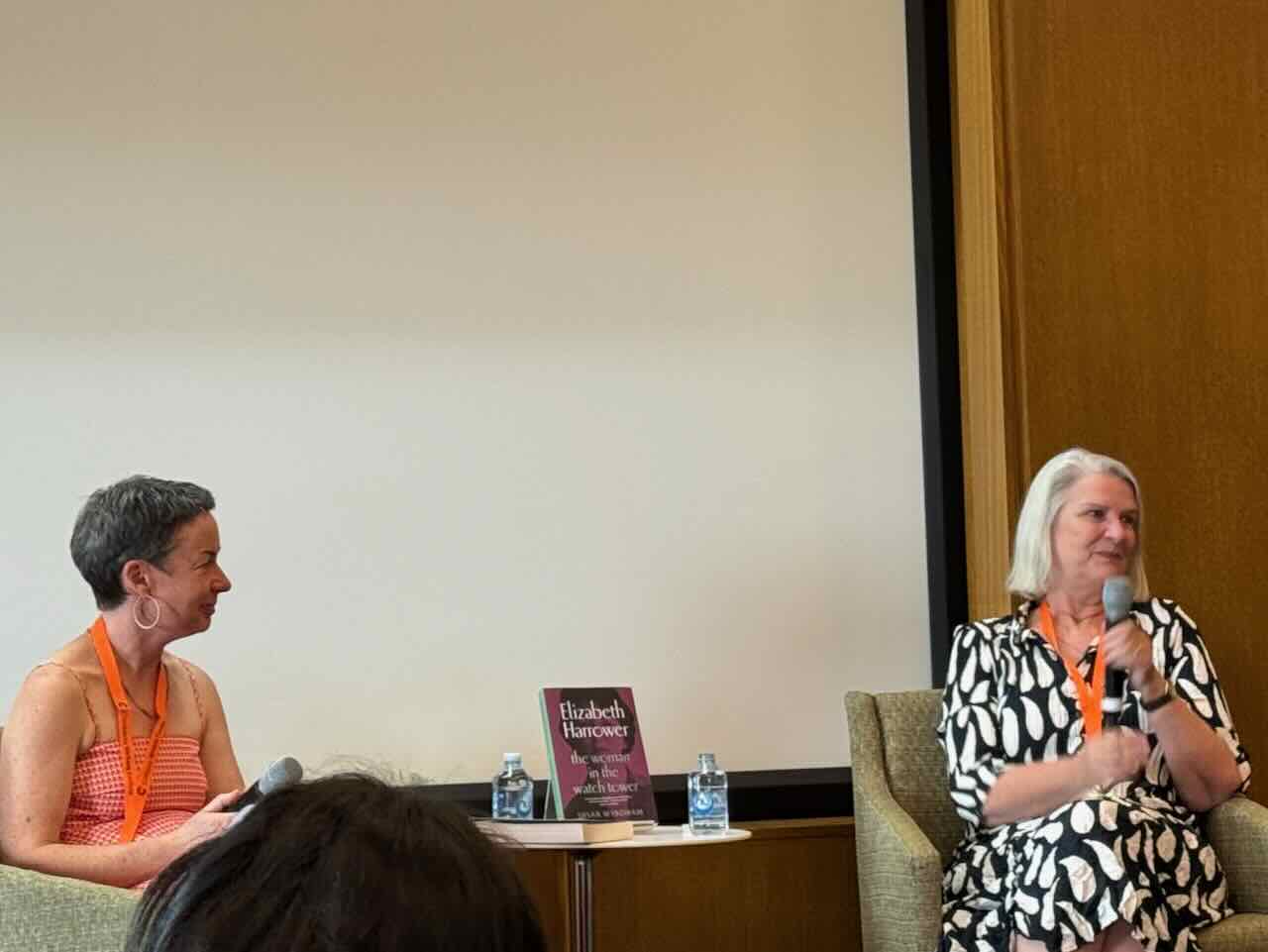
Julieanne Lamond, who teaches English at the ANU, introduced Susan Wyndham, journalist, literary editor and author, most recently, of the biography of Elizabeth Harrower: The woman in the watch tower.

There wasn’t a lot that was new for me in this session, because I’ve read a good proportion of her letters with Hazzard (not reviewed yet, because not finished) and Helen Trinca’s Harrower biography (my review). But I’ll document my notes for the record – and, reiteration always helps the memory.

Julieanne started with the obvious question to a biographer …

Why write about Elizabeth Harrower?
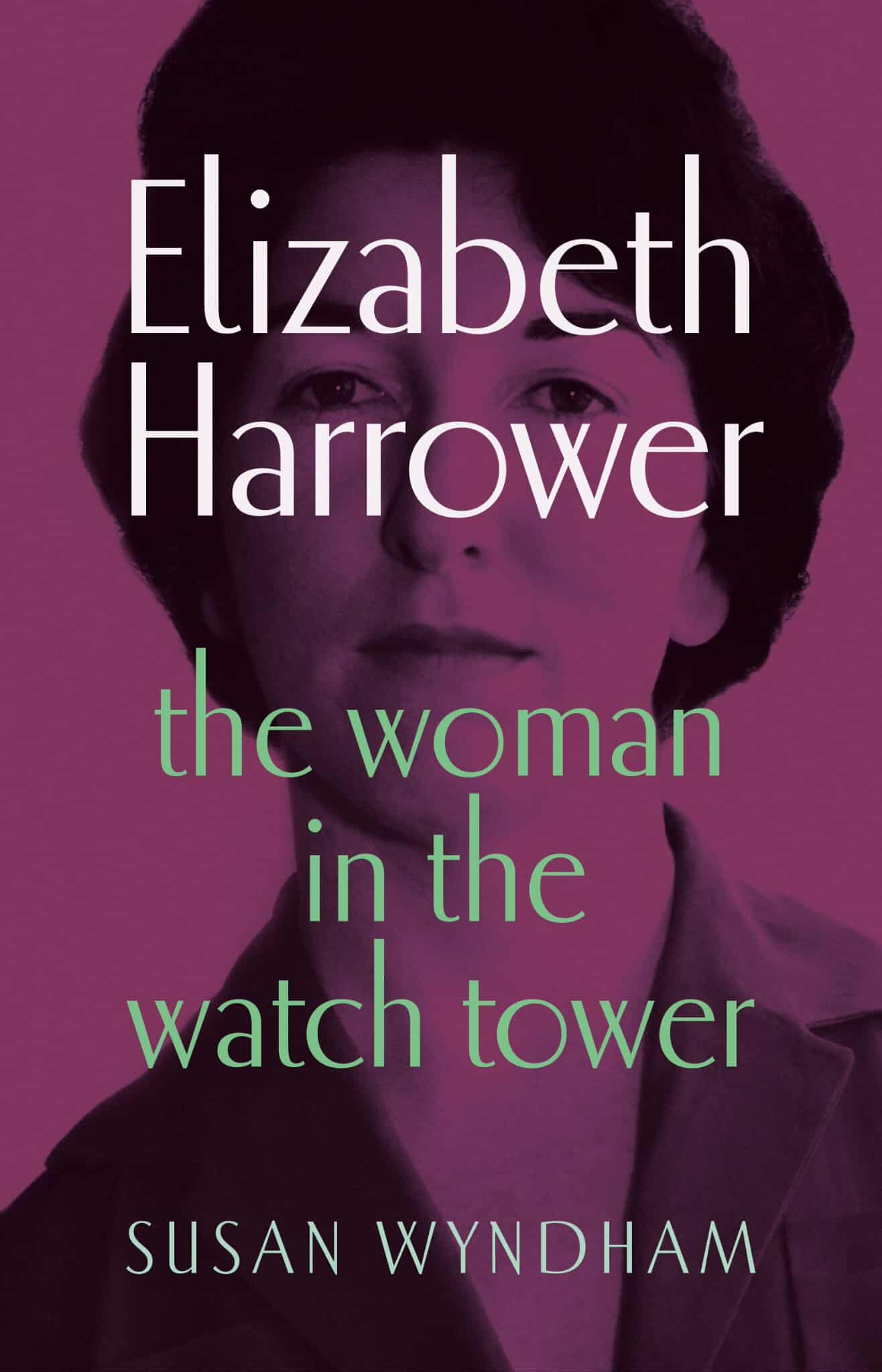
Susan first heard of Harrower when she won the Patrick White Award in 1996, but didn’t read her books until 2014 when Text was publishing her novels, including talking Harrower into publishing the shelved novel, In certain circles. This was Susan’s impetus to read and interview Harrower. She found her novels vivid, and was stunned by their power. But, over the years, she had many questions that were left hanging.

After Harrower’s death in 2020, her papers became available. Susan also knew that Brigitta Olubas was working on Shirley Hazzard with whom Harrower had a long and deep correspondence, so her interest was sealed.

On her childhood – and its influence on her writing

Harrower, like Trinca, found many holes in Harrower’s story. She was able to fill some through her research, but not necessarily fully. Harrower painted over her origins, saying she was born in Sydney not Newcastle. She always called herself a “divorced child” and said she “never saw happy marriage” when she was young.

Susan jokingly said that if you are writing a biography, pray for a messy family, because stories about divorces, crime, deaths will be documented in government and other records. After her parents’ divorce when she was 4, Harrower lived with her grandmother, which inspired her novel The long prospect (my review). She was an only child, and solitary, though Susan did track down a childhood Newcastle friend. Overall, she had to make her own way through her childhood – and was a great reader.

Her childhood was divided in two parts – up to 12 in Newcastle, then she joined her mother in Sydney, with her mother’s new partner (and perhaps husband). This “stepfather”, R.H. Kempley was the model for Felix in The watchtower (my review), a book which still feels modern, and certainly relevant.

Julieanne segued into asking about Felix and Harrower’s intense psychological portrait of a coercive controlling relationship. Susan didn’t want to take away from Harrower’s creativity, because she was a great observer of people – hence the biography’s title. Indeed, Harrower said, “I wouldn’t have survived if I experienced everything in my novels”.

Susan described R.H. Kempley, whose name she tracked down through a brief mention she found in Trove about Harrower’s parents expecting her arrival back from England with her friend (and cousin) Margaret Dick. Her research into him found much evidence of crime – selling moonshine and blackmarket alcohol, debtor’s courts, and the like. Harrower felt shame, but he was a gift to her as a writer if not as a child.

Harrower, Susan believes, ran away from domesticity, determined to be independent and not controlled by anyone, but money was always a problem.

On whether she saw herself as a feminist

Harrower resisted the term, didn’t connect with it, but the way she wrote and lived her life showed she “knew it all”. Anne Summers included her in Damned whores and God’s police in her chapter on women writers.

On the shape of her career or, why she didn’t become the writer she set out to be

Those of you who know Harrower’s trajectory will know that she did not publish a novel after The watchtower in 1966, until Text Publishing republished her novels in the early-2010s, and talked her into publishing her unpublished manuscript, In certain circles (2014, my review).

There is no easy answer to this question said Susan (as Trinca also explored). Her novels were well received critically, and after The watchtower, which was published in Australia, everyone was waiting for her next. She received a Commonwealth grant, but was uncomfortable about it. She always said she wrote under difficult circumstances. She did write short stories and plays, but Susan thinks she’d lost her drive. She was trying something different, but it didn’t “come from her heart or her guts in the same way” as the four published novels had.

She was disappointed not to win the Miles Franklin Award for The watchtower. Also, her mother died, which paralysed her emotionally. She never got her momentum back. She became emotionally involved in politics. Having always been a great Labor supporter, she threw herself into supporting the party with Whitlam’s win in 1972. She was visiting Christina Stead in 1975, when the dismissal happened and was outside Parliament House when Whitlam made his speech. Also, she was enjoying her social life.

On seeing other writers through the lens of Harrower

However, although she only published one novel in Australia after her return from London in the 1960s, she moved in literary circles. She was not a big personality, but people loved her parties and she was a devoted, loyal, “almost too attentive” friend.

This is where her letters with Shirley Hazzard – from the 1960s to 2008 – come in, with their coverage of Harrower’s significant role in caring for Hazzard’s mother Kit. It took up a lot of time. She was willing, but resentment did build up. The supportive picture we see in her letters to Hazzard, is not the same one seen in her letters to and conversations with others. She didn’t like conflict, but she didn’t like feeling put upon, either. This – along with the fact that she was a giver but didn’t like accepting generosity – was probably behind the break in the friendship that occurred during her visit to Hazzard and her husband on Capri.

Harrower had many writer friends, including, significantly Patrick White, Kylie Tennant and Judah Waten. There was some discussion about these, particularly about White who was “a bit of a big brother figure”. They talked on the phone every Sunday, went to shows together, shared an intellectual life together. During the Q&A, Susan added that they had arguments, and shouted at each other, but, although he hurt her at times, she was a peacemaker. It was a genuine friendship.

On Susan’s research, including her Fellowship at the NLA

The National Library not only has Harrower’s papers but those of many in her circle, which provided a wonderful mosaic that offered different ways of looking at Harrower. Cross-referencing enabled her to solve mysteries, such as who she went on a cruise with – a cruise to Japan from which she jumped ship in Brisbane. (Harrower doesn’t provide the person’s name in her Hazzard letters, but did elsewhere. She was “annoyingly discreet”, and didn’t always name people. In this case, she named “Kylie” in a letter to Christina. Her relationship with Kylie was long and fraught.)

Unfortunately, like many writers, Harrower also destroyed papers, such as diaries and letters to her mother.

Q&A

On her relationship with readers: back in the 1950s and 60s, there were no public events, but she was reviewed and did have champions in the literary world. However, after being republished in the 2010s, she did her first ever public events, always with her publisher Michael Heyward, and she loved it. Her responses were always “beautifully formed, but left a whole lot out”. The 2017 Adelaide Writers Week was dedicated to her. She said there, that the greatest human quality was kindness.

On not continuing to write: Susan reiterated some of what she’d said during the conversation, but added that caring for Kit was probably also an issue. Susan thinks nothing was going to get her to write.

On which book to start reading Harrower: Probably The watchtower (her fourth novel), and then The long prospect, which is exactly my order! But Susan is becoming more fond of The Catherine wheel, the only one set in London

I enjoyed the session, though more on biography-writing itself would have been interesting. I could have asked a question, I guess!

Canberra Writers Festival, 2025
Finding Elizabeth Harrower
Saturday 25 October 2025, 1-1:30pm
Brigitta Olubas and Susan Wyndham in conversation with Julieanne Lamond

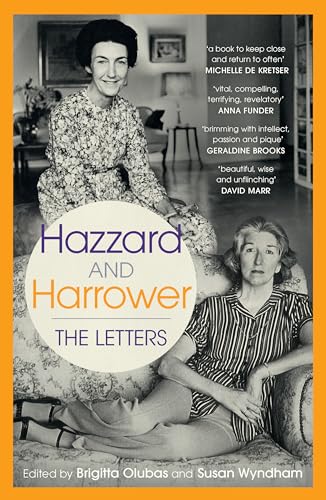
This week’s Meet-the-Author conversation with Brigitta Olubas and Susan Wyndham about their book Hazzard and Harrower: The letters was high priority for me – not only because Hazzard and Harrower are wonderful writers, but because Olubas and Wyndham are themselves significant players in Australia’s literary community.

For those who don’t know them, Shirley Hazzard (1931-2016) and Elizabeth Harrower (1928-2020) were both Australian-born writers, but Hazzard spent most of her life overseas, primarily in New York and Capri. She wrote four novels, of which I’ve read her last two (before blogging), The transit of Venus and The great fire (which won the Miles Franklin Award in 2004). Elizabeth Harrower’s trajectory was more complicated. Aside from living in London from 1951 to 1959, she lived most of her life in Sydney. She published four novels between 1957 and 1966 (of which I’ve read two), withdrew her fifth from publication in 1971, and then pretty much disappeared from view until Text Publishing reprinted her works in the 2010s. Text also convinced her to let them publish that withdrawn novel (In certain circles), and they published a collection of her short stories. I’ve read both of these. (My Elizabeth Harrower posts.)

Brigitta Olubas, an academic and Hazzard’s official biographer, instigated the project to edit the letters, and asked journalist and literary editor Susan Wyndham to collaborate with her. Wyndham had, during her career, interviewed both Hazzard and Harrower. For the project, Olubas focused on Hazzard’s letters and Wyndham Harrower’s. It was a big task that included negotiating how to reduce 400,000 words of letters to the final 120,000. During the conversation, Olubas joked that, at one stage, Harrower had five letters in a row, providing some insight into the challenge it had been to choose letters that would make a coherent whole. Julieanne Lamond, who conducted the conversation, is a literary critic and academic in Australian literature at the Australian National University.

The letters begin in 1966 and continue for four decades, though the two writers didn’t meet physically until 1972, and after that only a few more times.

The conversation

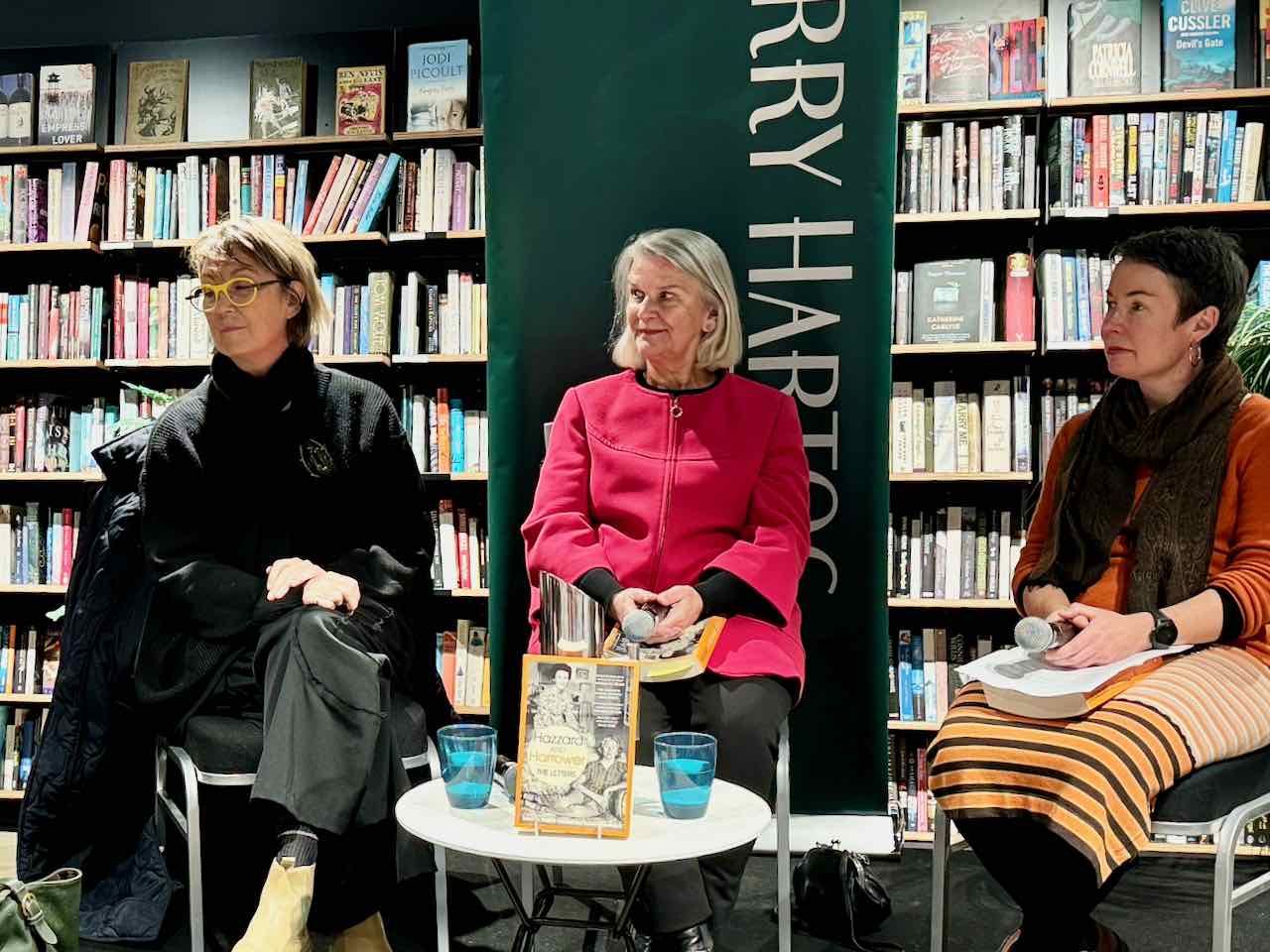
From left: Brigitta Olubas, Susan Wyndham, Julieanne Lamond

MC Colin Steele did the usual acknowledgement of country and introductions, before passing the session over to Julieanne, who started by asking Susan and Brigitta to describe the relationship between the two writers. I am going to use first names from hereon. Last names sound just too formal for warm-hearted events like these.

On their relationship: Susan explained that the two writers were introduced to each other by Shirley’s Sydney-based mother Kit, and that their friendship was formed on the page. Although Elizabeth’s friendship with Kit was kind and caring, family problems and Kit’s mental fragility meant that Elizabeth was thrust into an intimacy she wasn’t necessarily expecting. However, although Kit and her needs occupied part of their correspondence, the two women also wrote about their own lives, what they read, the political landscape, and challenges they confronted in writing (including writer’s block). Their correspondence, suggested Brigitta, may have been more important to Shirley, who said that Elizabeth reflected “something eternal in my consciousness”. She also mentioned the brief falling out they had after Elizabeth visited Shirley and her husband in Italy.

For her part, Elizabeth would tell her friends that she didn’t have much time for Shirley Hazzard, and yet her final letters to Shirley express a keen desire (or concern) to hear from her. Susan suggested that Elizabeth’s attitude could be related to the fact that as Shirley became famous, she became grand in her manner, which Elizabeth didn’t like.

Later, Julieanne asked why would someone, like Elizabeth, take on responsibility for someone else’s mother. Susan explained that Elizabeth liked Kit; they had fun together. Also, her own mother had died (aged only 61) soon after Elizabeth had become friendly with Kit. Elizabeth felt some guilt about her own mother, so was perhaps making up for that. Caring for Kit also enabled her to procrastinate her writing! Julieanne suggested the situation created a complicated sibling-like relationship between Shirley and Elizabeth. Brigitta agreed, adding that Shirley had a sister living in Sydney with whom she had a poor relationship, and would call on Elizabeth to do things that one would normally ask of a sister.

On their careers: Elizabeth had a more difficult career. She wrote a lot in London but it became more difficult after she returned to Australia (due to her own mother’s health). Elizabeth moved in Sydney’s literary circles, including Patrick White, Kylie Tennant and Christina Stead. She had good reviews, but didn’t make a lot of money from her novels. The watchtower – described as a “great act of compression and atmosphere” – was particularly well reviewed.

Shirley also had a late career with big gaps, but is now being rediscovered by younger writers. Both, Brigitta said, were writing “outside their time”, making them difficult to market. They wrote what they wanted to write, what they were good at.

Patrick White, who admired Elizabeth’s writing and kept urging her to write, apparently said that “she’s living a novel rather than writing one”! She was a diligent writer early on but needed a day job to pay her way. She was working at Macmillan publishing while writing her fourth novel, The watchtower (1966). She obtained a grant for her next novel, but that was the one she withdrew. Did she write better when she was pressured for time, as she had been with The watchtower?

By contrast, Shirley was lucky, as she was published by The New Yorker, which provided an income you could live on. She also had a much older, well-off husband, Francis Steegmuller. They worked as jobbing writers, honing their craft. Life wasn’t easy though. She was receiving “monstrous letters” from mother, and her husband started developing dementia.

Meanwhile, Elizabeth had her own challenges. Her mother died in 1970 but, besides Shirley’s mother Kit, she took on helping others, like Kylie Tenant. She got “sucked” into Kylie’s complicated life. She was sympathetic to others. She had a “laser vision into other people’s psyches” which was good for her writing, but it impacted her life.

Both writers, too, were sociable, and claimed they had no time to work. All this affected their careers.

On their correspondence: Both writers put a lot of effort into crafting their letters, which shows in the way their letters reveal their insight into character, dark humour, sense of place, and moral compass.

Brigitta answered in the affirmative Julieanne’s question about whether the two were thinking about posterity as they wrote their letters. Infuriatingly, Shirley didn’t keep her manuscripts – she seemed invested in herself as a “perfect first-time writer” – but she kept her letters and diaries. Elizabeth, on the other hand, threw out many letters, including those she wrote to her mother, but she did keep an “organised set of letters”. Susan believes she wanted posterity to find her. This may be why she was discreet in her letters, often not naming people she wrote about. Susan did some sleuthing to unearth some of this information.

Brigitta added that they had no false modesty. They were aware of their value as writers.

On their political views. Both Shirley and Elizabeth had strong political commitments. Shirley worked for the UN for 10 years. She was bound up in the moral seriousness of the project, and likened her own views to those of Milton – his liberal attitudes, and his commitment to becoming involved in political ideas. Later, Shirley became obsessed with Watergate. In 1977, her article “Letter from Australia” (paywalled) was published in The New Yorker. I think it’s here that Shirley writes about Nixon and Republicans, saying something like “each one in his awfulness makes the next one possible”. Hmmm…

As for Elizabeth, she grew up in Newcastle, through wartime. She saw poverty, and she witnessed the Aldermaston anti-nuclear protests in England. She was galvanised by Whitlam and his reform project. She was staying with Christina Stead at University House in Canberra when the Dismissal occurred, and was at Parliament House when Whitlam appeared on the steps. Susan read from Elizabeth’s letter to Shirley on 17 November 1975, but I’ll excerpt her excerpt. Elizabeth describes Stead answering the phone and being told that Malcolm Fraser was now Prime Minister, then writes:

… Horror. Horror and stupefaction. People very nearly fell down in the street with amazement and dismay. Manning Clark (our most splendid historian) said he was literally sick … Everyone was outraged. Our votes meant nothing. Moderate reform is not allowed to take place here. The new leaders came out on the balcony and laughed like Nazis …

We weren’t surprised when Susan said that later, Paul Keating became her new hero.

Despite this, Elizabeth wrote that she wished she hadn’t become so involved in politics.

Q & A

There was a brief Q&A. By this time I was struggling to keep up with my notes, but here are some of the points discussed:

  • Brigitta and Susan talked about their own, relatively new, literary friendship which has been forged through this project.
  • Regarding gaps in the letters – and things not discussed – they don’t know why. Were they discussed when they met, or over the phone, or?
  • Regarding the brief falling out between Shirley and Elizabeth, this happened in 1984 during a visit Elizabeth made to Capri. She hadn’t wanted to go but had relented after much urging from Shirley. Elizabeth didn’t behave well. Brigitta and Susan speculated on why. Perhaps she didn’t want to let Shirley feel grand (as she was inclined to do), or perhaps, being worried about spending money, Elizabeth didn’t want to feel obliged. An audience member wondered whether the awkwardness came from theirs being primarily an epistolary friendship. Perhaps, was the answer. Speech seemed to be a second language for Shirley. She could be more truthful in writing. She was also, they commented wryly, better at monologues than conversation. Writing gave them both time to consider their thoughts. (I relate to that!)
  • There was also discussion of the history being lost because people aren’t writing letters like this any more. Julieanne commented on the value of letters like these in which time and care have been taken to express thoughts. There is a sort of romance, too, it was suggested, in the time and distance correspondence like this involves.

Brigitta shared some words from a short letter Elizabeth wrote to Shirley on 13 June 2005 concerning a visit Shirley was making to Australia:

You say you hope to be recognizable, and I look much more worn than I feel, but we’ll know each other.

“But we’ll know each other”. Lovely – and what fascinating women.

Vote of thanks

Beejay Silcox, literary critic and Artistic Director of the Canberra Writers Festival, gave the vote of thanks. As eloquent as ever, she was enthusiastic in her acknowledgement of what Brigitta and Susan have achieved and of the conversation we had just experienced. I think I got the gist of her remarks. Describing herself as “a pathological shredder of the past”, she admired these “life-ravenous”, ferocious, flawed and gorgeous women whom we discover through their letters. She described the book as protecting the comradeship of writing, and as a “great and mighty gift” to readers. Our culture tends to praise newness, she said, and bright, shiny things are lovely, but they are not the whole story. Yes! (This is why my reading group aims to include at least one classic/significantly older book in our reading schedule each year. Not only do “good” older works make great reading but they add perspective and depth to all our reading.)

Another very enjoyable, and well-organised, meet-the-author event.

ANU/The Canberra Times Meet the Author
MC: Colin Steele
Harry Hartog Bookshop, Australian National University
16 July 2024