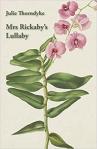
 Quaint title, eh? I really didn’t know what to expect when I accepted this book for review, but accept I did because the publisher is a quality little press and because the author, Julie Thorndyke, although unknown to me, has a track record as a writer, particularly of tanka. Mrs Rickaby’s lullaby, however, is her first novel.
In addition, I was intrigued by the advance description of the protagonist as a “semi-retired botanical illustrator … with a penchant for Mozart”. Well, I love botanical illustrations and I’m a fan of Mozart. Who isn’t? And finally, there was the fact that the novel is set in a “peaceful retirement village”. Being of an age that is eligible for retirement village living, that was a bit of a drawcard too.
So far so good, but what sort of book is it? Well, the back cover blurb provides a hint when it says that Mrs Rickaby’s “tranquility is disturbed when close friend and neighbour brings home a twice-widowed younger man of dubious character, and introduces him as her future husband. Petty theft, vandalism and violence disrupt the peaceful retirement village. How can Mrs Rickaby protect her friend from this con-man lover?”
Now we are getting closer. I think the best way to describe this novel is “cosy crime”, which Wikipedia describes as “a subgenre of crime fiction in which sex and violence are downplayed or treated humorously, and the crime and detection take place in a small, socially intimate community.” This is not really my genre, any more than any crime is, but Mrs Rickaby’s lullaby turned out to be a light enjoyable read.
The story is told in Mrs Rickaby’s first person voice. She is in her early 70s and had moved to the retirement village after losing her much loved husband. She has two children who, at the start of the novel, are both living overseas, so her most important social contacts are her friends at the village, particularly her neighbour Irene, plus her cat Missy.
It’s a curious book, because it doesn’t, I’d say, perfectly conform to the “cosy crime” genre. Much of it reads like a story about contemporary life, and the challenges of ageing, of losing your partner and having to make a new life for yourself. All this Mrs Rickaby does. Her days are occupied by spending time with Missy, by her involvement in the local Orchid Society, by her free-lance botanical illustration commissions, and by socialising with her friends in the village. It’s only gradually that the crime aspect comes into view as her early suspicions about Irene’s new man, Ralph, start to seem valid. Gradually, the mystery aspect hots up as Mrs Rickaby and another friend from the village, Annette, start nosing around about Ralph in their effort to protect Irene from making a bad, and potentially dangerous, mistake.
I enjoyed reading about Mrs Rickaby’s relationships with family and friends, albeit they were generally easier relationships than those in Charlotte Wood’s The weekend (my review). This is not surprising, perhaps, as most of Mrs Rickaby’s friends are new, and thus free of the years of baggage carried by Wood’s friends who are, coincidentally, in the same early 70s age range. My only demur regarding the characters concerns Irene, “a skilled surgeon” who was still volunteering for Doctors Without Borders”. Could such a person be taken in by such a con man? My initial reaction was not, but perhaps I’m naive? Anyhow …
The narrative is framed by Mrs Rickaby’s love of music. The ten chapters all have musical titles, like Nocturne, Misterioso, Counterpoint, Agitato, and Danse macabre. You can see, by these, how the chapter titles might reflect their content. Threading through all this is one particular song, a favourite of Mrs Rickaby’s, the lullaby “Weigenleid”, which is also the title of the final chapter. Once ascribed to Mozart modern research now suggests otherwise. It is a piece of music that is at once calming and melancholic, making it suited, Mrs Rickaby suggests, to contemplating the end of one’s life …
As you would expect with the “cosy” style, the novel has a light humorous touch. It also has some reflections worth pondering, such as this on loneliness:
It is quite amazing to me how easily habits, both good ones and bad, are formed. The single glass of chardonnay in the evening can easily become a bottle, and then two; one spoon of tiramisu becomes a bowlful; an attentive man becomes a lover to a lonely woman, then her husband, whether or not she wanted or needed one, in her rational mind. But loneliness does odd things to one, and even the simplest of pleasures can become a habit, a need, a necessity.
And this on life from Annette who reassesses her realisation in her forties that “life is short” to:
“Well, now I realise that it’s actually too long … too long and too lonely. The evenings,” she whispers. “Just too many and too long.”
And, this important one:
Investments in friendship are the most vulnerable and irredeemable of assets.
Mrs Rickaby’s lullaby is probably not a book for everyone – then again, what is – but is perfectly suited to those looking for something gentle and reflective, but spiced-up with just a little page-turning twist as well.
 Julie Thorndyke
Mrs Rickaby’s lullaby
Port Adelaide: Ginninderra Press, 2019
183pp.
ISBN: 9781760417093
(Review copy courtesy the author)
 Whispering Gums