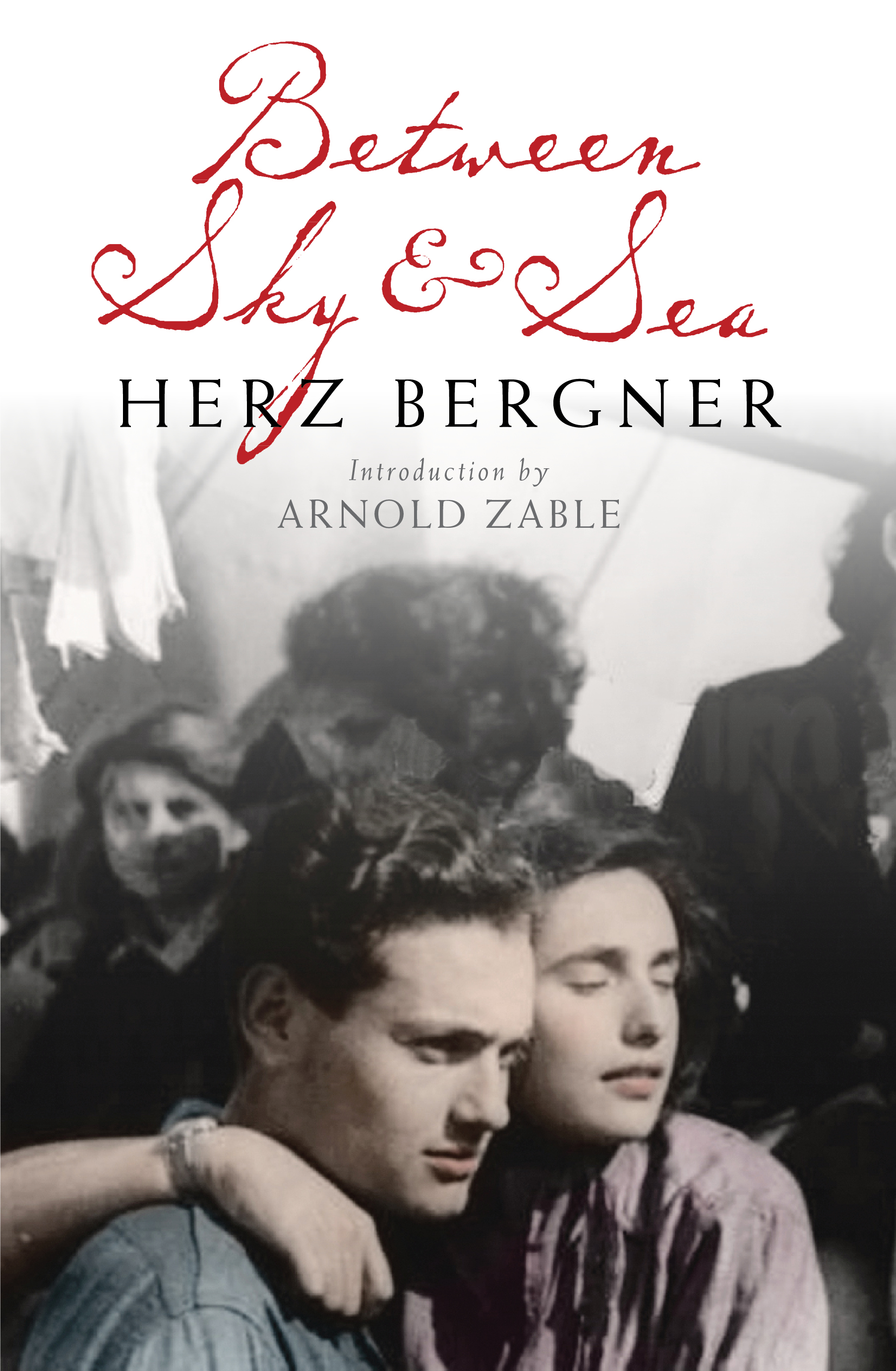
Do you read introductions to novels? And, if you do, do you read them before or after you read the novel itself? I read them, but always afterwards because I like to come to novels as objectively as I can. And so, this is what I did with Herz Bergner’s Between sky and sea which won the Australian Literature Society’s Gold Medal for Book of the Year in 1948. I’d never heard of it. (Well, I wasn’t around then, but still …!) However, this year Text Publishing has republished it, which is a pretty savvy decision because, as Arnold Zable suggests in the introduction, it has some resonances for contemporary Australia – but more on that anon. Zable also tells us that while Bergner, a Polish Jew who emigrated to Australia in 1938, wrote the book in Yiddish, it was first published in English, having been translated by another Australian Jewish novelist, Judah Waten.
The novel has a straightforward plot. It tells the story of a group of Jewish refugees from the Nazi invasion of Poland who are passengers on an old Greek freighter bound for Australia where they hope for a new life. (Australians, at least, will see the contemporary resonances now. Think SIEV X, for example). There is, though, an older resonance which Bergner presumably knew – that of the MS St Louis which tried to find a home for Jewish refugees in 1939 after they were turned away from Cuba (and which later inspired the book Voyage of the damned, so titled because, as many of you know I’m sure, they continued to be turned away as they went from port to port). These resonances and more are all referred to in the Introduction. Knowing readers will pick many of them up, but isn’t that the fun of reading? To pick them up yourself? So, read the book, I say, and then the rather fine Introduction.
Anyhow, back to the book. As I was reading it, I couldn’t help also thinking of that allegorical boat trip, the Ship of Fools. This is not that allegory – they are not fools, and the boat does have a captain, but as I read the novel I felt that awful sense of a world out of control that the allegory represents.
If this book were a film, it would be described as having an ensemble cast, because it has no identifiable heroes or heroines, no real anti-heroes either. Rather, it has a bunch of people who are thrown together by circumstance but who have little in common other than that they are Jewish refugees. Their backgrounds are diverse and they vary in their practice of Judaism (if they practise it at all). They include Nathan and Ida (who lost their respective spouses and children while escaping the invasion), the know-it-all Fabyash and his family, the flirty but mostly kind-hearted Bronya and her stolid overweight husband Marcus, Mrs Hudess and her two daughters (whose only remaining possession is one doll), and several others. As you might expect with such a set up, the novel explores the increasing tensions – the arguments, the pettinesses alongside the kindnesses – that occur as supplies of food and water dwindle and people get sick, while the journey goes on and on without an end in sight:
They were ashamed to lift their heads, to look each other in the face, and for two reasons. Because Fabyash had sunk so low that he had stolen food from a child, and because Mrs Hudess, who was regarded as such a refined person, had burst forth with the language of the coarsest market vendor. To what depths suffering can bring a person.
The strength of the novel is, in fact, its characterisation. Despite its almost non-existent plot (though there is a climax that I won’t give away), the novel maintains our interest because its characters are real in the way they relate to each other and their circumstances. We know these people, we are these people. In this regard it is a little different from those Holocaust novels – many of which also deal with “ordinary” people – that work on a larger-than-life heroism-betrayal scale.
Towards the end of his introduction, Zable quotes Waten regarding the translation. Waten apparently translated it with Bergner by his side, and says that Bergner was “very odd because he wanted every word translated, and if the number of words came out fewer in English he wasn’t very happy. He never really mastered the English language”. This makes a bit of sense because there are times when the novel feels a little – well – wordy. This never becomes a big problem, however, because Bergner’s imagery (mostly simile and analogy) tends to be fresh and is often two-edged:
A soft haze shimmered in the summer air, caressing their faces like spider webs. [on Nathan and Ida’s escape from Warsaw]
and
For a moment the moon shone through, glittering like a lance, and then it was quickly hidden again.
and
… at midday when the sun was ripe and full like a great golden pear that hung heavily from the centre of the sky.
I enjoy writing like this that contains layers of meaning that make you think a little before you move on. The language is not particularly complex, but Bergner has a habit of inserting a word or phrase that undercuts your expectation and keeps you reading.
The themes are both particular and universal – particular because they specifically depict the anti-Semitism that was rife during World War 2 (to the extent that even the crew on the boat treat the passengers as less than human), and universal because they explore the various ways humans behave under stress. The overriding theme – the biggie, in fact – is the way we continue to turn away other. The irony is that even when we are the other – such as the Jews on this boat – we find otherness amongst ourselves to turn away (until a bigger calamity forces us to reconnect). Will we ever change? I fear not. In fact, that’s what makes the universal, universal, isn’t it?
It is encouraging to see publishers like Sydney University Press and Text Publishing – not to mention of course Penguin – reissuing long out-of-print Australian classics. I hope it pays off, not only because I like to see forgotten Australian classics brought to life again but because, as in this book, the messages conveyed by these classics can be as valid today as they were when they were first written.
Herz Bergner (trans. by Judah Waten)
Between sky and sea
Melbourne: Text Publishing, 2010 (first ed. 1946)
215pp.
ISBN: 9781921656316
(Review copy supplied by Text Publishing)
 Whispering Gums