Delicious descriptions: John Hughes on Newcastle

Recently, Bill (the Australian Legend) commented on a post of mine that reviewers rarely talk about place or “think geographically”. I’m not sure exactly what he means, but I think, partly, he wants us to discuss whether we think what we are reading accurately depicts place.

Now, I love descriptions of place, for all sorts of reasons, but particularly for the tone they convey, and for the way authors use place to describe character or to underpin their themes etc. Place in literature was the prime topic of a book I reviewed last year, Chrystopher J. Spicer’s Cyclone country: The language of place and disaster in Australian literature. It offers a fascinating approach to studying place in literature. In a recent Delicious Descriptions, I briefly looked at Sara Dowse’s use of place in her novel, West Block, and in another I commented on place in Gay Lynch’s novel, Unsettled. Pure accuracy, you’ll have seen, is not something I focus on.

I have heard writers talk about place many times. It’s a popular topic at writers festivals. At the inaugural Yarra Valley Writers Festival, Karen Viggers (The orchardist’s daughter) and Alice Robinson (Anchor Point) spoke about it. Viggers said she uses place to orient herself as a writer, and then to explore our connections and help us reengage with the natural world and each other. The challenge, she said, is to bring readers in and engage them with ideas they may find uncomfortable. Robinson said that Anchor Point was based on landscape she grew up in. She was interested in how we have engaged with the landscape, and have failed to care for it.

For some authors, getting place right can be critical, more to avoid reader criticism, than because absolute accuracy is that important to them. They don’t want their novels to be de-railed by pickiness about, for example, whether the church was on this corner or that (which I have heard readers do!)

Anyhow, all this is to say that I think place can be very important in novels for a raft of reasons, and that I enjoy reading about place for the said same raft of reasons. John Hughes’ The dogs, while being about “big” human issues, is also very much set in place. Mostly this is Newcastle, and its environs, though there are vivid scenes in Europe, particularly Venice, and Surfers Paradise. Here, though, I’m focusing on Newcastle (which, I might add, has been written about by many authors, including Dymphna Cusack, Elizabeth Harrower, Marion Halligan, and Michael Sala).

Newcastle is probably best known to Australians as an industrial town, but, it is also a coastal city near beautiful beaches. Hughes draws on these beaches. At the end of Part 2 of the novel, protagonist Michael spends a day at a beach just north of Newcastle with his potential new love interest Catherine, and in Part 3, he and his son Leo spend a glorious day together, which takes in a Newcastle beach.

Here is an excerpt from the day with Catherine:

A cold sea breeze hit us when we got out of the car. There was no one on the beach. Catherine tied a scarf around her neck and pulled her shawl in tight around her shoulders. It was just like her to come so prepared. I, on the other hand, was wearing jeans and a T-shirt. It certainly cleared my head. We took our shoes and socks off and left them in the car, then walked down the small grassed slope. On the soft sand Catherine displayed for me the best way to walk without sinking. … But I’m a sinker by nature …

It’s all rather blissful, particularly when Catherine hikes up her skirt to paddle:

It was quite a sight, all that bare leg, and it made me lightheaded myself, my mind no longer on the surroundings, which were spectacular. When I looked up, the sky seemed higher somehow, like someone had lifted the roof.

There’s hope here for a new beginning for both these lonely people, but, soon after

At the top of the beach, in the soft dry sand she finds a small dune which offers some protection from the wind, which has picked up again while we’ve been walking. A few clouds have appeared in the sky and the sun moves in and out behind them, as if in the game of hide and seek.

Not long after this, their happy moment takes a downturn … This could be many beaches, I suppose, but the description of place seems accurate to me, and Hughes uses it to such great effect.

Then, in Part 3 comes our lovely father-son day in which this somewhat estranged pair plan to do something deadly serious – but first, there is the day together. It starts with Michael picking up Leo from Newcastle airport, and Leo taking the wheel:

I’m enjoying the world from the passenger seat and anticipating the view from the top of the bridge, which always takes my breath away even though I’ve seen it a million times. Above us, pens dipped in blue-black ink, Pacific swifts (on winter sabbatical from Siberia!) write their signatures on the sky and blink their wings. They leave no mark except in recollection, hurled into space with sudden changes of direction, hairpin turns, rapid wing-glides, accelerations, gear shifts. I’d like to point them out to Leo but I don’t want to distract him as he glides into the overtaking lane …

I don’t know this part of Newcastle, but what an evocative description. It made me stop my reading and think – the way nature and machine are seamlessly linked, and the bird metaphor for life with “sudden changes of direction, hairpin turns …”.

This book is full of delicious descriptions like these, descriptions which read so well on the surface, but which suggest so much more in terms of mood and meaning, whether we specifically notice it or not.

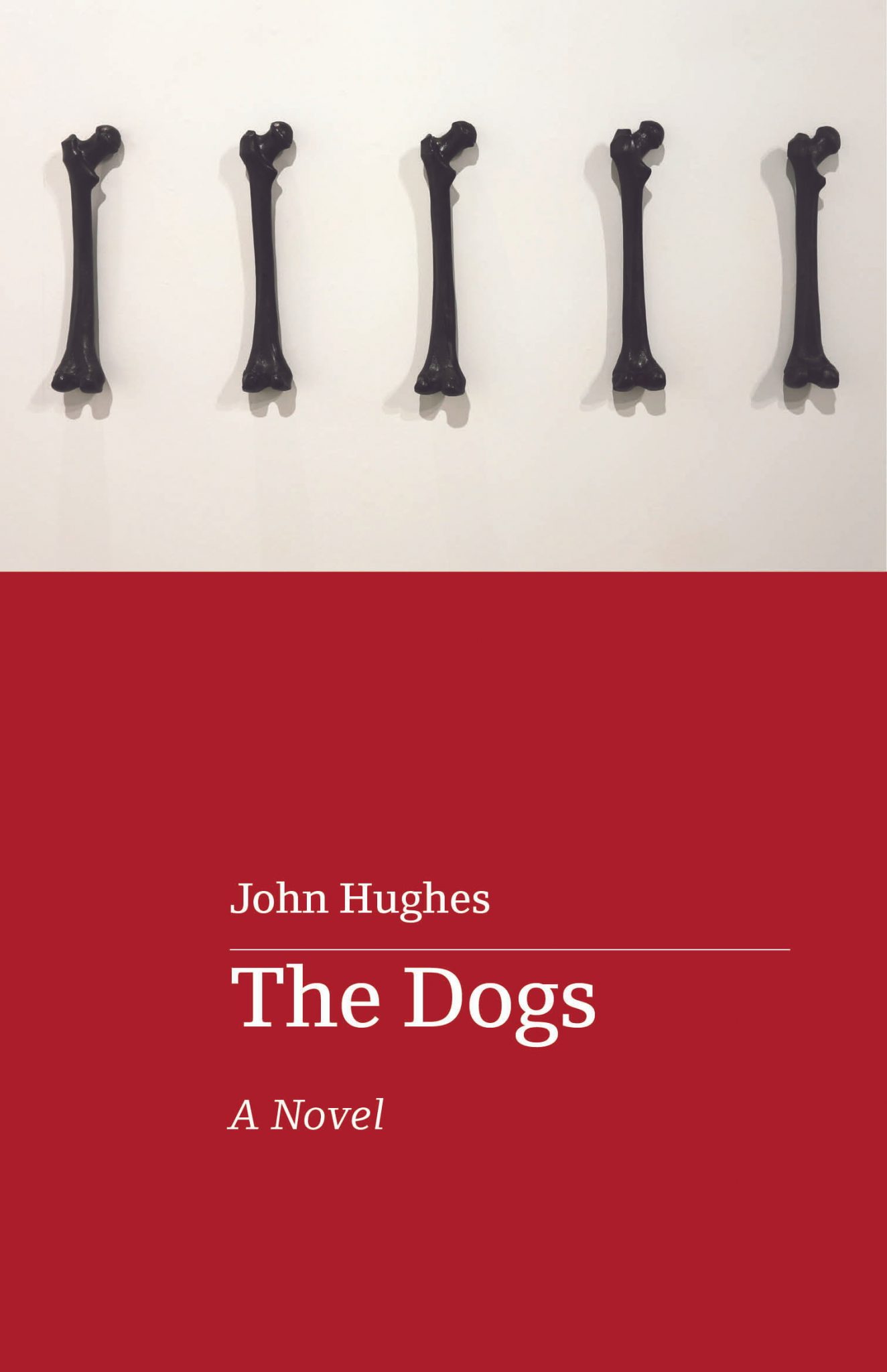
John Hughes, The dogs, Perth, Upswell, 2021

John Hughes, The dogs (#BookReview)

Dogs are mentioned frequently in John Hughes’ novel, The dogs, but the most dramatic reference occurs when the narrator’s mother, Anna, is hiding in a swamp with other partisans during World War 2. The barking of the Germans’ dogs tells them “it was only a matter of time” before they’d be found, causing Anna to do something that will irrevocably change who she is and result in her being the glacial, detached mother she was.

This story, that we don’t get until half way through the novel, is foreshadowed in the Preface, where the narrator briefly backgrounds the story he is about to tell, sharing with us a telling moment. The last time he had visited his normally remote but now also ageing mother in her home, she’d said to him “Don’t you see them? … The dogs, they’re getting closer”.

So, The dogs. It was, for me, a bit of slow burn. I was pulled in from the start by Hughes’ writing. His gorgeous descriptions and his perceptive insights into human behaviour were enough to keep me going on their own. Also, the two main characters, Michael and his mother Anna, despite being, initially, more unlikable than not, intrigued me. But, I was unsure where all of Michael’s introspection was going. Patience, however, is a virtue, and my patience was rewarded, because this story about dysfunctional family relationships and inherited trauma had so much to offer both my heart and mind.

Fifty-five year old Michael is our first person narrator, and the novel starts with him returning to Newcastle in 2015 to see his 99-year-old mother, whom he had placed in a nursing home two years previously, against her will. He’d not seen her since, partly out of guilt, but partly also because she had rejected him for this action. Although Michael is a successful screenwriter, he is a lonely, isolated individual. He is divorced, and has a difficult relationship with his wealthy, property developer son.

The novel follows Michael as, desperate to understand both himself and his mother, he tries to untangle her mysterious past while she still has some memory left. With her mind going and her lifelong reticence, it’s not easy to get the truth, though he senses, as he always had, “the traces of a story she wasn’t telling”.

Anna’s past is a complicated one, taking in, among other things, an Italian opera-singer mother and a Russian Prince father, not to mention world wars and the Russian Revolution. Anna had grown up fatherless, as Michael had from the age of 7 after his father’s suicide. But Anna had other traumas too, about which Michael only learns in this closing stage of her life. It’s a convoluted tale, mostly revealed in the second part of this three-part novel through recently discovered letters and an interview Michael records with his ailing mother.

Now Anna, as I’ve already intimated, is not a sweet old lady, and Michael, as you’ll have gathered, is not the doting self-sacrificial son, but as the story progresses, we come to understand some of the whys. In doing so, I came to like the characters more. Isn’t that why many of us read? To see into the human heart to better know it? “Whose heart … isn’t a Pandora’s box?” Michael proposes late in the novel.

“It’s never really the past we remember”

The dogs is one of those books that can be explored from all sorts of angles, but one particularly captured my attention from the beginning – the past, and its relationship to the future. The past is mentioned several times in the first chapter, including this on page 12:

… it’s never really the past we remember. The future clings to the past like a winding sheet. Every time we think back, we attach the future to it, if only unconsciously … thus the past always knows the future, not as something still to happen, but as something that already has.

Get your head around that! Seriously though, I love this idea because it seems true that what we remember as the past is just that, what we remember – and what we remember is coloured by what has happened since. And, to complicate it a bit more, I guess, the past we remember informs who we are, which then affects the past a bit more? Michael says a little further on about his mother’s story that “in Europe she would have told one story; after seventy years she adds her whole life to the memory”.

Anyhow, the problem for Michael is, always was, that his mother would not tell him about the past – her past or his father’s – so he grows up never understanding who his mother really is, and why she is the way she is. Gradually we come to realise that this is a story about intergenerational trauma, about “the way family travelled through the flesh”. As the truth becomes clear, Michael writes of the impact of not knowing:

I thought it was me. That I’d failed to please her in some way. Some way she would never say. So solemn, so cold.

Furthermore, not only had he felt guilty, but he had also thought, equally, that “the monster was her”.

Having grown up in this atmosphere of coldness and unknowing, it’s not surprising that Michael had not been a good husband or father. He is, and this helps endear him to us, excruciatingly honest about his failings, but we see that these failings are replicated before and after him in this challenged family.

By now, you may be thinking this is a bleak book, but in fact, while there’s a lot of sadness here, the overriding sense is one of humanity and, reality. This means that there’s lightness too. There are wonderful scenes of connection, and there’s even a reference to the good things you can inherit from family. As Michael’s son Leo thinks happily of something he’s inherited from grandma Anna, Michael thinks, “so much pleasure in inheritance”.

The novel has four epigraphs, but I’ll just share the first, which comes from the Bulgarian author, Elias Canetti: “The story of a life is as secret as life itself. A life that can be explained is no life at all”. This is interesting given the book is about uncovering secrets, and about how important that is for Michael. Perhaps, though, it’s there to remind us that no matter how many secrets we might expose, we can, and should, never know it all.

I started my post by referencing “the dogs”, so I’m going to end with them too, because, in addition to negative connotations, “dogs” can also be positive, representing love, loyalty, warmth, protection. John Hughes’ The dogs is a tough, honest book about human frailty, about the decisions we make, the things we do that we shouldn’t, and the things we don’t do that we should have. But, it’s also about family, and ultimately, Michael and his son do the most loving thing they can do in the circumstances. Consequently, this title, The dogs, which encompasses such horror for Anna and, through her, for Michael, can also embrace the idea of redemption.

Lisa also enjoyed this book.

John Hughes
The dogs
Perth: Upswell, 2021
312pp.
ISBN: 9780645076349