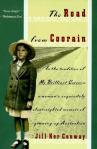
 Just before Mr Gums and I set off for our Arnhem Land holiday in early July, I came across an obituary for the Australian-born academic, educator and writer Jill Ker Conway (1934-2018). She had died on June 1, but I hadn’t heard. Why not? Her first memoir, The road from Coorain, was a best-seller, and I think her second one, True north, was also well received. I’ve read, and enjoyed, them both, but long, long before blogging. Her final memoir, A woman’s education, a slimmer volume, is on my TBR.
Those who know Jill Ker Conway will know why her passing didn’t make big news here. It’s because she made her name in the USA … added to which she was a woman. Or, am I being too paranoid?
So, who was Jill Ker Conway? Well, for a start she was born on a sheep station her parents named Coorain (Aboriginal for “windy place”) in outback New South Wales. Although more often hot, dry and dusty than not, Ker Conway loved it, as she shares in her first memoir.
Now, though, I’ll quickly summarise her career. She was, says Wikipedia, “an Australian-American scholar and author”. She was “well-known” for her autobiographies/memoirs, particularly for The Road from Coorain, but she also made history by becoming the prestigious Smith College‘s first woman president (1975-1985). She made history, of course, because she was its first woman president, but it’s fascinating to me that she was also Australian. She was 40 when appointed to this role, and in her first year was named Time magazine’s “woman of the year”. That’s impressive.
She was, later, a visiting professor at the Massachusetts Institute of Technology. In 2004, she was named a Women’s History Month Honoree by the National Women’s History Project, and in 2013 she was awarded the National Humanities Medal by President Barack Obama. She was, in other words, a bit of a mover-and-shaker!
I have, though, exaggerated the lack of news of her death here. There were some reports, including two in The Sydney Morning Herald. To give you a sense of how she was viewed, here are some of the titles of her obituaries:
- Jill Ker Conway, 83, Feminist Author and Smith President, Dies (New York Times)
- Jill Ker Conway, trailblazing historian and Smith College president, dies at 83 (Washington Post)
- Jill Ker Conway, chairman and trailblazer, dies at 83 (The Sydney Morning Herald Business section)
- Jill Ker Conway: author, historian and Smith College president (The Sydney Morning Herald National section)
Did you notice the odd one out? Yes, the SMH Business section report which identifies her as “chairman and trailblazer”. Chairman? Apparently, in addition to being an educator, academic, author and historian, she was a “business woman”. She was, in fact, “the first female chairman of global property group, Lendlease”. The Sydney Morning Herald says of her business career:
Dr Conway served on the boards of businesses including Merrill Lynch, Nike, Colgate-Palmolive and Lendlease. She was also a former chairman of the American Antiquarian Society.
In 2000 she was appointed as chair of Lendlease at a time when the company needed a firm hand.
Interesting woman eh? For an excellent obituary, do read the SMH National Section one.
She was also one of that wave of Australian intellectuals who left our shores in the 1960s and never really returned, mostly because of the stultifying academic lives they found here. Others included Germaine Greer (1939-), Robert Hughes (1938-2012), Clive James (1939-), not to mention writers like Randolph Stow (1935-2010). They went to England, while Ker Conway made the USA her home.
Ker Conway chronicles exactly why she left Australia in her first two autobiographies/memoirs. It was because she was regularly overlooked for significant jobs – or any job – in favour of men, and because she could not find the sort of intellectual enquiry she sought. Here she is, near the end of The road from Coorain, describing Sydney’s academic circles around 1959, and the group she thought most interesting because they were “iconoclasts, cultural rebels, and radical critics of Australian society”:
When I rejected the inevitable sexual advances, I was looked at with pained tolerance, told to overcome my father fixation, and urged to become less bourgeois. It was a bore to have to spend my time with this group rebuffing people’s sexual propositions when what I really wanted to do was explore new ideas and to clarify my thoughts by explaining them to others. I didn’t know then that I was encountering the standard Australian left view of women, but I could see that the so-called sexual revolution had asymmetrical results.
By the end of True north, she had her Harvard degree in history, and was living with her husband in Toronto when the Smith College job came up. She writes:
I’d been pushed out of Australia by family circumstances [all chronicled in the first memoir], the experience of discrimination, frustration with the culture I was born in. Nothing was pushing me out of this wonderful setting but a cause, and the hope to serve it.
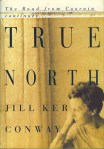 And what was that cause? Well, as she also writes in True north, her main consideration when choosing whether or not to accept Smith College’s offer was “where my work would have the greatest impact on women’s education”. That “impact”, she explains, was not just about numbers. It was about proving that a woman’s institution was not only valid but valid and relevant in a modern world, and about the potential for making it “an intellectual centre for research on women’s lives and women’s issues, research that could have influence far beyond Smith’s lyrical New England campus”. She was there for 10 years, and made her mark.
Ker Conway was, then, a significant woman whose achievements I’ve only touched on. Check the Wikipedia article linked above for more, including a list of her books. Meanwhile, I’m ending with her final words in The road from Coorain, as she’s departing Australia:
Where I wondered would by bones come to rest? It pained me to think of them not fertilising Australian soil. Then I comforted myself with the notion that wherever on the earth was my final resting place, my body would return to the restless red dust of the western plains. I could see how it would blow about and get in people’s eyes, and I was content with that.
The Sydney Morning Herald’s (National section) obituary concludes:
Her love for her two worlds was reflected in her final wishes. Half her ashes will rest in a small private cemetery with John’s, near their beloved house and garden in Massachusetts. The other half are to be scattered by the big tree beside the roadway into the house at Coorain.
How good is that?
 Whispering Gums