Why did Jane Austen?

What is it about Jane Austen? We all know the basic dichotomy. You know, the division between those who dismiss her as being slight, inconsequential, fluffy, chicklit and those who read her again and again swearing that each time they do they find something new to enjoy and appreciate. But, do you know about the dissensions that rage amongst the ranks of the latter? I often wonder how a writer so loved and admired can engender such huge and ongoing debates amongst those very ones who love and admire her!

English: Fanny sewing (detail from File:Mp-Bro...

Fanny sewing in Mansfield Park (Illus. Brock, Public Domain, via Wikipedia)

Here are some of the issues Janeites debate ad infinitum:

  • Fanny should have married Henry Crawford, not Edmund (Mansfield Park)
  • Marianne and Colonel Brandon could never be happy (Sense and sensibility)
  • Emma’s relationship with Mr Knightley is too “incestuous” to be acceptable (Emma)
  • Fanny is a weak and boring heroine (Mansfield Park)
  • Henry Tilney didn’t really love Catherine but married her out of honour for his father’s poor treatment of her (Northanger Abbey)
You would think, wouldn’t you, that fans of her books, those who read them multiple times, would agree at least on basic plotting and characterisation? But not so.
Why is this? That is, how can readers disagree with Austen and yet love her? Well, I would argue that it’s her wit and humour, her comedy – and the fact that her comedy is pointed, wicked even, but not bitter. Mr Collins (of Pride and prejudice), for example, is one of her silliest, most comic creations. He’s a snob, he’s tactless, he’s boring, but does he get his come-uppance? No. He ends as he always was, sublimely unaware of his failings – and fortunately (for him) married to the tolerant, sensible Charlotte. Then there’s Mr Wickham, the villain of the same novel. Far from getting his come-uppance for his dastardly deed – other than being stuck in a marriage with a silly girl – he receives help from the families he wronged:
Though Darcy could never receive him at Pemberley, yet, for Elizabeth’s sake, he assisted him farther in his profession.
Perhaps I should rephrase this. It probably is a come-uppance for Wickham to be stuck with the silly Lydia. Likewise, for Maria Bertram (in Mansfield Park) to end up as she did:
It ended in Mrs. Norris’s resolving to quit Mansfield and devote herself to her unfortunate Maria, and in an establishment being formed for them in another country, remote and private, where, shut up together with little society, on one side no affection, on the other no judgment, it may be reasonably supposed that their tempers became their mutual punishment.
But these punishments are mild by comparison with what happened to “villains” in most novels of the 18th and 19th centuries. This comes about because Austen’s characters exhibit a psychological realism that is somewhat unusual for the time. Her characters aren’t archetypes. They are fully realised creations who move and act in a comprehensible way. We’ve all known (or been!) an over-emotional Marianne, a proud and reserved but reliable Darcy, a silly boy-chasing Lydia, a mine-is-bigger-than-yours John Thorpe, a too-willing-to-judge Elizabeth Bennet. To so accurately render humanity was Jane Austen’s aim, as she most clearly expressed in Northanger Abbey when she described a novel as something
in which the greatest powers of the mind are displayed, in which the most thorough knowledge of human nature, the happiest delineation of its varieties, the liveliest effusions of wit and humour, are conveyed to the world in the best–chosen language.
And this is why we Janeites keep reading – and arguing about – her.

Horace Walpole, The Castle of Otranto

Tower of Horace Walpole's own Gothic house, Strawberry Hill

Tower of Horace Walpole's own Gothic house, Strawberry Hill (Public domain, via Wikipedia)

Would you believe the issue of fact and fiction is consciously raised in yet another novel I’ve read? In his preface to The Castle of Otranto Horace Walpole suggests that it’s possible the story – which he tells us that he “found” and translated – is based on fact. And he concludes that:

If  a catastrophe, at all resembling that which he [the original author, that is!] describes, is believed to have given rise to this work, it will contribute to interest the reader, and will make the “Castle of Otranto” a still more moving story. (Preface to the 1st edition)

Hmm … moving is not quite how I’d describe this Gothic tale but perhaps that’s because I’m a cynical 21st century reader and not a mid 18th century one? I did though enjoy the book, which I read as part of my local Jane Austen group’s preparation for our discussion of Northanger Abbey next month. I had planned to read a Gothic novel by a female author – such as Ann Radcliffe – but time got the better of me and so I settled on The Castle of Otranto which is a novella, but which is also interesting for its pioneer status as the first Gothic novel.

The first thing that entertained me about the novel was the preface and Walpole’s (rather postmodern-like) attempt to pass it off as a story he’d found and translated. He suggests the text had been written in medieval times during the Crusades (between 1095 and 1243). This first edition was well-received by the reading public as well as by some contemporary critics. And so in the second edition Walpole identifies himself as the author, and in its preface claims that the novel was “an attempt to blend the two kinds of romance, the ancient and the modern. In the former all was imagination and improbability: in the latter, nature is always intended to be, and sometimes has been, copied with success…”. This builds, in fact, on an argument he makes in the first edition’s preface that if we ignore the “miraculous” (read “supernatural”) aspects:

the reader will find nothing else unworthy of his perusal. Allow the possibility of the facts, and all the actors comport themselves as persons would do in their situation.

Hmm again … I think he errs on the improbable side of the pendulum, but the characters do, I accept, exhibit a reasonable level of psychological realism.

This change from the first to the second edition is interesting in itself and would be fun to research further … but it’s not something I plan to pursue in this review. I will, though, take up the issue of “the novel” further when I review Northanger Abbey in a month or so since it is in this novel that Austen argues the value of reading fiction.

This brings me to the second thing I enjoyed about the novel, and that was simply experiencing the introduction of the Gothic. Wikipedia says Walpole “introduces many set-pieces that the Gothic novel will become famous for. These includes mysterious sounds, doors opening independently of a person, and the fleeing of a beautiful [usually virginal] heroine from an incestuous male figure”. It also includes the sorts of features that we find in soap operas today – which one could argue are a continuation of the Gothic without the supernatural horror aspect. These features include mistaken identities, people returning from the dead (or, at least, when they are least expected), and love triangles (which are, of course, not only the province of the Gothic). The Castle of Otranto moves at a cracking pace. There’s a lot of dialogue, a good deal of action (human and supernatural), and not too much description.

Another thing that fascinated me is why readers enjoy such over-the-top stories. To prepare for my group’s discussion, I read a critique by Jerrold E. Hogle*. He argues, to put his academic thesis more simply, that the Gothic allows readers to “displace” real fears onto something more fictive. In Walpole and Radcliffe, these fears, he suggests, are somewhat paradoxical: a desire for and rejection of aristocracy and old Catholicism, by the middle class. My group’s discussion raised other reasons too. One is the “excitement” (sexual titillation) roused by these novels, particularly for the young women of the era like, say, Catherine Moreland and Isabella Thorpe in Northanger Abbey. Were Gothic novels that generation’s young adult novels? Another is the idea that, like crime novels, Gothic novels are about the restoration of order: “This is a bad world” says the hero earlier in the novel.

Anyhow, that’s enough of that I think. I haven’t really done a review have I? I haven’t even mentioned the plot. It’s pretty much the usual stuff. There’s Manfred, the lord of the castle, who needs to continue his line to maintain ownership of the castle, but his only son dies on his wedding day. This sets off a train of events in which Manfred decides to divorce his wife, Hippolita, to marry his son’s intended in order to, hopefully, produce more heirs. His plan is intercepted by the appearance of those who claim the castle is theirs. The story includes knights and friars, loving mothers and loyal daughters, helmets and portraits with minds of their own (“the portrait … uttered a deep sigh and heaved its breast”), and, of course, caves and tunnels. The interesting thing about the plot though, in terms of that restoration of order argument, is that not quite the perfect order is restored … but I won’t spoil the story further than that.

As for the opening quote, I’ll leave that for you to ponder …

Horace Walpole
The Castle of Otranto
Originally published 1764
Kindle edition
158Kb

* Hogle, Jerrold, W “Hyper-reality and the Gothic affect: The sublimation of fear from Burke and Walpole to The Ring“, in English Language Notes, 48 (1): 163-176, Spring/Summer 2010.

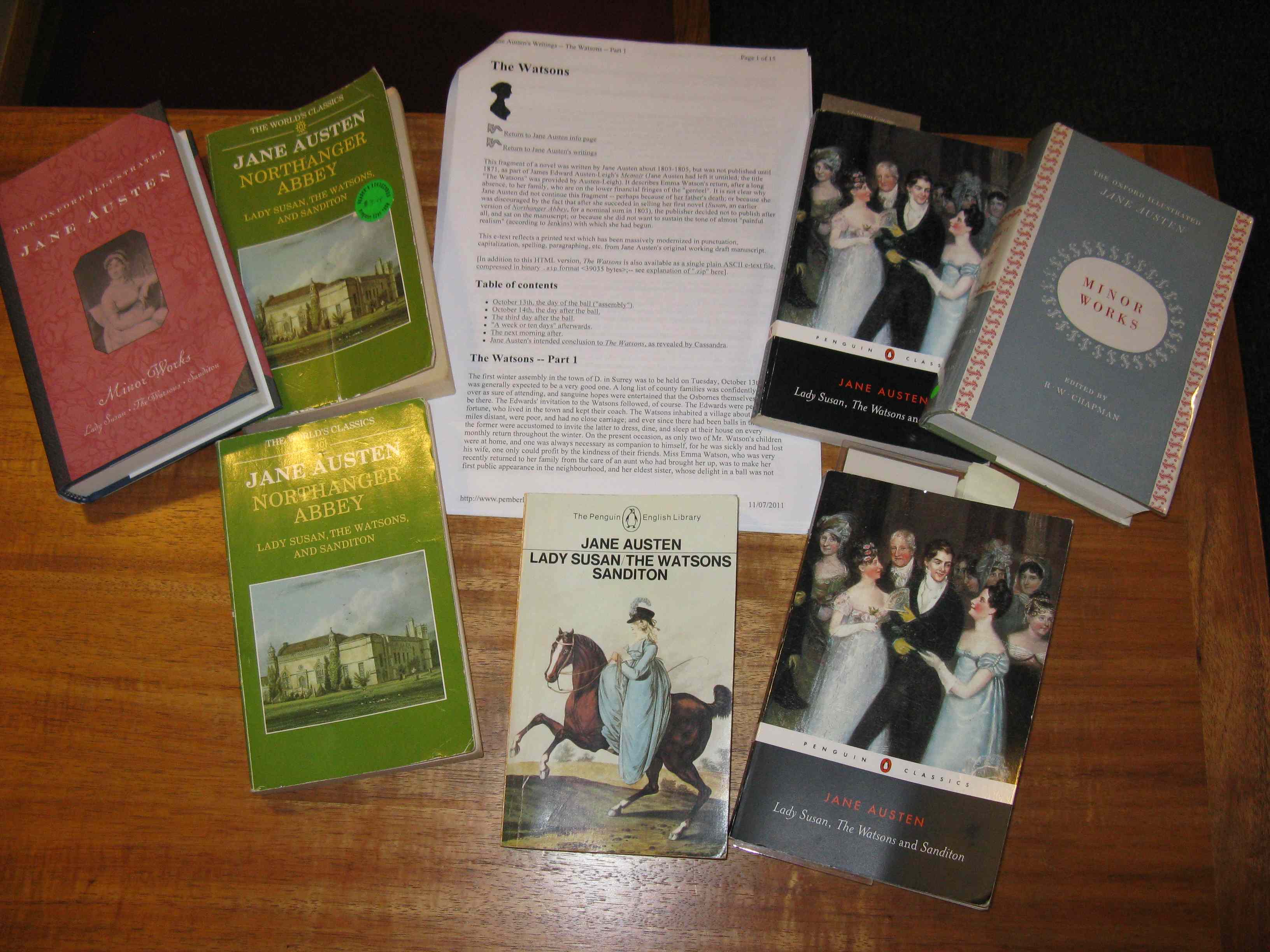
Jane Austen, The Watsons (Unfinished)

Book covers for Jane Austen's The Watsons

Book covers for Jane Austen's The Watsons

In one of those coincidences that we often bother about in fiction, my local Jane Austen group scheduled Jane Austen’s unfinished novel, The Watsons, for our July discussion. A coincidence because, if you are an Austen fan, you’ll know that just this week the manuscript was sold at auction for nearly £1 million. Thank goodness it was bought by an institution – the Bodleian at Oxford. Next time I’m in England I know where I’ll be going!

Anyhow, onto The Watsons. This unfinished novel was written in Bath probably around 1803-1805, though there is not consensus about this. A common belief is that she abandoned it after her father’s death due to sadness and the resultant uncertainty in her living conditions. Whether this is true or not, it is a fact that she didn’t take up serious writing again until she settled in Chawton in 1809 – which gives rise to the more interesting challenge. That is, why didn’t she take this one up again as she did with other early works such as First impressions which became Pride and prejudice. Enough of that, however, as all we can do is speculate. Let’s look at the work instead.

English novelist Margaret Drabble describes The Watsons as “tantalising, delightful and highly accomplished”. And it certainly is tantalising. We have only 68 pages (manuscript count). The story concerns 19-year-old Emma Watson who has returned, after living with her well-off aunt and uncle for 14 years, to her “poor” family. At the time of her return, just her oldest sister, the 28-year-old Elizabeth, is at home with their invalid father. The family however comprises four daughters and two sons, of whom only one son is married. The main plot-line is, of course, likely to be marriage, and so in these first chapters we are introduced to three men who could vie for Emma’s hand. We are also introduced to the characters belonging to Austen’s favourite subject, “3 or 4 families in a Country Village”. We know, from her sister Cassandra, how Austen intended the plot to play out. So tantalising that we never saw her do it!

Drabble’s next word is “delightful” and it is that too … because it contains those wonderful character descriptions and social observations that we have come to expect of Austen. I’ll share just a couple. The first one describes Emma (at the Ball where we meet three potential beaux):

… a lively Eye, a sweet smile, & an open Countenance, gave beauty to attract, & expression to make that beauty improve on acquaintance …

Contrast this to the following description of her sister Margaret:

Margaret was not without beauty; she had a slight, pretty figure, & rather wanted Countenance than good features; – but the sharp & anxious expression of her face made her beauty in general little felt.

There are also those delightful little set pieces we are used to finding in Austen, pieces that illuminate character as much as they move the plot along. One concerns Emma’s offer to dance with a 10-year-old boy when the snooty aristocrat Miss Osborne, doesn’t follow through on her promise to dance with him. “Oh Uncle”, the young lad says to one of the possible beaux, “do look at my partner. She’s so pretty.”

Sweet as she is, Emma proves herself to be well able – rather like Elizabeth Bennet – to hold her own. She refuses to pander to the flirtatious Tom:

Emma’s calm curtsey in reply must have struck him as very unlike the encouraging warmth he had been used to receive from her Sisters, & and gave him probably the novel sensation of doubting his own influence, & of wishing for more attention than she bestowed.

The last sentence of The Watsons starts, “Emma was of course uninfluenced …”. How sad we didn’t get to see more of this resourceful, delightful heroine.

Finally, “highly accomplished“. I’m not sure I totally agree with Drabble here. What we have is intriguing, tantalising us with its potential. It demonstrates much of what we know and love about Austen – and yet, despite evidence of extensive editing in the recently auctioned manuscript, it has (to my mind anyhow) an element of clumsiness. I find this particularly in an overuse of dialogue to convey information which the characters involved would surely already know – such as Elizabeth’s saying to her sister, Emma, “though I am nine years older”. It works well enough in the context but I believe the later, experienced Austen would have better conveyed this through authorial comment.

Nonetheless, it is accomplished. Its realism is remarkable and, like all her novels, it is clear from the beginning just what the targets are going to be. In this case, I see a major theme being the contrast between exterior and interior “refinement”. The fragment we have focuses heavily on the distinctions of class, often contrasting the superficiality of those who possess this so-called “class” with Emma whose refinement is more of the interior kind. This has the makings of a fascinating novel.

And yet, while it was not to be, we can point to many characters in later books who seem to draw, albeit with variations, from the characters here: the invalid father in Emma, the money-fixated brother in Sense and sensibility, the independent-thinking heroine in Pride and prejudice, the flirty young man of means in Mansfield Park, to name just a few. For whatever reason, Jane Austen did not return to this manuscript, but it’s obvious that she did not forget the characters nor some of the ideas behind their creation.

Jane Austen
“The Watsons”
in The Oxford illustrated Jane Austen. Vol VI, The minor works (ed. R.W. Chapman)
London: Oxford University Press, 1969
pp. 315-363

Jane Austen’s letters, 1807-1809

Portrait of Henry IV. Ink and watercolor on pa...

Watercolour by Cassandra, for Austens (juvenile) "History of England" (Presumed public domain, courtesy Wikipedia)

The letters Jane Austen wrote between 1807 and 1809 seem somewhat different to those she wrote later. There are probably a number of reasons for this but one could be that this was an unsettled period for her. Her father died in early 1805 which changed her (and her mother’s and sister’s) life circumstances dramatically. From then until July 1809 they did not have a home of their own. It is interesting that while she had written earlier versions of some of her six completed novels in the late 1700s and early 1800s, none was published until after she, her mother and sister moved to Chawton. This must tell us something, surely, about her state of mind.

The letters, mostly written to her sister Cassandra, are not necessarily easy to read. They are full of pretty straightforward gossip and chat about family and friends. There are myriad names to wade through. (Fortunately Deirdre Le Faye’s edition has an excellent Biographical Index.) If you don’t get bogged down though, you will find some gems, and gain an understanding of life in Georgian and Regency England.

So, what do these letters tell us about her? To make it easy to read, I’ll use headings.

She was a keen, clear-eyed and somewhat acerbic observer of humanity

These letters often make you laugh (though perhaps not so much if you were the subject of some of her comments). Here she is on her oldest brother, James:

I am sorry & angry that his Visits should not give us more pleasure; the company of so good & so clever a Man ought to be gratifying in itself; – but his Chat seems all forced, his Opinions on many points too much copied  from his Wife’s, & his time here is spent  I think in walking about the House & banging the doors, or ringing the Bell for a glass of Water.

And on one Miss Curling:

I wish her no worse than a long & happy abode there [Portsmouth]. Here she wd probably be dull, & I’m sure she wd be troublesome.

And on Lady Sondes (and her second marriage):

…but I consider everybody as having the right to marry once in their Lives for Love, if they can – & provided she will now leave off having bad headaches & being pathetic, I can allow her, I can wish her to be happy.

Austen, it is believed, had a somewhat tricky relationship with her mother. She mentions her mother often in the letters, mostly with cool description rather than warmth, and sometimes rather more pointedly:

My mother has been lately adding to her possessions in plate – a whole Tablespoon & a whole dessertspoon, & six whole Teaspoons, which make our sideboard border on the Magnificent. They were mostly the produce of old or useless silver …

She understood the import of money

This period of her life – post her father’s death, and pre-Chawton and the publication of her books – was her most insecure financially. Consequently, money seems to feature more prominently in this section’s letters. On one acquaintance, she says:

She looks remarkably well (legacies are a very wholesome diet) …

And on some particularly rich people:

They live in a handsome style and are rich, and she seemed to like to be rich,  and we gave her to understand that we were far from  being so; she will soon feel therefore that we are not worth her acquaintance.

On the impact of her own impecunious state which meant, for example, that she had to rely on the favours (and therefore schedules) of others when travelling, she writes:

I shall be sorry to pass the door at Seale without calling, but it must be so … till I have a travelling purse of my own, I must submit to such things …

She thought about writing constantly

We know that Jane Austen had a longstanding interest in writing and this is obvious in these earlier letters – from her (sometimes self-deprecating) comments on her letter writing to her brief but pointed comments on the books she was reading. Through her letters we get a sense of what she thinks a good novel should be. For example, she says of  Sarah Harriet Burney‘s Clarentine that

It is full of unnatural conduct & forced difficulties, without striking merit of any kind.

We also see that she is ever conscious of the act of writing. Often she feels she has no news and mentions how this challenges her letter writing ability:

I really have very little to say this week, & do not feel as if I should spread that little into the shew of much. I am inclined for short sentences …

I enjoyed her praise of another letter writer, Mr Deedes, who

certainly has a very pleasing way of winding up a whole, & and speeding Truth into the World.

There are also descriptions and stories which clue us to her writing and story-telling bent. She describes a fire at Southampton, vividly and with a touch of humour. Always there is humour. In another letter, having discovered that her aspiring-writer niece is also reading her letters, she discusses (with humour again) her increasing awareness of her writing:

I begin already to weigh my words & and sentences more than I did, & am looking about for a sentiment, an illustration or a metaphor in every corner of the room. Could my Ideas flow as fast as the rain in the Storecloset, it would be charming. We have been in two or three dreadful states within the last week, from the melting of the snow &c. – & the contest between us & the Closet has now ended in our defeat; I have been obliged to move almost everything out of it, & leave it to splash itself as it likes.

By mid 1809, the family had moved to the “remarkably pretty village” of Chawton, and Austen at last settled down to her writing (but she had only eight more years to live). One of the last letters in this section is to a publisher asking about the non-publication of Susan (later, Northanger Abbey) which she’d sold to them in 1803. She never did see it published. It was bought back by her brother Henry in 1817, and published posthumously… How sad is that?

Note: This is my third post on Austen’s letters. The first looked at her letters from 1814 to 1816, and the second from 1811 to 1813. With this post covering 1807 to 1809, you might be wondering about 1810. Well, there are no letters from 1810. This is probably because they were among those destroyed by family members after her death. Why, we do not really know.

Jane Austen, Sense and sensibility (Vol. 2)

Austen, Sense and sensibility, Ch 36 illustration

From Chapter 36, illus. by CEBrock (Presumed Public Domain, from solitaryelegance.com)

…and because they were fond of reading, she fancied them satirical… (Lady Middleton on the Dashwood sisters, Ch. 36)

In January, I wrote about Volume 1 of Jane Austen’s Sense and sensibility, which my local Jane Austen group is reading volume by volume this 200th anniversary year of its publication. Unfortunately I missed the February meeting and so didn’t take part in the discussion. But, I am still reading it volume by volume. Here are some thoughts on Volume 2 (which comprises Chapters 23 to 36).

In my discussion of Volume 1, I suggested that the “sense” and “sensibility” dichotomy is not as absolute as the title would suggest. However, in Volume 2, Elinor and Marianne are pretty well entrenched in these two opposing positions. Marianne gives full rein to her emotions as the extent of Willoughby’s perfidy becomes clear, while Elinor takes tight control of herself to hide her emotional distress about Edward. Is this a flaw in the novel? Or Austen’s skill in setting up the characters and then, in this central section, using their prime characteristic to further her plot and themes? Let’s see how it pans out in Volume 3.

Also in my discussion of Volume 1, I talked about what I saw as the theme of “judgement” being developed in the book. The word “judgement” does not appear as frequently in this volume, but I think the idea is still there. Elinor is convinced that Marianne and Willoughby have a “secret” engagement because she does not believe Marianne to be so lacking in judgement as to behave the way she does (giving Willoughby a lock of hair, writing to him) without being engaged. And yet, she’s not totally confident in Marianne because she decides to go to London with Marianne and Mrs Jennings

as she did not think it proper that Marianne should be left to the sole guidance of her own judgement…

Is Elinor a bit of prig? Some think so, but I prefer to see her as a wise young person, who needed to be so, given the mother and sister she had. As the volume progresses, we see the failure of judgement in many of the characters, such as Fanny Dashwood who ironically prefers to have the Steele sisters as her guests over her relations, the Dashwoods, and Mrs Jennings whose general kindness makes it hard for her to see through more calculating characters like Lucy Steele.

For all this, though, it is money that drives the plot in this book, that generates its main plot crises, one of which occurs in this volume. Money is behind Willoughby’s callous treatment of Marianne, as Miss Grey has £50,000! Miss Morton has £30,000, and so is being promoted in this volume as a good catch for Edward Ferrars who has only £2,000 of his own (though he is promised more if he marries well. What’s that about money begetting money?) Lucy claims to love Edward for himself, and not his money. Money is the governing principle in the lives of Mrs Ferrars and her daughter, Fanny Dashwood. John Dashwood never appears without money being far behind. Money is a significant factor – particularly regarding women and marriage – in all of Austen’s novels, something she establishes clearly in this, her first one to be published.

One of the delights of this volume is the way characters are so beautifully and consistently delineated. For example, here is how some of the characters respond to the news of Willoughby’s engagement to Miss Grey:

  • Hail-fellow-well-met Sir John Middleton finds the behaviour “unaccountable” from such a bold rider;
  • Cheery but garrulous Mrs Palmer “resolved never to mention his name again, and she should tell everybody she saw, how good-for-nothing he was”;
  • Cold Lady Middleton shows “calm and polite unconcern”; while
  • Kind Colonel Brandon makes “delicate, unobtrusive enquiries”.

Austen’s ability to define character so clearly, using satire, irony or straight description as the character warrants, is one of the things I love about her.

Finally, I just have to share this little bit of “plus ça change”:

Why don’t he, in such a case, sell his horses, let his house, turn off his servants, and make a thorough reform at once? I warrant you, Miss Marianne would have been ready to wait till matters came round. But that won’t do now-a-days; nothing in the way of pleasure can ever be given up by the young men of this age.

What do I hear today about today’s younger generation wanting it all now?

What you call Cult Fiction, I call …

Recently I wrote a post on why I love ABC’s Radio National, giving The Book Show as one of the reasons. Now, I will talk about why I love ABC TV. Or, at least, about The First Tuesday Bookclub and its spin-off Jennifer Byrne Presents. Both programs involve a panel discussing books. The First Tuesday Bookclub is a monthly program (on the first Tuesday of each month, no less)  in which Byrne, two regular panel members and two guests discuss, usually, a current book and an older one. Jennifer Byrne Presents is an occasional program in which Byrne and four guest panel members discuss a particular bookish topic such as bestsellers, crime fiction, travel writing.

One of these occasional programs was broadcast this week, and the topic was cult fiction. The guests were asked to name their favourite cult fiction book, and their choices were:

Fascinating, eh? After each panel member spoke a little to their choice, Byrne asked them …

What makes a cult book?

They tossed around a number of ideas, including that cult fiction should:

  • have some level of zeitgeist
  • have some sense of danger, of being a little off the beaten track, of being daring
  • be loved intensely (to the extent that people might dress up, talk the language such as Elvish, meet to discuss it, and so on)
  • have longevity
  • not be a bestseller

Not all the books nominated by the panel meet all these criteria, particularly the “bestseller” one.

Other questions Byrne asked were:

  • Does cult fiction have to be well-written? (Most panel members said yes)
  • Can you call a cult novel one you only read once? (The panel varied a little on this, though most believed it’s a book you read and read again)
  • Is your relationship with someone affected if you discover they don’t share your particular “cult fiction” love? (Again the panel varied but veered towards “yes”, though perhaps with a little bit of the tongue-firmly-planted-in-cheek)

Is Jane Austen a cult author?

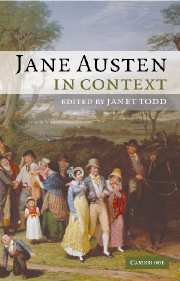
Janet Todd, ed, Jane Austen in context

Courtesy: Cambridge University Press

All this (of course) made me think of Jane Austen, and an essay by Deidre Shauna Lynch on the “Cult of Jane Austen” in Cambridge University Press’s book, Jane Austen in context (edited by Janet Todd). Lynch analyses the range of Jane Austen followers, from the fans to the scholars, and explores some of the implications behind Jane Austen ‘worship’ and the tensions that exist between those who wish to focus on her work and those who seek a more personal relationship with the author. She discusses how the latter group, in particular, have spawned a particular type of Jane Austen tourism that can be likened somewhat to that of pilgrims visiting their saint.

Coincidentally, around the time I read this essay, the Jane Austen House Museum wrote an open letter to the Jane Austen Society banning people from scattering ashes in Chawton‘s grounds. A manager said that while the Museum understood people’s desire to have their ashes scattered at Chawton:

we don’t really feel it’s appropriate. If it enriched the soil we wouldn’t mind so much but the ashes have no nutrients at all.

Oh dear! She does go on to say, however, that Jane Austen had a good sense of humour and that:

she would think it’s hilarious and be thrilled she inspired such devotion.

But, that’s enough of that … otherwise you will start to suspect me of Austen fandom.

Besides, what I really want to know is: How do you define cult fiction? And, do you love any books that you would put in this group?

Madeleine St John, The women in black

The women in black, Madeleine St John, book cover

The women in black bookcover (Courtesy: Text Publishing)

One thing mystified me as I started reading Madeleine St John‘s The women in black and that is why she would write a book in 1993 about 1950s? It seemed an odd choice. And then, as I read further, it started to become clear. The time period represents one of those cultural watersheds that nations experience. In this particular case, it was a time of social change: not only were things starting to change for women, but the “reffos” or “Continentals” (as the post-war European refugees were disparagingly called) were beginning to impact Australian culture.

St John chronicles these changes lightly, with warmth and gentle humour, but also with determination. It’s not a coincidence, I think, that St John, born in 1941, would have been around the age of the youngest character, Lisa/Lesley Miles, at the time the book is set.

Hmm … having introduced a character now, I’d better talk briefly about the plot. It centres around the women who work in the Ladies’ Cocktail Frocks and the more exclusive Model Gowns sections of a fictional (but thinly veiled DJs) upper crust department store in Sydney called Goode’s, and takes place over the few weeks before and after Christmas. Model Gowns is staffed by one woman, the Continental or reffo, Magda, while Ladies’ Cocktail is staffed by the middle-aged Miss Jacobs, the 29-year-old almost-on-the-shelf Fay Baines, the 31-year-old married-but-so-far-childless Patty Williams. There is also the buyer Miss Cartwright. Overseeing them all is, of course, a man, Mr Ryder. Into this mix is thrown 17-year-old Lesley (who changes her name to Lisa) Miles, who has just finished her Leaving Certificate.

The story is told in short chapters, each one devoted to one or more of these characters. The tone is (almost conspiratorially) conversational, which invites the reader in. St John draws her characters effectively through brief sections of perfectly caught dialogue and succinct but apt descriptions. The style is witty, with light wordplay and irony. Here are some excerpts from Chapter 2:

Mrs Williams was a little, thin, straw-coloured woman with a worn-out face and a stiff-looking permanent wave. Her husband Frank was a bastard, naturally.  [ …]

At the weekends she visited her mother or one of her sisters; Frank drove her there and fetched her, and while she was ‘jaw, jaw, jawing’ he played golf on the public course at Kingsford or drank in the pub. He was a bastard of the standard-issue variety, neither cruel nor violent, merely insensitive and inarticulate.

[…]  as she left the surgery, the physician looking idly at her back view thought, she’d clean up quite well with a new hairdo, some paint on her face and a black nightie; but the husband probably wouldn’t notice, the bastard …

By the end of chapter 2 I was hooked. In three and a bit pages we were told all we needed (and probably more than we wanted) to know about poor little Patty Williams and her bastard of a husband. But Patty’s is just one story. There’s also Fay Baines who’s desperate to be married but meets all the wrong men through her well-meaning night club manager friend, Myra; and Lisa Miles who expects to do well in her end-of-school results but whose father thinks women have no business at university. Into this mix are thrown the outgoing, confident (but “god awful” to the women in black) Magda and her also Continental/reffo husband Stefan.

Magda takes an interest in Lisa and invites her home. She also tries a little matchmaking with Fay. Meanwhile, Patty does try that black nightie, with consequences she would never have foreseen. It could all go horribly wrong but, without spoiling anything too much, I’ll simply say that St John’s book follows, loosely and more lightly, the Jane Austen tradition, that is, it’s a comedy of manners. Unlike Austen though, she’s writing in an historical, rather than contemporary, time-frame, and so has a slightly different goal in mind – and that is documenting the social change I mentioned in my opening paragraph.

Two simple examples of this are “kissing” between friends, and food. Here is Lisa on “kissing”:

And she [Magda] kissed her on the cheek. Lisa smiled shyly at her. I’ve heard she thought, that Continentals kiss each other much more than we do: it means nothing. They do it all the time, even the men. The men even kiss each other.  But how strange I feel.

This little paragraph struck me; I realised that my friends and I kiss each other in greeting but it was not, I think, the norm among my parents’ generation. In one or two generations, in fact, the often-maligned (in the book and in reality at the time) Continentals had effected quite a change. And then there’s the food. By the end of the book, Lisa, Fay, and even Lisa’s father had tasted and enjoyed such exotic foods as salami. And again I reflected on the immense change in diet from my parents’ to my generation.

I won’t tell you more of the story. It’s a gentle one, but there is a drama concerning Patty, and some little tensions surrounding Fay and Lisa, that keep the book moving while it observes a society in change. There are some perfect descriptions of Sydney, such as this of the women coming to do their last minute Christmas shopping:

From the wooded slopes of the salubrious North Shore to the stuccoed charm of the Eastern Suburbs, from the passé gentility of the Western ditto to the terra incognita of the Southern had they travelled by train, bus, tram and even taxi cab to this scene of final frantic activity.

It’s a book almost of vignettes than of fully realised stories, and there’s the odd clumsy or heavy-handed bit, but St John has nonetheless managed to convey a convincing picture of Australian society at the time, while also telling an engaging and generous tale. And, just to show she has a sense of humour, St John, who was a libertarian at university, injects near the end her own little in-joke. Here is Lisa’s father on the possibility of her going to university:

But I’ll tell you one thing: if I decide you can go, and you do go, if I ever hear of you being mixed up with any of those libertarians they have there, you’re out of this house like a shot and I never want to see you again, is that understood? Right then. If you go, no libertarians, not even one.

I wonder what St John’s father – the prickly politician Edward St John – said to her!

Lisa at ANZLitLovers has also reviewed the book.

Madeleine St John
The women in black
Melbourne: Text Publishing, 2010 (orig. 1993)
234pp.
ISBN: 9781921656798

(Review copy courtesy Text Publishing)

Jane Austen, Sense and sensibility (Vol. 1)

Ch 22 of Sense and Sensibility, (Jane Austen N...

From Chapter 22, illus. by CE Brock (Presumed Public Domain, via Wikipedia)

This year is the 200th anniversary of the publication of Jane Austen’s first (published) novel, Sense and sensibility. To celebrate this, my local Jane Austen group plans to discuss the novel over the next three months, volume by volume. We tried this last year with Mansfield Park and valued the opportunity it presented to delve a little more deeply into the novel – not only the characters and themes, but the writing and structure. Consequently, in this post I’m going to focus on Volume 1 (chapters 1 to 22) which ends with Lucy Steele’s dramatic announcement to Elinor.

But first, some caveats. I’m going to assume that most readers who come to this post will know the story – and if you don’t, the Wikipedia article provides a good summary. Also I am not going to write a formal review but just share some of the ideas that have struck me during this slow reading*.

I have always liked Sense and sensibility, partly because I’m fascinated by the dichotomy Austen sets up between the two sisters: Elinor (sense) and Marianne (sensibility). And yet, it’s not an easy-to-like novel. The heroines aren’t as sparkly nor the heroes as dashing or heroic as in Austen’s next novel, Pride and prejudice. It feels more serious, less witty – though not as serious as Mansfield Park. This could be because its premise – the sudden drop in wealth for Mrs Dashwood and daughters and their dislocation from their family home, due to the death of their husband/father – mirrors what happened to Jane and her mother and sister after Rev. Austen’s death in 1805. It wasn’t until the family settled in Chawton in 1809 that Austen, to the best of our knowledge, returned seriously to her writing. I wonder if this novel is her working through this very real experience of grief and insecurity. (Interestingly, a very similar story is played out at the beginning of Tracey Chevalier’s Remarkable creatures in which she describes the removal of the Philpot sisters from London to Lyme Regis in 1805).

That’s the historical background to the novel – and forms its social milieu. But there is more to the novel than social history. Austen is a far more complex writer than that. Take, for example, the money issue. There is a lot of focus on money and income in volume 1 – on who has what – indicating Austen’s real awareness of the issue, and yet Mrs Dashwood does not focus on husband hunting for her daughters. In fact, she says:

“I do not believe,” said Mrs. Dashwood, with a good humoured smile, “that Mr. Willoughby will be incommoded by the attempts of either of my daughters towards what you call catching him. It is not an employment to which they have been brought up. Men are very safe with us, let them be ever so rich. …”

This is no Mrs Bennet … but she’s not without her faults either.

And, take the dichotomy issue. It’s actually not quite as clear-cut as the title would suggest. Check the way our two heroines are introduced:

Elinor … possessed a strength of understanding, and coolness of judgment, which qualified her, though only nineteen, to be the counsellor of her mother, and enabled her frequently to counteract, to the advantage of them all, that eagerness of mind in Mrs. Dashwood which must generally have led to imprudence. She had an excellent heart; her disposition was affectionate, and her feelings were strong: but she knew how to govern them: it was a knowledge which her mother had yet to learn, and which one of her sisters had resolved never to be taught.

Marianne’s abilities were, in many respects, quite equal to Elinor’s. She was sensible and clever; but eager in everything; her sorrows, her joys, could have no moderation. She was generous, amiable, interesting: she was everything but prudent. The resemblance between her and her mother was strikingly great.

In other words, Elinor has sense (“coolness of judgment”) but is also emotional (“her feelings were strong”); and Marianne is emotional (“eager in everything … no moderation”) but also has sense (“sensible and clever”).

However, as I read the volume 1, the issue that kept raising its head was that of “judgment”. I’m not sure whether it will continue to do so in the next two volumes, and I need to think about how the judgment issue plays out in other novels, but it does seem that Austen is exploring people’s ability to judge – and most seem to be not very good at it. Sir John Middleton, who praises the Steele sisters, is confident in his judgment, as is Marianne of hers on Willoughby – and we know how those turn out. Meanwhile, Edward, says, Elinor, “distrusts his own judgment” – and he is probably right to (in some matters at least!) Elinor, on the other hand, recognises that she has made errors at times and suggests that you need “time to deliberate and judge”. Related to all this is the fact that Marianne tends to judge people by surface factors, whereas Elinor tries to understand what makes people (such as Edward, Col Brandon, Mr Palmer) behave the way they do. I look forward to seeing whether this idea continues to be specifically explored in volumes 2 and 3.

But let’s move on to Austen’s writing; specifically, her plotting. Until recently, Emma was my least favourite Austen. Then I read it again more attentively and was bowled over by how beautifully it is plotted. I started to notice something similar in Sense and sensibility but will just give one particular example – how Austen uses parallels to create links between the storylines and move the plot along. These parallels, though, aren’t all slavish, aren’t exact. Here are some from volume 1:

  • Willoughby asks for/is given a lock of Marianne’s hair; Edward wears a ring made of Lucy’s hair
  • Willoughby and Edward both leave Barton Cottage in different but less than happy circumstances, and the Dashwoods ascribe this, in both cases, to the influence of strong controlling women – Willoughby’s aunt, and Edward’s mother
  • Elinor states that correspondence between Marianne and Willoughby would convince her of their engagement; later, evidence of correspondence between Lucy and Edward convinces her of their engagement.

And here I shall finish, mainly because I’ve gone on long enough. There is so much more to say, but maybe they will still be relevant in volume 2. Meanwhile, I’d love to know what other Austen readers think …

* Our little nod, perhaps, to the Slow-Reading Movement which I must admit does hold some attractions for me.

Monday musings on Australian literature: The King’s Speech (Movie)

His Majesty King George VI of the United Kingdom.

King George VI, c. 1942 (Presumed Public Domain: From the United Nations Information Office, via Wikipedia)

I wasn’t going to review The King’s Speech, the current biopic about how Lionel Logue helped cure George VI‘s stuttering, because I mostly review Australian films. But, I do like a biopic and this film does have some Australian connections. These connections may not be particularly literary but, what the heck, at least one of the connections does relate to language … and so I’ve decided to make the review my first Monday musings of 2011.

Like most who’ve seen this film, I was engaged by it and would happily see it again to further explore its subtleties and nuances. Of course it helps that it stars Colin Firth. Anyone who has played Mr Darcy as well as he did is a friend of mine! And, it stars other actors from that wonderful 1995 miniseries of Pride and prejudice: Jennifer Ehle (Lizzie Bennet then, Myrtle Logue now) and David Bamber (Mr Collins then, a theatrical producer now). In addition, its actors include some Australians, including Geoffrey Rush as Lionel Logue and Guy Pearce as David, the abdicating King Edward VIII. And, let’s not forget the often underappreciated Helena Bonham Carter who plays George VI’s wife (later to become the much beloved Queen Mum). (Did you know that Helena’s distant cousin, Crispin, played Mr Bingley in the Firth-Ehle Pride and prejudice? Oh, the tangled webs!)

Now, I’m no expert in the history of George VI. I knew he was a shy man who did not want the monarchy; I knew he was a very popular monarch; and I was vaguely aware that he had stammered. I knew, however, absolutely nothing about the role an Australian played in the management (cure?) of this stammer. Consequently, I’m not going to comment, as I believe some others have done, on the veracity of the film. It is a biopic after all. Rather, I’ll just mention a couple of issues.

One relates to the fact that it was an Australian who helped George (Bertie to his family). At the time, the 1920s-1940s, Australians were very much seen as the “colonials” and not, really, as people who could teach the Brits anything. In the film this is portrayed pretty clearly through the Archbishop of Canterbury’s (played by another British acting great, Derek Jacobi) disdain for Logue and his lack of formal credentials, despite the successes he had already achieved with Bertie. I was tickled by the subtle way the film conveyed this little part of the history between our two nations. The tension between the two men is not subtle, but this particular subtext is.

The other issue has nothing to do with Australia, but is related to the film’s very effective sound design. First though, let’s talk Colin Firth. Can you imagine being an actor playing someone who can’t speak? What a challenge, but Firth pulls it off. The film is not afraid to let time drag when Bertie/George tries to speak. It lets the clicks and stutters reverberate as he struggles to get a word out . It’s excruciating – and is sustained just to the point at which we feel his pain and that of those around him but are not irritated by it. The score underpinning the movie is pretty spot on too – lovely original music combined with well-known music (particularly by Mozart and Beethoven). But, here’s my issue. I was intrigued by the use of a favourite piece of mine, the first movement of Beethoven’s 7th Symphony, to background the King’s first war-time speech. Beethoven? For a speech about a second war with the Germans? That was to me weird … Was it intended to be ironic in some way? The King’s triumphant speech set against the reality of what was to come?

Whatever, it’s an engaging film which not only tells a specific story about English royalty, but is also about universals: perseverance and hard work (the King’s in overcoming his speech problem), supporting, encouraging and standing by the one you love (his wife), and the value of experience and ingenuity over paper qualifications (Logue).

If you haven’t seen it yet, do … and tell them an Australian sent you!

Literary Societies of Sydney

Napoleon Sarony (1821-1896), english writer An...

Anthony Trollope. (Presumed Public Domain, by Napoleon Sarony, via Wikipedia)

Although I grew up in Queensland and New South Wales, and have spent most of my adult life in the Australian Capital Territory, it seems I have referred more in this blog to Melbourne (and Victoria), so now seems the time to balance it out a little. Why now? Because this week, in the December 2010 issue of the Jane Austen Society of Australia’s newsletter, Chronicle, I read about the Literary Societies of Sydney.

This is a new organisation, and its website describes it as follows:

The Literary Societies of Sydney is a loose federation of single-author literary societies in Sydney, formed to establish a presence online, to facilitate communication between those societies, and to encourage public contact with them. It is unfunded, and non-profit.

The single author societies it covers are (in alphabetical order by name of society):

Fascinating list, eh?  I don’t see any Australian author societies here like, say, a Miles Franklin Society, but I do love the fact that such societies as these exist. I wonder if they play the role that salons did in the past? (In fact, I sometimes wonder whether blogs operate a little like an online salon?) Certainly, for me, being a member of the Jane Austen Society of Australia provides an invaluable opportunity to share, debate and learn more about her books and ideas. Austenites, for example, can spend a lot of time arguing the case for (or against) Fanny Price, or discussing just how “bad” Frank Churchill is – not simply (or only) on the basis of personal preference, but also by looking at such things as literary traditions and social history. The society, with its wide membership, not to mention its events and publications, helps ensure that our discussions are informed ones.

Do you – or would you like to – belong to an author society (or two)? Why or why not?