John Banville, The infinities

Hermes, sculpted bronze figure by Lee Lawrie. ...

Hermes, sculpted bronze figure by Lee Lawrie (Presumed Public Domain, via Wikipedia

This is what Benny loves, what all the gods love, to eavesdrop on the secret lives of others.

Hmm … this is also, I think, what readers love! Readers after all are, surely, the ultimate voyeurs. And yet the god Hermes, who narrates John Banville‘s The infinities, also admits to the gods interfering in people’s lives, which is, in a way, what authors do. Is this double whammy – voyeur and meddler – one of the reasons why Banville chose a Greek god as his narrator?

The infinities is one of those books that takes place in a day, and it has a fairly small cast of characters. Adam Sr has had a stroke and is ostensibly on his deathbed. He is being cared for by his much younger second wife Ursula and his somewhat “loony” daughter, Petra. Also living on Adam’s Irish estate are the middle-aged employees Ivy Blount and Duffy.  The novel starts in the morning with the arrival of son, also Adam, and his wife, the aptly named Helen. During the day two more people arrive, separately, Roddy Wagstaff and Benny Grace. The only other characters are two Greek Gods, the narrator Hermes and his “father” Zeus.

You might presume from this that the novel is one of those traditional deathbed stories about a family which gathers to await the death of a loved one and lets loose their pent-up conflicts, but it’s not so. This is a more interior novel in which the interaction between the characters is less important than their individual responses to their rather messy lives. They are overseen by Hermes who watches with amusement and not a little envy while also trying to keep his father, the “randy” Zeus, in check.

Unlike The sea, that more sombre novel of Banville’s, this one has a light if not downright funny touch. The gods roam at will around the estate, occasionally taking the form of other characters in order to meddle a bit in their lives, or, in the case of Zeus in particular, experience a little human pleasure with the luscious Helen (“‘Oh’, she says laughing, ‘it was divine, surely'”). Some of the names are symbolic – Helen, of course, recalls Helen of Troy; Adam reminds us of the “first” man; Adam’s last name is Godley. But this isn’t overdone. Not all names are so laden with meaning – and those that are have a more playful than serious import. Added to this is the delightful humanising informality of Hermes talking of Zeus as “Dad”.

So, what is it all about? Adam Sr is (was) a mathematician who explored Quantum theory and developed his own theory of multiple infinities. By contrast, the gods of course are infinite (or, more accurately, immortal), but they envy humans their mortality. Hermes says of his father’s flirtations with women:

Each time he dips his beak into the essence of a girl he takes, so he believes, another enchanting sip of death, pure and precious. For of course he wants to die, as do all of us immortals, that is well known.

Towards the end Adam realises what the gods already know, that “somehow, extension brought not increase but dissipation”. He says:

I still do not understand it. The hitherto unimagined realm that I revealed beyond the infinities was a new world for which no bristling caravels would set sail. We hung back from it, exhausted in advance by the mere fact of its suddenly being there. It was, in a word, too much for us. This is what we discovered, to our chagrin and shame: that we had enough, more than enough, already, in the bewildering diversities of our old and overabundant world. Let the gods live at peace in that far, new place.

Ha! Except the gods already know what Adam and Benny learnt, which is why they keep hanging around the humans. They know that it is death that somehow gives life its meaning. This makes the ending, which I will not give away here, doubly ironic.

It feels impossible to do justice to this superficially simple but rather astonishing book and I have already laboured over my post far too long, so I’ll just make a couple more comments. One is the shifting POV from our narrator Hermes to interior monologues from others, particularly Adam Sr. It seems, at times, that Adam is Hermes, something both disconcerting yet also oddly logical. And there is the tight, evocative language. Take, for example, his use of colour. There’s a lot of blue-black-grey which expresses well the hovering death and its associated mystery, but there are also hints of the more earthy of-the-world green-brown colours and, in the cushion clutched by Ursula, a touch of passionate red. Banville’s intent can almost be read by simply tracking the colours.

In the end, the book is a hymn to the mortal world, in all the messiness that’s been laid before us:

This is the mortal world. It is a world where nothing is lost, where all is accounted for while yet the mystery of things is preserved; a world where they may live, however briefly, however tenuously, in the failing evening of the self, solitary and at the same time together somehow here in this place, dying as they may be and yet fixed for ever in a luminous, unending instant.

Couldn’t have said it better myself!

John Banville
The infinities
London: Picador, 2009
300pp.
ISBN: 978033045025
Kevin Barry, Fjord of Killary

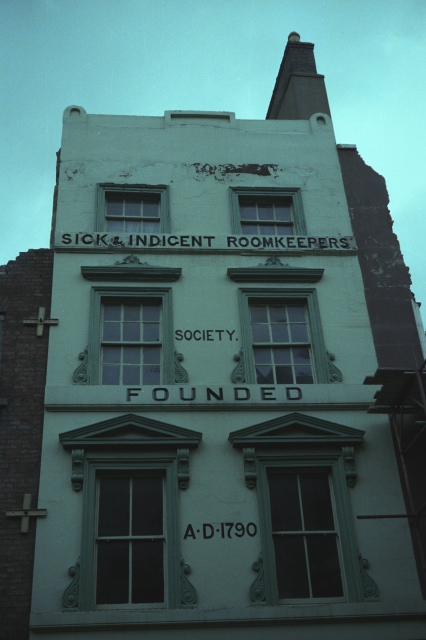
Sick and Indigent Roomkeepers' Society, London

A propos of nothing really, except it's Irish and makes me laugh ruefully like Barry's story

I hadn’t heard of Kevin Barry when his short story published in The New Yorker this month, “Fjord of Killary“, was brought to my attention. Kevin Barry is an Irish writer, born in Limerick in 1969, and this makes him 40 (or 41 this year). The first person narrator of the story is the same age, which rather suggests an autobiographical element, but … that’s for Barry to say! On turning 40, he (the narrator that is, a poet and a self-confessed “hopeless romantic”) did the sea-change thing, that is, he bought a pub on the west coast of Ireland and left his city life behind:

I had made – despite it all – a mild success of myself in life. But on turning forty, the previous year, I had sensed exhaustion rising up in me, like rot. Before forty, you think that exhaustion is something like a long-lasting hang-over. But at forty you learn all about it. Even your passions exhaust you. I found that to be alone with the work all day was increasingly difficult. And the city had become a jag on my nerves – there was too much young flesh around.

This is, it turns out, a mid-life crisis story. It takes place one night, in his pub. There is a storm raging outside and the waters from the fjord threatened to flood the pub … as indeed they do to the point that our narrator, with his customers and staff, retreat to the upper floor. Despite the reference to the cannibalistic black-backed gull eating its mate, this is not a gothic tale (of “the night was dark and stormy” ilk), or one of those tragic Irish sea stories. Rather it is a somewhat comic, somewhat satirical tale, about a publican whose sea-change doesn’t quite seem to be working.

The satire is conveyed in language which is both mock-heroic and melodramatic: the skies are “disgracefully gray “, the locals are prone to “magnificent mood swings”, and the downpour is “hysterical”. Our narrator self-deprecatingly equates himself with the many poets who have tried to escape to the countryside, the, as he describes it, “hypochondriacal epiphany-seeker”. He even manages a sly dig at the English occupation – yet another disaster the pub has had to withstand! There is straight-tending-to-the-absurd humour too. If you have ever spent a few hours in an Irish pub on a rainy, rainy day, as Mr Gums and I did in Avoca three decades ago (can it really be so?), Barry’s description of the drinkers and their ability to keep talking regardless of what’s going on around them or who is listening will ring true! As our narrator says of his customers:

They were all nut jobs. This is what it comes down to. This is the thing you learn about habitual country drinkers. They suffer all manner of delusions, paranoia and warped fantasies…

And he doesn’t? The joke in many ways is on him, because while these people are getting on with their odd, messy, unique lives, he is floundering.

This is a wonderfully Irish story in its wry and sly but also rather absurd take on life.  As for the ending? Well, I won’t give that away, except to say that, with my little blue pen, I wrote against the last line, “Love it!”. Read it here, and see what you think.

William Trevor, The woman of the house

[WARNING: SPOILERS, if you think it matters]

According to Wikipedia,William Trevor’s characters “are usually marginalised members of society: children, old people, single middle-aged men and women, or the unhappily married.” This is certainly the case with Trevor’s short story, The woman of the house, which was published last year in The New Yorker. All four characters in the story are marginalised, two are middle-aged to old, and two are young, but all live on the edge of society struggling to survive in one way or another. In fact it is said of the two young men that:

Survival as they were was their immediate purpose, their hope that there might somewhere be a life that was more than they yet knew.

Pretty grim stuff. The plot is simple. Two young men of “stateless” origin  are employed to paint the house of an old disabled man whose carer/companion is his nearing 50-year-old cousin, Martina. By the end of the story the old man has disappeared from view … we have a pretty good idea of what has happened to him and it ain’t pretty.

The story is perfectly set up. The two strange men who appear to know little about painting – and who we are told are somewhat like “gypsies” – have clearly been shown where the money of the house is kept. The woman, Martina, is (to be euphemistic) taken advantage of by the local butcher and in return receives some special meats. Aha, we think, here is a case of two con-men facing some easy pickings…but, this would clearly be too cliched for Trevor. They don’t steal the money and she is not so down-trodden as it seems. Trevor makes no judgement – just tells it like it is when life is hard and people make pragmatic decisions in order to survive.

And that’s all I’m going to say about this tight little story…except of course that it has inspired me more than ever to read a Trevor novel.

Vale Frank McCourt

Frank McCourt, 2007 (Photo by David Shankbone, used under Creative Commons Attribution ShareAlike 3.0)

Frank McCourt, 2007 (Photo by David Shankbone, used under Creative Commons Attribution ShareAlike 3.0)

I’ve only read one of Frank McCourt’s books, his Pulitzer Prize winning memoir, Angela’s ashes. I loved it, but for some reason didn’t really feel the need to read more, though I’m sure I would have enjoyed them if I had!

Angela’s ashes was such a visceral read. I’ve never read quite such a vivid description of poverty as I found in this book. I know there are some who claim that he exaggerated it but who cares? My sense is that what he described was “real” – real either because it “really” did happen that way or because it genuinely conveyed what deep poverty “feels” like. And, the fact that he could describe such poverty in a way that could make you laugh and cry at the same time marked him out as a true storyteller. One of the, little really, scenes I remember is when he was in hospital and isolated in a ward on his own. The nurse wouldn’t let him talk to the equally lonely and isolated girl in the ward next door. The nurse would yell out to them, “Diphtheria can’t talk to Typhoid” (or vice versa). Oh dear! Just as well he had a sense of humour I reckon.

I saw the film, too, of course. As I recollect it was true to the facts but it somehow managed to convey the grimness without the accompanying humour. That was a shame really.

Anyhow, now McCourt has died. I’m sure his death will result in a resurgence of interest in his books. Commercial, yes, but why should new readers not have his books brought to their attention? There are far worse books they could be reading! Just ask Tom Keneally, who knew McCourt and was interviewed on the radio today. He said :

He is the only man I’ve known who in his mid-60s went from a school teacher pension to being a multi-millionaire and also remaining the same bloke he’d been before it all happened to him. The same whimsical, ironic, very Australian sense of humour he had. …

In the first paragraph [of Angela’s ashes] he mentions the fact that in Limerick the churches were full but he says that was because it rained all the time. It was not piety but hypothermia that filled the benches and I think you would have to search a long way back into Irish history to find such a funny line as that.

I am missing him even now. I have to say starting, as old men do, to get teary that such a grand spirit has departed this earth …