Nationalism, in today’s western world, is pretty much a dirty word – and yet it is the idea of nationalism which underpins Indonesian writer Pramoedya Ananta Toer‘s Buru Quartet, of which I have just read the first book, This earth of mankind. Toer’s concept of nationalism was formed under colonial rule of his country by the Dutch and then under military rule by Indonesians. His notion of nationalism encompasses ideas of individual freedom and dignity, and the right of individuals and, by extension, the nations which they form, to be self-determining. None of these are well supported under colonial or military regimes.

Toer & a translator. Photo: Michael Scott Moore at radiofreemike.com
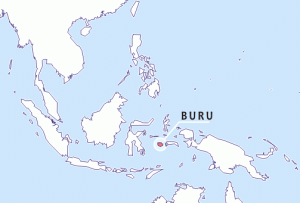
Toer (1925-2006) spent quite a bit of his life as a political prisoner and, in fact, this novel was first told orally to co-inmates in 1973 when he was imprisoned on the Buru Island penal settlement. He was first imprisoned (1947-1949) by the Dutch government after an anti British and Dutch revolution, and then later by the Indonesian government, first in 1963 when he supported Chinese minorities, and then after a military coup in 1965. On this third occasion, he was imprisoned until 1979, though after that was essentially kept under house arrest until 2002. The first two novels were published in 1979/1980, and were translated into English in 1981 by Australian diplomat in Indonesia, Max Lane, who was recalled to Australia that same year as a result. Clearly, the Indonesian government was not amused. Indeed, the books were banned by that government in 1981.
From Wikipedia, under GNU Free Documentation License
This earth of mankind is set in 1898, and provides a fascinating look at colonial life in Indonesia at that time. It tells the story of a Native, the only one to attend an elite school. Being a Native he has no formal name, and so throughout he is called several names – Sinyo or Nyo, Gus, and most commonly Minke. Early in the novel, he is introduced to a succesful concubine Nyai Ontosoroh and her beautiful daughter, Annelies, and is gradually drawn into their lives. The novel follows his – and their – fortunes as the colonial authority does its best to see that a Native does not rise above his station. Life turns out to be a paradoxical one for Minke – on the one hand his education teaches him to think and argue and believe that all things are possible while on the other hand the colonial structure, within which he lives, works to ensure that little is possible.
The novel is peopled with a wide range of characters of various ethnic backgrounds – primarily Dutch, Indo (people with Dutch and Native parentage), and Natives, but also French and Chinese. This ensures that the strictly enforced layer of colonially-decided rights is set against a wide variety of political and personal opinions and provides the reader with an excellent insight into a complex society. This is perhaps also the cause of its main flaw because it is, at heart, an ideological novel. And, like many ideological novels, characters and plots are simplified and exaggerated to make the point. So, in simple terms the story can be seen as poor clever boy meets rich powerful concubine and falls in love with her beautiful but weak daughter only to be crossed by the wicked brother. The story has a melodramatic edge and there’s not a lot of complexity – of greys – to the characters. They are there to serve a purpose.
That said, it is a rivetting read. Told, first person, in Minke’s voice, the novel immediately engages us with him and his situation. He is, in fact, a little more rounded than the others: we get a sense of his uncertainty as he makes his various decisions throughout the book. This is largely because it is also a coming-of-age novel: paralleling the ideological issues underpinning the novel is the story of Minke’s emotional, social and intellectual development. A major thread is that of education and what can (should) be expected of an educated person. Early in the novel his “mentor”, the French artist, Jean Marais, tells him:
You’re educated Minke. An educated person must learn to act justly, beginning first of all with his thoughts, then later in his deeds. That is what it means to be educated.
This advice underpins Minke’s thought and actions from that point on: at each test or decision point he tries to apply his education. There’s bitter irony here though because it is the source of that education – Europe – that causes his major problems at the end. As Minke is fast learning, you have to be strong to survive.
There’s a lot more that can be teased out in this book – including the role played by language in controlling and enforcing power and status – but rather than ramble on, I will end with the words of Minke’s favourite teacher, Magda Peters. She says:
…without a love of literature, you’ll remain just a lot of clever animals
It is not surprising then that Minke, Toer’s alter ego in this book, becomes a writer!
(Translated by Max Lane)
 Whispering Gums