Monday musings on Australian literature: on Nation and people

Hodge and Whitehurst, Nation and PeopleDo you keep your old textbooks? I do, though am now starting to move them on. But some I still can’t part with, one being my high school history text. Called Nation and people: An introduction to Australia in a changing world, and first published in 1967, it was written by Brian Hodge and Allen Whitehurst who were teachers at East Sydney Technical High School. I decided for today’s Monday Musings to have a little look at what my teenage self learnt from it …

I was tickled because some of what I saw, looking at it now, had connections with my future – though, of course, I didn’t know it then. First is the fact that I went to high school in Sydney, and the teachers who wrote it were in Sydney, but the front cover is an image of Canberra, the city I moved to for my first professional job after finishing university, and where I live today. The other is that the first book listed in the student’s bibliography at the back is “F. Whyte, William Morris Hughes: His life and times“. F. Whyte (actually William Farmer Whyte), a journalist, was the grandfather of the man I married. This biography was his magnum opus. I have no idea why it is listed first though. The list is not alphabetical by author or title, and Billy Hughes was not our first Prime Minister so there’s not an obvious chronological reason. The order is quite idiosyncratic to my librarian eyes!

What is history?

These, however, aren’t what I really want to share, entertaining though they are to me. I was interested, for example, in the Preface. The authors say that

students should be encouraged to look for themes. It is important … that they understand the nature of a particular topic they are studying and why they are studying it.

In other words, history is not about dates but ideas and trends. Now, my two favourite high school teachers were my history teacher (Mrs Reynolds) and the librarian (Miss Reeve). It was the late 196os, a time of increasing interest in rights for indigenous Australians, of the Civil Rights movement in the US, and when anti-Apartheid activism was becoming stronger. These two teachers – seen as “red” by more conservative parents – encouraged us to think about what we’d now call social justice. I loved them, because for them history was a living thing about themes, ideas and values.

Indigenous Australians

Of course, in looking at this book now, I particularly wanted to see what it told us about indigenous Australians, because this was an issue we felt strongly about. There are a few references to Aborigines, as indigenous Australians were called then, but there is also a 10-page section devoted to them. It starts with some quotes – from the Constitution (1901), “A Crown Lands Commissioner to Governor La Trobe in 1840”, and writer Marjorie Barnard (from her history of 1962) – followed by their introduction:

During the nineteenth century, the white settlers of Australia extended their frontiers and finally won a continent from its former black owners. The pattern was a similar one to other regions in the world where the white civilisation had made contact with coloured races which were less powerful and culturally different. Lands had been conquered, the stability of the conquered society shattered and the coloured peoples exploited.

They talk about early contact – from seventeenth century sealers to the later farmers – and their poor treatment of indigenous people. They note that “few whites made any effort to understand” cultural differences. They describe conflict between white and black people, in which killing occurred on both sides, but in their view:

Too often in Australian history in the nineteenth century good relations were destroyed by the low standard of settler and the low standard of police.

Next, they say

After the white man had won the land, his [this was before 1970s feminism!] attitude changed. The black man became regarded as a useful stockman who could perform important duties in areas of harsh environment where white labour was scarce and expensive. Thus an extensive cheap labour force was set up for the cattle stations …

They go on to discuss other aspects of black-white history in Australia: missionaries and paternalism, and then assimilation. In 1967, a referendum was passed which amended Australia’s Constitution “to allow aborigines to be included in the census”. Hodge and Whitehurst include a photo of some “Young Australians” sitting at desks. The caption reads: “Now these young Queenslanders will be counted. But will they count?” Good question.

This section ends by suggesting that “integration” is starting to be seen as a better policy than “assimilation”, but

This means, of course, that Australians would have to accept the fact that their society is multi-racial and multi-cultured, and that two cultures would live side by side with complete equality.

Those words – “would have to accept” – suggest, don’t you think, an uncertainty that Australians would indeed accept this. Around 50 years have passed since this was written, and progress has been made but “complete equality”? Nope. How very depressing it all is.

Further reading

Finally, the authors provide a list of additional reading at the end – where I found F. Whyte – but they say “the reading list in this text is recommended as a manageable one”.  They don’t think students “should or could read all the books listed, but … are thoroughly capable of looking at quite a number of them.” They tell students not “to become a slave to one or two general texts, even if they are concise and interesting” and not to “attempt to wade though volumes that are recommended as reference books”. Instead, they say:

Perhaps your most profitable course at this stage of your study of History would be to enter into the spirit of the course through biography. This plan of action  you will find very profitable in your study of Australian development. Through reading biographies you will gain a feeling for History and insight into the spirit and problems of each decade.

How sensible is that? Don’t make students read dry recitations of historical events and facts. Better to read books that will bring history alive. Those they recommend at the end include biographies and fiction, such as George Johnston’s My brother Jack, Xavier Herbert’s Capricornia and, interestingly, Alan Paton’s Cry the beloved country.

Looking at this book, I can see the origins of my ideas about what history is and what it means. Thank you Messrs Hodge and Whitehurst, and thank you too Mrs Reynolds and Miss Reeve. You have not been forgotten.

Do you have teachers and classes that have made a lasting impression on you and your way of thinking?

Jane Austen on history and historians

Jane Austen, we know from her letters, was a keen reader. She read novels, sermons, plays and poetry, magazines and, of course, histories. Did you know, though, that she also wrote a history? This is her juvenilia piece, The history of England from the reign of Henry the 4th to the death of Charles the 1st (online text), illustrated by her older sister Cassandra and completed in November 1791, the month before Jane turned 16.

It’s not, however, like any history you’ve read before, except perhaps Sellar and Yeatman’s 1066 and all that. Published in 1930, this book, Wikipedia tells us, is “a parody of the style of history teaching in English schools at the time”. Well, interestingly, scholars argue that Austen’s History is a parody of the histories being taught in the schools of her time, in particular, Oliver Goldsmith’s History of England from the Earliest Times to the Death of George II (1771). The parody starts on her title page where she tells us “N.B. There will be very few Dates in this History”. She also identifies the author of her history as “a partial, prejudiced, & ignorant Historian”, satirising Goldsmith’s claims to be objective. “It is hoped the reader admits my impartiality” he wrote in his Preface, but many readers, including our Jane, would not admit this at all given some of his pronouncements!

Mary Queen of Scots, by Cassandra Austen, believed to be modelled on Jane

Mary Queen of Scots, by Cassandra Austen, believed to be modelled on Jane

And so, as you’d expect in a parody, Austen is unashamedly subjective in her History, usually promoting the opposite to the prevailing view of her times. She is, for example, partial to the Stuarts, and particularly to Mary Queen of Scots, and is critical of Elizabeth I, “that disgrace to humanity, that pest of society”. She continues:

It was the peculiar misfortune of this Woman to have bad Ministers —— Since wicked as she herself was, she could not have committed such extensive Mischeif, had not those vile & abandoned Men connived at, & encouraged her in her Crimes. I know that it has by many people been asserted & beleived that Lord Burleigh, Sir Francis Walsingham, & the rest of those who filled the cheif Offices of State were deserving, experienced, & able Ministers. But oh! how blinded such Writers & such Readers must be to true Merit …

If you know anything about Austen scholarship, you won’t be surprised to hear that her History has been the subject of intense theorising, with various perspectives being explored, in addition the parody/satire angle. Other perspectives include that it

  • explores ideas about historiography, and the blurring of fact and fiction; and/or
  • reflects Jane and her sister Cassandra’s maternal line’s Jacobite/Stuart sympathies (which were not shared by the men of the family) or, conversely, it reflects their anti-mother attitudes; and/or
  • supports a feminist reading of her work; and/or
  • conveys Austen’s irreverence towards authority.

My aim is not to discuss these here, though, because I want to refer briefly to Northanger Abbey, the first version of which was written around 1798–99 (that is, only a few years after the History). It is famous for its defence of the novel, but it also contains references to other sorts of reading including, yes, history. I want to share some of these, which make interesting reading in the light of her History. The references come from heroine Catherine Morland’s conversation with Henry Tilney and his sister Eleanor.

When you read Austen, you need to know whether Austen approves of the characters who are speaking, as this affects how we are meant to read the character’s pronouncements. Now, in Northanger Abbey, Catherine is our heroine, but she is also young and a little naive. As the novel progresses, she is “taught” by the somewhat older and wiser, Henry Tilney, but he can also be a little pompous. So, I think we can read the following comments with some respect for Catherine’s position, as well as for Henry’s.

“That is, I can read poetry and plays, and things of that sort, and do not dislike travels. But history, real solemn history, I cannot be interested in. Can you?” [Catherine]

No, not necessarily, Austen is perhaps suggesting:

“… I read it a little as a duty, but it tells me nothing that does not either vex or weary me. The quarrels of popes and kings, with wars or pestilences, in every page; the men all so good for nothing, and hardly any women at all—it is very tiresome: and yet I often think it odd that it should be so dull, for a great deal of it must be invention. The speeches that are put into the heroes’ mouths, their thoughts and designs—the chief of all this must be invention, and invention is what delights me in other books.” [Catherine]

We hear you Catherine! And we think back to Austen’s History where, surely with tongue in cheek, she refers her readers to “inventive” writers for authority, such as Shakespeare (“whereupon, the King made a long speech, for which I must refer the Reader to Shakespear’s Plays” or “he afterwards married the King’s daughter Catherine, a very agreeable Woman by Shakespear’s account”) and Sheridan:

Sir Walter Raleigh flourished in this & the preceding reign, & is by many people held in great veneration & respect — But as he was an enemy of the noble Essex, I have nothing to say in praise of him, & must refer all those who may wish to be acquainted with the particulars of his Life, to Mr Sheridan’s play of the Critic, where they will find many interesting Anecdotes …

Cheeky Jane!

And so the discussion continues, with the reasonable Eleanor Tilney stating that she likes history but is happy if historians, such as Austen’s revered David Hume, embellish speeches to make them readable.

“Historians, you think,” said Miss Tilney, “are not happy in their flights of fancy. They display imagination without raising interest. I am fond of history—and am very well contented to take the false with the true. In the principal facts they have sources of intelligence in former histories and records, which may be as much depended on, I conclude, as anything that does not actually pass under one’s own observation; and as for the little embellishments you speak of, they are embellishments, and I like them as such. If a speech be well drawn up, I read it with pleasure, by whomsoever it may be made—and probably with much greater, if the production of Mr. Hume or Mr. Robertson, than if the genuine words of Caractacus, Agricola, or Alfred the Great.”

Ah Eleanor, I hear you. The scene concludes with Catherine making some concessions while suggesting that she used to think all historians did was to write “great volumes … for the torment of little boys and girls”, and Henry Tilney teasing her about this idea of historians aiming to “torment” rather than “instruct”.

Reading or studying history appears in other novels too, particularly in Mansfield Park, where, for example, Austen tells us Fanny, her heroine, had to “read the daily portion of history” but where she also says of Fanny and her sister, Susan, that “their conversations, however, were not always on subjects so high as history or morals”.

I’ve barely touched the surface of Austen’s discussions of history and what we might make of them, but I hope at least that I’ve shown why students (and lovers) of Austen never run out of ideas to think (and argue) about!

Monday musings on Australian literature: The Conversation’s Writing History

This is the post I planned for last week, when Jessica White hijacked me. Like that post, this one too was inspired by another person, this time my historian brother who sent me a link to an article in a new series by The Conversation called Writing History. This series aims to “examine the links, problems and dynamics of writing, recording and recreating history, whether in fiction or non-fiction”. A topic, as regular readers here will know, of interest to me.

I’m not sure how many articles are planned for the series, but here are the five that have been published to date:

I haven’t read them all yet, but I have read the first two, and dipped into another. In the first one, Nelson and de Matos explain that the series draws from essays that were published in a special issue of TEXT, an open-access academic journal. The issue is titled Fictional Histories and Historical Fictions, and its aim is to “get beyond … the often acrimonious exchanges between writers and historians that have been such a characteristic of the History Wars of the last ten years, with its boundary-riding rhetoric.”

The secret River cover

Now, if you are an Australian interested in this subject, you won’t be surprised to hear that both articles I’ve read refer to the conflict between historians and novelists inspired by Kate Grenville’s award-winning, best-selling novel The secret river – or, to be honest, by comments Grenville made about history in relation to her novel. Nelson and de Matos write that the question of who should interpret and write about the past and how the past should be taught or written about has been around for centuries but it was “made palpable” in the tussle over The secret river.

Nelson and de Matos discuss the accessibility of history – and the fact that historians can write accessible history, as proved by writers like Clare Wright in her award-winning The forgotten rebels of Eureka (my review). And they talk about the politicisation of history, referring to comments by politicians like Christopher Pyne bemoaning “the ostensible disappearance of western civilisation from the curriculum” and John Howard’s critiquing of “the black armband view of history”. While political interference is not a good thing, they suggest that in a sense, all history – in its relationship to debates about democracy, identity and social justice – is public history. It makes it even more critical, then, doesn’t it, that we understand what we are talking about and the grounds upon which we are doing it.

In the second article, Tom Griffiths tackles the intertwining of fiction and history. He argues that it was Eleanor Dark, a novelist, who confronted the complacent imperial view of history in Australia’s sesquicentenary, a view that ignored the place of “Aborigines, convicts and women”. She led the way in rethinking our history. Paradoxically, the poet Judith Wright, a few decades later, wrote a history, Cry for the dead, which “gave a secure scholarly foundation to the political campaign of the Aboriginal Treaty committee”. His point is that both writers chose the form that best suited their needs at the time. “Like Eleanor Dark”, he writes, “Judith Wright carefully set about becoming a historian”.

By 1990s, the idea of “frontier conflict” was an accepted part of our historiography but there was a conservative backlash which tried to discredit research by arguing detail such as the number of people who died “as if it decided the ethics of the issue”. It was into this “moral vacuum”, Griffiths writes, that books like Inga Clendinnen’s history Dancing with strangers (2003) and Kate Grenville’s novel The secret river (2005) appeared.

Unfortunately, Grenville’s comments on the value of fiction to history –

The voice of debate might stimulate the brain, the dry voice of ‘facts’ might make us comfortable, even relaxed. It takes the voice of fiction to get the feet walking in a new direction.

– got her involved in the wrong debates, in discussions about history and fiction rather than the topic she wanted, frontier violence. Griffiths suggested this occurred partly because of the timing, because the conservatives were interested, at that time, in debating the “precise, grounded, evidenced truths of history”. To debate on that ground you needed “time, place and specificity”. Grenville, in other words, “found herself at the centre of a debate that goes to the heart of the discipline of history”. I like this explanation. It explains for me some of the reactions to Grenville that never completely made sense, it explains why historians I admired came out so strongly against Grenville, whose story seemed to make a valid contribution to the discussion.

Griffiths concludes that history and fiction are “a tag team” in the study of the past, “sometimes taking turns, sometimes working in tandem”. “History doesn’t own the truth”, he writes, “and fiction doesn’t own the imagination”. We need to understand the distinctions and how they play out, but we shouldn’t see this discussion as “defending territory”.

I look forward to reading the other articles. But for now, I’ll close on a quote my brother also sent me last week. It’s from Jose Saramago’s The Elephant’s Journey (2008):

… that is how it’s set down in history, as an incontrovertible, documented fact, supported by historians and confirmed by the novelist, who must be forgiven for taking certain liberties with names, not only because it is his right to invent, but also because he had to fill in certain gaps so that the sacred coherence of the story was not lost. It must be said that history is always selective, and discriminatory too, selecting from life only what society deems to be historical and scorning the rest, which is precisely where we might find the true explanation of facts, of things, of wretched reality itself. In truth, I say to you, it is better to be a novelist, a fiction writer, a liar.

And so the discussion continues …

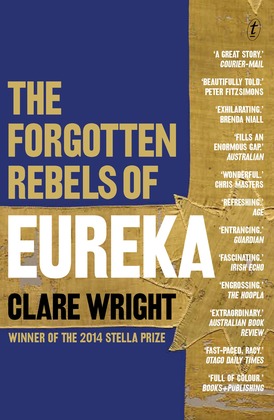
Clare Wright, The forgotten rebels of Eureka (Review)

Book cover, The forgotten rebels of Eureka

Courtesy: Text Publishing

Wah! Once again I delayed reading a much heralded book until my reading group did it*, and so it is only now that I’ve read Clare Wright’s Stella Prize winning history, The forgotten rebels of Eureka. The trouble with coming late to a high-profile book is how to review it freshly. All I can do, really, is what I usually do, and that is write about an aspect or two that particularly interested me. Since other bloggers have already beautifully covered one of these, the history**, I’m going to focus on Wright’s writing and the approach she took to telling her story. I won’t be doing this from the angle of historical theory, as I’m not an historian, but in terms of her intention, and her tone, style, and structure.

If you’re not Australian, you may not have heard of the Eureka Stockade. It was a significant event in colonial Australia’s march to democracy and independence, involving the British army and police attacking a stockade created by miners whose grievances included the payment of a compulsory miner’s licence and the fact that this licence, which they saw as a form of taxation, did not give them the right to vote in the legislature. It has traditionally been framed in masculine terms, but Wright discovered, somewhat by accident while researching another project (as historians do!), a new angle – the role of women in the rebellion. There were, she found, over 5,000 women on the goldfields:

Women were there. They mined for gold and much else of economic value besides. They paid taxes. They fought for their rights. And they were killed in the crossfire of a nascent new order.

Consequently, in her book, Wright draws on extensive primary and secondary sources to explore and expose the lives of these women and the until-now-unheralded role that she believes they played in the goldfields, particularly in the lead up to and aftermath of that fateful day of 3 December 1854.

Wright opens the book with three epigraphs, one of which is particularly illuminating in terms of my subject. It’s by Australian historian Geoffrey Blainey and states that “every history of every country is a mirror of the author’s own interests and therefore selective rather than comprehensive”. Having been interested in historical writing since studying EH Carr’s What is history at university, I like the admission that histories are inherently subjective, regardless of how well researched they are. The historian makes decisions about what s/he will research, what the limits of that research will be, and how s/he will interpret that research. It’s common sense. How can it be otherwise? And so, in this history, Wright’s specific interest in the role of women means that all her research – even research into men’s activities – is viewed through that prism. There’s another implication, too, regarding selectivity: with her focus being specifically the women, we cannot read this book as a comprehensive history of the Eureka Stockade. It complements, or expands, or even jousts with other works.

None of this is meant negatively. I thoroughly enjoyed the read. My point is simply that it’s important, as it always is, to be aware of what we are reading – and I like the fact that Wright recognises this. So, what we have here is, to the best of my knowledge, a thorough but selective history. The text is extensively referenced, with 25 pages of meaningful endnotes and nearly 20 pages of bibliography, and there is a useful index. These are things I look for in a good nonfiction work. The book is logically structured, by theme and chronology, and its (creatively titled) chapters are divided into three main parts: Transitions, Transformations and Transgressions. You can sense a writer’s touch in the alliteration here.

And it’s the writer’s touch I want to turn to now, because Wright has achieved that difficult mix – a well-researched but readable history. It has been written, I’m sure, with an eye on a general, but educated audience. The language is often breezy and even jokey (perhaps a little too much) at times, and yet is replete with classical, Shakespearean, biblical and other literary allusions. She uses metaphor, such as “the cornered lizard bared its frills” to describe the hoisting of the famous Australian flag in the days before the attack. Her descriptions are evocative, and often visceral. You feel you are there in the crowded “tent city” that was Ballarat:

The arrival of the extra troops meant squashing more stinky little fish into an already overpacked tin … From the outside, it seemed like the tightrope was about to snap.

Her stories of the childbirth experiences of Sarah Skinner and Katherine Hancock are devastating to read.

Indeed, I would place this book in the narrative non-fiction tradition. It has a strong narrative drive, with a large cast of characters, some of whom stay with us, some of whom pass through. They include Ellen Young whose poems and letters in the Ballarat Times articulate the mining community’s distress and sense of injustice; hotel-keeper Catherine Bentley who, with her husband, earns the ire of the diggers by consorting with government officials; theatre-owner and actor Sarah Hanmer who donated more to the rebels’ cause than anyone else; and newspaper publisher Clara Seekamp who takes the helm when her husband is arrested for sedition. These women provide significant evidence for Wright’s thesis that women played more than a helpmeet role in the intellectual and political life of Ballarat.

In addition to “developing” these characters, Wright uses other narrative techniques, such as:

  • plot cliff-hangers (much like a screenwriter, which she also is, would do) and pointed aphorisms at the end of chapters
  • foreshadowing to suggest causation: “Even female licence holders expected a modicum of representation for their taxation—as dramatic events would later demonstrate”
  • repetition of ideas and motifs to propel her themes. Take, for example, the Southern Cross. It functions as “a hitching post for existential certainty when all else was in mortal flux” during immigrants’ sea journey from the northern hemisphere to the south (Ch. 3, “Crossing the line”) and is later picked up as a symbol for the rebels’ flag “as the one thing that united each and every resident of Ballarat” (Ch. 11, “Crossing the line (Reprise)”).

As an historian, Wright is confident and fearless, expressing clear opinions, either as direct statements, or indirectly through her choice of language. She calls the Bentleys’ murder trial, for example, a “morality play”. She asks questions; she offers close analysis of her sources, such as noting that the use of the word “demand”, rather than “request” or “humbly pray”, conveys the diggers’ frustration with authority; and she makes considered deductions by testing textual evidence against her understanding of the times and the work of other historians. She discusses discrepancies in reportage, such as the different witness reports of the fire at the Bentleys’ hotel. But she also, as other bloggers and my own reading group have commented, draws a long bow when she suggests the full moon and menstrual synchrony may have been a factor in so many men leaving the stockade on the night of the attack. She provides some evidence for this synchrony as a phenomenon, and offers other reasons for the desertion, but it feels a little out of left field.

At times her nod to the popular and her push for dramatic effect jars, but Wright’s argument that women played an active role at the diggings and in the stockade is convincing. I’m not surprised she won the Stella Prize, because this is engaging reading that is underpinned by extensive scholarship and clear thinking. It’s exciting to see a work that doesn’t just explore the role of women in history but that puts them right in the action.

awwchallenge2014Clare Wright
The forgotten rebels of Eureka
Melbourne: Text Publishing, 2013
539pp.
ISBN: 9781922182548

* I bet you can hardly wait until next month now!
** Do check out historian bloggers, the Resident Judge and Stumbling Through the Past, and litblogger Lisa of ANZLitLovers.

Monday musings on Australian literature: What’s in a street name?

Street names may be an unusual topic for a post on literature, but I think it could be argued that names of things are part of our wider literary culture. It can certainly be argued so for my city because street names here are serious business. None of your 5th Avenues and 61st Streets for us! I know, I know, New York’s a great place, and very easy to navigate compared to Canberra with its reputation for going round in circles, but we have our reasons …

I was inspired to write this post because this past weekend Prince Charles and the Duchess of Cornwall were in town as part of their Diamond Jubilee Tour downunder. One of their duties was to take part in the renaming of Parkes Place to Queen Elizabeth Terrace. This has special meaning for me because the address of my first library employer was Parkes Place, which was named for Henry Parkes, the “father” of our Federation. Queen Elizabeth now joins Queen Victoria, King Edward, and King George in being commemorated by a street in what we call our Parliamentary Triangle. I’m pleased to say that poor old Henry is not being completely brushed aside: the little roads that circle Old Parliament House will now be called Parkes Place.

Enough about my inspiration though, and back to the main point, which is that in 1928 the Canberra National Memorials Committee of the Australian Parliament presented a “Report in Regard to the Naming of Canberra’s Streets and Suburbs” which laid down principles for Canberra’s official nomenclature. Early in the document comes this:

… the commission divided the Canberra City District into 23 divisions. It devolved upon the National Memorials Committee to find names for these divisions, which will eventually become the suburbs of the capital. It was felt by the Committee that patriotic and national sentiment would be best met if the names of those men who have contributed most to Australia’s existence as a unified nation, be used in the most important places, that is, for the names of the divisions or suburbs of Canberra.

The patriotism of a nation is often expressed by memorials to its benefactors, so it is deserving and right that the names of those great statesmen who laboured in the cause of the federation of the Commonwealth should be perpetuated as place names to be used in the mother-tongue by all Australians for all time.

A map of inner Canberra showing the Parliament...

Inner Canberra early suburb names. (Photo credit: Martyman, using CC-BY-SA 3.0, via Wikipedia)

Now isn’t that a great piece of bureaucratic literature! I particularly love the reference to “mother-tongue” after the preceding references to “men” and “statesmen”. It then lists the names of these men, and explains that “a suffix has been added, similar to some of the Anglo-Saxon names of towns in Great Britain, where the name is thought not to be very euphonious”. So, while Braddon gave rise to the suburb of Braddon, and Barton Barton, Lyne became Lyneham and Fysh Fyshwick. Ingenius eh?

The Report then goes on to note that other suburbs would be based on names connected with Canberra’s early days and its pioneers, and that “the use of aboriginal names has not been overlooked.” They stated that much knowledge of indigenous naming in the Canberra region had been lost but those known would be retained, and so they are – with most rolling off the tongue beautifully (euphoniously, even), like Narrabundah, Yarralumla, Pialligo, Jerrabomberra, Mugga, and Canberra itself.

All this is probably pretty common in cities elsewhere but the committee went on to set down principles for the naming of streets:

The Committee has adopted the idea of grouping together various classes of names in separate areas. Sections of the City have therefore been set apart for Governors, Explorers, Navigators, Scientists and others, Foresters and others, Pioneers and others, Founders of the Constitution, and euphonious Aboriginal words.

I wonder whether the names of the scientists, foresters, “and others” had to be “euphonious”?

I won’t go on with more of the report, but I will say that this plan has continued to the present. One of our newest suburbs, still in the making, is Wright – named for the poet Judith Wright. Yes, we do now have a handful of suburbs named for women, including the writers Miles Franklin, Dame Mary Gilmore and Henry Handel Richardson. Moreover, some of our street names, says ACTPLA, our current planning authority, are named for “quiet achievers”. Things do change in the corridors of government – eventually. As for the theme for Wright’s streets, it’s a somewhat diverse one, “Environment, Poets and Butterflies”. Maybe there’s a connection there; Wright was a poet and a conservationist so perhaps the latter covers the “environment” and the “butterflies”!

I like that fact that such thought has been put into Canberra’s urban (or is it suburban) nomenclature, and I’m glad that while the spirit of the early planners has remained our nomenclature has broadened to encompass women, quiet achievers, the arts and increasing usage of indigenous names. The end result is, for we capital residents, a fascinating literature of suburb and street names. Do you have such literature where you live?

Monday musings on Australian literature: Australian women’s non-fiction writing

Today’s Monday Musings was inspired by a post last month in Overland literary journal’s blog. The topic – Women and non-fiction writing – is a big one, bigger really than I have time for now, but I figured it wouldn’t hurt to make a start.

In the Overland post, which comprised an interview with writer, Rebecca Giggs, Giggs discusses the issue of authority in non-fiction and the notion that “nonfiction writing is supposed to have a fidelity to the real world. Disgrace comes to the author who adds too much of the unreal to their mix”. She talks of how it is believed that “things must be stated, accounted for, and settled. Declared. The unknown turned into the known” and sees this view very much as a gendered thing. As male, in other words. And then she continues

But of course, this is not how the world actually is. Inner and outer worlds are not so easily divided! And permitting that fact – allowing such things as the corporeal, the uncertainty, the experiential in – doesn’t just make clear that falsity, it also lets in other modes of authority. It questions the role of women’s interior lives in our political discourse.

So much to unpack here that I fear getting bogged down, so will just keep to the surface (more or less). I have always been intrigued by the subjective in history, ever since I read EH Carr‘s What is history in which he argued, convincingly for me, the interpretive basis of history, that the role of the historian is significant in terms of what we come to know as “history”, as “fact”. I have no idea how Carr is viewed now as I’m not an historian but it would take a good argument to shake my belief in Carr’s basic premise.

And so, I like the changes I’m starting to see in non-fiction writing. I like the fact that the role of the historian – or, let’s broaden this to non-fiction writer – is becoming more transparent in the (in some anyhow) writing. And it seems that a lot of this is being driven (championed, even) by women writers (although my impression could be skewed by the fact that I’ve read more non-fiction by women over the last decade or so. I would love to hear whether you agree). In the rest of this post I’ll discuss a few of the writers who have come to my attention, in roughly the order I’ve read them.

Helen Garner

Garner was the first to confront me with a new personal way of writing non-fiction. She put herself in the picture and told us exactly what she thought about the subjects she was writing about: college master-student harassment in The first stone, murder/manslaughter and duty of care in Joe Cinque’s consolation. Garner caused quite a furore with these books, particularly the former, but I’m not going to go into that here. Google if you are interested. My point is that she was fearless in putting herself in the frame, and in documenting her process. It’s exciting writing – and it’s honest. I like that, whether or not I agree with her views and conclusions. I like the fact that she allows us to see her thinking and to engage in the discussion – and engage we surely did.

Chloe Hooper

Chloe Hooper.

Chloe Hooper (Public Domain, via Wikipedia)

In a way, Chloe Hooper in her Tall man did for Cameron Doomadgee‘s death-in-custody what Garner did for Joe Cinque. Chloe Hooper is less emotional, less heart-on-sleeve, than Garner but she does also put herself into the story, taking us with her as she researches the situation, and admitting her sympathies. She specifically raises at one point the issue of “historical relativities” which I read as meaning that the facts can be seen from different angles depending on where you are in the spectrum – in many often overlapping spectrums in fact, the historical one, the black-white one, the power one, to name a few.

Anna Krien

Krien’s book Into the woods and essay Us and them work very much like Hooper’s book. She’s there in the story she is investigating. She researches all sides as best as she can. She makes her sympathies clear as they become clear to her, taking us, like Hooper, on her journey.

Francesca Rendle-Short

The Garner, Hooper and Krien books I’ve mentioned above are all pretty straightforward. They put the “I” in their nonfiction writing, something that was once a no-no. But they still focus on the “facts”, albeit recognising the subjective and/or interpretive aspect to them. Francesca Rendle-Short’s memoir-cum-fiction, Bite your tongue, though, is quite a different matter. And it is, I think, a good example of what Giggs is talking about when she talks about “letting the experiential in”. Rendle-Short’s story is powerful and no less valid or true because she has chosen to write most of it through a fictional voice. It’s a clever book. Most of it is told in the voice of the fictional Glory because “some stories are hard to tell, they bite back … [so] I’ve had to come at it obliquely, give myself over to the writing with my face half-turned” but the “real” Francesca has the odd chapter which comments on, validates, Glory’s experiences. The truths in this book are palpable.

Anna Funder

Funder has said that she initially planned to write Stasiland as fiction but for several reasons turned it into non-fiction. One was that she wanted to honour the people whose stories she was telling, that in fact “it didn’t feel right” to turn those stories to another purpose. But, another reason was that she felt the stories were so far-fetched at times (such as the story of the “smell samples”) that they would not be believed in fiction. And so Funder wrote Stasiland as non-fiction and she, too, put herself in the book. When she interviews her subjects we don’t get a dry reportage of the results of the interviews, nor do we get a simple interviewer-interviewee style presentation. What we get is her in the room – reacting to the person as a human being while also reacting to, and reporting on, the facts being presented. The result is something rich in which the particulars lead to a complex universality (or truth) that encompasses both sympathy and horror.

Oh dear, I have gone on haven’t I … so I will close here on Giggs’ point about these new approaches letting in “other modes of authority”. I’m not 100% sure what she means by that, but what I take from it is a recognition that this new “authority” can encompass something beyond the mere “declaration” of facts, something that encourages us to empathise, something that might force us to confront the moral dimension to the stories being told. And this is, to me, a good thing. What’s more, in the right hands, it can make for darned good reads.

I’d love to know whether you read non-fiction and what you look for in it, particularly in terms of “authority” or, dare I say it, “truths” …