Helen Garner, The last days of chez nous, and Two friends (#BookReview)

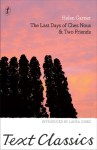
Helen Garner, Last days of chez house & Two friendsHelen Garner must have loved prize-winning book designer WH Chong’s cheeky cypress-dominated cover for the Text Classics edition of her two screenplays, The last days of chez nous and Two friends. You’d only realise this, though, after reading her Preface, in which she explains that she had incorporated cypresses into her screenplay for their “freight of meaning”, but that, because an appropriate location could not be found, they were replaced by a spire! For the published screenplay, however, Garner says she’d taken “the liberty of removing the spire and putting the cypress trees back in.” Love it.

I enjoyed reading this book much more than I expected. I’ve seen and enjoyed both films – a long time ago, as they were made in 1992 and 1986, respectively – but reading screenplays didn’t seem very appealing. How wrong I was. I’m glad, therefore, that Text decided to republish this volume in its Text Classics series. As always, they’ve value-added by commissioning an expert to write a commentary, which, in this case, given there was already an author’s Preface from the original 1992 edition, they appended an Afterword. It’s by well-regarded Australian scriptwriter, Laura Jones (who, coincidentally, is the daughter of the late Australian writer, Jessica Anderson.)

Both the Preface and the Afterword are informative and engaging, but I’ll start by discussing the plays. They are presented in the book in reverse chronological order of their writing, which means The last days of chez nous comes first. Both stories chronicle relationship breakdowns. This is common fare for Garner, but here as in all her work I’ve read, it’s not boring. Her skill lies in the intelligent, clear-sighted way she explores these situations, and in her ability to inject both humour and warmth. She’s never maudlin, and she never judges.

So, in The last days of chez nous, the breakdown is the marriage of Beth and her French husband JP, while in Two friends it’s the friendship between two 14-year-old girls, Louise and Kelly. Both, as is Garner’s wont, draw from her life. She was married to a Frenchman, the marriage did break up, and her husband did fall in love with and eventually marry her sister, most of which happens in the play. In Two friendsBernadette Brennan reports, she drew on a friendship her daughter had had, but, when she saw the film, she realised that it was “really, in a funny sort of way, about me.” And the “me” character was not the sensible daughter, based on her own daughter, but the friend from the troubled background.

In her Preface, Garner tells how the impetus to write her first play, Two friends, was money. She needed it at the time, so when the idea was put to her:

I rushed home and rummaged in my folder of unexamined ideas. Out of it stepped Kelly and Louise, the young girls who became Two friends.

She continues that, although money had been the initial driver, she found, as she got down to it, the writing was “powered by the same drives as fiction” – curiosity, technical fascination, and “the same old need to shape life’s mess into a seizable story.”

This latter point is important, not only because it confirms her lifelong subject matter, “life’s mess” aka relationships, but because it answers those criticisms that she “just” presents her journals. She doesn’t, she “shapes” what she’s experienced (and seen) into “a seizable story”. She also shares in the Preface some of the things she learnt from film writing, including the challenge of working collaboratively which is something writers don’t usually have to do, the “priceless art of the apparently dumb question”, and that she was “forced to learn and relearn the stern law of structure.” She explains, using Last days of chez nous, how her “perfectly smooth narrative curve” was turned into “a little Himalaya of mini-climaxes”.

This is a good place, though, to talk about the structure of Two friends which chronicles the girls’ relationship breakdown in reverse. That is, we start at the point where it appears to have broken down and move back through the months to the peak of their togetherness. Experienced scriptwriter Laura Jones discusses this in her Afterword:

The story … is daringly told in the present tense, backwards, although each of the five parts is told in the present tense, forwards. We hold these two storytelling modes in our minds at once, the forwards momentum and the backwards knowledge […] Such deft playing with time–elegant, formal and musical–offers great storytelling pleasure, as we move from dark to light, from the painful separation of two adolescent girls to the rapturous closeness of ten months earlier.

She’s right, it’s clever because the end is bittersweet – we love the close friendship but we know what’s coming.

Now I want to share some of the experience of reading these plays. Here is an example from early in Two friends when Matthew, Louise’s wannabe boyfriend, tells her he’s seen Kelly:

LOUISE: What did she look like?
MATTHEW: All right.

He shrugs; like many boys he is not good at the kind of detail Louise is after.

These instructions to the actor about his character also enliven the reading. It’s the sort of sentiment you’d find in a Garner novel, though perhaps expressed a little more creatively.

And here’s some scene-setting in the next part, where Louise, Matthew and Kelly are together:

Kelly plays up to Matthew–almost as if she can’t help it. (Kelly will become one of those women who, when there’s a man in the room, unconsciously channel all their attention towards him.)

Similarly, in Last days of chez nous. Here is a scene where Beth has eaten some French cheese that JP has been storing carefully until it reaches maturation. He’s very upset, and eventually Beth senses the importance to him:

Beth is silent. They stand looking at each other. She has not quite succumbed, but for once he has her full attention–and this is so rare that he does not know what to do with it …

All this is probably what always happens in scripts, but Garner’s way of describing the situations and characters certainly made the screenplays more than just readable. They were engrossing.

Of course, I read Shakespeare’s (and other) plays at school – but that was school and, although I enjoyed them, I haven’t really gravitated to reading plays/scripts since. I won’t be quite so cautious in future.

Do you read them?

AWW Badge 2018Helen Garner
The last days of chez nous and Two friends
Melbourne: Text Publishing, 2016
243pp.
ISBN: 9781925355635

(Review copy courtesy Text Publishing)
Bernadette Brennan, A writing life: Helen Garner and her work (#BookReview)

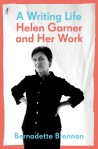
Bernadette Brennan, A writing life Helen Garner and her workEnough of the filler posts for a while! It’s time for a review, and it’s a special one because it’s for a book about one of my favourite writers, Helen Garner. The book is Bernadette Brennan’s A writing life: Helen Garner and her work. Described as a “literary portrait” rather than as a biography, it carefully and thoroughly explores her work from multiple angles, the effect of which was to confirm my overall understanding of her work while also resolving some of the gaps or misconceptions in my reading of her.

This brings me straight to the book’s fundamental assumption that knowing a writer’s life is (or can be) relevant to understanding his or her work. Brennan writes in her Introduction that she did not want to write a biography, which was just as well, as Garner did not want her to either. However, Brennan “knew” that the intersection of Garner’s “life and art made discussion of the biographical essential to understanding her work.” There are those who argue that the text is the thing – and the only thing. However, others of us believe that our reading of a text can be enhanced by other factors, that, as editor and critic Adam Kirsch has said, it is valid “to use the life to clarify the factors that shape the work — to show how life and work were both shaped by the same set of problems and drives.” What I realised while reading this book is that this can be as true for non-fiction as for fiction.

“honest, authentic” (Brennan)

I have written about Helen Garner several times on this blog, and many of those times I’ve explained that I love her writing, even though I don’t always agree with her. I love her honesty I say. Well, so do others apparently. In her Introduction, Brennan writes that:

Garner is one of the best-known and, some would say, best-loved writers in Australia. That admiration is inspired by a sense that she is honest, authentic …

And then, working chronologically, she starts the book proper with Garner’s first novel, Monkey grip. Concluding this chapter, Brennan quotes the judges who awarded Garner the National Book Council Book of the Year Award in 1978. They described her as “utterly honest in facing the dilemmas of freedom, and particularly of social and sexual freedom for women”. That was just the beginning. Garner, as we now know, continued to confront difficult issues and, as a result, to face censure, again and again, throughout her career. Brennan, to use current jargon, unpicks all this, book by book, using the texts themselves, the responses of critics, Garner’s unpublished letters and diaries, the clippings she collected, and spoken and written conversations with Garner herself and with several who know (or knew) her. It’s comprehensive.

You may be wondering at this point whether you need to have read Garner’s books to gain value from this book. Not necessarily, I’d say. I have read eight of the listed fourteen books, and found the chapters on those I haven’t read engaging despite not knowing them. However, those on the books I have read were particularly engrossing, and frequently illuminating.

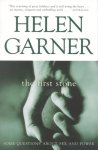
Helen Garner, The first stoneTake The first stone, for example. Subtitled “Some questions about sex and power” it explores a 1992 sexual harassment scandal at a Melbourne University college. The book was highly controversial at the time and Garner copped some ferocious criticism, particularly from feminists, for the stance she took. I was one who disagreed, strongly, with her. But, here is where my point regarding the value of knowing the author’s biography comes in. In a 50-page chapter, Brennan analyses the book in depth, exploring the circumstances of the case, Garner’s writing process, and the role played by the facts of her life in the approach she took. It was enlightening. I came away still not exactly agreeing with her, but understanding Garner’s position more. Brennan describes, among other things, Garner’s uncertainty regarding the young women, and how her own history and vulnerabilities affected her response.

Brennan starts this chapter with the statement that the “truth” surrounding the events “may never be fully known”, and follows this with the “facts” that are known. Of course, I loved this differentiation. Another significant point Brennan makes in the chapter concerns Garner’s positioning of herself in the story. The idea came from friend and publisher Hilary McPhee who, writes Brennan

suggested she insert herself as a character in into the narrative and write a book that charted the effects of each person’s statement on her own point of view. That strategy allowed her to explore the issues with which she was grappling, despite the absence of the complainant’s perspective, yet it late infuriated some commentators.

This approach would have come naturally to her, I’d say, given that all her writing has a strong autobiographical component, as she herself admits. This intrusion of her “self” has become a feature of her non-fiction writing and is part of a style of narrative non-fiction that she helped pioneer and that we now see used by younger Australian writers like Anna Krien and Chloe Hooper.

Brennan’s research into the writing of The first stone is meticulous, and is carefully documented in the end notes. Her subsequent analysis and the conclusions she draws are well-considered and make sense. She applies this technique to every chapter – to her discussions of Garner’s fiction like Monkey grip and Cosmo cosmolino, as well as to her other non-fiction works like Joe Cinque’s consolation and This house of grief. The book ends with last year’s essay collection, Everywhere I look.

“For me, particularly, it’s one book. The book of what I make of the world and my life as I have lived it.” (Garner)

Superficially, Garner’s work is diverse. She has written in almost every form you could imagine, including song lyrics, libretti, and plays as well as novels, short stories, essays and longform non-fiction. But the subject matter is much tighter – it tends to be domestic and relationship-based, but with a particular focus, because it grapples, says Brennan, with the problem of balancing “the desire for personal freedom with ethical responsibility”. Garner’s concerns are ethical and moral. She explores these values in the daily lives of ordinary people, in both her fiction and non-fiction, whether it’s a mother deserting her family (in The children’s Bach) or a father driving his car full of children into a lake (This house of grief), and she doesn’t separate herself from the issues. She shows her own failings, her own ugliness, with a breathtaking vulnerability, and brings, Brennan shows, much distress upon herself. She doesn’t, in other words, write what she writes lightly.

So, what picture does Brennan paint of Garner, the writer? It’s a complex one. It’s of a writer who has strong emotions, a fierce intellect and a commitment to seeking out the “truth”. It’s of a writer who can be hard on others, including those she knows, but who is equally hard on herself. It’s of a writer who isn’t scared to cross boundaries of form and defy expectations in order to tell the best story she can. Brennan’s approach to her topic is analytical, rather than critical. That is, she interrogates Garner’s work and mines her life for the aspects that will help us understand the work, but she doesn’t, herself, critique the work – which is probably to be expected, given the book’s title.

There is so much more that could be said about the book, so many angles from which it could be discussed, but I’ll close here by saying that this is, obviously, a book for those who want to understand Garner’s work more. But, it is also a book which makes clear the significant contribution Garner has made to Australian literature. And, in doing that, it is itself a significant book.

aww2017 badgeBernadette Brennan
A writing life: Helen Garner and her work
Melbourne: Text Publishing, 2017
334pp.
ISBN: 9781925498035

Helen Garner, Why she broke: The woman, her children and the lake (#Review)

Three years ago I reviewed Helen Garner’s This house of grief about Robert Farquharson who drove his car into a dam in Victoria, resulting in the deaths of his three sons. It’s a grim grim story, so you might wonder why I am now writing about her essay “Why she broke: The woman, her children and the lake” about Akon Guode who, in 2015, drove her car into a lake in Victoria resulting in the deaths of three of the four children inside.

There are two reasons, the main one being that this essay was, last week, awarded the Walkley Award (about which I’ve written before) for Feature Writing Long (over 4000 words). I hadn’t read the article when it was published in June this year, and probably wouldn’t have read it now, except for this award. What, I wondered, when I heard the news, made this essay, on a topic so seemingly similar to her recent book, worthy of the Walkley Award? The other reason is that although there are similarities – both parents drove their cars into water resulting in the deaths of children – there is a big difference. One parent was a father, and the other a mother. I wanted to know what, if anything, Garner would make of that in her analysis.

I’ll start two-thirds through the essay, where Garner quotes Guode’s defence counsel using a statement made to the Victorian Law Commission in 2004:

While men kill to control or punish their children or partner, women kill children because they cannot cope with the extreme difficulties that they encounter in trying to care for their children.

Given the current political climate – Harvey Weinstein, Don Bourke, et al – this statement must surely be read as part of that bigger picture concerning women’s powerlessness.

In the first part of the essay, Garner describes Guode’s life. She was a Sudanese refugee to Australia who had been married as a teenager but had then lost her husband in the civil war there. In that culture women cannot remarry, but remain a possession of their husband’s family. Guode’s third child was fathered by a brother-in-law. Eventually, after more trauma in Africa, she was sponsored to come to Australia by another of her late husband’s brothers, Manyang. Her life here became difficult in a different way, with her bearing four children to this already married man. At the time of the incident she had seven children.

Garner details the difficulties of Guode’s life, including the traumatic birth of her seventh child, and her struggle to care for her family while also sending money back to family in Africa. To her, this was an obligation, but at the committal hearing, Garner writes, a local community leader said that “It is not an obligation. I would call it a moral duty”! Not surprisingly Garner’s reaction to this is that “under the circumstances this seems like a very fine distinction”! This sort of word play – “obligation” versus “moral duty” – can make such a mockery of the law (or of its practitioners), can’t it?

There was of course discussion during the hearing of Guode’s mental state, with the judge suggesting that “something dramatic” must have triggered her action. The psychiatrist, however, argued that “it can just be the ebb and flow of human suffering, and the person reaching the threshold at which they can … no longer go on.”

But Garner also proposes a possible “trigger event” that went back 16 months to the last traumatic birth. Postnatal haemorrhaging was so bad she was close to needing a hysterectomy. Guode initially refused treatment. Garner writes that she was

prepared to risk bleeding to death on a hospital gurney rather than consent to the surgical removal of the sole symbol of her worth, the site of her only dignity and power: her womb?

Surely, a woman whose life had lost all meaning apart from her motherhood would kill her children only in a fit of madness.

Garner also discusses the technicalities of infanticide versus murder in Victorian law, and Guode’s counsel’s argument that all three deaths should be viewed through “the prism of infanticide”, which would result in a lesser sentence, even though only one of the children met the age criterion. Her eventual sentence makes clear that he didn’t win his argument.

What makes this essay so good, besides the analysis, is Garner’s writing. Here she is on a jury trial versus a plea hearing (which this was):

If a full-bore jury trial is a symphony, a plea hearing is a string quartet. Its purpose seems to be to clear a space in which the quality of mercy might at least be contemplated. There is something moving in its quiet thoughtfulness, the intensity of its focus, the murmuring voices of judge and counsel, the absence of melodrama or posturing. It’s the law in action, working to fit the dry, clean planes of reason to the jagged edges of human wildness and suffering.

That last sentence! Breathtaking. It reminds me once again what an excellent essayist Garner is, and it’s not just for her style. She has the ability to take us on a journey, leading us logically, and empathically, to consider values and ethics, without ever being didactic.

In this essay, it’s her concluding comments and final question regarding mercy which gets to the nub of it. It concerns the idea of “mother”, which she calls “this great thundering archetype with the power to stop the intellect in its tracks”. Read Garner’s essay, and/or this report in The Age, and see what you think. I don’t envy Justice Lasry’s job, but I know, based on what I’ve read, where my intellect goes.

aww2017 badgeHelen Garner
“Why she broke: The woman, her children and the lake”
The Monthly, June 2017
Available online

Helen Garner on writers and writing (in Everywhere I look)

Helen Garner, Everywhere I look

As I promised in my main review of Helen Garner’s engaging book of essays and jottings, Everywhere I look, I am here doing a little follow-up post on her discussions of other writers. I enjoyed reading her thoughts about specific writers, but even more I liked that in talking about these writers she gave away her own writing preferences.

So, what did I know about Garner’s writing before this? One is that she tends to write from her own life and experience. This is why, I’m sure, she moves so comfortably between fiction and non-fiction, but it’s also something that has got her into trouble at times. Some critics argued that her first, generally applauded novel, Monkey grip, was just her diary; others suggested that The spare room is not really a novel either. Garner has retorted – and I take her point – that when she writes novels drawing from her life, she selects, orders and constructs a narrative and that that is art.

The other main thing I’ve noted is that her writing is on the sparer side of the spectrum. She can be highly evocative but she doesn’t go much for metaphorical flourishes. I’ve quoted her before as saying that Thea Astley’s writing “is like a very handsome, strong and fit woman with too much makeup on … This kind of writing drives me berserk”. I was reminded of this when I read her piece in this collection on Tim Winton. She says about first meeting him at a writers’ weekend in 1982. She had not long before written a review of his first novel:

Stabbed with panic, I scoured my memory for what I’d said in my review. I liked the novel and had said so; but from the lofty eminence of a minimalist who’d published  fully two books, I’d drawn attention to what I saw as his overworked metaphors …

Fascinating, because as much as I love Winton, I clearly remember thinking something similar about his second novel, Shallows.

But now, with that introduction, I’ll get to what I really want to share. Her discussions about writers come mainly from two (“Notes from a brief friendship” and “The journey of the stamp animals”) of the book’s six sections. The writers she talks about include Australians Tim Winton (“Eight views of Tim Winton”), Elizabeth Jolley (“My dear lift-rat”), and Barbara Baynton (“Gall and bare-faced daring”), the American journalist Janet Malcolm (“The rapture of first-hand encounters”), and the English novelist who needs no introduction here Jane Austen (“How to marry your daughters”). Each of these gave me little insights into Garner, and I’m just going to tease you with a smattering because – well, you know why, because you should read the book yourself.

Although I’ve already mentioned Winton, I’ll share one more thing. It relates to Garner’s interest in (and reputation for) sentences, and is an exchange from their ongoing correspondence:

I sent him a jubilant letter: ‘Hey! I’ve just written a 200-word sentence which is syntactically perfect!’ ‘I couldn’t care less,’ he replied, ‘about that sort of shit.’

For all this, though, she likes Winton!

Garner loves Elizabeth Jolley for her ability “to strike a note of mortification and inject it with the tincture of the ridiculous that makes it bearable.” That’s Jolley alright, and I can see that both she and Garner, while very different writers, do both look at the world, at people’s relationships in particular, with a sort of self-deprecating sense of absurdity that can lighten darkness. Does that make the sense I think it does?

I was surprised by her piece on Barbara Bayntonabout whom I have written frequently here – not because I was surprised to find she admires Baynton but because I didn’t know she did! Her piece starts:

I was well into my forties when I came upon Barbara Baynton’s story “The chosen vessel”, and I have never got over it.

Yep, I know what she means. I was late to Baynton too, and equally stunned. Garner is impressed, of course, with the power of Baynton’s stories, with their lack of romanticism, particularly about women’s lives. But what I want to share here is her comment on Baynton’s writing.  She recognises that some of Baynton’s sentences can seem “clogged and heavyhanded” to modern ears, but, Garner writes

… my God, when she hits her straps, she can lay down a muscular story […]

At their height, her dry, sinewy sentences stride forward, powered by simple verbs.

You are probably getting a picture of the sort of writing Garner likes – direct, clear, fearless, like Jolley, like Baynton.

And then there’s the American journalist Janet Malcolm, of whom I’ve heard but not read (to the best of my knowledge). Malcolm, she says, has been her greatest teacher. I’ll just share a comment from her opening paragraph:

I have never met her, or heard her speak, but I would know her voice everywhere. It is a literary voice, composed and dry, articulate and free-striding, drawing on deep-learning, yet plain in its address, and above all fearless …

Need I say more?

And finally, Austen. She surprised me when, describing herself sitting down to read Pride and prejudice in 2013, she said that she wasn’t sure when, or even whether, she’d read it before! What? However, she writes,

I sharpened a pencil and sat down at the kitchen table.

Just how I like to read, with a pencil in hand. Garner goes on to describe her experience of reading Austen – providing wonderful writer’s commentary on the style, the narrative arc, the characters – and how she became hooked:

I lowered the blinds against the heat, unplugged the phone and moved operations to my sopha, where, dispos’d among charmingly group’d cushions, I settled in for the duration.

… as did I, to read more of her (first?) impressions! She continued, still with her writer’s eye:

In order to keep my eye on how Austen was actually doing things, I was having to work hard against the seduction of her endlessly modulating, psychologically piercing narrative voice, her striding mastery of the free indirect mode.

She describes how Austen “gives us five enthralling pages of Elizabeth thinking“, she provides commentary on how the story proceeds, but best is her perspective on that “piece of trash” Lydia and her role in ensuring that the loose ends aren’t quite so perfectly wrapped up as Garner feared they would be. It’s a delicious piece of writing – Garner’s I mean – about a delicious piece of writing. I laughed.

And now, I must get Garner’s previous collection of essays, The feel of steel …

Helen Garner, Everywhere I look (Review)

Helen Garner, Everywhere I lookI was very sad to come to the end of Helen Garner’s latest essay collection, Everywhere I look. It was such a joy – such a joy – to read. Garner ranges across a wide variety of subjects from a kitchen table to Russell Crowe, from some of the darkest things humans do to each other to the beauty of ballet dancers in rehearsal, and she does it in a natural, warm voice that makes you almost feel as if she’s sitting across that kitchen table from you. While it would be cheeky of me to say that I now understand her, this collection provides wonderful insight into the way she thinks, how she goes about the business of living, why she writes the things she does. We come to know her as a human being who muddles through life, making mistakes, questioning herself, confronting challenges, rather than as the literary doyenne she in fact is. In other words, as she always does, she lays herself open.

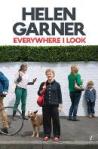
I call these essays, but some are probably better described as articles or perhaps even columns, and there are a few which read more like collections of jottings or diary entries. Form isn’t the important thing here, it’s the content. The collection comprises 33 pieces, all but three of which have been previously published. Three date back to the 1990s. Many were published in Monthly, and some others in the Age and the Sydney Morning Herald. It’s not always obvious why they were originally written, but in this collection they have been loosely grouped into six broad thematic groupings, starting with “Part One: White paint and calico”, which is all about homes and things domestic, and ending with “Part Six: In the wings”, which I’d describe as comprising reflections about life and self. The cover, designed by the award-winning WH Chong, is just gorgeous, and I found myself looking at it several times as I read, opening it out to look at the whole front-and-back panorama.

But now, that common challenge of writing about a collection: what to discuss, what to leave out. I am going to leave out one thing, and that’s her discussion of writers and writing, because I want to save that for another post. Perhaps I’ll start with some “yes” moments, not that I have to always agree with writers to appreciate them, but affirmation can be nice. There’s her jotting in “When not writing a book” in which she expresses elation over the election of Obama. What an exciting time that was, even for us antipodeans. Her statement – “To think I’m alive when this happened” – is one many of us shared. I remember popping a bottle of bubbly with my patchwork group for the occasion.

There are delightful, often humorous, anecdotes about family life, especially about her grandchildren who now live next door to her, and there are little jewels of description, such as this perfect one of Christmas mornings:

The unnerving silence of Christmas morning. No sound of traffic. Sun lies fresh on everything. Birds sing with unnatural sharpness. The air is still.

And I did love her reference to a criticism of Muriel Spark in “Funk paradise”, another diary style piece:

Apparently her letters make no reference whatsoever to current events. So?

This accusation is also levelled at Jane Austen – for both her novels and letters – the implication being that to be valid you have to be political. I contest that. Austen and Spark write compassionately but incisively about human nature. Let others do politics if they will!

However, the section that grabbed me most was “Part Four: On darkness”. Here she explores the dark sides of human nature through five stories/cases about people who have done terrible things to others. This is subject-matter that many readers shy from, and those who do this tend to make those of us who don’t feel a bit ghoulish. Garner writes in this section about some well-known cases in Australia including the rape-murder of Jill Meagher (“The city at night”) and the murder of Luke Batty by his father (“The singular Rosie”). The fifth and last piece in this section is called “On darkness” and it’s about the Robert Farquharson trial which is the subject of her book, This house of grief (my review). In her opening paragraph she writes:

When the book came out I was struck by the number of interviewers whose opening question was ‘What made you interested in this case?’ It always sounded to me like a coded reproach: was there something weird or peculiar about me, that I would spend seven years thinking about a story like this.

She continues, describing how she would try to come up with “sophisticated explanations” for her curiosity, but eventually tired of being defensive. She outlines the complexity of the case – the ordinary people who behave in ways that even they can’t understand or explain – and asks why this is not worth exploring. She says:

People seem more prepared to contemplate a book about a story as dark as this if the writer comes galloping out with all moral guns blazing. A friend of mine told me that the woman who runs his local bookshop had declared she would, under no circumstances, read my book. Surprised, he asked why. ‘Because’, she replied. ‘I know that nowhere in the book does she say that Robert Farquharson is a monster.’

If he had been a monster, I wouldn’t have been interested in writing about him. The sorts of crimes that interest me are not the ones committed by psychopaths. I’m interested in apparently ordinary people who, under life’s unbearable pressure, burst through the very fine membrane that separates our daylight selves from the secret darkness that lives in every one of us.

This is why I like Garner. She’s generous, openly questioning, tender, but fierce too. And just in case you think she has no “moral guns”, read her piece in the last section, “The insults of age”, in which she describes her reaction to a young teenage girl whom she’d seen intimidating/disrespecting some Asian people. Garner writes:

… I saw the Asian woman look up in fear, and something in me went berserk.

In two strides I was behind the schoolgirl. I reached up, seized her ponytail at the roots and gave it a sharp downward yank. Her head snapped back. In a voice I didn’t recognise I snarled, ‘Give it a rest, darling.’ She twisted to look behind her. Her eyes were bulging, her mouth agape. I let go and she bolted away to join her friends …

This is why I like Garner!

There is so much in this book, lighter stuff too, but I’ll leave those delights for you to discover.

In “My dear lift-rat”, her delightful piece on Elizabeth Jolley, Garner says that she frequently wrote about Jolley’s books “in literary magazines, trying not to go over the top”, and that Jolley would write “formal” thank you letters. “I never knew”, Garner wrote, “whether she really liked them, or if she thought I had missed the point”. If Garner can feel that way about writing reviews (or critiques), then I don’t feel so badly about having the same worries! I sure hope, though, that I haven’t missed her points in this one.

awwchallenge2016Helen Garner
Everywhere I look
Melbourne: Text Publishing, 2016
227pp.
ISBN: 9781925355369

Helen Garner, This house of grief: The story of a murder trial (Review)

Helen Garner, This house of grief book cover

Courtesy: Text Publishing

Well you might ask why you would want to read a book about the trial of a man accused of murdering his three sons by driving his car into a dam and escaping the car himself? Indeed, Helen Garner was asked why she would want to attend such a trial – and write about it. But Helen Garner is made of strong stuff, having previously written The first stone about the sexual harassment of two girls at Melbourne University’s Ormond College and Joe Cinque’s consolation about the trial of a woman accused of murdering her boyfriend via a drug overdose. I’ve read and appreciated both these books, along with novels and short stories by Garner, and so was keen to read this, her latest.

For those of you who don’t know the story, here’s Wikipedia’s summary of what happened:

… as Farquharson was returning his children to their mother after a Father’s Day access visit, his white 1989 VN Commodore vehicle veered across the Princes Highway between Winchelsea and Geelong, crashed through a fence and came to rest in a farm dam where it filled with water and submerged. His three children, Jai (10), Tyler (7) and Bailey (2), were unable to free themselves and drowned. Farquharson managed to escape and alerted another driver who took him to nearby Winchelsea. Police divers recovered the boys’ bodies about 2 am the next day. They were still inside the vehicle and unrestrained by seatbelts.

Farquharson claimed that he did not intend to kill his children, that he had blacked out during a coughing fit (a condition known as cough syncope). However, he was tried and found guilty, tried again after winning an appeal and found guilty again, and was then refused leave to appeal to the High Court of Australia.

Garner sat through both trials, the first one lasting around 7 weeks, and the second one 11 weeks, and managed to condense it all into 300 pages of lucid prose. One of the reasons I was keen to read the book was to see what approach she’d take. In The first stone and Joe Cinque’s consolation, Garner’s opinion is pretty clear from the beginning – and I didn’t fully agree with her (for very different reasons in each of the books). However, in This house of grief, Garner is more measured. She doesn’t want to believe that Farquharson is guilty – “longed to be persuaded” otherwise – but is gradually swayed by the evidence to believe it must be so. She doesn’t engage emotionally with the participants in the intense way she did in Joe Cinque’s consolation, but she is emotional. How could you not be in such a case? There are two reasons I like Garner – her tight, evocative prose, and her fearless honesty. And so, in this book, she tracks her own response as she listens to the evidence – from her disbelief that a father could do such a thing, and her sentimental desire to believe Farquharson, to her horrified admission that any doubt about it is “no more substantial than a cigarette paper shivering in the wind”.

So, let’s get back to the original question. Why read such a story? There are a few reasons, but I’ll discuss my two main ones. The first is to gain insight into, and understanding of, human behaviour. Why do people do what they do? It’s so easy to judge people out-of-hand, but even horrific events have nuances, and I want to understand those. Not to excuse, because it’s impossible to excuse taking the lives of those in one’s care, but to be able to empathise in some way. Isn’t this what literature is about?

Garner achieves this by not demonising Farquharson. As she watches him in court, and listens to the evidence – professional, personal, expert – she presents a picture of a man who was “emotionally immature, bereft of intellectual equipment and concepts, lacking in sustaining friendships outside his family”. At the end of the first trial, the judge speaks kindly to Farquharson, and Garner writes:

Farquharson nodded to him, courteous and present. For the first time I saw him as he might have been in ordinary life, at work, at school. It touched me. Again I felt shocked, as if this response were somehow illegitimate.

(Interestingly, Garner did not accord such recognition to Anu Singh in Joe Cinque’s consolation. Yes, different case, very different people, but the principle still stands I think.) A little earlier in the trial, Garner quotes “a tough American prosecutor” who’d said to her:

‘If I were appearing for him, I’d try to make his family see that loving him doesn’t have to mean they believe he’s innocent’.

But, how tough that would be, eh?

My second reason is to understand the workings of courts and justice. I have never (yet anyhow) been called for jury duty. Oh my, oh my, after reading this, I’m even more desperate that I never am. Although it’s pretty obvious that the right verdict was achieved in this case, the process was not reassuring. Garner’s reporting of evidence and cross-examination reads very like those court dramas you see in film and television. There’s drama, police mistakes, twisting of the truth, character assassinations, conflicting expert opinions – and, in this case, a lot of complicated and sometimes obfuscatory technical evidence about cars and tire tracks and steering inputs, about arcs and gradients. And it goes on for weeks.

Garner keeps it interesting by focusing on the people and their reactions, reporting some dialogue, and summarising the critical (which, she makes clear, is not always the most relevant) points of evidence. Her descriptions of the defence and prosecution team are drawn with a novelist’s eye for character. Sometimes Morrissey, the defence barrister, is “as jumpy as a student undergoing an oral exam”, while at other times he’s “less flustered … more in control of the content and tone of his discourse”. His “waxen” appearance at the second trial is quite different from the beginning of the first when he’s presented as a hearty “spontaneous, likeable man” whose “stocks were high”.

She also pays a lot of attention to the jury. Of course we cannot know what they thought or discussed but Garner watches them, noting when their attention flags and when it picks up, when emotions get the better of them. She writes, for example, of one witness that “the jury liked him … he was one of the witnesses they instinctively trusted”. During her report on the second trial, she quotes American writer, Janet Malcolm who wrote that “jurors sit there presumably weighing evidence but in actuality they are studying character”.

Partway through the book, Garner comments that the question “Did he do it?” is the “least interesting question anyone could ask.” Later, between the first and second trial, she quotes a grandmother from another murky situation in which a father was suspected of killing his children via a house fire. The grandmother asks:

‘What’s worse? — living with suspicions and various possibilities and never knowing the truth, or living with the truth of something too horrible to contemplate.’

Books like Garner’s enable us – nay, force us – to contemplate such questions. They show us that trials are less about retribution, perhaps even less about justice, but more about the truth. What we are to do with the truths we so glean is another question – but that question, Garner suggests, is our “legitimate concern”, and I agree.

awwchallenge2014Helen Garner
This house of grief: The story of a murder trial
Melbourne: Text Publishing, 2014
300pp.
ISBN: 9781922079206

(Review copy courtesy Text Publishing)
Meanjin’s Tournament of Books 2011, Finale

… and now we have a winner! Those of you who have been following the tournament will know that the two books facing off in the Finale were Helen Garner‘s The children’s Bach and Joan London‘s Gilgamesh. I would not have guessed this at the beginning (and neither, they say, did the organisers). Not because these aren’t great books – I’ve read them both – but because they are not the ones on the top of people’s tongues (like, say, My brilliant career) or the ones with critical weight behind them (like, say, The man who loved children or The fortunes of Richard Mahony). That said, I’m surprised but not sorry, because it’s no bad thing to expose other works to wider attention. The question is, will they get it?

Anyhow, onto the finale. It was judged a little differently: there was a panel of 5, with each giving a brief reason for his/her vote. You can read their reasons on the Meanjin site, because here I’m simply going to announce that the winner.  And it is, drum roll please, with 3 votes to 2,  Zombie Round returnee, Helen Garner’s The children’s Bach.  I’m happy – after all it’s one of the few from the original list that I’ve reviewed on this this blog. It was a reread too, which tells you something: Garner is a great writer.

The real question, though, is what happens next? Has the Tournament achieved anything for Australian literature, and Australian women’s writing in particular? Is it worth doing again next year? Well, I’m not sure. Leaving off the question concerning the merits of judging books, and looking at it from a consciousness-raising point of view, which were, I believe, its main goals, did Meanjin‘s Tournament achieve what it set out to. I fear it didn’t … and that I suspect is due less to the tournament itself than to lack of promotion of it. I didn’t see or hear much buzz about it around the traps – in neither the formal print and electronic media nor in less formal places like blogs.

Appropriately, the following quote from The children’s Bach has some application here:

Like many women of her age whose opinions, when they were freshly thought and expressed, had never received the attention they deserved, Mrs Fox had slid away into a habit of monologue, a stream of mild words which concealed the bulk of thought and knowledge as babbling water hides submerged boulders.

I fear that, like Mrs Fox’s wisdom, the submerged boulders of good Australian literature have stayed submerged … what must (can) we do to expose them?

Meanjin’s Tournament of Books 2011, Zombie Rounds

Just one round of Meanjin‘s tournament of books to go … after this one, that is.

The Zombie round comprises the winners of Semifinals 1 and 2 being pitted against the books returned to the fray by reader vote in the Zombie poll (on which I reported at the end of the Semifinals post).

Zombie Round 1: Joan London’s Gilgamesh defeated Alexis Wright’s Carpentaria

Well, hmmm … I don’t have a particular problem with the winner here as they are both very fine books. I love Gilgamesh and would not be sorry to see it win, though I did have a slight preference for Carpentaria because of the “bigness” (to use my best litcrit terminology) of its idea/s and language. It is a larger than life novel that takes you on a very wild ride. And it explores some of the conflicts and challenges faced by contemporary Indigenous Australians, something we need to see more of in our contemporary literature. But, this judging was odd. Firstly, the judge was First Dog on the Moon, the pseudonym of Andrew Marlton, the cartoonist for the independent electronic magazine Crikey. This is fair enough, but he got his facts wrong. He described the two books he was judging as “zombie” books. However, only one is. And then, the judging took the form of a cartoon. It was just a little too light-hearted, a little too minimal … but perhaps, really, he took just the right tack. We’ll get a winner in the end but we all know, don’t we, that all the books are winners!

Zombie Round 2: Helen Garner’s The children’s Bach defeated Miles Franklin’s My brilliant career

Ah well, the grand old dame of Australian literature, the bequeather of our (arguably) most important literary prize, has been toppled off her perch by the zombie! Just shows it’s never over till it’s over, eh? Lorelei Vashti, the judge, uses some rather odd criteria to make her decision – she likes the old-fashioned (or, is that, oldfashioned) way Garner’s book used “ear-rings” for “earrings”; she believes (and gives examples) that men called Harry always get the girl but Franklin’s Sybylla rejects her Harry for a career! In the end, being (semi-) serious, she gives it to Garner because, and I’ll quote:

So, in conclusion: near the end of The Children’s Bach, Philip instructs a girl who is trying to write pop song lyrics: ‘Make gaps. Don’t chew on it. Don’t explain everything. Leave holes,’ and that there is a Garner masterclass; it’s precisely what her book does. You never find her doing something so obvious as, for example, rhyming Harry with marry; this book is all about the gaps and holes.

I do think Garner is a very fine writer, so I won’t argue – though I probably wouldn’t have argued with the alternative either. It’s that sort of tournament after all.

Next …

The Final. Who will win? Gilgamesh or The children’s Bach? Which would you vote for?

Monday musings on Australian literature: Writers from Victoria

Coat of Arms of Victoria (Australia)

Victoria's Coat of Arms (Presumed Public Domain, via Wikipedia)

Over the course of these Monday musings have been occasional posts on writers from specific geographic locations in Australia – but I have not done our two most populous regions, the states of Victoria and New South Wales. The time has come to confront there two – and so, today, I present you Victoria.

Now Victoria is a special state – not only does Mr Gums Jr live there, but its capital Melbourne was the second city to be designated as a UNESCO City of Literature! That’s a pretty impressive achievement. I have written some literary road posts on Victoria, which have mostly focused on writers and works from the past, so in this post I will, as I have done in other regional posts, list (in no particular order) five of my favourite current writers from Victoria – some were born there, some migrated there.

Helen Garner

Garner is one of our most controversial writers – and has been, really, since the publication of her first novel, Monkey Grip, which some critics argued was simply her writing her own life. They meant by this that it had no creative merit, no literary value. This didn’t deter our Helen though, and she has gone on to become one of our significant writers – of both fiction and non-fiction. She has also written some successful screenplays. She writes about relationships and the things that cause disconnects between people, no matter how much they wish it might not be so. As regular readers of this blog will know, I don’t always agree with Garner, but I am always happy to read her because the woman has style. I’ve read too many of hers to list here, but if you’d like a recommendation, please ask!

Elliot Perlman

You may not have heard of Perlman, particularly if you are not Australian, because he is not particularly prolific. The first novel of his that I read was the multiple point of view Seven types of ambiguity (which makes a sly reference to literary theorist William Empson‘s book of the same name). It’s a good, thoughtful book about love and obsession, and the ambiguities therein! I then read Three dollars which explores the question of what happens “when bad things happen to good people” and how consumerism challenges (compromises) our values. It was adapted for film, starring the gorgeous David Wenham (aka Diver Dan if you are a Sea Change fan). Both these novels are set in Melbourne. According to Wikipedia he has a third novel out this year.

Arnold Zable

If you have been reading this blog recently, Arnold Zable will need no introduction. His focus is human rights, with a particular interest in the migrant experience. I’ve read two of his novels – Cafe Scheherazade and The sea of many returns – and will happily read more. His prose is lovely, his attitude warm and generous. I’m looking forward to reading his new novel, Violin lessons.

Beverley Farmer

I’m going to throw in a somewhat forgotten, I think, writer here. Way back in 1988 when my reading group started, we focussed on Australian writers, particularly Australian women writers. One of those was Beverley Farmer. We read her collection of short stories Milk and not long after I also read her second collection of short stories, Home time. Both these were published in the 1980s. She has also written novels, and one of those writers’ notebooks, A body of water, in which she documented her ideas and thoughts over a year, the books she was reading, the people she met. I was drawn to her because of the evocative way she conveyed her experience of being a young Australian wife in a Greek village. Like Perlman, she’s not prolific, but in 2009 she was awarded the Patrick White Award (for writers who “have made a substantial contribution to Australian literature but … may not have received adequate recognition for their work”) which says something about the quality of her work.

Peter Carey

I’ll conclude on another controversial writer. People, it seems, either love him or hate him – and I fall more in the first camp. He is one of only two writers to have won the Booker Prize twice. I have by no means read all of his books but I like the fact that he takes risks in his writing. I think his Oscar and Lucinda is a worthy contender for the Great Australian Novel (should we take that notion seriously). His True history of the Kelly Gang makes a significant contribution to the Ned Kelly myth by attempting to tell the story in Kelly’s voice. It is not all “true” in the factual sense, but it contains a “truth” that Carey thought worth exploring. His most recent novel, Parrot and Olivier in Americatook more risks – in voice and subject matter. Carey, as many of you will know, now lives in New York, but he was born in Victoria – and that’s good enough for this post!

So there you are, five Victorian writers. Now’s your chance to tell me what Victorian writers you like – or simply whether the writers I’ve listed here interest you.

Helen Garner, Postcards from Surfers

Helen Garner is a fiercely honest writer – and a prolific one too. She has written novels, short stories, essays and non-fiction books. All are generally well-acclaimed, though not always without controversy (as I mentioned in my recent Monday musings). Certainly, I haven’t always agreed with her … but I do admire her honesty and the quality of her writing. The book I’m reviewing here, Postcards from surfers, is a collection of short stories and provides an excellent introduction to her writing and her (fictional, anyhow) concerns.

Helen Garner, Postcards from Surfers

The collection was first published in 1985, but it has been recently rereleased (2010) by Penguin in their Popular Penguins at a Perfect Price series. Penguin also did an edition in 2008. That says something, I think, about the standing of this collection.

Unlike the last short story collection I reviewed, Leah Swann’s Bearings, this one takes its name from one of the stories in the book, the first to be precise. There is nothing in my copy to indicate whether the stories were written for this collection or whether some or all had been published before. The Resident Judge in her review said that several of the stories had appeared elsewhere before being collected here. I’d like to know when and where: I’m one of those people who always reads that part of the front or end matter for short story collections.

Anyhow, on with the stories. There are 11 of them and while there is an overall theme – the theme that we expect of Garner, that is love and relationships, particularly from the point of view of failure and loss – they are surprisingly (and wonderfully) varied. They vary in length from the little 4-page “The dark, the light” to more hefty first one (the title story) that runs for over 20 pages. The point of view varies: six are told in first person, and five in third person. So does the voice, from a girl child to a male drunk in a bar, from a female friend to a rejected lover. And the style varies. This was its most surprising aspect for me. There is, for example, the seamless flow across place, time and ideas of the first story (which is the more typical Garner), the disjointed vignettes of “The life of art” chronicling a long standing friendship, and the nicely sustained drunken first person rave of “All those bloody young Catholics”.

The subject matter varies too. The title story is about an adult woman coming to visit her retired parents and aunt at Surfers Paradise, leaving a broken relationship and a not fully successful life behind her. I was ready for something more discontented in this story, but the sense we’re given is that she’s matured and has learnt to be content with (tolerant of, perhaps) her imperfect family:

If I speak they pretend to listen, just as I feign attention to their endless looping discourses: these are our courtesies: this is love. Everything is spoken, nothing is said.

(Doesn’t that have a lovely flow to it? Garner’s writing is delicious.) This being Garner, several stories are about broken or past relationships, but there are also stories dealing more generally with families and parenting (“Little Helen’s Sunday afternoon” and “A happy story”) and friendship (“The life of art”).

I once heard Garner in an interview express admiration for the way Elizabeth Jolley reused and retold stories. I felt (though my memory may be failing me here) that she admired Jolley’s risk-taking in doing this (would it irritate or bore readers?) as well as her ability to spin more out of a character or situation. It seems Garner decided that if Jolley could do it, so could she. There is a character, a previous lover, Philip, who appears twice in this collection. He sounds very much like the Philip in Cosmo cosmolino. He represents the lost true love and often appears in her work (under that name or others). Where he is, some pain is usually there too. Here are two excerpts from “Civilisation and its discontents”:

He [Philip] woke with a bright face. ‘I feel unblemished’, he said, ‘when I’ve been with you’. This is why I loved him, of course: because he talked like that, using words and phrases that most people wouldn’t think of saying.

and

I wanted to say to him, to someone, ‘Listen, listen, I am hopelessly in love’. But I hung on. I knew I had bought it on myself, and hung on until the spasm passed.

Helen Garner wears her emotions openly. She’s never afraid to hang out the dirty laundry, to show the darker, more unpleasant sides of human relationships – the selfishness, the jealousy, the unkindness, and of course the pain – but it is always underpinned by a willingness to understand and accept our humanity rather than condemn it. Garner’s world is very much the real world. It’s not hard, I think, to find something in it you recognise (whether you like it or not!)

Helen Garner
Postcards from Surfers
Camberwell: Penguin Books, 2010 (orig. 1985)
ISBN: 9780143204909
154pp.

POSTSCRIPT: I wrote and scheduled this a couple of weeks before my Monday musings post. When I came back to check it I was rather relieved to find that I had not contradicted myself.