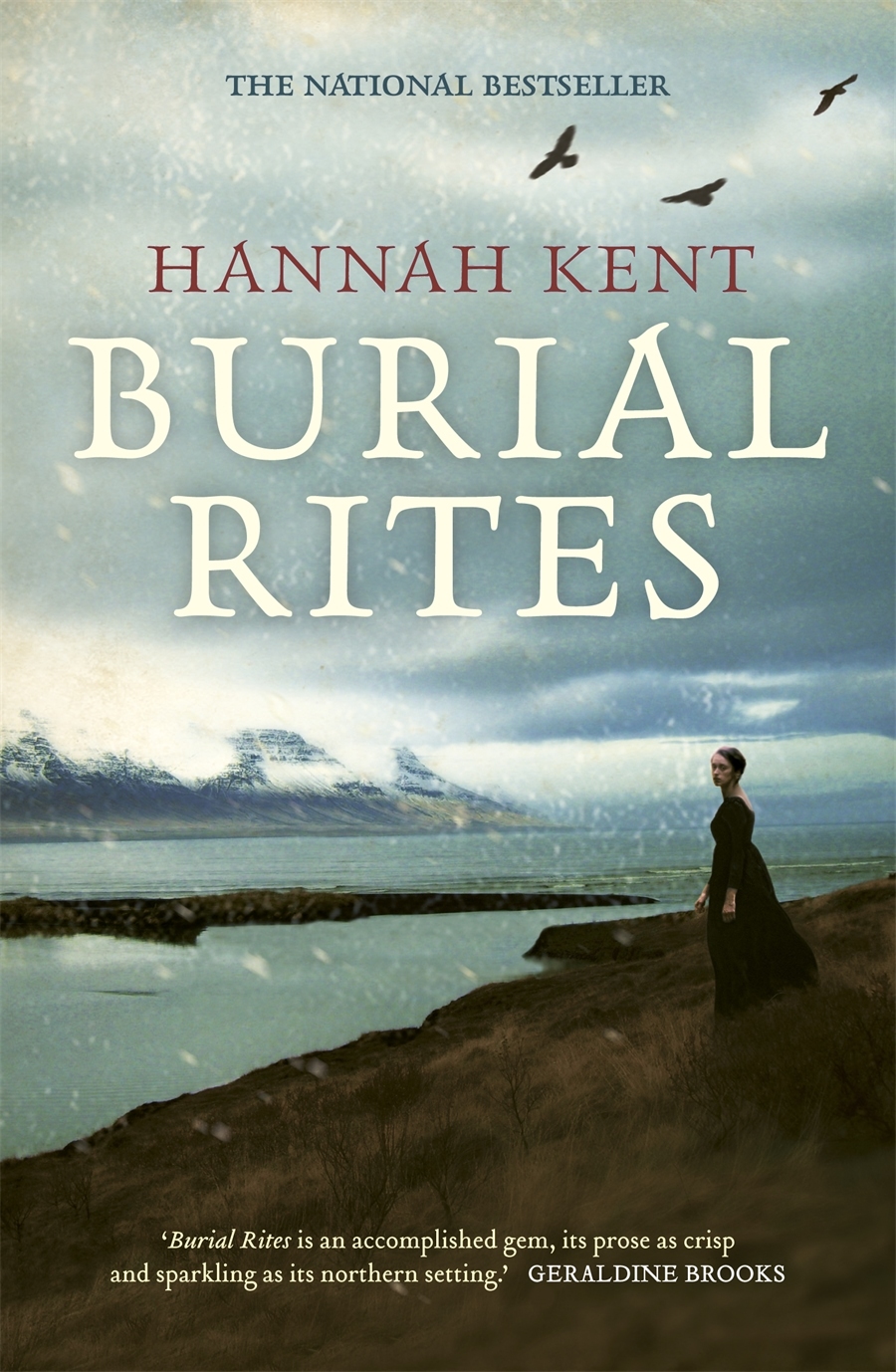
Courtesy: Picador
“We’ll remember you” says Margrét to Agnes on the day of her execution. We sure will, if Hannah Kent’s debut novel Burial rites has anything to say about it. Kent’s book is the second novel set in Iceland I’ve read, the first being Icelandic writer Halldor Laxness’s unforgettable Independent people. Although Laxness’s novel is set a century after Burial rites, it prepared me for Kent’s novel – for the difficult landscape, the hard lives, and the unforgiving natures that such an environment can engender. Yes, that’s a generalisation I know. You can find unforgiving natures anywhere, but oh, they work so well in harsh environments. Just think, for example, of My Antonia (my review).
But now, what to say about a book that hit the book stands running? I wanted to read it last year, but I also wanted to read it with my reading group, which is why I have only now read it. Reading a book so late can make it difficult to add anything meaningful to the conversation. Fortunately though, while I couldn’t avoid the early buzz, I haven’t read the myriad reviews out there, enabling me to come to it reasonably freshly. So, here goes …
Remember your place, Agnes
It’s a compelling read. Icelanders may know the basic story, but we don’t. It concerns Agnes Magnúsdóttir – great sounding name, eh? – who, in 1830, was the last person to be executed in Iceland. She and two others, Fridrik Sigurdsson and Sigrídur Gudmundsdóttir, were convicted of murdering Natan Ketilsson, a complicated and probably cruel man, and his friend Pétur. Fridrik was also executed, while Sigrídur’s sentence was commuted to life imprisonment. Apparently, executions were normally carried out in Denmark but District Commissioner Björn Blöndal wanted to make an example of Agnes. As it would take some time to organise the executions and as Iceland had no real prison facilities, Agnes and Fridrik, were, literally, farmed out to live with public officials who were also farmers. Most of the novel takes place on the farm, Kornsà, to which Agnes was sent. The main characters, there, are the farmer’s dying wife Margrèt, her two daughters Steina and Lauga, and her husband Jón. Making regular visits is Assistant Reverend Tóti, chosen by Agnes to be her religious adviser. As the novel progresses, we also meet the victim and Agnes’s co-murderers.
Kent creates a believable world in which the people at Kornsà are initially resentful and fearful, but gradually, more gradual for some than others, come to recognise Agnes’ humanity and to believe that her sentence “isn’t right”. Similarly, the anxious but conscientious Tóti grows through his relationship as Agnes’ mentor. We learn about Agnes’ childhood, in which she is early deserted by her mother and then loses a loving foster-mother through death in childbirth. And we learn about her struggles to support herself as a woman. She thought she’d found her place with Natan, who seemed to offer her love while also offering her a job, but he soon reminds her of “her place”! Kent’s Agnes lives most of her life alone, lonely, and unsupported, which was probably not uncommon for women of her class at that time. This is, I’m sure, one of the themes Kent wants to explore in her novel.
You could argue that, overall, Kent’s women are fleshed out more than her men, but this is Agnes’ story and we know, I think, what we need to know about the men. There is a feminist reading to the book, but it is also more broadly sociological, to do with poverty and disempowerment. That women are more likely than men to find themselves in these positions is part of the problem.
This is what I told the reverend
Kent doesn’t use a simple, direct narrative to tell her story. (What novelist does in this post-postmodern world of ours!) For a start, she opens each chapter with one or more translated archival documents. This regular interruption of the main narrative could irritate readers by breaking emotional engagement with the story, but I found it enhanced the novel, particularly considering Kent’s intentions. One of these intentions, as she explained in an interview at last year’s World Book Expo, relates to the fact that she sees the novel as “speculative biography” not “historical fiction”. She describes, in this and other interviews, her methodology which was to use facts wherever they were available. Where the facts weren’t available, she says, she did broader contextual research about Iceland to imagine what was most likely to have occurred. She felt “free to invent” only in the outright gaps. She describes this approach as “research-driven creative-practice”. It’s logical, given all this, that she would use archival documents to support her “story”.
The other main narrative technique Kent uses is to switch voices from first person for Agnes, to third person for everyone else. This also makes sense given that Kent’s prime motivation was to give Agnes a voice, to “find her ambiguity, her humanity” and lift her out of the prevailing, more caricatured image. Again, I think it works, mostly. Agnes’ voice is distinctive, strong, and wavers, as you would expect, from confidence and hope to anxiety and fear. However, there were times when the switch back to third person seemed unnecessary. Mostly the third person sections focus on other characters, even when they are interacting with Agnes, but on a couple of occasions the shift occurs in the middle of Agnes’ story. One minute she is telling her story – “This is what I told the reverend” – and next minute the reverend asks “What happened then” and her story continues in the third person with her words in quotation marks. This was a little disconcerting, though it didn’t spoil the story significantly.
A magic stone
While the main point of the novel is Agnes’ story, Kent, in the process, paints a rich picture of Icelandic society, of the farmers, healers, neighbours, poets, gossips, maids and so on. Religion is clearly important, but for some characters, omens and superstition are equally if not more powerful. Natan is depicted as highly susceptible to bad omens, and for Agnes the ever-present ravens – “their black feathers poisonous against the snow” – reflect her sense of aloneness, and bode ill. By contrast, stones suggest good luck:
The stone Mamma gave me before she left. It will bring you good luck, Agnes. It is a magic stone.
It is, therefore, telling when she spits out a stone from her mouth on the day of her execution.
This brings me to Kent’s writing. It’s strong, evocative and often visceral. She uses motifs, like the ravens and stones, to reinforce her ideas. (It’s probably not coincidental, either, that the novel has thirteen chapters!). She is though, a first-time novelist, and at times the writing becomes a little heavy-handed, like this, for example:
Sometimes, after talking to the Reverend, my mouth aches. My tongue feels so tired; it slumps in my mouth like a dead bird, all damp feathers, in between the stones of my teeth.
But who’s complaining? Burial rites is a magical read that gets you in from the first page and doesn’t let you go until you get out your hanky at the end. Consider yourself warned.
 Hannah Kent
Burial rites
Sydney: Picador, 2013
Design: Sandy Cull
338pp
ISBN: 9781742612829
 Whispering Gums