This week I received the Library of America’s annual email in which they list their “Top 10 Story of the Week selections of 2016″. I’ve only read eleven of their selections this year, but two – Kate Chopin’s “A pair of silk stockings” (my review) and Willa Cather’s “Enchanted bluff” (my review) – are in their Top Ten. More interesting to me though is that it contains another writer I like, Eudora Welty. I read her book One writer’s beginnings and what is probably her most famous short story, “Why I live at the P.O.”, before I started blogging, so I decided to read this Top Ten story, “A curtain of green”.
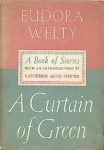 Welty was a short story writer and novelist who wrote mostly about the South. She won the Pulitzer Prize in 1973 with her novel The optimist’s daughter and, according to Wikipedia, was the first living writer to be published by the Library of America (LOA)! “A curtain of green” was one of her early stories. It provided the title for (and was included in of course) her first published collection of short stories (1941), which also includes “Why I live at the P.O.”
However, before I get to the story, I want to share a little from One writer’s beginnings. This book originated in a series of lectures, the inaugural ones apparently, she gave in 1983 at Harvard University, the William E Massey Sr. Lectures in the History of American Civilisation. The cover of my 1984 edition claims that it was on the New York Times Bestseller List for 46 weeks! Pretty impressive for a series of essays I think. She was born in 1909 in Jackson Mississippi, the eldest of three. From the opening pages of the book she tells us how her growing up contributed to her writing.
For example, in the first paragraph she mentions growing up “to the striking of clocks”. She’s not sure whether it’s because of her father’s Ohio family “having been Swiss back in the 1700s” but her family were all “time-minded” all of their lives:
This was good at least for a fiction writer, being able to learn so penetratingly and first of all, about chronology. It was one of a good many things I learned, almost without knowing it; it would be there when I needed it.
Surely there’s a little bit of the tongue-in-cheek in her reference to the Swiss origins? Anyhow, two pages in, and she’s talking about her parents’ respective reactions to the weather, her father’s caution regarding storms for example and her mother’s rejection of that “as a character failing”:
So I developed a strong meteorological sensibility. In years ahead, when I wrote stories, atmosphere took its influential role from the start. Commotion in the weather and inner feelings aroused by such a hovering disturbance emerged in dramatic form.
And so the book continues in this delightful manner, sharing her childhood with affection, perception and a wonderful sly wit … but now to “A curtain of green” in which meteorological conditions do, in fact, feature!
“A curtain of green” is about grief, but it starts
Every day one summer in Larkin’s Hill, it rained a little. The rain was a regular thing, and would come about two o’clock in the afternoon.
One day, almost as late as five o’clock, the sun was still shining …
It tells the story of Mrs Larkin whose husband had died the previous summer in a terrible accident – a tree, “a fragrant chinaberry”, had come crashing down on his car as he was arriving home. She had seen it happening, had believed her love would keep him safe. And so now, while the other women of the town sit inside “fanning and sighing, waiting for the rain”, Mrs Larkin is out in her garden, where she is now all the time, because “since the accident in which her husband had been killed, she had never once been seen anywhere else”. It’s a fertile garden, needs “cutting, separating, thinning and tying back” to keep the plants from “overreaching their boundaries and multiplying out of all reason”. But, Mrs Larkin is deranged with grief. She does none of this, just works incessantly, obsessively, planting
thickly and hastily, without stopping to think, without any regard for the ideas that her neighbours might elect in their club as to what constituted an appropriate vista, or an effect of restfulness, or even harmony of colour. Just to what end Mrs Larkin worked so strenuously in her garden, her neighbours could not see …
She doesn’t offer flowers when they’re sick or die, for example. I love how the language in this story just piles on, driving us forward this way and that, just like Mrs Larkin’s grief does to her. The garden, to the neighbours who had initially tried to support her, “had the appearance of a sort of jungle, in which the slight, heedless form of the owner daily lost itself”. It’s oppressive to us, but Mrs Larkin has isolated herself behind her “curtain of green”. The only person she tolerates in this garden, and then only occasionally, is Jamey, “the coloured boy who worked in the neighbourhood”.
At this point in the story, which is told third person, the perspective shifts from omniscient to subjective, to Mrs Larkin’s point-of-view, that is. We are now in the garden with her as her memory returns her to the day of the accident. Suddenly all is still, “everything had stopped again, stillness had mesmerised the plants …” Jamey infuriates her, with his “look of docility”, of being “lost in some impossible dream of his own”. She watches him – her hunger for his innocence suddenly overtaken by a fury at his youthfulness, at his being able to be lost in this, to her, “impossible dream”. She’s overwhelmed by the unaccountability of accident, of life and death, by the meaningless of it all, and wants to smash his innocent absorption – but then comes the rain. There are two more pages in the story after this, but I’ll finish here.
This story was written in 1938 – quickly written and easily published, according to LOA. LOA also tells us that in 1931, Welty and her mother had been present when her father died of leukaemia, and they quote Welty’s biographer Suzanne Marrs as saying that her mother “discovered solace in gardening”. She spent hours in her garden, most days, often with Eudora by her side. Welty, says Marrs, wrote in an unpublished essay that “its [the garden’s] peace and fragrance are soothing to frayed nerves when we are weary from contact or perhaps conflict with the everyday world.” This memory clearly informed her story of the grieving Mrs Larkin.
“A curtain of green” is a great read, for its exploration of how grief can derail you, making you, temporarily at least, a little mad; for its evocative writing which captures that sense of derailment, taking you right into that garden with Mrs Larkin; and for its resolution which offers hope without being simplistic about it. After such a year as this has been, it seems just the right story to end on. Happy New Year everyone!
Eudora Welty
“A curtain of green”
First published in: Southern Review (Autumn 1938).
Available: Online at the Library of America
 Whispering Gums