Hands up who likes to travel? And keep your hands up if you like to read travel writing! This post is especially for you. I’ve numbered it (1), because I’m drawing primarily from a book, which I think could warrant a few posts.

1957 edition
The book I’m using is another of those that I retrieved from my aunt’s house when Mr Gums and I were clearing. The book is titled, yes, Some Australian adventurers, and was edited by someone called Enid Moodie Heddle, so let’s start with her. Wikipedia says she was an “Australian poet and writer for children”, but she did more than that. Wikipedia says that she joined Longmans publishing house in 1935 where she worked as an educational adviser until 1946, at which time she was appointed Education Manager. In this job, to 1960, she “oversaw the publication of textbooks for schools and universities.” Some Australian adventurers was published by Longmans, Green and Co. in 1944.
Heddle wrote the brief introduction to Some Australian adventurers. She says its aim is “to catch something of the spirit of adventure and joy in discovery which seem to us to be not only characteristic of the majority of the writers here represented, but also of Australians as a race”. Hmm … Australians are known to like travelling, but is it a racial characteristic? She goes on to say that
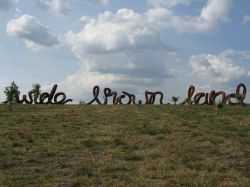
Wide Brown Land (National Arboretum)
From our British ancestry we have inherited qualities which, no doubt, make us turn eagerly to far horizons, and even our own wide brown land* is not enough for most of us. Like the writers of these extracts, we would walk “the wind-wide ways”* of the world and see strange sights and meet strange people, from the Northern Lights to Antarctic snows. If this is impossible for us, the next best thing is to read of action by others. Here, then, are some accounts of real and imaginary adventures from the legendary wanderings of the aboriginal, at home in the land of the Southern Cross long before the white man came, to modern tales of land, sea and air.
The first thing to say is that these sentiments are very much of their time, so I’m not going to comment on ideas like the “qualities” Aussies “inherited” from “our British ancestry”. As readers, though, we would still agree with the idea that if you can’t travel “the next best thing” is to read other people’s travel writing. And, it is interesting, given the era, that she references Indigenous Australian stories, about which more below.
The last thing I’ll share from her introduction is her discussion of her chosen extracts, from which she says
we may learn, if we wish, something of what goes to build up tradition, of what makes for riches in experience, of what stuff is life.
I love this language, and her aspirations for the book. She emphasises that it comprises fragments from larger wholes, and is thus a “prelude to adventure”. To help further adventuring, she provides bibliographical details for the works excerpted, plus additional reading suggestions.
The book is then divided into thematic sections:
- In the land of Mirrabooka: from K. Langloh Parker
- The white intruders: from Eleanor Dark, Elizabeth Bussell, William Hatfield, Ion L. Idriess
- Animals and men: from Frank Dalby Davison, Vance Palmer, Hedley Herbert Finalyson
- Further afield: from Jack Gordon Hides, Sir Douglas Mawson, Sir George Hubert Wilkins, C.E. Kingsford-Smith, Alan J. Villiers, Wilfred G. Burchett
- Strange encounters: from Jack McLaren, Frederic Wood Jones, Walter Murdoch
- Story and character: from Henry Lawson (twice)
The thing that struck me about the table of contents is that it contains many writers I don’t know. Further investigation explained it, however. Most, though not all, of those I don’t know wrote non-fiction, such as Hedley Herbert Finalyson, Jack Gordon Hides and Jack McLaren. My guess is that non-fiction writers disappear from view faster than fiction ones? Anyhow, some of these new people are interesting, as are the familiar ones. I look forward to sharing some of them in future Monday Musings.
K. Langloh Parker
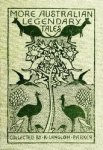
First published 1898
I’m going to conclude with K. Langloh Parker because she has the opening section of the book to herself! She was, in fact, Catherine Eliza Somerville Stow (1856-1940). She was born (and died) in South Australia but spent time in the nineteenth century in New South Wales where she recorded the stories or legends of the local Ualarai people. Introducing Parker, Heddle writes that
The first adventurers of whom we know in Australia, the land of Mirrabooka, the Southern Cross, were the Australian Aboriginals. Even now we have much to learn of their customs and culture.
She continues that Parker has done a great service “by collecting their legends and retelling them in English in a way as near as possible to the original”. Wikipedia, writing in our time, says that “her testimony is one of the best accounts of the beliefs and stories of an Aboriginal people in north-west New South Wales at that time. However, her accounts reflect European attitudes of the time.” Not surprisingly.
The interesting thing to me, though, is that Heddle recognised the importance and relevance of Indigenous Australian stories to her book. It’s also interesting though that she presumably didn’t have access to Indigenous versions of these stories. Her further reading suggestions are also all by non-Indigenous writers. She says that the book from which her extract “Beereeun the mirage maker” comes was illustrated (uncredited I believe) by an Indigenous artist. Wikipedia says that the Indigenous artist Tommy McRae illustrated the first volume, Australian legendary tales, but doesn’t mention his illustrating the second. It’s likely though that he did, as the same people were involved in producing both.
Australian legendary tales, but not More Australian legendary tales, is available at Project Gutenberg Australia.
* Aussies will recognise “wide brown land” as alluding to Dorothea Mackellar’s poem “My country”. Fewer of us, I think, including me, would recognise “wind-wide ways”, which she encloses in quote marks. It comes from a poem called “The bush” by Bernard O’Dowd, who has been mentioned here a couple of times, first in my Monday Musings about most popular poets and novelists in 1927.
 Whispering Gums