Andrew Blackman, Nights on Fair Isle (Review)

You probably know by now that I occasionally like to review short stories that are available online, most often those published by the Library of America.  So when author and blogger, Andrew Blackman, recently posted that one of his stories had been published online, I thought I’d check it out.

“Nights on Fair Isle” is, he says, the first time he has had a short story available free on the internet, but he expresses uncertainty about the value of reading online and asks his readers’ opinions. Good question and one I’d like to answer … somewhat anyhow, and then bat it on to you. I don’t as a rule read fiction online. I read novels on an e-Reader but I don’t think that’s the same as online, or is it? And I read short stories and essays that are made available online. But, here’s the rub. I don’t read them online. I print them out and read the hard copy instead. This might just be the product of my babyboomer-dom… I could in many cases, I suppose, download stories and essays onto my e-Reader, but mostly I think what’s the point. It’s just as fast to print it out.

Anyhow, the story. It’s a little story … And I mean that literally in terms of its length not as a comment on its quality. In just three pages (in my printout version), Blackman tells a tightly controlled story of loneliness and how one woman goes about soothing her soul to enable her to keep on going day after day in a big city, London to be exact. We don’t know where Aurelia is from, but we do know that she wasn’t an English-speaker when she arrived in London. Not long after her arrival, she stumbles on the shipping  forecast on the radio and hears a “gentle male voice intoning” words like “Low, Fastnet, nine seven three, falling slowly”. Each night she tunes in to the same words, and thinks it’s a nightly prayer that she’s hearing. Eventually of course she’s put right, but she goes on tuning into the forecast for its soothing sound …

And for the way it reminds her of her mother’s “sweet lullabies … that chased away the shadows and fears”. Blackman neatly segues from the shipping forecast to the sea and Aurelia’s favourite sea-based fairy story, and effectively uses the paradoxes inherent in sea/water imagery to convey both fear and calm. I won’t relate more of the story though … after all it’s short enough for you to read yourselves via the link below. I’ll just say that I liked the way Blackman gently explores the power – and limit – of dreams and reverie to keep you going. It’s a realistic rather than grim or depressing story.

Meanwhile, do you read online? And if so, do you think it changes the way you read, or what you read?

Andrew Blackman
“Nights on Fair Isle”
SolquShorts, 2012
Availability: Online

Jane Austen’s letters, 1801-1806

The  years from 1801 to 1806 were somewhat unsettled if not downright traumatic years for Jane Austen. In December 1800 her father retired and her parents decided to move themselves and their two daughters to Bath. And then in 1805 her father died, suddenly. She writes to her brother, Francis, on 21 January (Letter 40) that “I wish I could have given you better preparation-but it has been impossible”. The impact, though, was greatest on the women. It left them in a difficult and dependent financial position.

Austen writes about the above events in the letters, but there are others about which she is silent. This could be because she and her sister Cassandra, the main recipient of her letters, were together, but it could also be because Cassandra destroyed selected letters after Jane’s death in 1817. One event not in these letters is the famous proposal by Harris Bigg-Wither in 1802. Austen accepted the proposal but the next day changed her mind, and promptly left the Bigg-Wither home with Cassandra. It was a distressful situation, as the Bigg-Withers were family friends.

Something else she doesn’t talk about in this selection of letters is her writing. She didn’t write a lot during this time, and nothing, as far as we know, from the time of her father’s death until they settled in Chawton in 1809. But, she did revise Northanger Abbey (then called Susan) in 1802, selling it to a publisher in 1803, and she started her (unfinished, as it turned out) novel, The Watsons, in 1804.

So, there’s quite a bit she didn’t talk about – in the surviving letters – but there’s still plenty to interest here. These letters were written when Austen was aged 25 to 30 years old, years when she was still relatively young but old enough to have some experience of the world. As with the later letters, there’s a lot of gossip and chat about family and friends, but there are signs of the novelist she was becoming, in addition to insight into life in Georgian England.

As with my last post on her letters, I’ll use headings to structure my discussion.

Georgian England

Jane Austen wrote novels about her own era and in many ways her letters replicate in reality much of what we learn from her fiction. She describes, in these letters, modes of transport and particularly travelling arrangements for women, the boats her Naval brothers worked on, accommodation hunting in Bath, fashion, card games, balls and food. All of these we find in her novels – sometimes with barbed effect.

I particularly liked her descriptions of place. Here is Bath, soon after her arrival:

The first view of Bath in fine weather does not answer my expectations; I think I see more distinctly through rain. The sun was got behind everything, and the appearance of the place from the top of Kingsdown was all vapour, shadow, smoke, and confusion, (Letter 35)

And a little town called Appleshaw:

that village of wonderful Elasticity, which stretches itself out for the reception of everybody who does not wish for a house on Speen Hill (Letter 30)

How could someone who writes that not be a novelist!

Lyme, as Austen readers will know, is where a major scene occurs in Persuasion. What, though, do you think she thinks of the place when you read this description of

a new odd-looking man who had been eyeing me for some time, and at last, without any introduction, asked me if I meant to dance again. I think he must be Irish by his ease, and because I imagine him to belong to the hon(ble) Barnwalls, who are the son, and son’s wife of an Irish viscount, bold queer-looking people, just fit to be quality at Lyme

On her self

Not surprisingly, we learn quite a lot about Austen, directly and indirectly, through these letters. We learn much  about her likes and dislikes. She’s interested in fashion but she doesn’t like “tiny” parties with only a few people “to talk nonsense to each other”. She spanned the Age of Reason and of Romanticism, but she’s more a child of the former: she highly values “wit”, a word that appears repeatedly in her descriptions of people, often defining whether she likes them or not, and she approves rationality. “To be rational in anything”, she says, “is great praise” (Letter 43).

We also learn something about her character. She’s stoical, for example, writing about a disappointment that “there is nothing which energy will not bring one too.” (Letter 33).

Clergy

If you’ve read Jane Austen you know that she has pretty definite ideas on the clergy. She ridicules pomposity (Mr Collins in Pride and prejudice) and vanity (Mr Elton in Emma). She admires sense and responsibility (Edmund in Mansfield Park). I had to laugh, then, when I read this in her letter:

You told me some time ago that Tom Chute had had a fall from his horse, but I am waiting to know how it happened before I begin pitying him, as I cannot help suspecting it was in consequence of his taking orders; very likely as he was going to do Duty or returning from it.  (Letter 44)

How I wish I could write letters like this!

Observations of people

It is her observations of people, however, that most delight readers of her letters and show us her novelistic eye in the making. In this group of letters, for example, is a wonderful description of an older woman that doesn’t take much to remind us of Emma’s Miss Bates:

Poor Mrs** stent! it has been her lot to be always in the way; but we must be merciful, for perhaps in time we may come to be Mrs** stents ourselves, unequal to anything & unwelcome to everybody. (Letter 44)

I would not have wished our Jane to have ended up as impecunious as poor Miss Bates, but I do wish she’d lived a bit longer to give us more novels and more letters to enjoy.

Note: This is my fourth post on Austen’s letters. The first covered her letters from 1814 to 1816, the second from 1811 to 1813, and the third from 1807 to 1809.

Julian Barnes, The sense of an ending (Review)

I should have known I wouldn’t be the first to think of it, but during my reading Julian Barnes‘ Booker Prize winning novel, The sense of an ending, I was suddenly reminded of TS Eliot‘s The love song of J. Alfred Prufrock. It was the melancholic tone, the sense of life having passed one by, that did it:

What did I know of life, I who had lived so carefully? Who had neither won nor lost, but just let life happen to him?

Doesn’t that remind you of “I have measured out my life with coffee spoons”? I don’t usually read reviews before I write my own, but I wondered if my thought had come to anyone else. Of course it had. I googled “julian barnes sense of an ending prufrock” and up came several hits. Oh well, I thought, at least I’m not going to sound totally foolish. There is safety in numbers, after all, which brings me back to Tony, the novel’s protagonist, who says, at another point in the novel:

I’m not odd enough not to have done the things I’ve ended up doing with my life.

I admit to having a certain fellow feeling with Tony, a self-confessed “average” person who’s led an average life “of some achievements and some disappointments”. But, enough self-revelation, let’s get on with the review.

I’ll start by saying that this book is right up my alley. Firstly, it’s a novella and regular readers here know how I love a good novella. Secondly, it’s a good novella, by which I mean it’s tightly constructed and sparely written. And thirdly, plot is not the main point; character and life are Barnes’ focus.

Nonetheless, while there’s not a strong plot, there is of course a story, and it concerns the aforesaid Tony. He’s the first person narrator and is a reliably unreliable one. He tells us this on the second page, while at the same giving away the novel’s essential form:

But school is where it all began, so I need to return to a few incidents that have grown into anecdotes, to some approximate memories which time has deformed into certainty. If I can’t be sure of the actual events any more, I can at least be true to the impressions those facts left. That’s the best I can manage.

This tight little para tells us a few things about what’s to come. The word “deformed” combined with the idea that he “can’t be sure of the actual events” tells us to beware, that imperfect (for whatever reason) memory is at play. The mention of returning “to a few incidents” describes the basic structure of the novel, as it does indeed focus on and tease out the ramifications of a “few incidents”.  And the reference to school hints that there might be something of the bildungsroman about it.

I still haven’t told you anything about the story, though, have I? It’s divided into two parts. In Part One, Tony is in his teens and twenties and focuses on his three male friends and his first serious girlfriend, Veronica. This part is less than 60 pages and, as Tony promises at the beginning, primarily comprises a few scenes from his life, linked by some running commentary. There are classroom scenes and a particularly memorable one involving his first  (and only) weekend visit to his girlfriend’s home. We come back to this scene in the second part. I loved how, after spending some 50 pages on his youth, Tony wraps up around 40 years of his adult life in two pages. Impressive writing.

In Part Two, Tony is confronted again with some of the major incidents from his youth and is forced to reconsider his sense of self. The most important of these incidents concerns the suicide of one of his friends … and gradually we get a whiff of a mystery, albeit one just hovering around the edges. This is because the mystery is not the main point.

Tony, in this part, is bequeathed, out of the blue, the diary of the friend who had committed suicide 40 years previously. Now, Tony believes that it is the witnesses to your life, those you spent time with, who “corroborate” who you are. As these people drop away, there is, he says “less corroboration, and therefore less certainty to what you are or have been”. He therefore sees this diary as potentially significant:

The diary was evidence; it was – it might be – corroboration. It might disrupt the banal reiterations of memory. It might jump start something – though I had no idea what.

The bequest does “jump start something” but to what purpose is the moot point. An issue that occupies Tony is that of change. “Does character develop over time?” he asks and then continues, in one of those little postmodern touches we’ve become used to, “In novels of course it does, otherwise there wouldn’t be much of a story”. You said it, Tony/Julian, we are tempted to respond, except that by this time Tony had so captured my attention that the minimal story was neither here nor there.

And this is where I’ll leave the story … and return to an issue I raised earlier in the post, that regarding its being something of a bildungsroman. It’s not a traditional coming-of-age novel because only the first part of the novel chronicles his development as a young man. But, something is jump started for Tony in his 60s that forces him to rethink who he had been and who he had become. Memory, he says, can lock you into

the same loops, the same facts and the same emotions. I press the button marked Adrian or Veronica, the tape runs and the usual stuff spins out. The events reconfirm the emotions – resentment,  sense of injustice, relief – and vice versa. There seems no way of accessing anything else; the case is closed.

Occasionally, however, something happens to break the loop, as it does for Tony. He is suddenly confronted with new (or, different) memories which bring new emotions. He looks at “the chain of responsibility” and sees “my initial there”. He learns that the things he’d thought fixed or certain can be dissolved, that memory cannot be relied upon and can, in fact, come back to bite you. Time and memory, Barnes shows us, are malleable, suggesting, to me at least, that perhaps we never really do come of age.

Julian Barnes
The sense of an ending
London: Vintage, 2011
150pp.
ISBN: 9780099564973

PD James, Death comes to Pemberley (Review, sorta)

How do you review or evaluate a Jane Austen “sequel”*? Do we expect, want even, the author to channel Austen? I suspect the answer is as varied as are the readers of sequels, and it probably depends on why we read Austen. Those who are mostly interested in the stories and what happens to the characters are likely to have a completely different perspective from those who love Austen’s language and her very particular wry, sly eye on humanity. I fall into the latter group and this is why I am not drawn to sequels. I want to read Austen for Austen, and other writers for their style and worldview.

I have just read PD JamesDeath comes to Pemberley. I’d describe it as a traditional sequel, with a difference. That is, it picks up the story of Elizabeth and Darcy some six years after their wedding, but it is a crime novel, which adds an extra complication for the reviewer, because not only is there the issue of Jane Austen’s story and characters to consider, but there’s a shift in genre. This, I’ll admit right now, puts me at a double disadvantage: I don’t read Jane Austen sequels and I don’t read crime novels. So why did I read this book? Two reasons really. It was given to me by a friend and my local Jane Austen group decided to discuss it as part of this year’s focus on Pride and prejudice.

I’m glad I read it, mainly because I’ve been wanting to try a “sequel” for some time to understand what they are all about – and a sequel by a writer of PD James’ reputation seemed like a good one to try. However, I can’t say I really enjoyed it. It was, however a quick read – and I did find it intriguing to ponder what sequel readers look for.

Before I discuss that, I’d better say something about the plot, though that’s hard without giving too much away. The story proper starts on the night before a big annual ball. Elizabeth, Darcy, Colonel Fitzwilliam (now Viscount Hartlep), Georgiana and the Bingleys are all at Pemberley getting ready, when a carriage careens into view carrying, we soon discover, an hysterical Lydia claiming that her husband, Wickham, has been shot. Darcy, Colonel Fitzwilliam and a new character and suitor to Georgiana, Alveston, set off into the woods to find out if indeed this has been the case. The novel then, as crime novels tend to do, follows the story of a murder through inquest, trial and resolution. It’s an interesting enough plot, and one whose resolution I didn’t guess. But then, as I’ve already said, I’m not a crime reader.

But now, rather than review the book in my usual way, I’m going to talk about it specifically in terms of its “sequelness”. (Is that an ok neologism?). So here goes…

Characterisation

If there’s one thing a sequel should do, I think, it’s to be true to the characters. No matter what new situation they are placed in, they need to still be them. Unfortunately, in this novel, Elizabeth and Darcy do not come across as Jane Austen’s creations. Darcy spends most of the novel – which, remember, occurs six years after the wedding – bothering about his decision to marry Elizabeth and how it returned Wickham to his world. He’s not sorry about marrying Elizabeth but he mulls and mulls and mulls yet again about the implications feeling, for example, “that he had lost some respect in his cousin’s [Col Fitzwilliam] eyes because he had placed his desire for a woman above the responsibilities of family and class”. That’s not our Darcy!

Similarly, it’s a rather subdued Elizabeth we see. Sure, she’s older but she is still in her 20s. And sure, she’s now the mistress of Pemberley, but that doesn’t mean the young woman who stood up to Lady Catherine, unlike “sensible” girls who recognise their need of a husband, now has to be quiet and, yes, dull. Why doesn’t she tell Darcy of some clues and suspicions that may be relevant to the murder?

Would Charlotte Lucas really harbour resentment towards Elizabeth? James suggests she does:

… but it was unlikely that Charlotte had either forgotten or forgiven her friend’s first response to the news [that she’d accepted Mr Collins].

Style

I’m not sure that a sequel must ape Austen’s style … which is just as well because James doesn’t really. The problem is that I think she tried. She’s clearly a good writer, but it probably would have been better for her to stick to what she does best. There were moments of wit and humour, but much was ponderous. Here is Georgiana’s suitor speaking to Darcy:

Forgive me, sir, but I feel I must speak. You discuss what Miss Darcy should do as if she were a child. We have entered the nineteenth century; we do not need to be a disciple of Mrs Wollstonecraft to feel that women should not be denied a voice in matters that concern them. It is some centuries since we accepted that a woman has a soul. Is it not time that we accepted that she also has a mind?

This is way too didactic and preachy for Austen, particularly for a non-Mr-Collins-like character. The dialogue, overall, lacks Austen’s light touch – and is often stilted without capturing the formality of the period.

There were times too when I felt she was more Dickens than Austen. Some of her characters’ names are pure Dickens, such as Hardcastle, Pegworthy and Belcher.

However, I understand that James is known for her settings – something that Austen did not focus much on – and her descriptions of place are generally evocative and effective.

Observations

Along with her style, it’s the way Austen hones in on human behaviour and describes it with brevity and wit  that keeps me coming back to her. James was clearly keen to match Austen in this area and occasionally made me smile, as with this description:

… had exacerbated a disagreement common in marriages wherein an older husband believes that money should be used to make more of it, and a young and pretty wife is firmly of the view that it exists to be spent; how otherwise, as she frequently pointed out, would anyone know that you had it?

And this comment by the imperious Lady Catherine:

I have never approved of protracted dying. It is an affectation in the aristocracy; in the lower classes it is merely an excuse for avoiding work.

These little commentaries were like beacons in the forest … and showed me that, despite the misses in the novel, James does “get” Austen.

Genre

Then there’s the genre shifting. This is both a crime novel and historical fiction. I can’t speak much for the crime aspect except to say I thought it was well plotted and kept me guessing. I didn’t work out whodunnit, but when it came, the clues generally made sense. James also incorporated some Gothic elements – nature awry, dark woods and possible ghosts – something that Austen didn’t write, though she did spoof readers of Gothic fiction in her Northanger Abbey.

The historical fiction aspect was mixed for me. James had clearly researched the period thoroughly and I enjoyed learning about the practice of law, in particular. However, there were times when it felt that she just had to impart some information, whether or not it was essential to the story. Interesting enough, but it got in the way of her story.

Unlike Austen, who is often criticised for not writing about current events, James makes regular references to the Napoleonic war – and to English nationalism. This is fine. I don’t think a sequel has to limit itself to Austen’s subject matter.

I’d love to write more, but have already taken up way too much of your precious reading time. I’ve probably panned the novel more than I originally intended to. This is because it’s not the book for me – but it’s by no means a “bad” book. If you like Austen sequels, you’ll probably like it. If you like crime novels or are a fan of PD James, you could very well like it. But if you like Austen for her Austen-ness, then, like me, you’d probably rather read Pride and prejudice  – again. Horses for courses, as they say.

Death comes to Pemberley
London: Faber and Faber, 2011
310pp
ISBN: 9780571283583

*  Sequel in this Jane Austen context are books written by other writers based in some way on Austen’s novels. They can be “real” sequels (or prequels) in that they take an existing novel and tell us what happened next (or before); they can be retellings of a particular novel; or they can take another approach, such as tell the story of, or from the point of view of, another character.
Virginia Woolf, The mark on the wall (Review)

Back in November I wrote a post titled Nettie Palmer on short stories which resulted in Stefanie (of So Many Books) recommending one of her favourite short stories, Virginia Woolf‘s “The mark on the wall”. I told her I’d read it and, finally, I have.

This is the sort of story I like. It doesn’t have a strong plot but is the meditation of a lively, creative mind. This meditation is inspired by a mark on the wall which leads the first person narrator to wonder what the mark is, and what it might signify. She doesn’t want to get up to investigate, preferring to let her mind wander, as it will, on the possibilities:

How readily our thoughts swarm upon a new object, lifting it a little way, as ants carry a blade of straw to feverishly, and then leave it …

The story does progress, albeit in an organic, stream-of-consciousness way, rather than according to any clear logic. She wonders if the mark is a hole, then thinks it could be a stain, or even, perhaps, something more three-dimensional like a nail head that has broken through the paint. At the end, we do discover what the mark is, but that’s not the point of the story. The point is what she thinks about as she considers the mark …

And the things she thinks about are wide-ranging as we have come to expect in stream-of-consciousness, a technique of which Woolf was one of the early pioneers. The thing about stream-of-consciousness is not only that it tends to roam over a wide range of ideas and topics, but that these ideas and topics are very loosely connected. Sometimes the thread between them is barely visible, usually because the connection is idiosyncratic to the thought processes of the narrator.

This is the case with “The mark on the wall”. The first paragraph uses strong imagery – based around the colours of red and black – which encouraged me to expect something more dramatic than what did, in fact, follow. In the third paragraph she exclaims:

Oh! dear me, the mystery of life. The inaccuracy of thought! The ignorance of humanity!  To show how very little control of our possessions we have — what an accidental affair this living is after all our civilisation …

Nothing, though, is accidental in Woolf’s story, no matter how much the stream-of-consciousness form may lull us into thinking it is. This is the story of a woman concerned about the meaning or import of reality. She ponders the shallowness of “things” (including, even, knowledge). In the second paragraph she suggests the mark may have been made by a nail holding up a miniature that would have been

a fraud of course, for the people who had this house before us would have chosen pictures in this way — an old picture for an old room.

She writes of how we like to construct positive images of ourselves but how fragile this is, of how superficial reality is. Interestingly, while the story flits from idea to idea, there’s one motif (besides the mark) that recurs, Whitaker’s Table of Precedency. Whitaker’s exemplifies “the masculine point of view which governs our lives”. She uses it to represent the faith we have in rules, and the way we let rules and reality prevent our seeing the “sudden gleams of light”.

There’s a funny sequence in which she imagines a Colonel pontificating with other men on the history of objects like ancient arrowheads. The  Colonel, she imagines, might suffer a stroke and his last thought would be, not his wife and family, but the arrowhead which, she suggests in her stream-of-consciousness way,

is now in the case at the local museum, together with the foot of a Chinese murderess, a handful of Elizabethan nails, a great many Tudor pipes, a piece of Roman pottery, and the wine-glass that Nelson drank out of — proving I really don’t know what.

That made me, a librarian-archivist, laugh!

And so, what is it about? Well, the mark seems to represent the unwelcome intrusion of reality into her life – it gets in the way of her thinking (of her desire “to catch hold of the first idea that passes”) while also, paradoxically, offering inspiration to her thoughts. An intriguing story. And, like Stefanie did to me, I recommend it to you.

Virginia Woolf
“The mark on the wall”
Originally published: 1919
Available online at The Internet Archive 

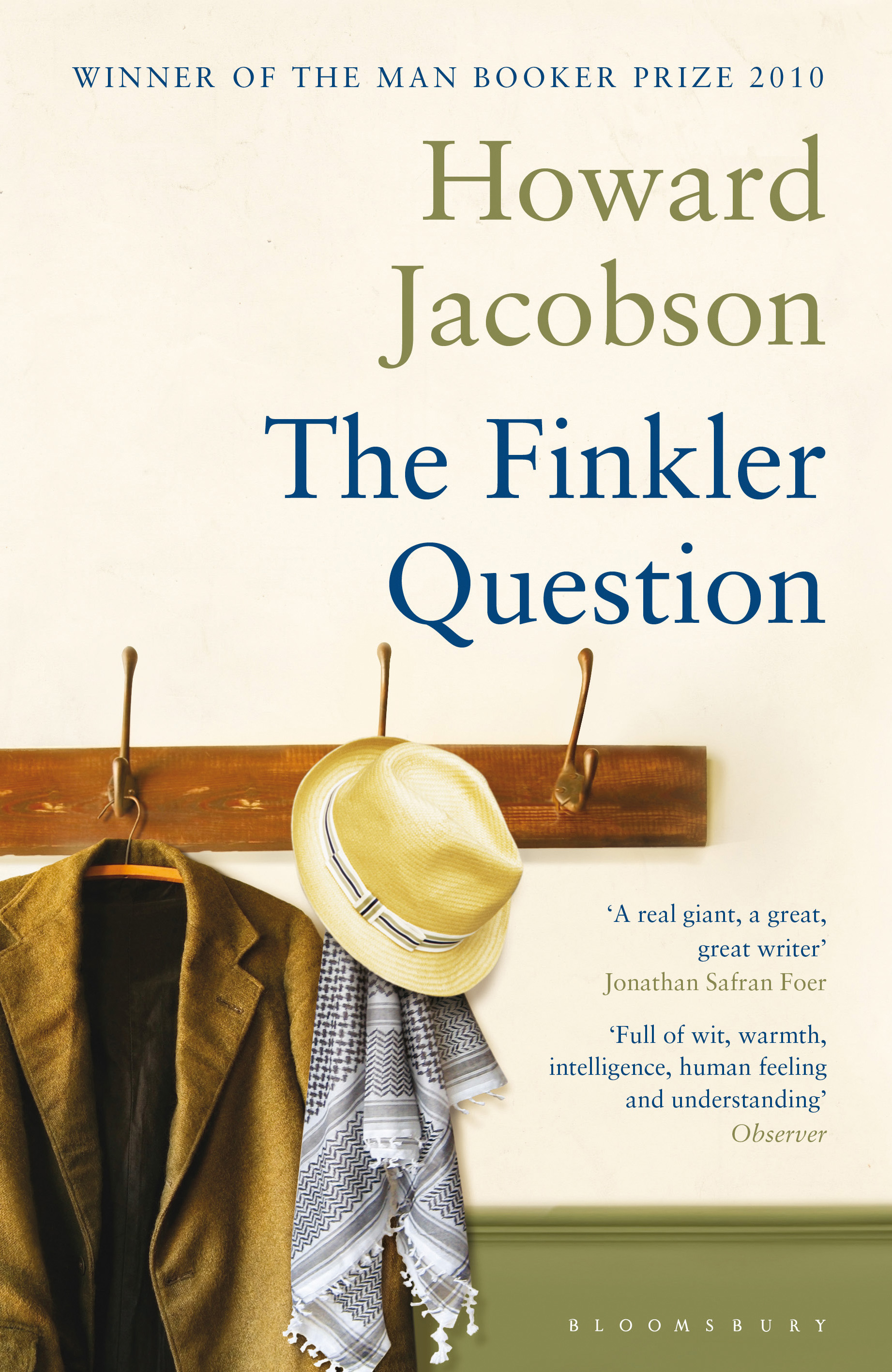
Howard Jacobson, The Finkler question

Howard Jacobson's The Finkler question

Howard Jacobson’s The Finkler question (Courtesy: Bloomsbury Publishing)

Whispering Gums, as you would expect, writes erudite marginalia and so you’d be in for a treat if you ever obtained my copy of Howard Jacobson‘s 2010 Booker award winning novel, The Finkler question. The margins are peppered with my reactions, like, you know, “Ha!” and “Oh dear”. Riveting stuff … and yet, what comments would you make in this book? Ah yes, “stereotyping” is another one, because that, really, is the springboard from which this rather funny book is written.

Do I need to summarise the plot? I feel that I’m about the last blogger to read this book, but just in case I’m not, here goes …  It concerns three longstanding friends: Julian Treslove and Sam Finkler who have been friends since schooldays, and Libor Sevcik who was their teacher at school. At the beginning of the book, Finkler and Libor, both Jews, have been recently widowed. Treslove, the non-Jew, is the “honorary third” widower because he is single (yet again). The novel’s premise is that Treslove would like to be a Jew …

Why, you might ask, would Treslove want to be a Jew (or, a Finkler, as he privately calls them – and hence the title)? It is not an accident that Treslove’s occupation when the novel opens is to be a paid double (or “lookalike”) of famous people at parties, conferences, corporate events:

Treslove didn’t look like anybody famous in particular, but looked like many famous people in general, and so was in demand if not by virtue of verisimilitude, at least by virtue of versatility.

And that’s pretty much how his Jewishness goes too. He might look and play the part but, deep down, can a non-Jew ever really be Jewish? Treslove is about to find out.

Jacobson has a way with words. It was this, together with the endless discussion, using every Jewish stereotype going, of what makes a Finkler (a Jew, remember!) a Finkler, that kept me going through a book that I wasn’t really sure was going anywhere. I laughed at Treslove’s incomprehension of Finkler (the character, this time):

“Do you know anyone called Juno?” Treslove asked.
“J’you know Juno?” Finkler replied, making inexplicable J noises between his teeth.
Treslove didn’t get it.
“J’you know Juno? Is that what you’re asking me?”
Treslove still didn’t get it. So Finkler wrote it down. D’Jew know Jewno?
Treslove shrugged. “Is that supposed to be funny?”

Oh dear! “Julian Treslove knew he’d never be clever in a Finklerish way” but, despite this, he continues with his goal to be Jewish. Meanwhile, Finkler, grieving for his wife and a marriage he still doesn’t understand, tries to dissociate himself from Jews (particularly Zionists) through membership of the ASHamed Jews. And Libor, grieving heavily for his true love, tries to dissuade Treslove from his ambition.

The book chronicles a year or so in the life of these three as each confronts his particular challenge. Treslove falls in love with Libor’s (Jewish) great-niece, Hephzibah, furthering, he hopes, his path to Jewishness; Finkler starts to fall out with the ASHamed Jews though not with their anti-Zionist principles; and Libor starts to fall out of life itself. All of this is told with both warmth and humour. The humour is always there, and yet is never pushed so far that the humanity of the characters is lost. You feel for them, despite their flaws and foibles. You want Julian, the hopeless father and failed lover, to make a go of it this time. You want Finkler to make peace with his Jewishness. And you want old Libor to get over his grief and join the world again. But through all this, you wonder, why? Why is Jacobson writing this story?

I have a few ideas. One may simply be to capture the diversity of Jewishness. Through all the stereotypes that made me laugh (Jews are musical, brokenhearted, rich, clever, comic, and so on), Jacobson shows that Jews, like any other group, are not all the same, cannot all be put in the one basket. Another  reason, though it’s depressing to think it’s needed, may be to defend Jews in an anti-Semitic world, to show their humanity. You care for these characters whose troubles with identity, love and loss are universal. And another may be to explore Zionism, safely. Can Zionism be defended? Has it changed into something more ugly, something that undermines its original conception?

In the end I did like this book because, while I was contemplating the “why”, I was engaged by the characters and their stories. The novel commences with Treslove, the would-be Jew, but it concludes with Finkler, the troubled Jew. Here he is, towards the end:

He was a thinker who didn’t know what he thought, except that he had loved and failed and now missed his wife, and that he hadn’t escaped what was oppressive about Judaism by joining a Jewish group that gathered to talk feverishly about the oppressiveness of being Jewish. Talking feverishly about being Jewish was being Jewish.

Ha! You said it, Mr Jacobson, I’m tempted to say. But that would be too smart-alecky of me because the book is, in fact, as much about humanity as it is about being Jewish.

Howard Jacobson
The Finkler question
London: Bloomsbury, 2011
370pp.
ISBN: 9781408818466

Horace Walpole, The Castle of Otranto

Tower of Horace Walpole's own Gothic house, Strawberry Hill

Tower of Horace Walpole's own Gothic house, Strawberry Hill (Public domain, via Wikipedia)

Would you believe the issue of fact and fiction is consciously raised in yet another novel I’ve read? In his preface to The Castle of Otranto Horace Walpole suggests that it’s possible the story – which he tells us that he “found” and translated – is based on fact. And he concludes that:

If  a catastrophe, at all resembling that which he [the original author, that is!] describes, is believed to have given rise to this work, it will contribute to interest the reader, and will make the “Castle of Otranto” a still more moving story. (Preface to the 1st edition)

Hmm … moving is not quite how I’d describe this Gothic tale but perhaps that’s because I’m a cynical 21st century reader and not a mid 18th century one? I did though enjoy the book, which I read as part of my local Jane Austen group’s preparation for our discussion of Northanger Abbey next month. I had planned to read a Gothic novel by a female author – such as Ann Radcliffe – but time got the better of me and so I settled on The Castle of Otranto which is a novella, but which is also interesting for its pioneer status as the first Gothic novel.

The first thing that entertained me about the novel was the preface and Walpole’s (rather postmodern-like) attempt to pass it off as a story he’d found and translated. He suggests the text had been written in medieval times during the Crusades (between 1095 and 1243). This first edition was well-received by the reading public as well as by some contemporary critics. And so in the second edition Walpole identifies himself as the author, and in its preface claims that the novel was “an attempt to blend the two kinds of romance, the ancient and the modern. In the former all was imagination and improbability: in the latter, nature is always intended to be, and sometimes has been, copied with success…”. This builds, in fact, on an argument he makes in the first edition’s preface that if we ignore the “miraculous” (read “supernatural”) aspects:

the reader will find nothing else unworthy of his perusal. Allow the possibility of the facts, and all the actors comport themselves as persons would do in their situation.

Hmm again … I think he errs on the improbable side of the pendulum, but the characters do, I accept, exhibit a reasonable level of psychological realism.

This change from the first to the second edition is interesting in itself and would be fun to research further … but it’s not something I plan to pursue in this review. I will, though, take up the issue of “the novel” further when I review Northanger Abbey in a month or so since it is in this novel that Austen argues the value of reading fiction.

This brings me to the second thing I enjoyed about the novel, and that was simply experiencing the introduction of the Gothic. Wikipedia says Walpole “introduces many set-pieces that the Gothic novel will become famous for. These includes mysterious sounds, doors opening independently of a person, and the fleeing of a beautiful [usually virginal] heroine from an incestuous male figure”. It also includes the sorts of features that we find in soap operas today – which one could argue are a continuation of the Gothic without the supernatural horror aspect. These features include mistaken identities, people returning from the dead (or, at least, when they are least expected), and love triangles (which are, of course, not only the province of the Gothic). The Castle of Otranto moves at a cracking pace. There’s a lot of dialogue, a good deal of action (human and supernatural), and not too much description.

Another thing that fascinated me is why readers enjoy such over-the-top stories. To prepare for my group’s discussion, I read a critique by Jerrold E. Hogle*. He argues, to put his academic thesis more simply, that the Gothic allows readers to “displace” real fears onto something more fictive. In Walpole and Radcliffe, these fears, he suggests, are somewhat paradoxical: a desire for and rejection of aristocracy and old Catholicism, by the middle class. My group’s discussion raised other reasons too. One is the “excitement” (sexual titillation) roused by these novels, particularly for the young women of the era like, say, Catherine Moreland and Isabella Thorpe in Northanger Abbey. Were Gothic novels that generation’s young adult novels? Another is the idea that, like crime novels, Gothic novels are about the restoration of order: “This is a bad world” says the hero earlier in the novel.

Anyhow, that’s enough of that I think. I haven’t really done a review have I? I haven’t even mentioned the plot. It’s pretty much the usual stuff. There’s Manfred, the lord of the castle, who needs to continue his line to maintain ownership of the castle, but his only son dies on his wedding day. This sets off a train of events in which Manfred decides to divorce his wife, Hippolita, to marry his son’s intended in order to, hopefully, produce more heirs. His plan is intercepted by the appearance of those who claim the castle is theirs. The story includes knights and friars, loving mothers and loyal daughters, helmets and portraits with minds of their own (“the portrait … uttered a deep sigh and heaved its breast”), and, of course, caves and tunnels. The interesting thing about the plot though, in terms of that restoration of order argument, is that not quite the perfect order is restored … but I won’t spoil the story further than that.

As for the opening quote, I’ll leave that for you to ponder …

Horace Walpole
The Castle of Otranto
Originally published 1764
Kindle edition
158Kb

* Hogle, Jerrold, W “Hyper-reality and the Gothic affect: The sublimation of fear from Burke and Walpole to The Ring“, in English Language Notes, 48 (1): 163-176, Spring/Summer 2010.

Red Dog (Movie and Book)

Pilbara landscape

Pilbara landscape

First, the disclaimer: I’m a dog person and am therefore a sucker for stories about dogs and their loyalty. I know, I know, it’s their nature, but that doesn’t stop me crying over doggie devotion stories. Red Dog is one of these! If dogs don’t move you, you may not want to see this film, but that would be a shame because while the dog – and it is based on a real dog – is the central idea, the film, and novel from which it draws, are about more than “just” a dog and his devotion to a master.

I first came across Red Dog – the (apparently famous) Pilbara Wanderer – several years ago through Louis de Bernières‘ novella (of sorts) which was first published in 2001. It’s a slim little tome and is based on stories de Bernières gathered about the dog, who lived from 1971 to 1979. De Bernières claims in his Author’s Note that the stories “are all based upon what really happened” to the dog but that he invented all of the characters, partly because he knew little about the people in Red Dog’s life and partly because he did not want to offend people by misrepresenting them. John though, he says, is “real”.

There is a simple plot in the book – it tells how Red Dog decides on John as his master and it then chronicles Red Dog’s various adventures in the mining communities of the Pilbara. The film follows de Bernières’ book pretty closely, though it takes a little artistic license, including adding a romance into the mix.

The story – and the film – is set in the Pilbara, the red earth country of Western Australia where mining is the main industry. It was – particularly back in the 1970s – a male dominated place and the workers at that time were mostly migrants:

It was lucky for him [Red Dog] that the town [Dampier] was so full of lonely men … They were either rootless or uprooted. They were from Poland, New Zealand, Italy, Ireland, Greece,  England, Yugoslavia and from other parts of Australia too. … Some were rough and some gentle, some were honest and some not. There were those who got rowdy and drunk, and picked fights, there were those who were quiet and sad,  and there were those who told jokes and could be happy anywhere at all. With no women to keep an eye on them, they easily turned into eccentrics.

And it is this* that the film, directed by Kriv Stenders, does so well … capturing men’s lives in a male dominated environment, against the backdrop of the starkly beautiful Pilbara. The cinematography is gorgeous, setting the region’s natural beauty against the ugliness (or beauty, depending on your point of view) of a mining environment. The music is what you’d expect, mostly 70s rock including, of course, Daddy Cool, but is appropriate rather than clichéd. And the dog is played by 6-year old Koko with aplomb!

The central story concerns John (Josh Lucas), Red Dog and Nancy (Rachael Taylor), but there are other smaller “stories” – the publican (Noah Taylor) and his wife, the Italian (Arthur Angel) who can’t stop talking about his beautiful home town, the brawny he-man (John Batchelor) who knits in secret, the miserly caravan park owners, to name just a few. Their stories are slightly exaggerated, and there is fairly frequent use of slightly low angle close-ups that give an almost, but not quite, cartoonish larger-than-life look to the scenes. These all work effectively to convey something rather authentic about character and place.

That said, occasionally the humour is too broad and the script a little clumsy – but these are minor. Overall, the film keeps moving at a pace that ensures it never gets bogged down in too much sentiment or romance or adventure or comedy. In other words, it’s not a perfect movie and yet it perfectly captures the resilient, egalitarian spirit of those people in that time. It’s a film I’d happily, if somewhat tearily, see again.

Louis de Bernières
Red dog
London: Vintage, 2002
119pp
ISBN: 9780099429043

*POSTSCRIPT: I quoted this passage from the book for a reason, and then got carried away on another point, but Kate’s comment below reminded me of what that reason was: it was of course to refer to Red Dog’s role in this male dominated environment. Not only does he symbolise the men’s independence and spirit of adventure that brought them to the Pilbara, but he also provides an outlet for their affection. Through this, he forges a community out of a bunch of individuals. As the publican says at the beginning of the film, it’s not so much what Red Dog did as who he was …

Jane Austen, The Watsons (Unfinished)

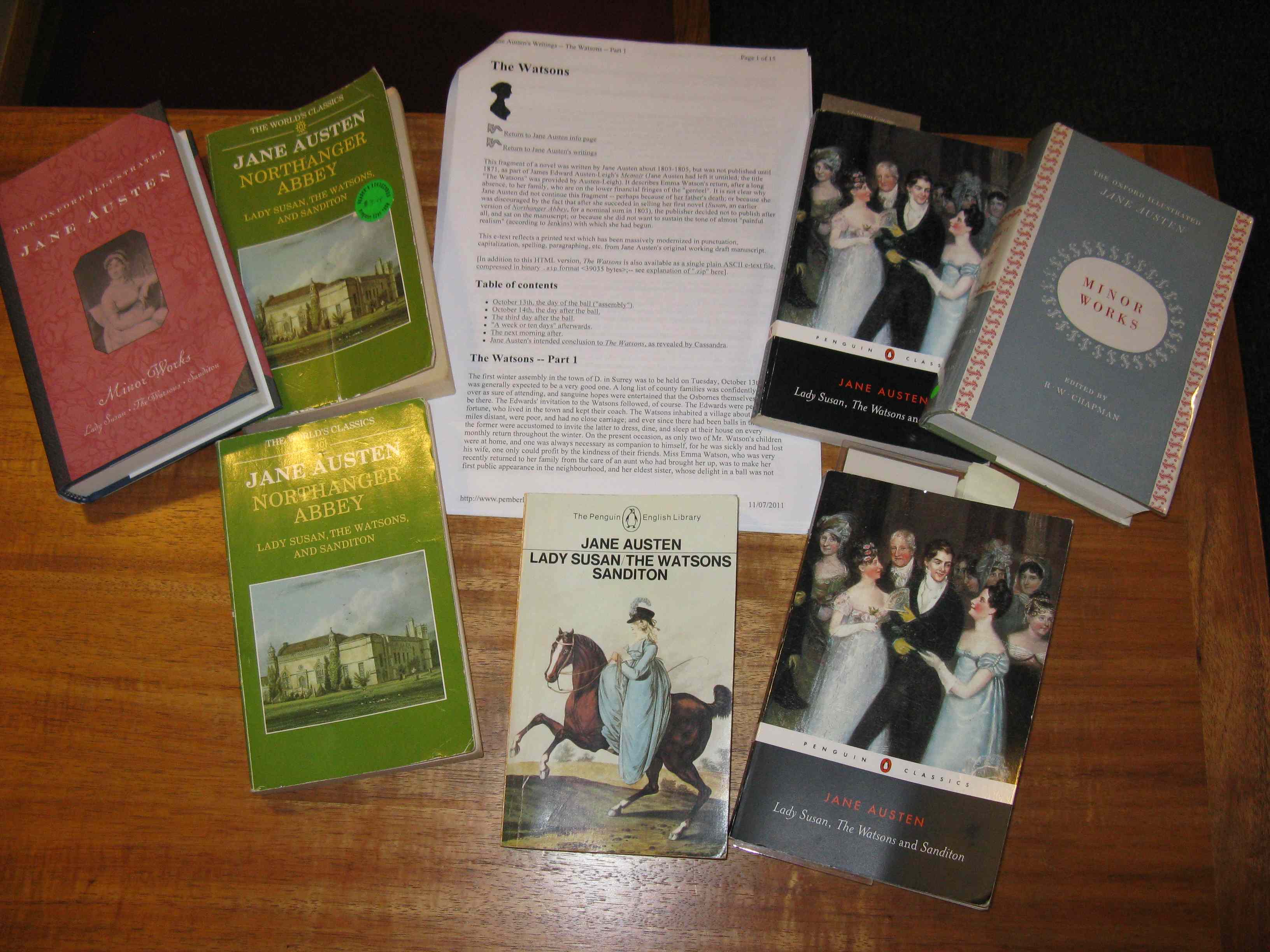
Book covers for Jane Austen's The Watsons

Book covers for Jane Austen's The Watsons

In one of those coincidences that we often bother about in fiction, my local Jane Austen group scheduled Jane Austen’s unfinished novel, The Watsons, for our July discussion. A coincidence because, if you are an Austen fan, you’ll know that just this week the manuscript was sold at auction for nearly £1 million. Thank goodness it was bought by an institution – the Bodleian at Oxford. Next time I’m in England I know where I’ll be going!

Anyhow, onto The Watsons. This unfinished novel was written in Bath probably around 1803-1805, though there is not consensus about this. A common belief is that she abandoned it after her father’s death due to sadness and the resultant uncertainty in her living conditions. Whether this is true or not, it is a fact that she didn’t take up serious writing again until she settled in Chawton in 1809 – which gives rise to the more interesting challenge. That is, why didn’t she take this one up again as she did with other early works such as First impressions which became Pride and prejudice. Enough of that, however, as all we can do is speculate. Let’s look at the work instead.

English novelist Margaret Drabble describes The Watsons as “tantalising, delightful and highly accomplished”. And it certainly is tantalising. We have only 68 pages (manuscript count). The story concerns 19-year-old Emma Watson who has returned, after living with her well-off aunt and uncle for 14 years, to her “poor” family. At the time of her return, just her oldest sister, the 28-year-old Elizabeth, is at home with their invalid father. The family however comprises four daughters and two sons, of whom only one son is married. The main plot-line is, of course, likely to be marriage, and so in these first chapters we are introduced to three men who could vie for Emma’s hand. We are also introduced to the characters belonging to Austen’s favourite subject, “3 or 4 families in a Country Village”. We know, from her sister Cassandra, how Austen intended the plot to play out. So tantalising that we never saw her do it!

Drabble’s next word is “delightful” and it is that too … because it contains those wonderful character descriptions and social observations that we have come to expect of Austen. I’ll share just a couple. The first one describes Emma (at the Ball where we meet three potential beaux):

… a lively Eye, a sweet smile, & an open Countenance, gave beauty to attract, & expression to make that beauty improve on acquaintance …

Contrast this to the following description of her sister Margaret:

Margaret was not without beauty; she had a slight, pretty figure, & rather wanted Countenance than good features; – but the sharp & anxious expression of her face made her beauty in general little felt.

There are also those delightful little set pieces we are used to finding in Austen, pieces that illuminate character as much as they move the plot along. One concerns Emma’s offer to dance with a 10-year-old boy when the snooty aristocrat Miss Osborne, doesn’t follow through on her promise to dance with him. “Oh Uncle”, the young lad says to one of the possible beaux, “do look at my partner. She’s so pretty.”

Sweet as she is, Emma proves herself to be well able – rather like Elizabeth Bennet – to hold her own. She refuses to pander to the flirtatious Tom:

Emma’s calm curtsey in reply must have struck him as very unlike the encouraging warmth he had been used to receive from her Sisters, & and gave him probably the novel sensation of doubting his own influence, & of wishing for more attention than she bestowed.

The last sentence of The Watsons starts, “Emma was of course uninfluenced …”. How sad we didn’t get to see more of this resourceful, delightful heroine.

Finally, “highly accomplished“. I’m not sure I totally agree with Drabble here. What we have is intriguing, tantalising us with its potential. It demonstrates much of what we know and love about Austen – and yet, despite evidence of extensive editing in the recently auctioned manuscript, it has (to my mind anyhow) an element of clumsiness. I find this particularly in an overuse of dialogue to convey information which the characters involved would surely already know – such as Elizabeth’s saying to her sister, Emma, “though I am nine years older”. It works well enough in the context but I believe the later, experienced Austen would have better conveyed this through authorial comment.

Nonetheless, it is accomplished. Its realism is remarkable and, like all her novels, it is clear from the beginning just what the targets are going to be. In this case, I see a major theme being the contrast between exterior and interior “refinement”. The fragment we have focuses heavily on the distinctions of class, often contrasting the superficiality of those who possess this so-called “class” with Emma whose refinement is more of the interior kind. This has the makings of a fascinating novel.

And yet, while it was not to be, we can point to many characters in later books who seem to draw, albeit with variations, from the characters here: the invalid father in Emma, the money-fixated brother in Sense and sensibility, the independent-thinking heroine in Pride and prejudice, the flirty young man of means in Mansfield Park, to name just a few. For whatever reason, Jane Austen did not return to this manuscript, but it’s obvious that she did not forget the characters nor some of the ideas behind their creation.

Jane Austen
“The Watsons”
in The Oxford illustrated Jane Austen. Vol VI, The minor works (ed. R.W. Chapman)
London: Oxford University Press, 1969
pp. 315-363

Delicious descriptions from Down Under: Melbourne scenes, 1850s

One of the contributors to Charles Dickens‘ weekly magazine Household Words was Richard HorneAccording to the notes on Contributors in Margaret Mendelawitz’s five-volume set, Charles Dickens’ Australia, which I reviewed last week, Horne was an English-born author who lived in Australia from 1852 to 1869. He agreed to write travel pieces for Household Words “in return”, say the notes, “for advances to equip the expedition and for regular payments to his wife”. (Apparently Dickens refused to have anything to do with Horne when he returned to England due to the minimal contributions Horne had made to his wife’s support while he was away. Given Dickens’ own less than admirable treatment of his wife this smacks a little the pot calling the kettle black, methinks)

Anyhow, one of Horne’s articles for Household Words is included in the first book of Mendelawitz’s set. The article, published in 1853, is titled “Convicts in the gold region” and discusses convicts in the Melbourne area. I enjoyed some of his descriptions and thought I’d share a selection with you.

on Melbourne

… Melbourne, famous, among other things, ever since it rose to fame two years ago, for no roads, or the worst roads, or impassable sloughs, swamps, and rights of way through suburb wastes of bush, and boulder stones, and stumps of trees …

I was going to use this to talk about how stereotypes start but in fact Melbourne’s roads aren’t particularly bad these days, even though it does have a reputation for its strange road rule, the hook turn. The next description, however, is more typical of Melbourne:

It is night; a cold wind blows and a drizzling rain falls.

And yet again I jest a little when I say typical. Melbourne is famous for having four seasons in a day so cold and rain are not the only weather you experience there!

at the Pentridge Stockade

Pentridge prison was built in 1850 to cater for the growing number of prisoners resulting from increased crime due to the gold rush. Horne had a reason for describing Melbourne’s roads at the beginning of his article, because the road to Pentridge itself was a beautiful one. It was built using convict labour.

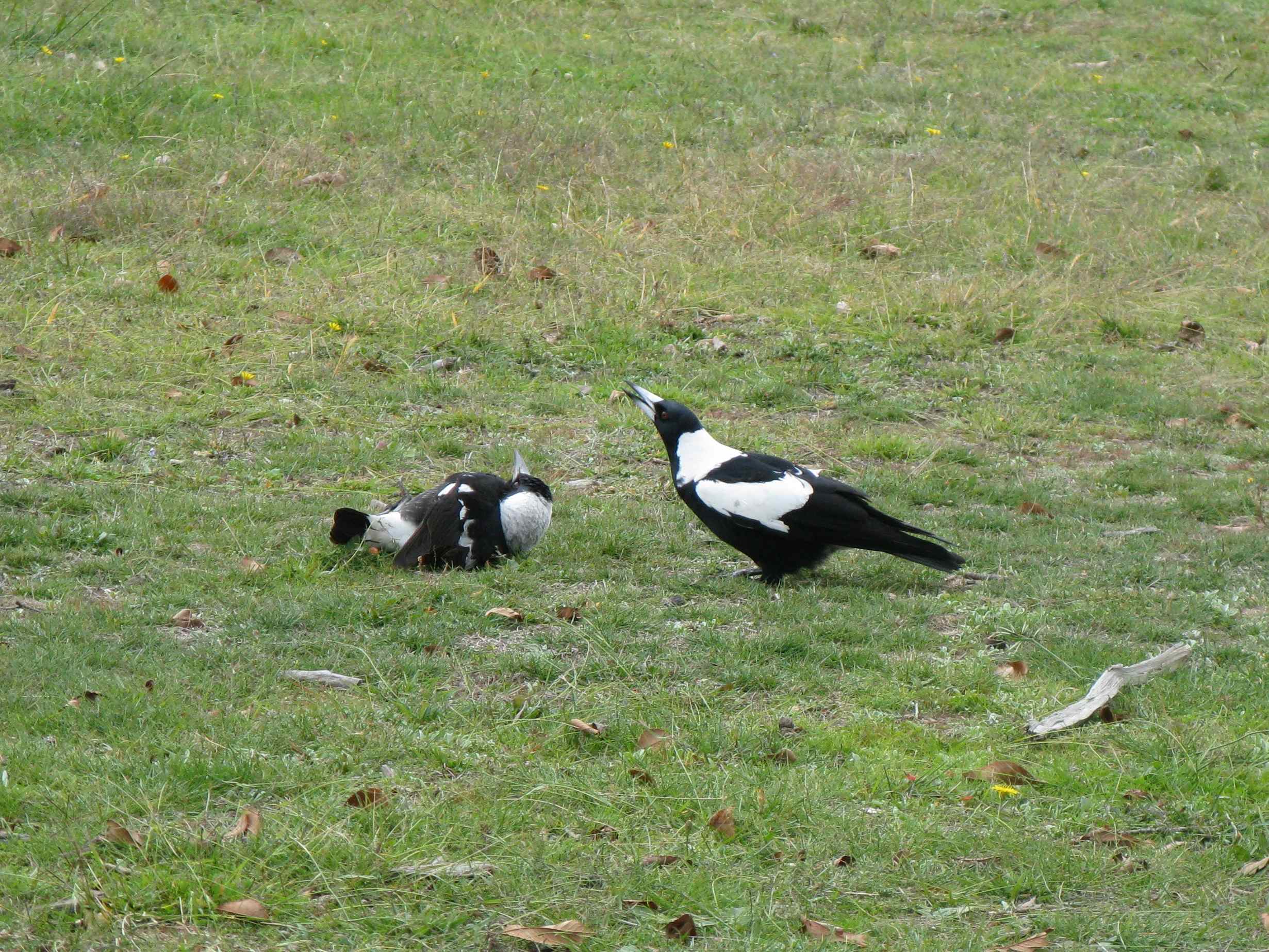
Magpies at Tidbinbilla

Not on broken granite, but magpies nonetheless

The yard is covered with loose stones of broken granite; and I notice close to my feet and looking directly into my face, a magpie. He also, holding his head on one side interrogatively, seems to ask my business here. I take a fresh breath as I look down at the little thing, as the only relief to the oppressive nature of prison doom that pervades the prison scene.

This man is clearly a writer … the contrast he draws here is both pointed and poignant.

I have taken a stroll around the outskirts of the Stockade, and, while gazing over the swampy fields, now wearing the green tints of the fresh grass of winter which is near at hand, and thence turning my gaze to the bush in the distance, with its uncouth and lonely appearance, I hear …

And now we’re really talking … because this description of the Australian bush as uninviting and unappealing was widely held by our 19th century colonials. And, I’d venture to say, Australian culture didn’t really start to come into its own until we started to appreciate the beauty of our bush!