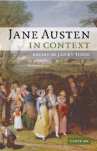
Courtesy Cambridge University Press
What Janeites call sequels, others, such as Elizabeth Paton writing in the June 2009 issue of goodreading, call fan fiction. And, I guess, fan fiction is a little more accurate since what Janeites call sequels is, in fact, “fiction written by the fans, for the fans of a particular book”. In her essay titled “Sequels” in Cambridge’s Jane Austen in context that I referred to in a recent blog, Deidre Shauna Lynch commences with “the sequels, prequels, retellings and spinoffs that Jane Austen’s novels have inspired”. In other words, what Austen fans loosely call “sequels” are not necessarily sequels at all.
Paton’s description of fan fiction works well:
Fan writers shape or expand their favourite works, taking existing characters, settings or plots and creating their own stories. Fan writers may attempt to fill holes in the story or completely change the ending, add new characters or transfer original ones into different settings, tease out subplots or even merge the storylines of two different books.
She goes on to say:
In many of these stories, the imagination can take precedence over quality. Pornographic content is common, as are two-dimensional characters, illogical plots and poor sentence construction. … you may need to sort through a lot of dross to find fan fiction gold – but it is out there.
Writing generally on fan fiction, Paton provides a brief history of the genre and a wide range of examples from a 1614 sequel to Cervantes’ Don Quixote written by Alfonso Fernandez de Avellaneda to Geraldine Brooks’ 2006 Pulitzer Prize winning March which reimagines Mr March from Louisa May Alcott’s Little Women. She concludes her article describing in a little more detail “perhaps the most succesful sequels[!]”, “those rewriting or continuing Jane Austen’s Pride and prejudice“.
This brings me to Deirdre Shauna Lynch and her fascinating analysis of “sequels” in the Cambridge publication. Early in the essay she makes a rather apposite point:
the history of Austen sequels … seems to confirm a cynical understanding of sequel writing as the literati’s closest approximation to a get-rich-quick scheme.
However, she then delves a little more deeply into the phenomenon, asking why Austen’s novels have proven themselves so hospitable to sequelisation. She suggests there are two types of sequels:
- the kind (that I would call the “true sequel”) that goes past the original ending to recount what happens next. This kind she says feeds into the pleasure humans “derive from gossip”. She suggests that “these narratives often feel like throwbacks to the Gothic and sentimental novels that Austen liked to burlesque”.
- the kind that finds other ways to return to Jane Austen’s world, such as reimagining a story from the point of view of another character, or combining characters from more than one book. These books, she says, sometimes explore unsettling undertones in the original, and can display “a kind of postmodern playfulness and predilection for insider joking”.
In her analysis she suggests that at least some of the “sequels” represent the very playing around with narrative conventions that Austen herself liked to do, what she calls Austen’s “unorthodox narratology” which includes repetitions, circularity and implied backstories (ie prequels).
I have to be honest here and say that while I have read Barbara Ker Wilson’s Jane Austen in Australia, I have never read an Austen sequel. I have been wondering lately though whether the best of them, particularly Lynch’s second kind, might operate a bit like a novel commentary: a good writer retelling Emma from Jane Fairfax’s point of view, for example, may very well jolt me into a new way of looking at Emma. And it’s never a bad thing to find a new way to look at a Jane Austen, or indeed any much-loved, novel.

 Whispering Gums