David Mitchell, The thousand autumns of Jacob de Zoet

‘Oh I found ways to live to tell the tale. It’s my chief hobby-hawk is the noble art of survivin’.’

‘Loyalty looks simple,’ Grote tells him, ‘but it isn’t.’

‘…Expensive habit is honesty. Loyalty ain’t a simple matter, Di’nt I warn yer…’

It’s interesting that some of the main themes of David Mitchell‘s The thousand autumns of Jacob de Zoet are conveyed by one of its lesser (in terms of status) and more questionable (in terms of morality) characters, the Dutch cook, Arie Grote. Interesting because such a slippery and relatively minor character expresses some critical themes and because Mitchell’s making this choice provides a clue to the book’s tone and style. It has, in other words, a rather wry undertone.

Dejima model, Nagasaki

Model of Dejima, at Dejima Wharf, Nagasaki

So, what is its plot? Broadly, it is about the Dutch East India Company‘s activities on Dejima, a walled island in Nagasaki harbour, during Japan’s isolationist (or, “Cloistered Empire”) period, with most of the action taking place between 1799 and 1800. It follows Jacob de Zoet, a young man who arrives in 1799 to work as a clerk (and to make his fortune so he can return home to marry his love, Anna). What he finds is a multicultural community comprising Dutch, Japanese, a Prussian, an Irishman and others including Malay slaves, living and working within a complex web of ambitions, animosities and allegiances. He discovers pretty quickly that he’s going to need good survival skills to make it through. The question is: will he make it through, and will he do it with his integrity intact?

There is a love triangle of sorts, involving a young Japanese midwife named Orito. And there’s a drama centred on her “abduction” to a horrifying (invoking, for me, Margaret Atwood‘s The handmaid’s tale) monastery/nunnery called Mt Shiranui, which is overseen by the evil lord/abbot, Enomoto. This sounds, I admit, a bit melodramatic and in a way it is, but it seems to work, largely because of the characterisation.

The novel has a huge cast of characters, as this Character List (source unknown) shows and, over the course of 450+ pages, Mitchell gives us the backstories to many of them. At times I felt there was too much detail – as in “why do I need to know all this?” – but the stories were so interesting that I didn’t really mind. Mitchell is not, I have to say, a taker-outer and so, if you like your stories to move along at a fast clip, this is not for you. Many of the characters, from bottom to top of the hierarchy, are corrupt, as they scheme, bribe and manipulate for money, power and/or prestige, but not all are. Some of the most interesting characters are those who are not corrupt but are not perfect either. They include Jacob; the doctor/scientist, Dr Marinus, who tests Jacob somewhat cruelly; the young interpreter, Ogawa Uzaemon, who overlooks Jacob’s illegal importation of his Christian psalter; and John Penhaligon, the gout-ridden English captain who makes a play for Dejima late in the novel.

Having read and enjoyed Cloud atlas, I must say I kept expecting some, shall we call it, literary “tricksiness” but it never really appeared. This is historical fiction told in a linear fashion, albeit with the odd digression and some shifting perspectives. In fact, while not particularly “tricksy”, the style is not simple. There is a lot of variety in the telling:

  • dialogue (and italicised thoughts of characters, as conversations or action occur);
  • backstories;
  • set-ups that don’t always follow through as you would expect (such as that concerning Jacob’s hidden psalter);
  • scenes in which the main action is interspersed by something else going on (such as Cutlip preparing his boiled egg while Penhaligon negotiates with the slippery Prussian, Fischer);
  • action and adventure; and
  • a good deal of humour (including the scene in which a Japanese translator tries to translate a scientific lecture being given by Dr Marinus).

The language is similarly diverse. Mitchell uses irony, metaphor and symbolism, wordplay, and repetition, to name just a few techniques. Here, for example, is a rather lovely oxymoron:

The creeds of Enomoto’s order shine darkness on all things.

And here is a moving description related to an honourable death (without naming names):

An inch away is a go clamshell stone, perfect and smooth …
… a black butterfly lands on the white stone, and unfolds its wings.

I was impressed by the array of literary devices he used and how it never felt overdone. It was his language and characterisation, more than anything else, that kept me engaged.

The book does suffer a little, though, from the breadth of its concerns. I flicked through the book to jot down its themes and ran out of space on my page! So, I grouped them:

  • Political/historical: commerce, nationalism, colonialism and slavery
  • Philosophical: fate, faith and belief, truth
  • Social: education, oppression of women, science and enlightenment
  • Personal/psychological: loyalty and betrayal, honesty, love and integrity, survival

That’s a pretty broad church and, although some naturally overlap, the effect is to dilute the book’s impact somewhat.

So, how would I encapsulate it? Well, I’d sum it up as being about “imprisonment”, both literal and metaphorical. The Dutch are imprisoned on Dejima, the Japanese are imprisoned within their self-imposed isolationist policy, Orito and her “sisters” are imprisoned at Mt Shiranui. And people are imprisoned by their roles and/or culture. For example, women’s options are restricted, slaves have little control over their lives, and many of the characters, including Jacob, are imprisoned by their lack of economic resources that would enable them to freely choose their lives.

This is one of those rather unwieldy books that is hard to pin down but, despite this, I did rather enjoy watching Jacob and co. going about “the noble art of survivin'” in an intriguing place and time.

Monday musings on Australian literature: Elizabeth von Arnim

Cover of "All the Dogs of My Life"

All the Dogs of My Life (Courtesy: Vintage Books, via Amazon)

This week’s Monday musings is a bit cheeky since Elizabeth von Arnim (or Mary Annette Beauchamp, her birth-name) was born in Sydney in 1866 but her parents left Australia in 1871 for Switzerland and then England. Von Arnim spent the rest of her life abroad. So, why am I writing about her? She didn’t grow up in Australia and doesn’t write about it either. Well, it’s because I love her writing and thought I could use the Australian birth justification to write about her now rather than later. After all, it’s my blog and I’ll do what I want to!

Before I talk about her writing, it’s worth mentioning that she has a famous relation: her first cousin was Katherine Mansfield (born Katherine Mansfield Beauchamp in 1888). But this isn’t the only name-dropping that can be done. The writer E.M. Forster tutored her children at one stage, she had a three-year relationship with H.G. Wells, and she married (but soon regretted it) Bertrand Russell‘s older brother. In other words, she had an interesting life.

I have read a few of her 20 or so books:

And, I have Vera (1921), which some see as her best, on my TBR pile.

So, why do I like her? Well, not only is her main theme, at least from the books I’ve read to date, women’s lack of power in a male-dominated world but, like Jane Austen, she approaches this with wit and irony and with a clear eye for human failings in general. In other words, she empathised with women’s lot but wasn’t blind to their faults and foibles (as individuals, as women and as representatives of humanity). Just read Mr Skeffington, and you will see what I mean.

To give you a sense of her writing, here are the opening paras of her “memoir” All the dogs of my life:

I would like, to begin with, to say that though parents, husbands, children, lovers and friends are all very well, they are not dogs. In my day and turn having been each of the above – except that instead of husbands I was wives – I know what I am talking about, and am well acquainted with the ups and downs, the daily ups and downs, the sometimes almost hourly ones in the thinskinned, which seem inevitably to accompany human loves.

Dogs are free from these fluctuations. Once they love, they love steadily, unchangingly, till their last breath.

That is how I like to be loved.

Therefore I will write of dogs.

How can you not be captivated by such a wry writer? The book continues in this teasing tone. She insists it is not her autobiography (“as this isn’t an autobiography, I needn’t go into that” is a refrain), but a story of her dogs, and regularly tells us so. But of course, through the story of her dogs, we get a pretty good impression of her life. She may not give us all the details, but we certainly learn about many of her “ups and downs”. This book, though, was not my introduction to von Arnim: that goes to the delightful Elizabeth and her German garden.

In a recent post, Max of Pechorin’s journal wrote that “the line between novel and memoir can be a tricky one”. I immediately thought of Elizabeth and her German garden, which I first read back in the mid 1980s. This is, I believe, a novel (in diary form) but it is also rather close to her life. She did, like the Elizabeth of the book, marry a German (count) and she did call him, as she does in the book, “The Man of wrath”. Furthermore, she did have several children. In fact her second book, The solitary summer, is dedicated “To the man of wrath, with some apologies and much love”.  Anyhow, here is the Elizabeth in the novel:

The people about are persuaded that I am, to put it as kindly as possible, exceedingly eccentric, for the news has travelled that I spend the day out of doors with a book, and that no mortal eye has ever yet seen me sew or cook. But why cook when you can get someone to cook for you?

OK, so she is well-to-do … but still, I love her priorities! Here she is in her (aforementioned) memoir, speaking of herself and one of her dogs:

Fortunately we liked the same things. She only wanted to be outdoors in the sun, and so did I …

And so, while some of the facts may differ (though I don’t know which ones), the basic “truth” of her life – her likes, dislikes and, more to the point, her attitudes and personality, come through both books.

Elizabeth von Arnim was a woman who tackled life head on. Her first husband died, she had affairs and a failed marriage; she lived in England, Europe and the USA; and she met some of the significant thinkers and writers of her time.  But, through it all, she never lost sight of “women’s lot” and the psychological ramifications of their powerlessness. Here she is in Elizabeth and her German garden on migrant workers:

From us they get a mark and a half to two marks a day, and as many potatoes as they can eat. The women get less, not because they work less but because they are women and must not be encouraged.

There is also, in the same book, an extended – and infuriating – discussion between Elizabeth, the Man of Wrath, and two others on German women having the same (lack of) rights as children and idiots. But politics was not her main game, I think. Rather, she was interested in women’s lives, in their wish and need to make self-determined, meaningful lives for themselves. So, I might just finish with another little excerpt from All the dogs of my life:

What on earth did I, of all people, want with a lot of husbands? I asked myself in wonder. Besides, by readily sticking to poached eggs for dinner I was getting abreast of my expenses, and the bills of Saturdays held no more terrors for me.

Ha! What indeed (at least in those inequitable days)!

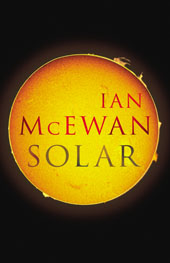
Ian McEwan, Solar

Ian McEwan Solar bookcover

Bookcover (Used by permission of the Random House Group Ltd)

I don’t know whether I believe your story, but I’ve enjoyed it.

So says McEwan’s latest creation, Michael Beard, to a character he has “done wrong”. This more or less sums up my feelings about Solar, the novel in which this statement appears. I am a McEwan fan and have greatly liked most of the 5 or 6 of his books that I’ve read but, while I found this one readable, I’m not convinced that it completely comes together into a coherent whole. This may have something to do with the fact that McEwan has tried for something lighter here and hasn’t quite pulled it off.

Do I need to describe the plot? It’s been reviewed so much by now that I presume most readers here already know it. However, to be on the safe side, here goes. It’s all about Nobel Laureate physicist, Michael Beard, who at the start of the book is 53 years old, 15lbs overweight and at the end of his 5th marriage (due to his incurable, it seems, womanising). On top of this he is struggling to keep his career alive: he is surviving, mostly on speaking engagements, while he waits, hopes, for a new inspiration. This is the set up. And, as is typical of McEwan, a little way into the book an event occurs that will be life-changing. In Beard’s case it will kickstart his career. How that occurs – and its eventual fallout – forms the rest of the book.

The novel is divided into three parts, labelled simply 2000, 2005 and 2009. If Beard was 15lbs overweight in 2000, in 2005 he is 35lbs overweight and by 2009 that has increased to 65lbs. This might tell you something about him: he is out of control in every aspect of his life – physically, emotionally, intellectually and morally. He is not, as you might gather from this, a likable man, but it is mainly through his eyes – told third person – that we experience the novel.

As the title suggests, the book’s subject matter is solar energy and climate change. And some of the best parts are those in which McEwan satirises the politics of climate change. In an amusing sequence, Beard is invited to the arctic along with a number of artists (making him the proverbial sore thumb) to experience climate change first hand. While he is there he observes the increasing chaos in the “bootroom” where the outdoor clothing is kept. From day one, the “bootroom” doesn’t work as people take items from pegs that are not their own resulting by the end of the week in no-one wearing a complete outfit that fits them. This works pretty well as a metaphor for the chaos and disorganisation in the climate change community. Add to this scenes like the idealistic climate-changers scooting about the ice in their gas-guzzling skidoos and you get a rather funny, and pointed, episode in the book.

The tone of the book is, in fact, comic-satiric which is a bit of a departure for McEwan who has tended to write books that are more dramatic, many with a “thriller” component. Here, though, there are even moments of slap-stick, such as when Beard early in the book pretends that he has a woman in the house in an attempt to make his wife jealous – all to no effect, but in terms of the novel’s plot it results in a deeply ironic statement:

Clearly he had been in no state to take decisions or to devise schemes and from now on he must take into account his unreliable mental state and act conservatively, passively, honestly, and break no rules, do nothing extreme.

Not long after this episode he does the complete opposite. Some of the members of my reading group found the book very funny but for me it fell a little flat. I saw the satire and thought it was clever at times, but it was sometimes more pathetic than highly comic, and at other times a little heavy-handed. Here, for example, is Beard on the bootroom:

How were they to save the earth – assuming it needed saving, which he doubted – when it was so much larger than the bootroom?

Now, most readers would already have got the point. I’m not sure that we needed to have it hammered home like this.

The focus of the book, as you will have gathered by now, is Beard and we spend a lot of time in his head. This is not a problem in itself, except that he never seems to change. He’s a gluttonous, arrogant, self-centred womaniser at the beginning and is the same at the end. He is also morally bankrupt – something you will discover soon enough if you read the book. Does a character have to change for a book to work? Not necessarily – think Jean-Baptiste Grenouille in Perfume – but we do have to stay interested in the character and Beard, for me, became a little boring. There was too much of the same – too much womanising, too much alcohol and fatty, fast food, too much self-aggrandisement – that I started to think “enough already”.

The key question to ask, then, is why has McEwan chosen such a character? The answer seems to be that McEwan wanted to express his fear – cynicism even – about 21st century humankind’s ability to enforce change. Early in the novel is this:

Beard was not wholly sceptical about climate change. It was one of a list of issues, of looming sorrows, that comprised the background to the news, and he read about it, vaguely deplored it and expected governments to meet and take action … but he himself had other things to think about …

Himself, basically. Is McEwan saying Beard is us, is Everyman? If so, I can’t help thinking he’s got a point, but I’m not sure he’s written the book – like, say, Animal farm – that sustains the trope well enough to last the distance.

Oh dear, I fear now that I have been more critical than I meant to, because I did find the book readable. I did want to know what happened. I liked a lot of the language. And I did enjoy many of the observations McEwan makes throughout the book – about reason and logic versus idealism, about feminism, and of course about politics. Take for example the following, which is very apposite given that we downunder are in the middle of a Federal election campaign:

He was aggressively apolitical – to the fingertips, he liked to say. He disliked the overheated non-arguments, the efforts each side made to misunderstand and misrepresent the other, the amnesia that spooled behind each ‘issue’ as it arose.

I can relate to that …

Finally, there is a sly bit of self-deprecation running through the book about stories, imagination and the arts. I had to laugh at Beard’s comment that:

People who kept on about narrative tended to have a squiffy view of reality, believing all versions of it to have equal value.

I’ll leave you to decide what you think of McEwan’s version here.

Ian McEwan
Solar
London: Jonathan Cape, 2010
283pp.
ISBN: 9780224090506

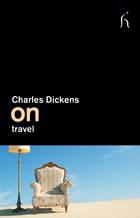
Charles Dickens, On travel

Charles Dickens, On travel

On travel bookcover (Hesperus Press, via LibraryThing)

In the 3rd essay in Hesperus Press’s lovely little volume On travel, which comprises a selection of Dickens’ travel essays, Dickens (1812-1870) makes a reference to Laurence Sterne’s character Yorick. In one of those lovely bits of reading synchronicity, Hungry Like the Wolf posted last week on Laurence Sterne’s A sentimental journey through France and Italy which features said Yorick. In it Yorick lists various types of travellers including Idle travellers, Vain travellers, and Sentimental travellers. Yorick’s type that best suits Dickens would, I think, be his Inquisitive type. However, I think Yorick needed another category to describe a traveller like Dickens: the Observant traveller. (Hmm…I wrote this before checking out the Introduction by Pete Orford. In the first para he praises Dickens’ “talent of observation”. Great minds, and all that!)

There are 6 essays in this slim but rather gorgeously produced volume – don’t you love the allusion to the “armchair traveller” on the cover?:

  • The last cab driver and the first omnibus cab (1836)
  • The passage out (1841)
  • By Verona, Mantua and Milan, across the Pass of the Simplon into Switzerland (1843)
  • A flight (1851)
  • The Calais Night Mail (1863)
  • Some account of an extraordinary traveller (1850)

Reading these reminds me yet again why I love Dickens. I enjoy his acute observation of humankind and his sense of humour. He makes me laugh. Regularly. And then there is his versatile use of the English language. The man can write.

Four of the essays describe train and boat travel, including to America, and to and through Europe. His descriptions of the actual experience of travel and of the various passengers (such as the Compact Enchantress, Monied Interest and the Demented Traveller) he meets on the way are highly evocative. You feel you are on the trains and boats with him because he captures that sense of being tossed about in the sea and of rushing in a train through landscapes and – “bang” (his word) – through stations. But it’s not all sensory – as engaging as that is. There is satire here too – against others, and against himself. For example, in “The Calais Night Mail” he sends up his own love-hate relationship with Calais as well as the behaviour of an English traveller who “thinks it a quite unaccountable thing that they don’t keep ‘London time’ on a French railway”. (It was ever thus, eh?)

The thing about his writing is its diversity – he mixes up his rhythm; he uses allusions, irony and metaphor; he plays with tense and punctuation; and he uses repetition, to name just a few of the “tricks” in his writer’s bag. Just look at the variety in the following examples.

A wickedly satirical description of a man who was transported twice to Australia:

If Mr Barker can be fairly said to have had any weakness in his earlier years, it was an amiable one – love, love in its most comprehensive form – a love of ladies, liquids and pocket handkerchiefs. It was no selfish feeling; it was not confined to his own possessions… (“The last cab driver and the first omnibus cab”)

On a rough crossing to Calais:

I am bumped rolled gurgled washed and pitched into Calais Harbour… (“The Calais Night Mail”)

A description of the Demented Traveller:

Faculties of second Englishman entirely absorbed in hurry. Plunges into the carriage, blind. Calls out of the window concerning his luggage, deaf. (“A flight”)

And then this little pointed comment written in 1863 but alluding to an earlier trip in 1843:

and I recognise the extremely explosive steamer in which I ascended the Mississippi when the American civil war was not, and only its causes were. (“The Calais Night Mail”)

Dickens was, as we realise from the last essay in the collection, more than aware of the horrors of slavery, not to mention the plight of “the fast-declining Indians”. His willingness to express such awareness did not always endear him to Americans but, as Pete Orford writes in the Introduction, Dickens was equally prepared to be satirical of home as abroad.

These essays provide a fascinating insight into how Dickens viewed his world and the people in it, and present wonderful exemplars of his writing. They also demonstrate how widely travelled he was, which, by broadening his understanding of humanity, must have fed his fictional muse too. Orford concludes his Introduction with some lines from the last essay. I can’t really think of a better way to end this than to repeat some of them too. Dickens wrote:

The more man knows of man, the better for the common brotherhood among us all. (“Some account of an extraordinary traveller”)

Some of Dickens’ words and allusions (though there are “notes” in this edition) may be a little obscure now, and some sentence structures are a little complicated to our modern eyes, but if you have any interest in Dickens or travel writing in general, you will enjoy this. I certainly did.

Charles Dickens
On travel
Hesperus Press, 2010
91pp.
ISBN: 9781843916123
(Review copy supplied by Hesperus Press via the LibraryThing Early Reviewers Program)

NOTE: I must apologise for once again hitting the Publish button too early and sending some half-finished gobbledy-gook to your various readers and email accounts. I should either take Tony’s advice and draft in Word or adopt Farnoosh’s recent “Slow down” admonition (to herself), because clearly I’m not getting it right at present! I beg your forgiveness.

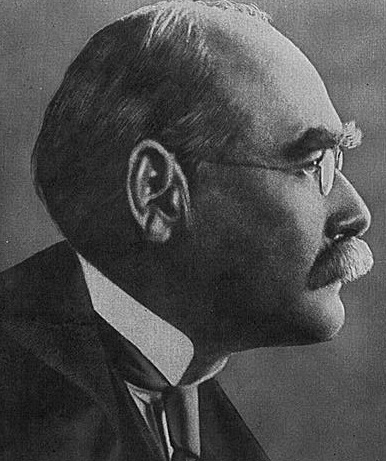
Rudyard Kipling, An interview with Mark Twain

Rudyard Kipling

Kipling, somewhat older than 23! (Presumed Public Domain, via Wikipedia)

How could I resist reading this offering from the Library of America, featuring as it does two giants of the late nineteenth and early twentieth centuries? Both are writers I know well in a superficial way: I’ve really read only a little of their works. This essay, I thought, presented an interesting opportunity to get to know them from a different perspective.

“An interview with Mark Twain” was published in 1890, the year after Kipling, then 23 years old and on his overseas tour to Europe and the USA, interviewed the great man. Twain was 54, and staying in Elmira, NY, at the time. We know from the opening lines that Kipling idolises Twain:

You are a contemptible lot, over yonder. Some of you are Commissioners, and some Lieutenant-Governors, and some have the V.C., and a few are privileged to walk about the Mall arm in arm with the Viceroy; but I have seen Mark Twain … Understand clearly that I do not despise you, indeed I don’t. I am only very sorry for you, from the Viceroy downward …

Clearly this is going to be a positively reported interview! The essay starts though, rather humorously, with the challenges Kipling faced in locating Clemens (as he was known) but, one-third of the way into the essay, we finally meet Twain who, despite his grey hair (that “was an accident of the most trivial”) looked “quite young”.

Kipling’s next comment rather continues his hero-worship – and reflects the way many of we readers think when we think of our favourite writers:

Reading his books, I had striven to get an idea of his personality, and all my preconceived notions were wrong and beneath the reality. Blessed is the man who finds no disillusion when he is brought face to face with a revered writer.

You might think, from all this, that the rest of the interview will be rather hagiographic, with Kipling hanging on Twain’s every words. But, while there is an element of that, Kipling is delightfully self-conscious and there is a lovely sense of like minds engaging. Kipling reports on a conversation that ranges over a number of issues, including copyright, about which Twain has strong feelings, believing that a writer (and his heirs) should maintain control over “the work of his brains” (Kipling’s words) in much the same way as you might own “real estate” (Twain’s analogy). If you search the Internet, you will find a number of references to Mark Twain and copyright. As an (ex) librarian/archivist, I have a complicated relationship with copyright. I believe in abiding by it, I believe that creators need recompense for their work and that copyright is one way they can ensure that, but I also like people to be able to access the works they wish. According to my Internet research, Twain did not seek perpetual copyright, but enough to protect/provide for his immediate heirs. That sounds fair enough to me. And, it sounded fair enough to Kipling, though he was a little tongue-in-cheek in reporting that he saw Twain’s point, because he follows it up with “When the old lion roars, the young whelps growl. I growled assentingly”.

[If you are interested in copyright in the USA, check this timeline prepared by the Association of Research Libraries.]

Anyhow, they move on to discuss Twain’s books, and the possibility of a sequel to Tom Sawyer. Twain, teasingly, suggests that he hasn’t decided, that he could “make him rise to great honour and go to Congress” or he could “hang him”! This was too much for Kipling who says “I lost my reverence completely” arguing that Sawyer “was real”. Ah, fiction and reality I thought! This essay is speaking to me again.

Twain replies that Sawyer “is real … he’s all the boys that I have known or recollect” but then goes on to say that:

Suppose we took the next four and twenty years of Tom Sawyer’s life, and gave a little joggle to the circumstances that controlled him. He would, logically, according to the joggle, turn out a rip of an angel.

He calls this Kismet, and asks whether Kipling agrees. Kipling does to a degree, but suggests that Sawyer isn’t Twain’s property any more, “he belongs to us”. Hmmm…I’m not sure that this is the aspect of “reality” in fiction that interests me, but the discussion (which is not reported further) is interesting, if only because it reflects topics that engaged these two writers.

They they go on to discuss “truth and the like in literature” but the discussion focuses more on autobiography and Twain’s view that no matter how much an autobiographer may lie about him/herself, the “truth” will out. Ain’t that the truth! All of us writing blogs give ourselves away, regardless, I think, of how we may try to “present” ourselves… But, I think I’ll move on from this possibly murky mire!

And then, in a fascinating little discussion of novel-reading comes this point which may interest we bloggers. It’s about assessing novels. Twain says:

You see … every man has his private opinion about a book. But that is my private opinion. If I had lived in the beginning of things, I should have looked around the township to see what popular opinion thought of the murder of Abel before I openly condemned Cain. I should have had my private opinion, of course, but I shouldn’t have expressed it until I had felt the way.

Is he saying what I think he’s saying? A little later in the essay, and on a slightly different topic, Kipling says “and I am still wondering if he meant what he said”! Knowing a little of Twain, I must admit I’m wondering what was “true” in his comments, and what wasn’t … so much of his “truth” is behind rather than in his words.

Twain goes on to talk about fiction and fact, implying that he prefers the latter, that he doesn’t “care for fiction”. He then gives this advice which I love:

“Get your facts first, and” – the voice dies away to an almost inaudible drone – “then you can distort ’em as much as you please”.

I can’t think of a better point upon which to close this post … but, by way of conclusion, I found at The Huffington Post this comment made by Twain, many years later, about the meeting:

I believed that he knew more than any person I had met before, and I knew that he knew that I knew less than any person he had met before–though he did not say it, and I was not expecting that he would. . . . He was a stranger to me and to all the world, and remained so for twelve months, then he became suddenly known, and universally known.

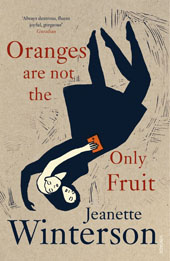
Jeanette Winterson, Oranges are not the only fruit

Winterson, Oranges are not the only fruit, book cover

Book cover: Used by permission of the Random House Group Limited

As I was reading Jeanette Winterson’s novella Oranges are not the only fruit, the question, rightly or wrongly, that was uppermost in my mind was “What is it with the oranges?” Is there something about oranges that I don’t know? Something specific that they symbolise?  I racked (wracked) my brain for something in my literary past that would give me a clue, but I came up with nothing. I guess she wanted to choose a motif to represent her mother’s limiting interactions with her and an orange seemed as good as anything? Certainly oranges are a recurring motif, and her mother regularly insists they are “the only fruit” until the end when a “pineapple” makes its appearance. I’m not sure, however, that this change heralds anything in their relationship other than compounding the paradoxes that seem to underpin this novel.

This is an intriguing book. It is a semi-autobiographical coming-of-age novel which tells the story of the first person protagonist, Jeanette, who was adopted by a religious zealot and is being brought up to be a missionary. However, around the age of 16 she discovers that her (homo)sexual leanings do not meet her mother’s (or her church’s) approval and, well, the plot is slim but perhaps I will leave it here nonetheless…

The novel exhibits some of the hallmarks of postmodernism, of which the most obvious is its metafictional elements, the way it contains stories within stories and plays around with the idea of stories in relation to “truth”. It all begins with Winterson naming the main character after herself and modeling that character’s life on much of her own, resulting in our being, from the start, teased by notions of what is “true” and “real”.

The book is divided into chapters titled appropriately, given Jeanette’s upbringing, by books of the Bible, such as Genesis, Joshua and Ruth. These titles are descriptive but also symbolic and even a little satirical; Jeanette, for example, has walls to confront just like Joshua. And the narrative, while roughly chronological, intermittently leaps from “reality” to “fantasy” as Jeanette tries to escape or make sense of her experience of life. Sometimes these stories – such as the Winnet story near the end – represent a parallel fantasy life for what is happening to her, but other times the reference point is more indirect, and draws on history and myth such as the King Arthur legend (and Sir Perceval’s search for the Holy Grail).

And this brings me to “story” and “history”. Readers of my blog will know that these notions, and the related one of “truth”, fascinate me when they are played out in fiction. I tend to enjoy reading books that deal self-consciously with them, that recognise the challenges and ambiguities inherent in them – and this is one of those books. Jeanette, the character, has some interesting things to say on these topics around the time the “truth” of her life, her sexuality, is becoming clear. She says in the short chapter titled Deuteronomy: The last book of the law:

Of course that is not the whole story , but that is the way with stories; we make them what we will. It’s a way of explaining the universe while leaving the universe unexplained … People like to separate storytelling which is not fact from history which is fact. They do this so they know what to believe and what not to believe. This is very curious …

And she goes on to discuss how history, the past, “can undergo change” because “the lens can be tinted, tilted, smashed”. She recognises that “perhaps the event had an unassailable truth” but we all see it through our own lens. Tellingly, near the end of the book, in the chapter titled Ruth, she runs into Melanie, her first lover (now married with a child):

…she [Melanie] laughed and said we probably saw what had happened differently anyhow … She laughed again and said that they way I saw it would make a good story, her version was just the history, the nothing-at-all facts.

Melanie, it seems, does not have the imagination to re-vision her “story”.

So, did I enjoy this book? Yes, pretty much. I like her attempt to make sense of what was a very particular childhood, and to try to draw from it some larger “truths” about how we might all manage the “stories” of our lives. It is not a straightforward read – and it is first novel with, perhaps, a little of the overdone in it. I’m not sure why, for example, she suddenly decides to include a little rant against Pol Pot. It usefully supports a point she is making about the uses of history, but it is odd in a story that is nowhere else political. Perhaps that’s just being post-modern!

In her introduction to my 1991 Vintage edition, Winterson claims to have written an experimental, anti-linear novel. Well, it is a bit of that I suppose, though not dramatically so. I would have called it reasonably linear – at least in the chronological sense – but perhaps the ideas in it do “spiral” (as she calls it) a bit in the way she toys, through the various narratives, with the idea of “story” and what it means to us. What it means, I think, is not always clear – we like stories but we cannot (perhaps need not) always draw conclusions from them. That is the paradox of our lives. As she says near the end

…not all dark places need light. I have to remember that.

Jeanette Winterson
Oranges are not the only fruit
London: Vintage, 1991 (orig. 1985)
171pp.
ISBN: 9780099935704

Jane Austen’s letters, 1811-1813

Mansfield Park book covers

Mansfield Park book covers - Penguin wins

Early in my blogging career I wrote a post on the letters Jane Austen wrote (well, those remaining anyhow) between 1814 and 1816. This was to coincide with my local Jane Austen group’s reading of Emma. This year we are reading Mansfield Park and so decided to read the letters she wrote during her writing of that novel, which was published in 1814.

These letters are less rich than the later ones in terms of containing specific information about her writing style and process, and they can be somewhat demanding to read as they are full of the names of people met and places visited. Le Faye, who edited the edition I read, provides excellent annotations and indexes to the letters so that you can look up the people and the places, but this can be tedious if you just want to get on with it. However, if you go with the flow, not worrying too much about all this detail, you can in fact glean a lot.

The most significant thing you learn, besides her biting wit as you will quickly see from the quotes below, is what a keen observer of people she was. This becomes very clear in a letter written from London in 1811, in which she speaks of visiting some museums:

… I had some amusement at each, tho’ my preference for Men & Women always inclines me to attend more to the company than the sight.

The letters are, consequently, full of her observations of people, and it’s easy to tell that they come from the pen of Jane Austen:

They have been all the summer, in Ramsgate, for her health, she is a poor Honey – the sort of woman who gives me the idea of being determined never to be well – & who likes her spasms & nervousness & the consequence they give her, better than anything else.

And I can’t help thinking that this woman provided the model for Miss Bates in Emma:

Miss Milles was queer as usual and provided us with plenty to laugh at. She undertook in three words to give us the history of Mrs Scudamore’s reconciliation, & then talked on about it for half an hour, using such odd expressions & so foolishly minute that I could hardly keep my countenance.

Many readers of Jane Austen, and I am one of them, see her as a protofeminist. There is a lovely, very Austen-ish, comment in an 1813 letter which supports this view. It regards the poor treatment of the Princess of Wales by her husband, the future George IV:

I suppose all the World is sitting in judgement upon the Princess of Wales’s Letter. Poor Woman, I shall support her as long as I can, because she is a Woman, & because I hate her Husband – but I can hardly forgive her for calling herself “attached and affectionate” to a Man whom she must detest…

And there is this on the education of the children of Reverend Craven:

…She looks very well & her hair is done up with an elegance to do credit to any education … & the appearance of the room, so totally un-school-like, amused me very much. It was full of all the modern Elegancies – & if it had not been for some naked Cupids over the Mantlepiece, which must be a fine study for Girls, one should never have Smelt Instruction.

As many of you probably know, her first novels were not published under her name, but during these years it was becoming harder for her to maintain her anonymity. In 1813, she writes to her brother Frances:

… but the truth is that the Secret has spread so far as to be scarcely the Shadow of a secret now – & that I believe whenever the 3rd [her third novel published, Mansfield Park] appears, I shall not even attempt to tell lies about it. – I shall rather try to make all the Money than all the Mystery I can out of it. – People shall pay for their Knowledge if I can make them.

As the poor daughter of a deceased clergyman, Austen highly valued the money she made from her books.

All this said, she does say a few specific things about writing. I found this one particularly interesting. It’s related to her finally receiving her “own darling Child” (that is, Pride and prejudice). She writes that:

There are a few Typical [typographical] errors – & a ‘said he’ or a ‘said she’ would sometimes make the Dialogue more clear – but ‘I do not write for such dull elves/As have not a great deal of Ingenuity themselves’*.

Hmm … perhaps that’s what Hilary Mantel would like to say to those readers who can’t cope with her use of “he” in Wolf Hall.

Another comment that gives us a sense of what she sees as important in a novel is this on Mary Brunton’s novel Self control:

I am looking over Self Control again, & my opinion is confirmed of its’ being an excellently-meant, elegantly-written Work, without anything of Nature or Probability in it.

Jane Austen, you see, was a realist. And in this section of letters we also discover the amount of research she did to get her facts right in Mansfield Park – ships, hedgerows in Northamptonshire, and buildings in Gibraltar are all things she wanted to get right.

These letters are full of other things too – family, food, and fashion feature heavily, as do the books she’s reading and the theatre she attends. If I have piqued your interest you can read them online here. In the meantime I’ll end with one of my favourite quotes from this section:

By the bye, as I must leave off being young, I find many Douceurs in being a sort of Chaperon for I am put on a Sofa near the Fire & can drink as much wine as I like.

Is it any wonder I like Jane Austen?

* Jane Austen here paraphrases Sir Walter Scott’s lines from his long poem Marmion.

Deirdre Le Faye
Jane Austen’s letters (3rd ed)
Oxford: Oxford University Press, 1995
642pp.
ISBN: 9780192832979

Note: The spellings, punctuation etc used in the above quotes come from Le Faye’s edition.

George Orwell, Confessions of a book reviewer

It’s been a while since I wrote on a George Orwell essay so it seemed – while I’m still reading my current read – to be a good time to do another. And what better, given my recent “how to write a book review” post, than to do Orwell’s essay on book reviewing.

Book Stack

Books (Courtesy: OCAL, from clker.com)

Orwell, as usual, makes you laugh. The essay starts off describing a rather seedy sounding person who is either malnourished or, if he’s recently had a lucky break, is suffering from a hangover. This person, Orwell says, is a writer. Could be any writer, he says, but let’s say he’s a reviewer. Yes, let’s, I thought, this could be interesting. This poor reviewer has a bundle of books from his editor who says that  they “ought to go well together”. They are:

“Palestine at the Cross Roads” [the essay is dated 1946! Oh dear], “Scientific Dairy Farming”, “A Short History of European Democracy” (this one is 680 pages and weighs four pounds [the satire is not necessarily subtle!], “Tribal Customs in Portuguese East Africa”, and a novel, “It’s Nicer Lying Down” (probably included by mistake).

(Note: Square brackets, me; round ones, George)

He goes on to say that, for a few of these, this reviewer knows little and so will need to read enough to avoid making some howler which will betray him to the author and the general reader. See my “How to review post” and the injunction to “Be accurate”! Harriet and I were serious! And then he describes how, at the last minute, just before the deadline, the reviewer will produce something:

All the stale old phrases – ‘a book that no one should miss’, ‘something memorable on every page’, ‘of special value are the chapters dealing with, etc etc’ – will jump into place like iron filings obeying the magnet.

Remember what Harriet and I said about adjectives? That goes for clichéd phrases too. He says that “the prolonged, indiscriminate reviewing of books … not only involves the praising of trash … but constantly inventing reactions towards books about which one has no spontaneous feelings whatsoever”.

To remedy this, he suggests that non-fiction books would be best reviewed by an expert in the subject and that novel reviewing could be done well by amateurs, but concludes that this is all too hard to organise so the editor “always finds himself reverting to his team of hacks”.

And then, here comes the crunch. He says:

None of this is remediable so long as it is taken for granted that every book deserves to be reviewed.

His preference is that we should ignore the majority of books “and give very long reviews – 1000 words is a bare minimum – to the few that seem to matter”.  He goes on to say that it is useful to publish short announcements of forthcoming books, but that 600 word reviews (even of books the reviewer likes) are “bound to be worthless”. (Phew, mine here tend to be around 1000 words, give or take! But, I do also think that there is something to be said for succinctness.)

There is a little more but this is the gist. Don’t you think Orwell would be rather fascinated to see today’s rather anarchic world of litblogs where amateur reviewers are doing exactly what he said – and where publishers, even if not newspaper and magazine editors – are starting to see the benefit of people reviewing books they want to review. Of course, he may not like the potential impact on his professional reviewer income stream, but them’s the breaks!

Alan Bennett, The lady in the van

It is a truism that truth is stranger than fiction, and Alan Bennett’s The lady in the van is one work that proves it. It is strange – and wonderful – that a woman could have lived the way the eponymous lady did for as long as she did, and it is equally strange – and wonderful – that Bennett allowed her to do so in his front yard for as long as he did.

This piece was first published in the London Review of Books in 1989, but I only happened across it this year, twice! First was in the form of a BBC-4 audio CD given to my mother-in-law for Christmas by my brother. She was both mystified and entranced by it and insisted I hear it. Second was, soon after, in a review by kimbofo at Reading Matters. It became clear that this was meant to be my year for The lady in the van! And so, a couple of weeks ago I finally heard the CD, and today I finished the book. Like many before me, I was charmed.

The lady in the van is a simple tale about an eccentric old lady (though she’s only in her late 50s when the story starts in 1969) who lives in a van which Bennett eventually allows her to park in his front yard. That was in March 1974 and it continued until her death in 1989. Fifteen years! It reminded me a little of the Maylses Brothers‘ documentary film, Grey Gardens, which documents the lives of Edith Bouvier Beale and her daughter, also Edith Bouvier Beale, Jackie Kennedy’s aunt and cousin. Due to lack of funds they lived for years in dilapidation and squalor. But, while Bennett’s lady, Miss Shepherd, also lived in squalor, it’s the feisty eccentricity in all these women that associate them in my mind. They are all women who, despite their rather desperate circumstances (for whatever reason), refused to be ground down by it, who maintained some sense of pride and self in the face of a life most of us could not comprehend.

Anyhow, back to Bennett. The story is told primarily through diary excerpts, with a brief introduction, and a postscript added in 1994. In the beginning, there was Miss Shepherd (the name she gives but not her real name) and she was parked in the street in Alan Bennett’s neighbourhood. The first diary entry starts in October 1969, nearly 5 years before she moves into his front yard. Bennett explains how it is that she managed to live in her van on the neighbourhood streets for so long:

What made the social set-up funny was the disparity between the style in which the new arrivals found themselves able to live and their progressive opinions: guilt, put simply, which today’s gentrifiers are said famously not to feel … There was a gap between our social position and our social obligations. It was in this gap that Miss Shepherd (in her van) was able to live.

The whole thing does, I have to say, sound particularly English – the tolerance that enabled her to live that way for so long, and the polite and reserved rather than familiar “relationship” she and Bennett maintained over the years. Throughout the twenty years that the story covers, we learn a fair amount about Miss Shepherd despite her pretty effective attempts to keep herself to herself. We learn that she is committed to the Catholic Church (had in fact tried to be a nun) and politically conservative, and that she occupies herself selling pencils and writing letters and pamphlets. We also learn some things about Bennett, that he is kind (keeping an eye on her throughout, while respecting her privacy) but also that he likes a quiet life:

I was never under any illusion that the impulse [to let her in and stay] was purely charitable … But I wanted a quiet life as much as, and possibly more than, she did.

Bennett gives us a vivid picture of Miss S, through her bizarre sense of dress (including a skirt made of dusters) and her little speech mannerisms, such as her frequent use of the word “possibly”. One of Miss S’s problems is hygiene and toileting, and by the end she is incontinent. Throughout the story, Bennett refers to the smell (stench, actually) of her van. One day he mentions the smell to her, and she responds:

Well, what can you expect when they’re [construction workers] raining bricks down on me all day? And then I think there’s a mouse. So that would make a cheesy smell, possibly.

This is a woman with pride, despite the destitute situation she finds herself in. She is also resilient and sly, and contrives to pretty well always get what she wants. Bennett tells the story with humour but not patronisingly – and this is because it’s a humour that contains admiration for her resourcefulness, for someone who “even when she is poorly … knows exactly what she is about”. How could he do otherwise with a woman who announces to him: “I was a born tragedian … or a comedian possibly”. He clearly struggles with how much he should intervene and how much he wants to intervene. It’s a pretty invidious position to be in really – how far can you (should you, do you) extend charity?

All this said, there is something uncomfortable about it all, as there is about Grey Gardens, and this is the voyeurism involved. Both are truly fascinating stories – but a fascination tinged with horror. Are we plundering their lives for our own entertainment, or are we learning something about the resilience of the human spirit? It’s a fine line: I think Bennett, like the Maysles, has managed to draw it in the right place, and this is because of the humility and real affection with which they have presented these women. Bennett ends up, in the postscript

wondering at the bold life she has had and how it contrasts with my own timid way of going on – living, as Camus said, slightly the opposite of expressing. And I see how the location of Miss Shepherd’s van in front but to the side of where I write is the location of most of the stuff I write about; that too is to the side, and never what faces me.

Bennett, Alan
The lady in the van
London: Profile Books, 1999
92pp.
ISBN: 9781861971227

Bennett, Alan
The lady in the van (audio)
BBC Audiobooks, 2009
85 mins running time

Sarah Waters in conversation with Marion Halligan

Sarah Waters
Sarah Waters, 2006 (Courtesy: Annie_C_2, via Wikipedia, under Creative Commons CC-BY-2.0)

In a delightful coincidence, Sarah Waters was in town tonight for a literary event, just one night after my reading group discussed her novel The little stranger – and so, naturally, those of us who were free turned up to hear her converse with Canberra novelist and literati, Marion Halligan.

It can be very special hearing one novelist interview another – and this was one of those occasions. Marion and Sarah appeared very comfortable together, respectful of each other’s skills, and Sarah was generous and open in her answers – except when it came to the ending of The little stranger! All she said on THAT score was that she left it deliberately open but that she tried to lead the reader to a certain conclusion. She’s been fascinated, she said, by the discussions that have ensued about the ending. Don’t we know it!

That said, she did share some things about The little stranger, and these may or may not throw light on the mystery! Its subject is of course class, and the changes that were occurring in post-war England. She said that her original plan was to use Dr Faraday as a straightforward, transparent narrator, someone who was firmly in the middle class and a friend of the family, and who would chronicle their decline. But as she started writing, she decided to make him more uncomfortable class-wise with some lingering class resentments. A little later, she talked about poltergeists and how they represent the release of unresolved tensions, conflicts and frustrations. Hmmm … if we accept poltergeists, then I think we have to see that more than one “person” is implicated in what happened at Hundreds Hall.

Some interesting issues were raised during question time. I’ll just dot-point the ones that grabbed me in particular:

  • Echoes of and homages to other works. Waters said that she does a lot of research for her novels and that that research includes reading fiction of the era she’s researching. It’s not surprising then, she said, if people see echoes of works like Brideshead revisited, The yellow wallpaper, Rebecca and The fall of the House of Usher in this novel. She doesn’t mind people seeing these in her work.
  • Genre. She was asked how the demands of genre shape her work, and her response was that she likes to see how you can both bend genre and surrender to it at the same time.  You can certainly see her doing that in The little stranger in the way it takes the conventions of the ghost story and yet does not resolve it in any way that you could call traditional.
  • Setting a novel overseas. For some reason, someone asked whether she would ever consider setting a novel outside of England. Her flippant response was that she thought she did well to move The little stranger from her usual London to Warwickshire!  But, then she answered seriously, and I found her response interesting. She didn’t give us that old chestnut about “writing what you know”. Rather, she said she likes “to have dialogues with the traditions of British fiction”. Good for her; she has a PhD in English literature and is clearly imbued with its traditions. The Roger Federer of the literary world perhaps?

Interspersed throughout the hour were some light-hearted interactions between Sarah and Marion. One concerned the fact that Sarah writes historical novels while Marion focuses on contemporary subjects. Marion said she admired all the research Sarah does, and suggested that lazy people write in the present. Sarah quickly rejoined that writing in the present is terrifying. Where, she said, is the security of the research. Vive la différence, I say!

There was more, as you can imagine, but that is the gist of it…except of course to boast that I do now have my very own signed copy of The little stranger.

ANU/The Canberra Times Meet the Author