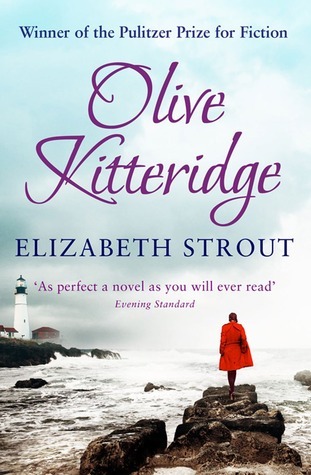
Elizabeth Strout’s Pulitzer prize winning novel Olive Kitteridge has been around for 17 years, but it’s only now that I have managed to read it. And that’s because my reading group scheduled it as our June read. It’s not that I didn’t want to read it – I really did – but other books kept getting in the way. I realise now that I should not have let that happen because Olive Kitteridge is a wonderful read.
Now, how to describe it? The first thing is its form. It’s more like a collection of linked stories, or what its Wikipedia article calls a short story cycle. Although I’ve read many linked short story collections, I haven’t come across this term before. I’d like to explore it some time, but not now, because I’m keen to talk about the book. I will say, though, that some in my reading group found the episodic form somewhat disconcerting at first. However, despite this, almost all of us thoroughly enjoyed the book. Why? Well, as it turned out, the form is partly what makes it such a strong and moving read.
As most of you will know, the novel is set mostly in the late 20th and very early 21st centuries in the fictional small-town of Crosby, in coastal Maine. It comprises 13 chapters – or stories – that explore the life of retired schoolteacher Olive Kitteridge and her relationships with family and friends. In some of the chapters Olive is front and centre, but in others she makes a cameo appearance, sometimes just as a passing reference. The end result is as much a picture of a small town as it is of Olive, though Olive is our lynchpin. As one of my reading group members said, her question as she read each story was, “Where’s Olive?”
everyone thinks they know everything and no one knows a damn thing. (“River”)
So, while my reading group talked about the form and the gorgeous writing, we mostly focused on the picture painted of a small town – which, said one, provides an antidote to the “apple-pie” image we typically get of small-town America – and on the character of Olive. She is complex and not easy for readers to like, but we found her real, and most of us did like her. The opening story, “Pharmacy”, doesn’t pull any punches in its depiction of Olive. She comes across as curmudgeonly, uncompromising. She is cutting about her husband Henry’s new young pharmacy assistant and unwilling empathise with her. She is prickly and vengeful with her son’s new bride, Suzanne (“A Little Burst”), while Bob in “Winter Concert” wonders how Henry can “stand” her.
However, there are many occasions where Olive is kind and compassionate, where she sees need in others and helps or offers to help, where, as Henry describes it, “all her outer Olive-ness” is stripped away. For example, ex-student Julie remembers Olive telling a class
“Don’t be scared of your hunger. If you’re scared of your hunger, you’ll just be one more ninny like everyone else.” (“Ship in a bottle”)
And Rebecca recollects Olive saying to her at school, “if you ever want to talk to me about anything you can” (“Criminal”). Olive also quietly talks a young man, an ex-student, down from suicide (“Incoming tide”) and she and the truly “nice” Daisy try hard to help the young anorexic Nina (“Starving”).
Olive, too, can be insightful. In “Security”, for example, we read that sometimes she had “a sense of just how desperately hard everyone in the world was working to get what they needed”. And she suffers, especially from a “rupture” with her beloved son, and from grief over husband Henry’s massive stroke.
So, what we have is a character who can be tough and acerbic – even engage in a little schadenfreude – but also be sensitive and empathetic. This led me to see the book as being about more than a picture of a small town, much as that is a central and engaging part of it. The form – the interconnected short stories about life in the town – supports this view of the novel. However, this form also supports another way of looking at it, one encompassing something fundamental about our humanity.
In each story, we see characters confronting some crisis or challenge in their lives – some big ones, some quieter ones. We never see these stories fully through. They are vignettes, even those featuring Olive. This made me think about how little we know others, and perhaps even ourselves? We never fully know what others think of us, or what impact we have on others, but in this book – largely because of its form – we do see, for example, how Olive is, or has been, viewed or remembered, both positively and negatively. No one perspective is right, but each contributes to a picture of a person. This is how life goes. We see little parts of people’s lives, and sometimes we are little or big parts of people’s lives, but what do we truly know?
A bleak interpretation of this could be that it exposes our essential aloneness, but a more positive perspective is that it reminds us that we are all “real” people with good and bad, hard and soft selves. Books like Olive Kitteridge encourage us to look around corners, to not take one aspect of a person at face value, to be generous to others and ourselves. It also reminds us that we never stop learning about ourselves (or others). Certainly, at the end of this book, Olive, in her early 70s, is still discovering things about herself and her feelings. She isn’t giving up, no matter how tough things have become.
In my group’s opening discussion, I said that I thought the novel offered many truths, albeit often uncomfortable ones. For example, in “Tulips”, which is a story about things going terribly wrong, Olive reflects, “There was no understanding any of it”. But, my favourite occurs in “Security”, when some rapprochement is being made with her son, and Olive thinks
whatever rupture had occurred… It could be healed. It would be leaving its scars but one accumulated these scars.
One surely does!
There’s so much more to talk about in this book – the spot-on descriptions, the quiet humour, the many beautifully wrought characters and their trials, and the political references such as to 9/11 and George W Bush which provide context. But the main story is the human, the personal. The novel closes with Olive reflecting deeply on her life and her choices, on how much had been “unconsciously squandered”. She realises that, while
It baffled her, the world. She did not want to leave it yet.
I love getting inside the heads of characters like Olive, and so I loved Olive Kitteridge. I’ll be reading more Strout I’m sure.
Brona and Kate both read and enjoyed this long before I did!
Elizabeth Strout
Olive Kitteridge
London: Simon & Schuster, 2008
270pp.
ISBN: 9781849831550
 Whispering Gums