Elizabeth Jolley, Diary of a weekend farmer

Elizabeth Jolley's Diary of a weekend farmer

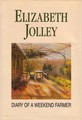
Bookcover (Image courtesy Fremantle Arts Centre Press)

I took 2 valium and went to bed early (Monday 12th October, 1970)

Elizabeth Jolley’s Diary of a weekend farmer is one quirky memoir (if you can call it that). And yet it is, really, exactly what you might expect from a writer who rarely wrote the expected!

It is a slim volume – illustrated with warm, shimmery paintings by West Australian artist, Evelyn Kotai. The diary entries were written by Jolley at irregular intervals from 1970 to 1974 (probably), and are accompanied by poems by Jolley, plus the occasional contribution from her husband Leonard and daughter Ruth. Some of the entries are reflective

… being on this piece of land makes me feel very much aware of the shortness of life, I mean our human life in comparison with the land and the big old trees. (from Monday 6th [September, 1971] continued)

while others are factual

Ruth and I tried to plant tomatoes ground too dry and hard. (from 10th November 1970)

As you can see, little care (or perhaps a lot of care – how are we to know?) is taken with punctuation.

Jolley’s trademark wry, or even wicked, comments are in evidence

Next door’s place has been well cleared and conquered I think the word should be … (from 11th November 1970)

There is, in fact, a tiny plot running through the book and it has to do with the “neighbour woman”. She appears regularly as a rather ambiguous presence who doesn’t respect Elizabeth and her city-slicking family, and their farming endeavours, but offers some useful advice at times. Much of this “plot” is carried though a poem (“Neighbour Woman on the Fencing Wire”) which continues in sections throughout the book:

I suppose you didn’t notice last Sunday evening
you left your rake and mattock out …
(from “Continuation from the Fencing Wire”)

This woman is a little thorn in Jolley’s side – always pointing our her failings – and yet at the end, Jolley’s underlying compassion becomes evident as she writes of the “neighbour woman’s death” and her husband’s grief:

… and I understood I was face to face with someone who really loved the neighbour woman and that he would never get over something that is brushed aside in the word bereavement. (from No date required)

But, what this little volume particularly shows is her love of the land – along with her recognition of its challenges. Here’s one example:

Is it an alien place resisting or is it retreating from all our human endeavour. And then the doves fly up glowing in the rising sun and the sound from their wings is like a tiny clapping. (from Monday 25th February, 1973).

There is a very Jolley-esque tension here between an almost mystical beauty and a power that is not always benign.

And here is a reference to gums and their widow-making capability:

The wind moves the trees great branches fall
In the wind or in the stillness
A few feet nearer and I should have been crushed
Into the greater stillness.
(from “Great Branches Fall”)

These diary entries were made before her first book, Five acre virgin, and other stories, was published in 1976, though she’d had individual short  stories published from the 1960s on. When I read memoirs by writers, I look (of course) for references to writing. There is not much here, though. Besides the mention of something her husband said as being “a very good 1st sentence”, the main reference to her writing is this:

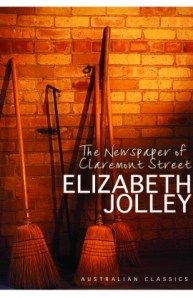
I finished the story “Pear Tree Dance” for the BBC, an idyllic ending! The newspaper of Claremont Street contains the grim and sinister side of things. (from 19th August 1971)

She’s right about that. Newspaper is one of my favourites of hers but it is rather grim. It was not published until 1981 … and is about a woman who wanted her own piece of land. I think I’ll leave it here – and let you ponder that idea!

Elizabeth Jolley
Diary of a weekend farmer
South Fremantle: Fremantle Arts Centre Press, 1993
ISBN: 1863680438
95pp

Elizabeth Jolley, My father’s moon

‘No one,’ she says, ‘can write anything till they’ve had experience. Later on perhaps. You will write later on.’ (Elizabeth Jolley, My father’s moon, 1989)

Although fiction demands imagination, it must be based on  some kind of genuine experience. (Elizabeth Jolley, “Only Connect”, essay first published in Toads, 1992)

My father’s moon is the first book in Jolley’s semi-autobiographical trilogy, the others being Cabin fever and The George’s wife. It won The Age Book of the Year Award in 1989.

I am an Elizabeth Jolley fan – and, along with Helen Garner, another Jolley fan, I enjoy the way she repeats and revisits stories and characters from one book or story to another. In this book is the chapter, “Night Runner”, which was published as a short story in Meanjin in December 1983, and again in a short story anthology, Room to move, published in 1985. The narrator of the story – and of the novel – typifies Elizabeth Jolley’s alienated protagonists and their often peculiarly self-centred and self-deluded ways of coping with their loneliness. Clearly Jolley decided that this was a character she wanted to develop further. And clearly she also drew a lot from her own experience to develop this character. Like Vera, Jolley was brought up as a Quaker, her parents sheltered refugees before and during the Second World War, and she trained as a nurse. Like Vera, Jolley probably experienced loneliness and alienation. However, this is fiction and so we need to be careful about how far we take these analogies between Vera and her creator. Much as I can empathise with Vera’s predicament, I must admit that I would hate to think she is Elizabeth Jolley.

It’s an uncomfortable novel. Vera, the first person narrator, is not a highly sympathetic character but neither is she totally disagreeable either. What she is, though, is lonely. The book has a somewhat challenging structure – and I had to concentrate to keep track of where I was. It starts with Vera, a single mother, leaving her parents’ home, with her young daughter, to live and work in a boarding school. Her hopes for a lovely life there among people “who feel and think as I do” are dashed. Such people “are not here as I thought they would be … I am by my own mistakes buried in this green-leafed corruption and I am alone”. In this first chapter are flashbacks to the past, and gradually the book moves into the past, providing us with insights into her character and how she has ended up where she is. Most of this past takes place in the hospital where she trains as a nurse during the war. The book finally returns to the beginning of the novel with Vera resolving to make a step towards alleviating her loneliness. However, we are by no means convinced she will.

Moon, by atomicshark @ flickr, licensed under Creative Commons CC-BY 2.0

Moon, by atomicshark @ flickr, licensed under Creative Commons CC-BY 2.0

The book comprises titled chapters, many if not all of which could be (and some have been) published separately as short stories. This gives it a somewhat disjointed feel – but seems appropriate for the story of a person like Vera. It is full of wonderfully drawn characters, with some very funny (if often dark) scenes and dialogue. Just think nurses and hospitals! There are many references to music – something that is common in Jolley’s works. Music is usually a comforting force for her characters, offering them respite from what is often a cruel world – and this is the case here, with Vera being drawn to characters who love and play music. There is a lot of irony, some of it subtle, some of it less so as in Magda’s comment to Vera who has fantasised about an affair with her husband: ‘You are so innocent and good … Don’t ever change’. Naive perhaps, innocent no!

So, what about the title? Funnily enough(!), it refers to Vera’s relationship with her father, a major stabilising influence in her life. He tells her throughout her childhood that wherever she is she can always look at the same moon he is looking at, ‘And because of this … you must know that I am not far away. You must never feel lonely’. A lovely concept and one to which Vera regularly returns in the book.

My father’s moon is not, I think, the easiest Jolley to read, and there are some things that might become clearer on a second reading. However, its concerns are very representative of her work – loneliness and alienation, homosexuality, parenting, memory, music and religion. While Vera is deeply lonely, while she often behaves selfishly, she can also be kind. She is also no quitter. For that I rather like her.

Favourite writers: 2, Elizabeth Jolley

Not , unfortunately, being a time-traveller, I haven’t managed to see or hear Jane Austen in person. I am, however, far more fortunate in this regard when it comes to the subject of my next favourite writers post – Elizabeth Jolley. I did get to see and hear her at a literary lunch at the height of her career. My reaction was the same as many others – her “little old lady” appearance and voice belied her sharp wit and earthy worldliness.

Elizabeth Jolley (Photo: Courtesy Fremantle Arts Centre Press)

Elizabeth Jolley (Photo: Courtesy Fremantle Press)

It’s not surprising that she is one of my favourite writers: I call her my antipodean Jane Austen. She is witty and ironic, she is wicked (though blacker than Austen), and she tends to write about a small number of people in a confined, often domestic, situation. But here the similarity ends. While the “character” of Austen’s characters play a role in what happens to them – there’s a reason why Elizabeth not someone like Lydia “gets” Mr Darcy – Austen’s main interest is in the social and economic constraints on her characters. Jolley on the other hand focuses more on the interior. She explores loneliness and alienation. She looks at the disturbing or unsettling sides of relationships, the ‘feelings’ people have but often don’t admit to such as those for a person of the same sex or for a person for whom they should not have feelings for (due, for example, to age differences, power differences, or infidelity). She shows how difficult it is to maintain a long-term intimate or deep relationship that is equal on all levels (physical, intellectual, social, material, etc).

In the Australian and New Zealand Journal of Psychiatry (Vol. 25, No. 1, 1991), Jolley writes:

In my own writing I have been interested in the exploration of survival (perhaps emotional survival), resilience and responsibility. (I only know this now after several books are written).

How very Jolleyesque that aside is – humble but a bit sly at the same time. She continues a little later to say:

…for the most part my characters are perplexed, anxious, often frightened with perhaps one redeeming aspect in their personalities – that of optimism which might for a time, until it gets out of hand, keep them from the specialist’s doorstep.

Photo: Courtesy Fremantle Press

Photo: Courtesy Fremantle Press

The first Jolley I read was the short story, “Night runner”, in an anthology titled Room to move. It introduced me to her concept of alienation and rather black notion of survival, her particular brand of irony, her portrayal of characters who more often than not suffer from some level of self-delusion, and her dark humour. I went on to read Miss Peabody’s inheritance, The newspaper of Claremont Street, The well, The sugar mother, and An innocent gentleman, among others, and have never really been disappointed. I enjoy her use of repetition and self-referencing, the motifs and the characters, even, that reappear in different works.  She gets me in the pit of my stomach with her vulnerable but often unkind or downright cruel characters, but makes me laugh at the same time with her depictions of their attempts at survival. You just have to see Ruth Cracknell playing The woman in a lampshade to know what I mean!

I have not yet read all of Jolley’s works. Just as for a long time I kept back one Jane Austen novel because once I’d read it I’d have read them all, I am now doing the same with Jolley. Her books are so delicious they need to be savoured. I’m sure this is not the last post I’ll be writing about her.