Delicious descriptions: Eimear McBride is not all grim

Reactions to Eimear McBride’s A girl is a half-formed thing, which I reviewed recently, vary greatly. It is, overall, a bleak read and its style is idiosyncratic, which makes it a double whammy. So, for example, it has been called “brutal” (by Sunday Times Ireland) and a “joyous thing” (by Michael Cathcart, RN’s Books and Arts Daily). Both of these make sense to me – the story is “brutal” but the writing is “a joyous thing”, because it’s alive, it wakes you up, it compels you on.

In 2013, as you may have already heard, it was the inaugural winner of the Goldsmiths Prize, which was “established to celebrate the qualities of creative daring associated with the University and to reward fiction that breaks the mould or opens up new possibilities for the novel form. Accordingly, the annual prize of £10,000 will be awarded to a book that is deemed genuinely novel and which embodies the spirit of invention that characterises the genre at its best”.

Like most “brutal” works of art, though, A girl is a half-formed thing does have light or chuckle-inducing moments. I wanted to share one with you. Reviewers, I’ve noticed, have tended to choose a scene from the grandfather’s wake to illustrate this so I thought I’d choose something different, a description of Mammy being visited by her church friends early in the novel. Here goes:

Some most are women. In a blue moon a man. I like to eye. Sitting in the corner jugging as I can for all they say is interesting. Dress undressing no-neck cindy. Not stopping or I get look at little lugs there listening in. Oh taking it all in that one. Doesn’t miss a thing. Spelling I know but too iquick to understand r.u.n.o.f.f with the s.a.c.r.i.s.t.a.n and they are living in s.i.n down in such and such a place. There’s stink girl’s mother and her sister with women’s troubles so peculiar all pointed down and asked and how’s ahem? Ah she’ll not sit down for years. Apparently the smell of it is something wicked but god knows it’s not her fault. Their brother’s second wife — ach the first died leaving five behind. Tell me where’s the sense? They’re wild as wild. As bold as brats. The P.P’s housekeeper — God rest her late husband. A lovely man. She gave him a hard life but sure. Mrs one whose husband ran the AIB. Uppity up in herself — behind palms in the scullery they whisper adding a splash to warm the pot. Great red hat she wears to mass. So we have a look at her and where’s the humility in that? Ah each to their own, they say. Then your woman who bought a knitting machine. A hundred and twenty pounds now where did she … Her little boy. Downs. God love him. She does school jumpers so she can get him toys that are ed-u-cat-ional nod nod. That’s right for God helps those who help themselves. The politician’s wife they’d normally spite but God help us her heart is broke. He’s running about with this one and that one. She can’t look down on them. Her vows were sacred and he’ll not get her in mortal sin. Her heart may be pierced with a thousand spears but she’ll offer it as a penance that’s a bit proud don’t you think? And the one whose husband’s a desperate drunk. Like his father before him you know the type, vicious. That’d kill you in it by mistake. Her blue eyes. Her black eyes. Is he on the bottle? they say and pray for sometimes giving up and the forgiveness of his sins.

Go with it – and it’s perfect, a funny, biting rendition of women’s gossip. Stop to unpack the “sentences” – and you’re lost.
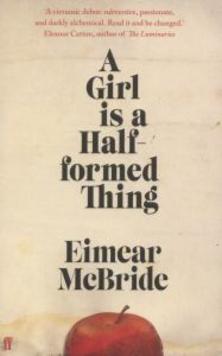
Eimear McBride, A girl is a half-formed thing (Review)

Eimear McBride, A girl is a half-formed thingI try very hard when writing reviews to avoid clichés and superlatives, like, say, “achingly beautiful” or “masterful”. But I think I’m going to use one for Eimear McBride’s multi-award-winning debut novel A girl is a half-formed thing when I describe it as “searing”. I can’t think of a more apposite word. Yet I fear it too has been over-used to the point of meaninglessness. So, let’s try something else …

Once again I’m coming late to the read, and once again this is partly because it was scheduled by my reading group. All I can say is, wow. I’m not sure I’d go so far as Eleanor Catton’s “read it and be changed” commendation on the front of my edition, but I do agree with her  “virtuosic” and “subversive”. It’s a gut-wrenching read.

The plot itself is simple enough. It’s the story of a family – a pious one-could-say-religiously-fanatical mother, a son who survived a serious brain tumour as a toddler, and the younger daughter. The tumour leaves the son somewhat brain-damaged and, of course, it returns. This tumour, the trauma of it, shapes their behaviour and defines their relationships. The story, which spans around 20 years, is told through the daughter and could, in one sense, be seen as coming-of-age. But. This. Tells. You. Nothing. Because …

This is not your typical first-person voice. Instead, we are in the head of the unnamed “girl”. We are there in her conscious unconsciousness (or, is it her semi-consciousness?) in which we hear what she’s experiencing in language that is – here’s another cliché – raw. By this I mean that the language is stripped of the mediation of a formalising narrator’s intellect. Instead it captures the immediate emotional truth of the girl’s experience as she grapples to make sense of her world. This is a book in which the style conveys the meaning as much as the words do.

How does McBride do this you are probably wondering (unless, of course, you’ve already read the book). Well, mostly by breaking, consistently, the rules of grammar and syntax. We are in the girl’s head, a place where, I believe McBride is saying, we rarely think in coherently formed sentences but in what I would call “impressions”. Take, for example, this description, on the first page, of the brother before his diagnosis:

I know. The thing wrong. It’s a. It is called. Nosebleeds, headaches. Where you can’t hold. Fall mugs and dinner plates she says clear up. Ah young he says give the child a break. Fall off swings. Can’t or. Grip well. Slipping in the muck. Bang your. Poor head wrapped up white and the blood come through. She feel the sick of that. Little boy head. Shush.

To orient you, “she” is Mammy, “he” is the father who disappears two pages later, and “you” are the little boy, the girl’s brother. Most of the novel is addressed to him (that is “you”). One of the challenges of reading this book, and it is a challenge to read, is its pronouns. Once you’ve got a handle on them, and once you realise that they are all from the perspective of the girl, you are half way there.

Anyhow, there is easier syntax than the above when life is relatively calm but, when our “girl” is distressed such as when the truth of her brother’s situation can no longer be avoided, it collapses almost completely:

I walk the street. City. Running through my mouth. Running in my teeth the. My eyes are. All the things. The said the done what there what’s all this? That stuff. I could do. My. I walk the street. Who’s him there having a look at me he. Look at my. Tits. Ssss. Fuck word. No don’t. Fuck that. No. Will. Not that. Not. That. But. If I want to then I can do.

This is not the most extreme example – I don’t want to spoil too much – but it should demonstrate what I mean by the language mirroring/enacting/even being her state of mind.

In addition to the idiosyncratic syntax, McBride draws on wide range of literary techniques to keep us focused on, grounded in the emotions of the here and now. The imagery is visceral, returning again and again to  “muck”, “dirt”, “blood”, and “puke”. She alters her rhythms to match the tone, not only through the syntax as evident in the examples above, but through allusions to and repetitions of prayers and hymns, lines from children’s games, literary works and sayings. She makes up new words (“I trup trup off behind her”), mangles existing words (“swoll” for “swollen”), and twists common expressions (“There’s a foul there’s a wind where’s the air”). McBride was inspired by Joyce she says, but her fresh, fearless, urgent language reminded me too at times of Gerard Manley Hopkins.

The novel is clearly set in Ireland and there are odd references to 1980s technology like Game Boys, but overall place and time are unspecified, and none of the characters are named. All this keeps the focus squarely on the emotional core of a family in pain, and the girl in particular. She is abused by her uncle at the age of thirteen and begins a strange love-hate, violent-tender, but sick, relationship with him. Sex becomes for her a weapon, a tool and a punishment. But the book is not about this, that is, it’s not yet another book about abuse. It is about the girl’s inability to handle her emotional pain, and her family’s inability to see her need, it’s about growing up unsupported. She is complicit in her own degradation because for her physical pain is better than the emotional. Like those who self-harm, she seeks out abuse again and again because

… what’s wrong here is me me me. Me the thing but I. Think I know. Is that the reason for what’s happened? Me? The thing. Wrong.

I know this all sounds unremittingly bleak and it largely is, but there are light touches – blackly comic scenes, surprising word plays, and chuckle-inducing descriptions (like her mother’s friends, “they polyester tight-packed womanhood aflower in pink and blue”).

A girl is a half-formed thing is hard to read style-wise and painful to read content-wise. But it is a book that, if you let it, reaches deep into your core and makes you understand the lives of others in a way that only the best literature can. I’m so very glad I read it.

John at Musings of a Literary Dilettante also liked it.

Eimear McBride
A girl is a half-formed thing
London: Faber and Faber, 2014
203pp.
ISBN: 9780571317165