Tim Flannery, After the future: Australia’s extinction crisis (Review)

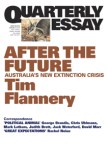
Quarterly Essay No 48 Cover

Quarterly Essay 48 cover (Courtesy Black Inc)

Tim Flannery is an Australian palaeontologist-cum-environmentalist who has been on the public stage for a couple of decades now. He has published several books on environmental issues, some best-sellers, including The future eaters and The weather makers. He was Australian of the Year in 2007, has starred in three television documentary series with comedian John Doyle, and is currently Chief Commissioner of Australia‘s Climate Commission.  With the environment being his passion, he is used to controversy, but many of us regard him as a national treasure. There, I’ve shown my hand!

Needless to say, I enjoyed his current Quarterly Essay titled After the future: Australia’s new extinction crisis. In it he analyses the causes of the second wave of extinctions, and suggests solutions.

The essay is divided into 8 short sections. Near the end of the second section, Flannery writes

I hope the message is loud and clear. Australian politics, and the bureaucracy that supports it, is failing in one of its most fundamental obligations to future generations, the conservation of our natural heritage.

It’s scary stuff. On the preceding page he discusses public ignorance, arguing that most people are unaware that a new wave of extinction is happening, and that those who are aware “commonly believe that our national parks and reserves are safe places for threatened species”. I fall into this latter camp, I’m afraid. I knew it wasn’t all hunky-dory but I had assumed that the parks and reserves were working. Apparently not. The reasons are complex. Funding is of course one aspect and underpins some of the issues he raises, such as the lack of resources and support for effective planning and management, and a decrease in scientifically trained staff able to research and monitor the situation.

However, Flannery argues there are more systemic issues, mostly relating to “politics”. One is the increasingly risk-averse behaviour of governments, resulting in their being prepared to do nothing rather than risk failure. Another is the fact that the environment is no longer the bipartisan issue it once was, with the right increasingly seeing the environment as a left issue. The conservatives are, paradoxically, losing interest in conservation! Environmental stewardship, Flannery argues, once inspired leaders of the right, like Theodore Roosevelt and Ronald Reagan in the USA, and Malcolm Fraser in Australia. It was Malcolm Fraser “who first used federal powers to prevent sand mining on Fraser Island, who proclaimed Kakadu a national park, and who ended whaling in Australia”. However, the rise of green parties (here and in other first world nations) is alienating the right, and yet are not always friendly to conservation. “Animal rights issues, such as opposition to the culling of feral species”, for example, “can sometimes get in the way of environmental stewardship”. The result of environmental issues being seen through the lens of party politics and ideology is that the effort to discredit conservation has resulted in the rejection of science as “a guide to action”. This, says Flannery, is dangerous territory.

While Flannery spends around a third of the essay setting out the problem and discussing the causes, his main thesis is that the current focus of environmental programs on preserving ecosystems is not working – and he presents some convincing arguments for changing the focus to saving individual species. He describes programs in the Kimberleys which are managed by the Australian Wildlife Conservancy (with which he is connected) in partnership with indigenous groups, using their fire management techniques. But his most impressive example is a privately managed program in Papua New Guinea, the Tenkile Conservation Alliance, focused on saving a tree kangaroo. He argues that it “is a prime example of saving an ecosystem by concentrating on saving a species”, and asks:

How is it that one Australian couple has almost single-handedly transformed the fortunes of a people and the biodiversity of a mountain range while trying to save  an endangered species of tree kangaroo? The answer is simple: the Thomases [zoologists] set clear goals, used scientific methods to monitor their progress, and reported back to the people.

I’m not sure I’d call that simple. Or, perhaps I’d say the process is simple, but deciding on environmental priorities and finding the right mix of people/organisations to manage it is not so simple. Flannery’s solution is there needs to be:

  • a legislative commitment to zero tolerance on further extinctions;
  • the establishment of a Biodiversity Authority [yes, I know, another bureaucratic body] that is independent of government, that has “unequivocal targets”, and which faces strong consequences [what, I wonder?] on failure to deliver; and
  • the acceptance and formal involvement of non-profit organisations in managing biodiversity programs.

The Conversation, an Australian academic and research sector blog, is currently running a weekly series on endangered species. A commenter on last week’s post suggested outsourcing the listing of endangered species to peak groups, pretty much mirroring Flannery’s argument regarding partnerships between the government and non-government sectors.

Overall, the essay is clearly argued, but occasionally Flannery makes a statement that jars. One is his statement that “even under Labor governments with a strong green bent, national parks are not always safe” which he supports using the example of the Bligh Government’s starting the process of de-gazetting a part of the Mungkan Kaanju National Park with a view to returning it to its traditional Aboriginal owners. He doesn’t elaborate on this. I wrote in the margin, “Is this wrong”? Not surprisingly, at least one indigenous leader, Marcia Langton, took offence. I suspect it was a case of Flannery finding a poor example to support his argument regarding national parks being threatened even by supposedly sympathetic governments, but I don’t know.

Despite odd moments like this, I did find his argument convincing. However, as I’m sure he’d say himself, it’s not a guaranteed solution. Early in the essay he makes a point of discussing scientific method, arguing that “science is not a search for the truth” but about “disproving hypothesis”.  The hypothesis he proposes here is surely worth testing given the failure of current methods. It begs his early questions, though, regarding political and social will, which may in fact be the critical variables that we need to resolve.

Tim Flannery
“After the future: Australia’s new extinction crisis”
in Quarterly Essay, No. 48
Collingwood: Black Inc, November 2012
107pp.
ISBN: 9781863955829

(Review copy supplied by Black Inc.)

Mary Austin, The scavengers

I’ve never heard of Mary Austin but when I saw this story (essay), “The scavengers”, appear as a Library of America offering, I had to read it, because it’s about the deserts of California – and I love those deserts. Mary Austin (1868-1934) was an early nature writer about the American southwest. LOA’s notes tell us that she moved in the literary/artistic circles of her times. She met Ambrose Bierce (whose work she admired though she was less pleased with the man!). She collaborated with Ansel Adams on Taos Pueblo, a hand produced photographic essay. And Willa Cather apparently wrote the last chapters of Death comes for the archbishop while staying in Austin’s home in Taos. Austin and her husband were also involved in the California Water Wars, that were documented so dramatically in the film Chinatown.

According to LOA, she was “among the first to write with careful attention about the desert, and to do so in a way that managed to capture its beauty without indulging in undue sentimentality”. This essay “The scavengers” was first published in 1903 in her book of essays and stories titled The land of little rain, a book that was so well received it enabled her to write for the rest of her life.

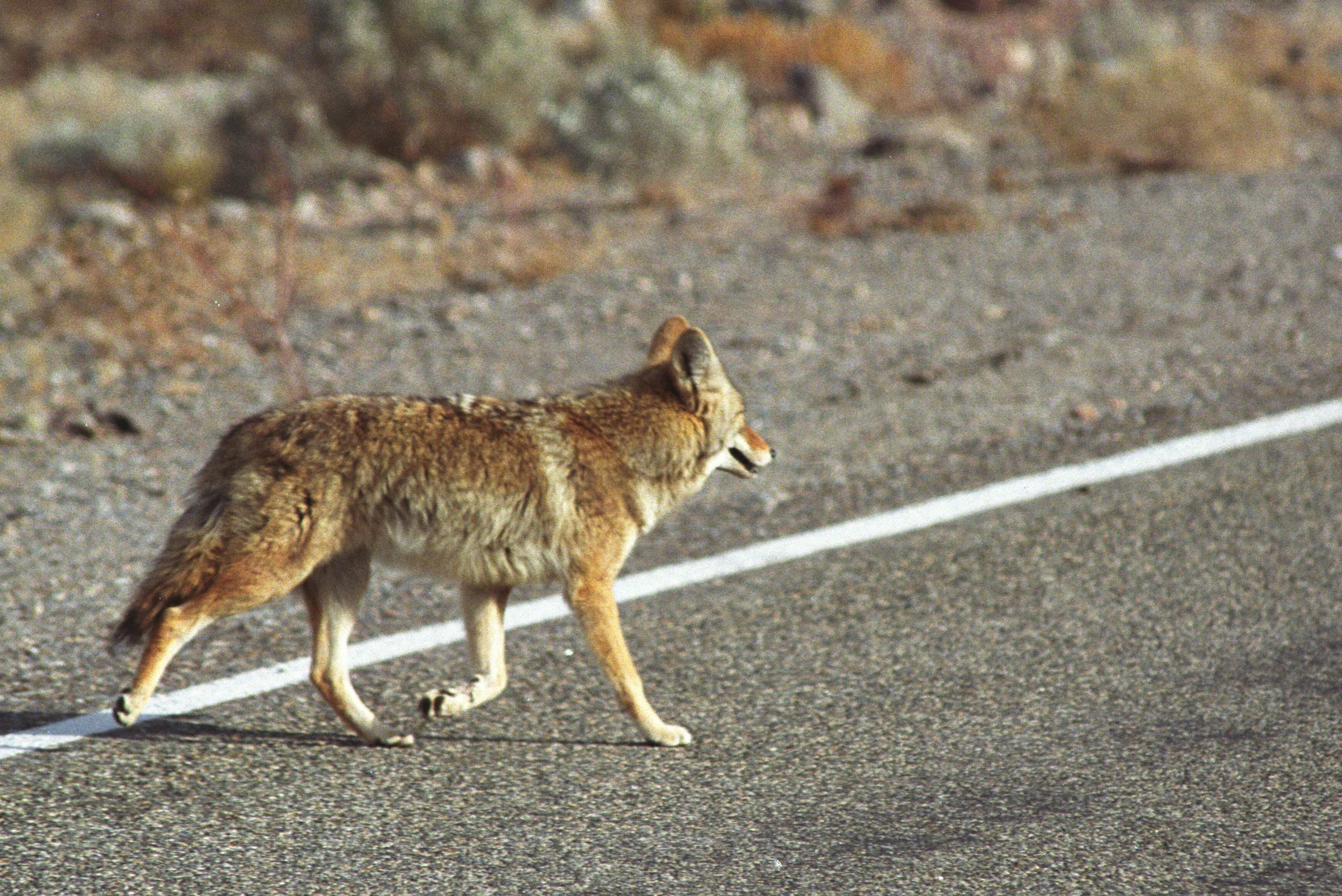
Coyote in Death Valley

Coyote in Death Valley, Dec 1992

And so to “The scavengers”. It is a short essay describing, unsentimentally, the buzzards, vultures, ravens (or “carrion crow”), coyotes and Clark’s crows (or “camp robber”) which survive on the death of others. The essay opens on a vivid image:

Fifty-seven buzzards, one on each of fifty-seven posts at the rancho El Tejon, on a mirage-breeding September morning, sat solemnly while the white tilted travelers’ vans lumbered down the Canada de los Uvas. After three hours they had only clapped their wings, or exchanged posts.

She was, clearly, a careful observer. A major theme of the essay is nature’s balance which, in this case, means that when there is drought some creatures die and others (the scavengers) thrive. She graphically describes the slow death by starvation of the cattle with the buzzards waiting patiently for the end (because they will not feed until the last breath is drawn):

Cattle once down may be days in dying … It is doubtless the economy of nature to have the scavengers by to clean up the carrion, but a wolf at the throat would be a shorter agony than the long stalking and sometime perchings of these loathsome watchers.

She goes on to describe vultures, comparing their qualities with those of the buzzards, and then moves on to the other previously mentioned scavengers. She sees the raven as the “least objectionable” of them, partly because “he is nice in his habits and is said to have likable traits”. I particularly enjoyed her observation on “the interdependence of wild creatures, and their cognizance of the affairs of their own kind”. She suggests we may never fully credit this, and she’s probably right, though she’d probably also be astonished by how far science has come in the last century in terms of ecological knowledge. Anyhow, I liked the following description of animal behaviour as coyotes bring down an antelope:

… Rabbits sat up in the chaparral and cocked their ears, feeling themselves quite safe for the once as the hunt swung near them. Nothing happens in the deep wood that the blue jays are not all agog to tell …

She wonders how much of this knowledge of each other is learnt by experience and how much is taught by their “elders”. Austin surely would have loved David Attenborough – or even been him (if you know what I mean!) – had she been born a few decades later.

As I said, a main theme is the balance (or economy, as she calls it) of nature but she concludes on another idea, and that is the role of mankind. Nature, she says, cannot account for the works of man:

There is no scavenger that eats tin cans, and no wild thing leaves a like disfigurement on the forest floor.

Mary Austin
“The scavengers”
Available online at Library of America
Originally published in The land of little rain, 1903

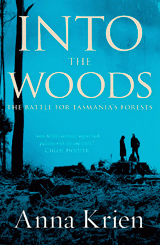
Anna Krien, Into the woods

How can so many people all be looking at the same thing and see it so differently? The man moseying around in front of me looks at a 300-year old tree and sees a nursing home, while an activist twenty minutes down the road sees a block of flats for furry and feathered creatures.

Vive la différence? Or not! Anna Krien’s Into the woods is an exposé of the decades long battle in Tasmania for its forests, particularly its old-growth native forests. For those who don’t know, Tasmania is Australia’s southern island state. It is famous for its beauty and its wilderness but also, it seems, for its Vs, that is, vitriol, violence and vigilantism. You see, being a small island state, with only 500,000 people, it’s a challenge to keep its economy in the black. Sawmilling and, more recently and more controversially, woodchipping have played an important role in maintaining its economy. It is this controversy – particularly surrounding woodchips – that Krien explores in her book.

Anna Krien, Into the woods

Cover image (Courtesy: Black Inc

On the cover is a “blurb” by Chloe Hooper who wrote The tall man about the death in custody of an indigenous man on Palm Island. This provides a clue to the book’s style, and that is that the author, like Hooper, engages personally in the situation, meeting with parties on all sides of the conflict. In Krien’s case this meant meeting ferals, environmentalists, politicians, loggers, whistleblowers, craftsmen and businessmen.

Krien has organised the book into five thematic sections:

  • Ratbags: the new generation protesters, or ferals, who live pretty primitively on/near the site  they are protecting and who are often in conflict with older activists
  • Loggers: the logging industry workers who range across a wide range of jobs in the industry and are also often conflict with each other
  • The company: Gunns Ltd, the main player in the Tasmanian logging industry, meddler (if so benign a term can be used) in politics, and initiator of the Gunns 20 lawsuit
  • Groundswell: change agents such as whistle blowers, proponents of the “rights” of nature, and shareholders wanting ethical investments
  • The mill: Gunns pulp mill saga, the beginning of the an end?

The story is a complex one, delving into competing interests within the logging industry itself – sawlogs versus woodchips, old-growth versus regrowth native forests versus plantations, public versus private forests – not to mention dissension amongst environmentalists and some very dirty politics. It is a story about jobs versus the environment and the “rights” of nature, of different value systems that set “unmanned” pristine forests against “manned” ones. It is a story of blaming and buck passing. And it is a story of half-truths and distorted truths, all in the name of defending one’s own patch. “I am on a journey through selective truths”, she writes at one point in the book.

This issue of “truths” is beautifully conveyed in her discussion of the timber industry’s language:

I find myself constantly having to decipher new words. Nature needs “disturbance”, logging is “harvesting”, deforestation is “afforestation”, burning woodchips for electricity is a form of “bio-fuel” or “renewable energy”. Woodchips are “feedstock”, while the non-commercial attributes of a forest are “non-wood values”.

The word-games though work on both sides. As she says, “evoking napalm, Hiroshima and the holocaust to describe logging is manipulative”.

A major argument presented by the logging workers is the economic one – jobs – but Krien estimates from the information given her that forestry “accounts for no more than 3% of the workforce”. In fact, she suggests that machines may be a bigger threat to timber jobs than “any greenie”. The more cynical amongst us might think that it is not so much about “jobs” but about “big business”. Sometimes, of course, big business means jobs, but that’s not always necessarily so, not if much of the work can be automated (or, sometimes, though not necessarily here, moved off-shore).

I can’t begin to convey all the information she presents in this book – the history, the statistics, the science, the criss-crossing relationships, not to mention the people, the overt and covert deals, and the truly horrifying violence (both actual and threatened). There are times when I started to feel bogged down in the complexity of it all, but I was reassured when I realised she was feeling it too. She is, in fact, like Hooper, taking us on a journey – but it is a journey that, despite her very real efforts to explore the whole story, does lean to one side, that of those who wish to protect not destroy. As she says in the last chapter:

I’ve tried to balance my seesaw heart, carefully weighing up each argument. But there is something about this island that wants you to choose sides.

I can understand that – it is, in many ways, a magical place. However, I do have one complaint about the book – my ongoing one for books of this ilk – and that is its lack of an index. It is jam-packed with people, events, places, philosophies and theories but how can the casual reader or researcher find them?

And so, is there a resolution to it all? Well no, but there is, she says, a universal story:

… in the greater scheme of things, the island is nothing but a drop in the ocean. But the story is universal – and what goes on in Tasmania goes on in the Pacific islands, in other continents, until it all comes back over the ice to Tasmania again. … Deep down in our bones we must know – we must know that nothing we do is done in isolation. Cause and effect: how did it get so noisy in between?

How indeed? Read this thoughtful, throughly researched book, and you will, unfortunately, find out.

Anna Krien
Into the woods: The battle for Tasmania’s forests
Melbourne: Black Inc, 2010
302pp.
ISBN: 9781863954877

(Review copy supplied by Black Inc)