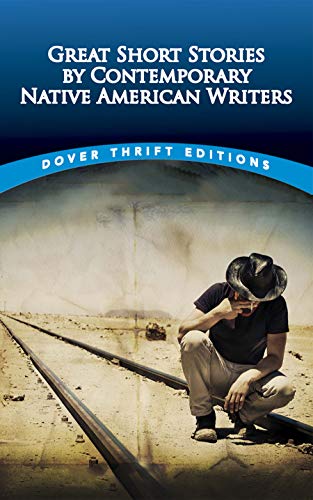
Duane Niatum’s “Crow’s sun” is the tenth story of fourteen in the anthology, Great short stories by contemporary Native American writers, and moves us into the 1990s, where we will remain for the next two stories before ending up in the early 2000s.
Duane Niatum
Anthology editor Bob Blaisdell provides more information about Niatum than he does for some of the writers, but I am supplementing that with information from Wikipedia and the Poetry Foundation. Variously described as a poet, fiction writer, playwright, essayist and editor, Niatum was born in 1938 in Seattle, Washington, to a Klallam (Salish) mother and Italian-American father. After his parents divorced when he was just 4, he spent a lot of time with his maternal Klallam grandfather, from whom he learnt tribal ways and oral traditions. He is an enrolled member of the Klallam Tribe (Jamestown Band).
At 17, Niatum enlisted in the United States Navy, and served in Japan. On leaving the Navy, he did his B.A. in English, at the University of Washington, studying with poets, Theodore Roethke and Elizabeth Bishop. He then earned his M.A. at Johns Hopkins University, and a Ph.D. in American culture from the University of Michigan.
Poetry was his main love, it seems. Wikipedia states that he “established himself as one of the most influential promoters of Native American poetry”. He edited a Native American author series at Harper & Row Publishers, producing two “influential anthologies”. He has published essays on Native American literature, and his poetry has been translated into many languages.
The Poetry Foundation says that his “writing is deeply connected with the Northwest coast landscape, its mountains, forests, water and creatures” and that “the legends and traditions of his ancestors help shape and animate his poetry”. However, it is a short story, of course, that Blaisdell has chosen for his anthology.
“Crow’s sun”
I’ve now read a couple of Niatum’s poems at Poetry Foundation, but none that specifically illuminate this story. “Crow’s sun” presumably draws from his experience in the Navy as it deals with a young sailor named Thomas sentenced to 30-days in the brig. I’m not saying that the story is autobiographical. It may be – I don’t know – but my point is that his Naval experience, and its treatment of people of colour, is sure to have informed the story.
The narrative takes place over one day. It starts with Thomas, just one year into his service, waiting to be taken to the brig and ends with him behind bars. Not a lot of action, in other words, but a lot goes on. This is a story about systemic racism. Thomas, we learn, had let his mother and step-father talk him into enlisting under-age, a common story for youths of colour with limited opportunities. In his case, he’d already been kicked out of home after he’d “stopped his step-father from beating up his mother in a drunken brawl”.
Once in the Navy, things don’t go well. Thomas “cannot fathom why sailors 17 to 70 live in some dream of future glory, which is the oldest myth of the military”. We are not told what Thomas has done, but it appears, from Shore Patrolman Cook’s advice as he delivers Thomas to the brig, that Thomas has been treated harshly:
“This hole’ll be your home for thirty days, Thomas. And buddy, you’d better watch your mouth in this joint. Do your time with your trap shut, until you’re running free. Don’t act the wise-guy. I don’t like your face, Thomas, but I don’t think those hicks from the base were right. You’re a punk, but who isn’t at your age. They went too far. I believe burning a man at the stake’s too much like what like what I left in Alabama.”
This surprises Thomas, because Cook, who “is a spit and polish sailor married to the idea that blind obedience to orders is the only law”, has never really liked him. His advice, then, means something, and Thomas thanks him for it. The rest of the story tells of his admission interview with the Brig Warden – and we get the full measure of the racism he is likely to experience. The Warden aggressively violently enforces his will. He calls Thomas, insultingly and erroneously at that, a “wetback”. He ridicules Thomas’ name insisting it should be “Pancho Villa or Willy Garcia”. I don’t need to continue because you’ve surely seen or read enough scenes like this to get the gist.
What makes this story is how Thomas handles the situation, which is to call on the wisdom of his grandfather. At the first sign of the Warden’s aggression:
The muscles in Thomas’ face tighten; his eyes thicken; narrow into tiny moons peering from behind a shield of fern. He sways slightly; stiffens his whole body, not sure what to expect from the man closing in. Grandson to Cedar Crow, Thomas feels his fingers change to claws, to a wing of thrashing spirit flying wildly inside his ear. (Be calm and steady now. This man could be your enemy. Know his every move. Break him like a twig if he tries to harm you. Be the Thunderbird of our song. I am Crow, your father.)
From here on, Thomas draws on his grandfather’s wisdom to assess and manage the situation. There is violence but he sees death is not on the cards. We learn that many Klallam people had lost faith in their beliefs and practices, but not Thomas. His late grandfather, “the quiet man of family, sea and forest had counselled him well”. From here to the end, where we leave Thomas standing in his cell, we observe him watching and responding to the Warden and drawing on his spirit wisdom.
It’s a strong story about the power and value of knowing your culture.
Duane Niatum
“Crow’s sun” (orig. pub. 1991)
in Bob Blaisdell (ed.), Great short stories by contemporary Native American writers
Garden City: Dover Publications, 2014
pp. 75-83
ISBN: 9780486490953
 Whispering Gums