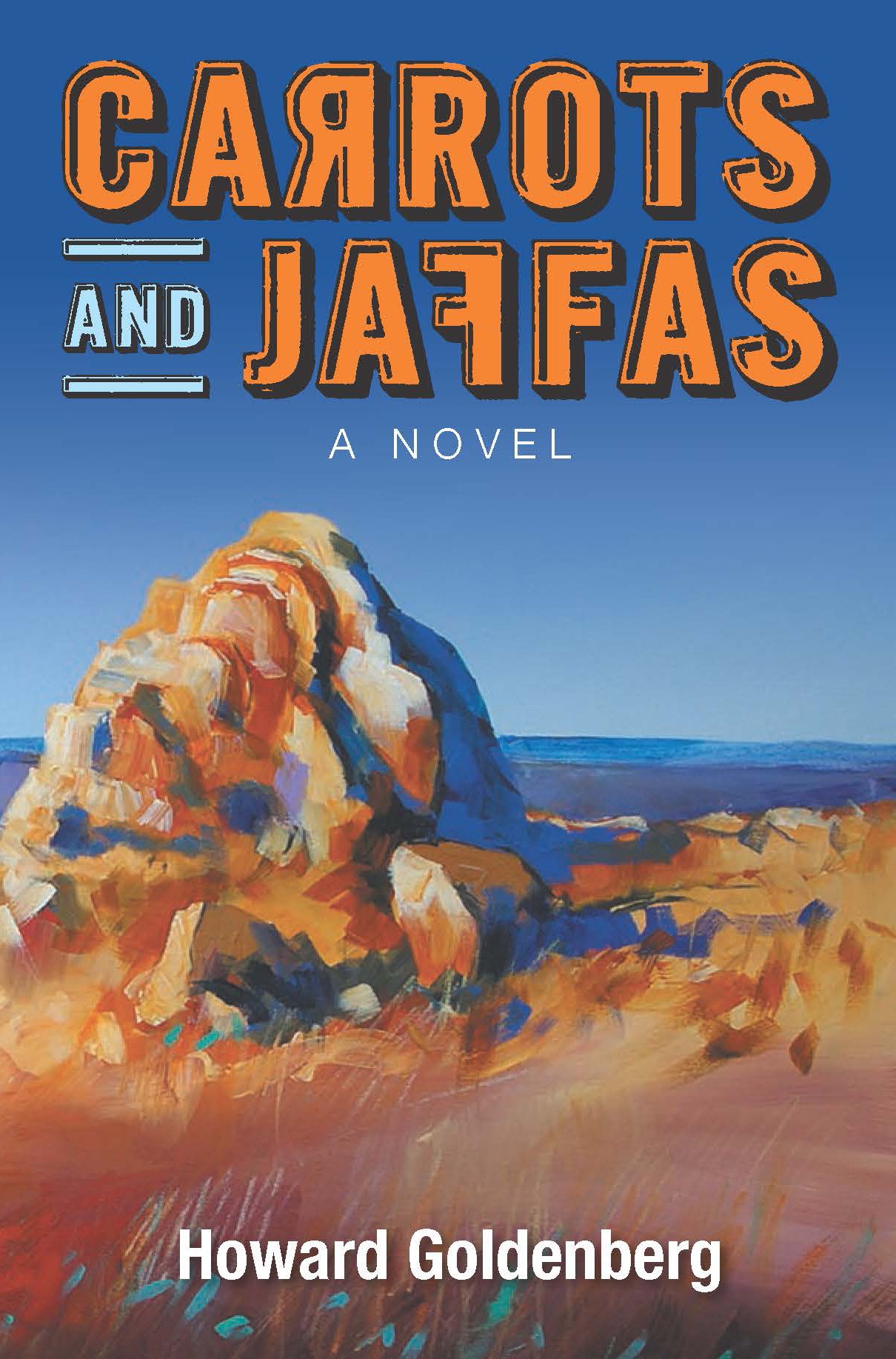
Howard Goldenberg, Carrots and Jaffas (Review)

Howard Goldenberg, Carrots and Jaffas

Courtesy: Hybrid Publishers

Howard Goldenberg, we are told in “About the Author” at the back of his debut novel Carrots and Jaffas, is the sole practitioner of a literary genre – the rhyming medical referral letter! Wouldn’t I love to see some of those! Anyhow, you’ve probably guessed now that Goldenberg is a doctor, and you’d be right. But he’s a doctor with some very specific experience. Earlier this year I wrote about white writers writing on indigenous subjects. It resulted in quite a discussion. While the overall opinion was that there should be no taboos in subject matter for writers, we agreed that such writing is most effective when done from a standpoint of knowledge (and, it goes without saying, sensitivity). Howard Goldenberg, whose novel Carrots and Jaffas I’ve just completed, has such knowledge*, as he has and still does practise for part of his time in outback Aboriginal communities. Beats me how he could also find time to write a novel, but like all passionate writers, he has!

I hadn’t heard of Howard Goldenberg before, but apparently he was featured in one of the sessions at this year’s inaugural Melbourne Jewish Writers festival, about which (the festival, not Goldenberg) Lisa (ANZLitLovers) and Jenny (Seraglio) have posted on their blogs. Goldenberg writes on his blog of his session with Martin Flanagan. He says that Flanagan “led a conversation about the book, about my choice to turn from serious non-fiction to the novel, about stolen children – the ultimate wound, about twinness, about the problems and pitfalls of the whitefella writing about blackfellas.” Oh, wouldn’t I have loved to have been there!

This novel, Carrots and Jaffas, is pretty ambitious. It covers a lot of ground, asking us to make the right connections between different experiences of suffering and loss. It uses parallel stories and a frequently shifting narrative perspective to do this. It has the odd awkward moment – a coincidence pushed a little far, an irony that doesn’t quite ring true, an earnestness that gets in the way – but these are minor in a story that totally got me in from the first page. Goldenberg has written two works of non-fiction – a memoir about his father, My father’s compass, and a book of stories about his experiences as a doctor in outback Aboriginal communities, Raft. These non-fiction works have clearly honed his narrative skills.

The main action of the novel occurs around 2004, with the setting split between suburban Melbourne and the Flinders Ranges in South Australia, in Adnyamathanha country. The plot starts with the abduction of 9 year-old Jaffas, one of identical twins, by an ex-drug addict, ex-con, who plans to deliver him to an old indigenous woman, Greta, who had two sons stolen from her in the 1960s. Clean now, but with a brain damaged by PCP, he (Jimmy aka Wilbur) sees himself as Golem or the Redeemer. He is going to right a wrong. He planned to take the two boys but it goes wrong and he ends up with just Jaffas, leaving behind a distraught Carrots. The story then flashes back to the story of how Carrots and Jaffas came to be, to the meeting and subsequent marriage of their parents, Bernard, an IT specialist who had lost his father when young, and Luisa, an immigrant from Buenes Aires who, we gradually learn, had suffered significant trauma and loss in her youth. Later, we meet Doc who works in the Flinders Ranges, but who has experienced a loss of his own, a sibling through divorce.

From here the story alternates between Carrots at home, and Jaffas in the outback in a neighbouring state. As Carrots starts to fall apart, Jaffas, who was threatened with the death of his twin if he tells, is introduced to indigenous culture. He is not happy, is biding his time for an opportunity to go home, but in the meantime, over a period of a couple of months, he starts to hear different stories about life – indigenous ones from Greta and scientific ones from Doc – and learns another way of living. I will leave the story at this point … except to say that there is drama alongside reflection. It’s quite a page turner, in its quiet way!

There is humour here, despite the serious subject matter. I particularly loved the chapter on the kindergarten fancy dress parade. It brought back such memories. Even in this lighthearted scene, though, there’s seriousness. One child is particularly diminutive, and Goldenberg writes:

No one in his class considered him abnormal. But already behind him, forever past, were the years of parity with his classmates. This would be his last year of unselfconsciousness, the last year before he entered the big school, where bigger kids would be free with unkind comparisons. Luisa gazed at him, concerned; she realised the child did not suffer from dwarfism – not yet.

Oh, the power of labels!

The characters are engaging, each clearly individualised – from Luisa’s bible-learnt English and understandable fearfulness to Greta’s confident, nurturing nature, from Bernard’s practical approach to life to the Doc’s passionate if somewhat eccentric one.

There are many losses explored in this novel – parents “lose” children, and children their parents, siblings lose siblings – and they are mostly needless, human-induced. Goldenberg examines what happens to the soul, the spirit, when it experiences such pain. Not everyone responds in the same way – some start to disintegrate, some go into problem-solving mode, others respond with increased generosity of spirit – but all suffer.

Carrots writes letters that he clearly can’t send to the abducted Jaffas. In one of them he writes “I am not me without you”. They are of course twins, but most people, Goldenberg shows, are irrevocably changed when they experience loss. For all this, the novel is redemptive. I’d love to know how indigenous people respond to the novel but, for me, it’s a novel written with love from the heart. I enjoyed it.

Howard Goldenberg
Carrots and Jaffas
Melbourne: Hybrid Publishers, 2014
242pp.
ISBN: 9781925000122

(Review copy courtesy Hybrid Publishers)

* Read, for example, his powerful, heartfelt blog post on the current Budget recommendations regarding co-payment for medical treatment.

Kirsten Krauth, just_a_girl (Review)

Kirst Krauth, Just a girl

Courtesy: UWA Publishing

If you’ve already heard about Kirsten Krauth’s debut novel just_a_girl, you’ll know something about its confronting nature – and it is confronting, though perhaps not quite in the way I expected. It was both more and less, if that makes sense.

However, if you’re not Australian, you may not have heard about this novel. Essentially a coming-of-age story, just_a_girl is told in three voices. Two are first person – Layla, a 14 to 15 year-old-girl, and Margot, her mother – and the other is, interestingly, told third person, Tadashi, a lonely Japanese man. The main voice, though, is Layla. She opens and closes the novel, which is set around 2008 in Sydney and the Blue Mountains.

Layla typifies the modern knowing teenage daughter that parents worry they may have. She’s sexually precocious and is acutely aware of her effect on men. She’s what many would call “a tease”. She tells us, though, that she’s a virgin (technically, anyhow, because she’s done pretty much everything else). She wants, she says, to wait until she’s 16:

Fifteen just seems too skanky. You tell your kids you lost your virginity at 15. They’ll just want to do it even younger.

This tells us something more about Layla – her street-wise wisdom. It’s believable because Layla has had to grow up fast. Her parents separated when she was in primary school because her father finally admitted his homosexuality. Her mother, prone to depression, turned to an evangelical church. Layla has learnt to navigate these waters with smart talking, and by using all the weapons at her disposal including personal attributes and modern technology. With studied insouciance, she tells us about her relationships, with her mother, her friend, her father, and various boys and men. She is not innocent, but she is also abused in several ways, by old and young, through the novel.

Meanwhile, her mother Margot struggles with depression, a sense of rejection and failure, and consequent inability to properly relate to her daughter. She has turned to God, but unfortunately the church she has chosen, with its hypocritical leader, is unlikely to be her salvation. You see how easily relationships can go awry during these turbulent years if family members are not strong and confident in themselves. But, Krauth keeps it real. This is not melodramatic. There are no over-the-top mother-daughter scenes, just lack of real communication leading to distance and lack of mutual support where both need it. By the end of the novel both have learnt something and are starting to see each other as people, rather than simply as roles. In other words, it’s not only Layla who needs to grow in this contemporary coming-of-age novel.

Into this mix is added a third voice, Tadashi. He often travels on the same train as Layla, and on one occasion rescues her from a risky situation. Like Margot, he’s lonely, used to relying on a mother who has now gone. In scenes reminiscent of the bitter-sweet movie Lars and the Real Girl he orders and takes possession of a sex (or love) doll which he sees as “a person” who will alleviate his loneliness. In some ways it’s an odd inclusion in the story but, besides his probably not essential role as rescuer, he adds another angle to the exploration of loneliness and relationships, and the use and misuse of sex to address gaps in people’s lives.

In her “Sources and permissions” note, Krauth tells us about her sources for “love dolls” and other ideas or events in the novel. She also explains that some of Layla’s comments have been inspired by teenagers who have appeared on SBS’s Insight program. She has listened well, because from my experience of similar programs I felt very comfortable (if one can call it that!) with Layla’s voice. She’s so fresh, so funny, so knowing, that you can’t help liking her and worrying about her vulnerability, while also being horrified.  Here’s a short example:

Mum says I have to be careful now that I’m in year 9. Because men will start looking at me in a new way. Fuckadoodle, they’ve been looking at me like that for years. Especially when I eat Chupa Chups on the train.

I was going to share the Chupa Chups (“I have a favourite game on the train trip home from school”) episode with you, but I reckon you should read it yourselves. It would be funny if it weren’t so disturbing. It’s a fine piece of writing about a sexualised young girl who “knows” too much. Talk about playing with fire!

Margot’s voice is quite different – the long run-on sentences versus Layla’s short ones convey her anxiety and uncertainty well. Here she is, for example:

When is this soul-searching going to end, I mean, I knew coming off the meds would be hard as I’ve tried it a few times before but it’s like I’ve sunk into a bog, and it’s been a horrendous week because of that film Layla hired, Brokeback Mountain, you know she loves Heath Ledger and was completely devastated when he died last year and everyone thought … [and on she goes for several more lines]

I feared at times that Krauth was trying to pack too much in – single mother, gay father, hypocritical evangelical church, breast cancer scare, viral you-tube, sex doll, workplace sexual harassment, and so on – but no, she made it work. They are treated as things that happen. She doesn’t trivialise, but neither does she labour. Instead, she keeps her focus on the main game, which is how we, and particularly young people and their parents, must navigate the modern digital world with its potential for serious ill, and how in such a world might we still forge meaningful relationships. A thoroughly modern book for a thoroughly modern audience. It will be interesting to see what Krauth does next.

Lisa at ANZLitLovers also liked the book.

awwchallenge2014Kirsten Krauth
just_a_girl
Crawley: UWA Publishing, 2013
265pp.
ISBN: 9781742584959

(Review copy supplied by UWA Publishing)

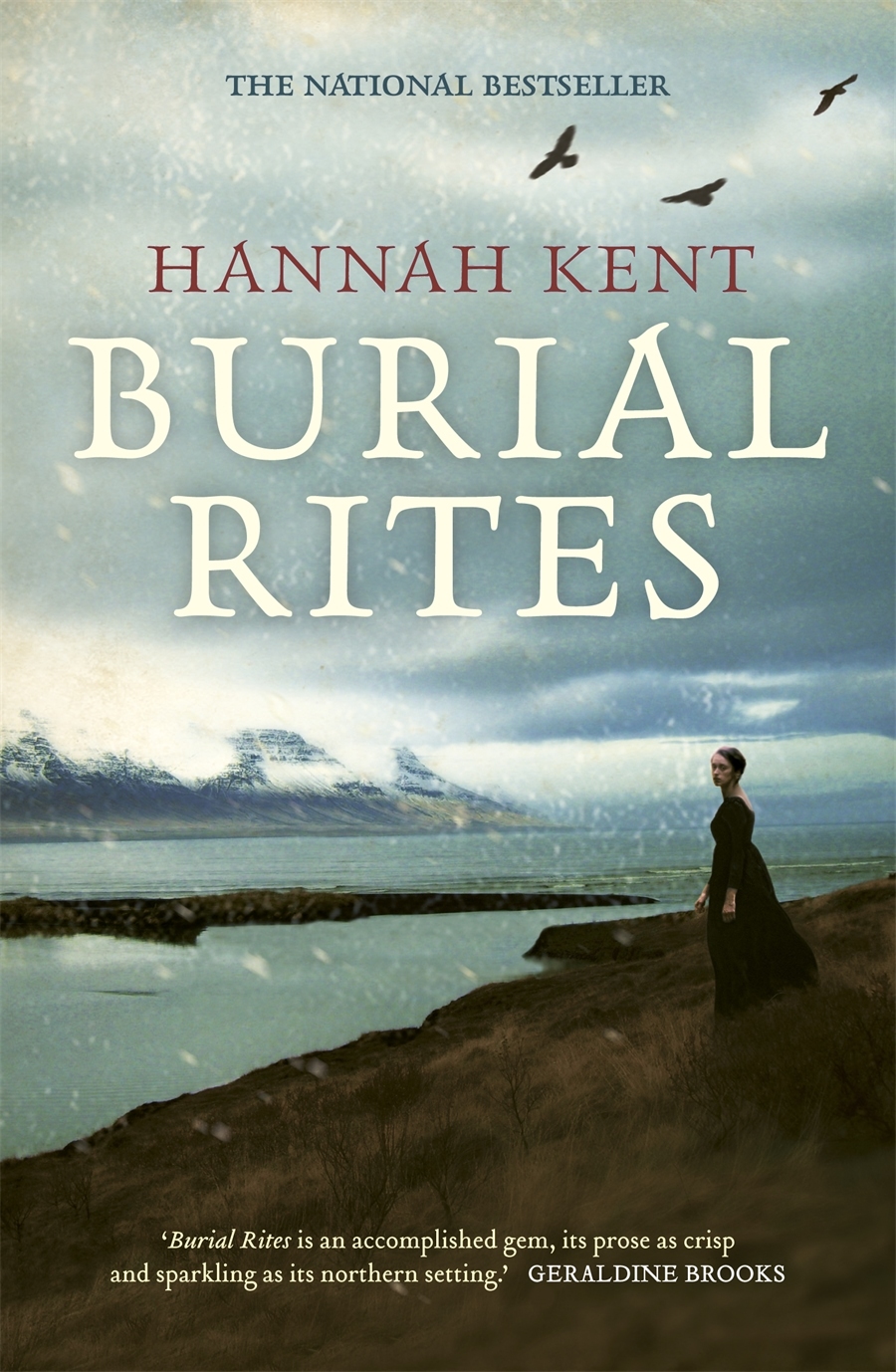
Hannah Kent, Burial rites (Review)

Hannah Kent, Burial Rites bookcover

Courtesy: Picador

“We’ll remember you” says Margrét to Agnes on the day of her execution. We sure will, if Hannah Kent’s debut novel Burial rites has anything to say about it. Kent’s book is the second novel set in Iceland I’ve read, the first being Icelandic writer Halldor Laxness’s unforgettable Independent people. Although Laxness’s novel is set a century after Burial rites, it prepared me for Kent’s novel – for the difficult landscape, the hard lives, and the unforgiving natures that such an environment can engender. Yes, that’s a generalisation I know. You can find unforgiving natures anywhere, but oh, they work so well in harsh environments. Just think, for example, of My Antonia (my review).

But now, what to say about a book that hit the book stands running? I wanted to read it last year, but I also wanted to read it with my reading group, which is why I have only now read it. Reading a book so late can make it difficult to add anything meaningful to the conversation. Fortunately though, while I couldn’t avoid the early buzz, I haven’t read the myriad reviews out there, enabling me to come to it reasonably freshly. So, here goes …

Remember your place, Agnes

It’s a compelling read. Icelanders may know the basic story, but we don’t. It concerns Agnes Magnúsdóttir – great sounding name, eh? – who, in 1830, was the last person to be executed in Iceland. She and two others, Fridrik Sigurdsson and Sigrídur Gudmundsdóttir, were convicted of murdering Natan Ketilsson, a complicated and probably cruel man, and his friend Pétur. Fridrik was also executed, while Sigrídur’s sentence was commuted to life imprisonment. Apparently, executions were normally carried out in Denmark but District Commissioner Björn Blöndal wanted to make an example of Agnes. As it would take some time to organise the executions and as Iceland had no real prison facilities, Agnes and Fridrik, were, literally, farmed out to live with public officials who were also farmers. Most of the novel takes place on the farm, Kornsà, to which Agnes was sent. The main characters, there, are the farmer’s dying wife Margrèt, her two daughters Steina and Lauga, and her husband Jón. Making regular visits is Assistant Reverend Tóti, chosen by Agnes to be her religious adviser. As the novel progresses, we also meet the victim and Agnes’s co-murderers.

Kent creates a believable world in which the people at Kornsà are initially resentful and fearful, but gradually, more gradual for some than others, come to recognise Agnes’ humanity and to believe that her sentence “isn’t right”. Similarly, the anxious but conscientious Tóti grows through his relationship as Agnes’ mentor. We learn about Agnes’ childhood, in which she is early deserted by her mother and then loses a loving foster-mother through death in childbirth. And we learn about her struggles to support herself as a woman. She thought she’d found her place with Natan, who seemed to offer her love while also offering her a job, but he soon reminds her of “her place”! Kent’s Agnes lives most of her life alone, lonely, and unsupported, which was probably not uncommon for women of her class at that time. This is, I’m sure, one of the themes Kent wants to explore in her novel.

You could argue that, overall, Kent’s women are fleshed out more than her men, but this is Agnes’ story and we know, I think, what we need to know about the men. There is a feminist reading to the book, but it is also more broadly sociological, to do with poverty and disempowerment. That women are more likely than men to find themselves in these positions is part of the problem.

This is what I told the reverend

Kent doesn’t use a simple, direct narrative to tell her story. (What novelist does in this post-postmodern world of ours!) For a start, she opens each chapter with one or more translated archival documents. This regular interruption of the main narrative could irritate readers by breaking emotional engagement with the story, but I found it enhanced the novel, particularly considering Kent’s intentions. One of these intentions, as she explained in an interview at last year’s World Book Expo, relates to the fact that she sees the novel as “speculative biography” not “historical fiction”. She describes, in this and other interviews, her methodology which was to use facts wherever they were available. Where the facts weren’t available, she says, she did broader contextual research about Iceland to imagine what was most likely to have occurred. She felt “free to invent” only in the outright gaps. She describes this approach as “research-driven creative-practice”. It’s logical, given all this, that she would use archival documents to support her “story”.

The other main narrative technique Kent uses is to switch voices from first person for Agnes, to third person for everyone else. This also makes sense given that Kent’s prime motivation was to give Agnes a voice, to “find her ambiguity, her humanity” and lift her out of the prevailing, more caricatured image. Again, I think it works, mostly. Agnes’ voice is distinctive, strong, and wavers, as you would expect, from confidence and hope to anxiety and fear. However, there were times when the switch back to third person seemed unnecessary. Mostly the third person sections focus on other characters, even when they are interacting with Agnes, but on a couple of occasions the shift occurs in the middle of Agnes’ story. One minute she is telling her story – “This is what I told the reverend” – and next minute the reverend asks “What happened then” and her story continues in the third person with her words in quotation marks. This was a little disconcerting, though it didn’t spoil the story significantly.

A magic stone

While the main point of the novel is Agnes’ story, Kent, in the process, paints a rich picture of Icelandic society, of the farmers, healers, neighbours, poets, gossips, maids and so on. Religion is clearly important, but for some characters, omens and superstition are equally if not more powerful. Natan is depicted as highly susceptible to bad omens, and for Agnes the ever-present ravens – “their black feathers poisonous against the snow” – reflect her sense of aloneness, and bode ill. By contrast, stones suggest good luck:

The stone Mamma gave me before she left. It will bring you good luck, Agnes. It is a magic stone.

It is, therefore, telling when she spits out a stone from her mouth on the day of her execution.

This brings me to Kent’s writing. It’s strong, evocative and often visceral. She uses motifs, like the ravens and stones, to reinforce her ideas. (It’s probably not coincidental, either, that the novel has thirteen chapters!). She is though, a first-time novelist, and at times the writing becomes a little heavy-handed, like this, for example:

Sometimes, after talking to the Reverend, my mouth aches. My tongue feels so tired; it slumps in my mouth like a dead bird, all damp feathers, in between the stones of my teeth.

But who’s complaining? Burial rites is a magical read that gets you in from the first page and doesn’t let you go until you get out your hanky at the end. Consider yourself warned.

awwchallenge2014Hannah Kent
Burial rites
Sydney: Picador, 2013
Design: Sandy Cull
338pp
ISBN: 9781742612829

Margaret Merrilees, The first week (Review)

Margaret Merrilees, The first week

Courtesy: Wakefield Press

Having discussed in this week’s Monday Musings Margaret Merrilees’ essay on white authors writing about indigenous Australians, I’m now getting to my promised review of her debut novel, The first week, in which she does just this. It also, according to Wakefield Press’s media release, won the Adelaide Festival’s Unpublished Manuscript Award in 2012. I can see why it did.

The plot is simple. It chronicles the first week in the life of Marian, after she hears shocking news about something her adult son Charlie has done, news that would chill the heart of any parent. Marian is a middle-aged, widowed countrywoman who jointly manages a farm with her oldest son, Brian. She holds the conservative views that would be typical of her demographic. The setting is south-west Western Australia, the Noongar country of Australian author Kim Scott whose That deadman dance (my review) tells of early contact in that very region, but Marian understands little of that. She’s about to learn though, because, standing at a fence that she used to clamber through, she realises

… it was different now. There was a claim on it. This fence, a fence she’s ignored for years, had taken on new meaning. Where she stood was her land. The other side was theirs. Someone’s. Those Noongars from town.

What would they do with it? Any more clearing would be a disaster. The salt was already bad down there.

This comes early on day one, Monday, before she hears the news about Charlie, but already Merrilees has introduced us to Marian, the land she works and her attitudes. She clearly has little respect for “those Noongars from town” and yet she knows the land has been damaged. Merrilees also describes other aspects of Margaret’s life that will help inform our understanding of the week to come – guns, the family’s dynamics including her relationship with her troubled late husband, a dependence on a more savvy friend. It’s all lightly, naturally done through a well controlled third person voice.

By day two, Tuesday, Marian is in Perth, where the first order of the day is to attend Charlie’s arraignment in court. Here she meets Charlie’s housemates and is invited to their home to talk about what has happened – and there she meets Charlie’s neighbour and friend, the indigenous woman, Lee. In addition to the reference to “those Noongars” on Monday, Merrilees leads us up to this meeting with other suggestions of Marian’s prejudiced attitudes to “other” (to Asians and Aboriginal Australians). Needless to say, her meeting with the educated, political Lee does not go well.

This is where Merrilees confronts the issue she addresses in her essay, because for Marian to develop she needs to hear from indigenous characters. Marian meets Lee cold, that is, she doesn’t know Lee is indigenous: “No one had mentioned that. They wouldn’t think it mattered, probably. But it did.” Lee tells her about the Reserve in her region, about the treatment of indigenous people there and in the town. Marian doesn’t want to know – or believe – what she hears. She uses those patronising words “you people” and leaves in rancour. However, she is a woman still in shock and, knowing that all this has something to do with Charlie’s actions, her better self starts to realise that “she had to know whatever there was to know”. She reads Lee’s paper, attends Lee’s talk, and converses again with Lee. Lee is presented as fair but determined. She doesn’t go easy because Marian’s in pain, and when Marian admits that Lee has made her think, and that she’s ready to learn, Lee tells her:

Then you owe me … I won’t forget. Salvation doesn’t come cheap.

To my white Australian mind, Merrilees handles her indigenous characters well. They ring true to what my experience and reading tell me, but, as Merrilees also says in her essay, “it is not for a white writer or critic to decide what is appropriate.” I would love to know what indigenous readers think.

And this segues nicely to what I most enjoyed about the book – its humanity and lack of judgement. Merrilees lets her characters be themselves, warts and all. Lee, for example, is rather fierce but open to discussion and sad about the direction Charlie took. Marian is conservative, in great pain and feeling a failure as a mother, but is open to change. I particularly liked the way Merrilees captured the physicality of Marian’s pain – she can’t eat, or sleep, or remember her son’s phone number, her chest tightens, her heart races. From my own experience of an awful shock, I related to the point where she really has to face her changed circumstance:

Getting out of the car and leaving it behind suddenly seemed difficult. Her last tie with home and normal.

If my review has seemed a little vague about detail, that’s partly because the book is too. There’s a lot we aren’t told about what exactly happened, about why Charlie did what he did, but that’s because he is not the book’s main subject. Early in my reading, I was reminded of Lionel Shriver’s We need to talk about Kevin. This, though, is a different book. Yes, both books are about a mother and a terrible act by a son, but Merilees’ compass is broader. It’s both personal and political. And so, on the personal level, Marian realises that she can – she will – survive. But it’s the political lesson that is dearest, I think, to Merrilees’ heart, and it is simply this, “that she, Marian, was ready to listen” to Lee’s story, to listen to it “wherever and in whatever way” suits Lee. The first week is a compelling read with, dare I say it, an important message. I hope it gets out there.

Lisa (ANZLitLovers) also recommends this debut.

awwchallenge2014Margaret Merrilees
The first week
Kent Town: Wakefield Press, 2013
225pp.
ISBN: 9781743052471

(Review copy supplied by Wakefield Press)

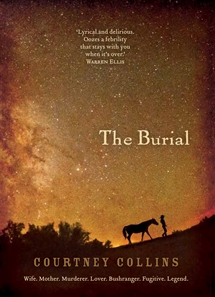
Courtney Collins, The burial (Review)

Book cover (Courtesy: Allen & Unwin)

Book cover (Courtesy: Allen & Unwin)

I became aware of Courtney Collins’ The burial when it was longlisted for the Stella Prize. It has since been shortlisted for the Stella, shortlisted for the new writing award in the NSW Premier’s Literary Awards, and longlisted for the Dobbie Literary Award for new writing. It had previously been shortlisted for the 2009 Australian/Vogel Award for Unpublished Manuscripts. This is one impressive debut. While I’m attracted to several of the books longlisted for the Stella, I particularly wanted to read this one because of its subject matter; it is inspired by the life of Jessie Hickman, an Australian woman bushranger. I hadn’t heard of her before and thought this would be an interesting introduction. I wasn’t wrong. The burial is no ordinary historical fiction.

The bulk of the novel takes place in 1921 when 27-year-old Jessie, having had a gutful of her abusive, horse rustling husband Fitz, takes off, having first … well, let’s just say, done to him what she’d been wanting to do for a long time. In other words, she’s on the run. Now Jessie is no saint. She’s already been in prison for rustling, but she didn’t deserve the treatment she got at the hands of Fitz. The novel chronicles Jessie’s escape, and the story of the two men looking for her, Jack Brown, her lover and co-horse rustler for Fitz, and Sergeant Barlow, who has a story of his own. Escape is, we discover, Jessie’s speciality. It’s not for nothing that the book starts with a story of Houdini, or that Jessie’s horse is named for him.

As I read, I was reminded of two American writers – Toni Morrison and her powerful, gut-wrenching novel Beloved, and Cormac McCarthy and his western novels – for pretty obvious reasons. The burial is narrated by Jessie’s prematurely born daughter whom she kills and buries at the start of the novel, reminiscent of Sethe’s daughter Beloved, despite their different behaviours. And the elemental, evocative language along with the themes – human against human, human against nature, in a forbidding and lawless environment – immediately bring Cormac McCarthy to mind.

What is particularly impressive about this debut is Collins’ handling of the narrative voice and structure. The baby’s voice is generous and wise, not maudlin or pathetic. She cares about this mother of hers, and is a bit like a guardian spirit, albeit one without any power. Somehow, despite what Jessie did to her, she humanises Jessie and encourages us to feel sympathy rather than horror. Collins is light-handed in her use of this trope. As the novel progresses, it feels like a third person story, which it is, really, because it is not about the narrator but is her story of her mother. Every now and then, though, we are reminded of our narrator when she says “my mother”.  As for the structure, the narrative alternates, loosely rather than rigorously, between Jessie’s story and that of Brown and Barlow. It’s basically chronological but there are flashbacks to fill us in on Jessie’s origins as we follow her escape.

Back now to the story. Early in the novel, Jessie is released from jail to be an apprentice horse-breaker and domestic help to Fitz, and pretty soon we are told all we need to know:

Her hope was that her employer was a good man. But he was not.

I love the way Collins’ language flows – from lyrical description to the plain and straight.

Fortunately, Jessie, while fearful of this man who beats her, is also spunky and “found freedom in the ways she defied him”. There is a bit of the picaresque in the novel, as we follow Jessie’s escape and the various people she meets, but it has none of the lightness of that form. A better description is probably gothic. It’s a tough world Jessie finds herself in – one that is particularly cruel to women and children. She spends time, for example, with an old couple. The woman wants her because “All of these years in this miserable place I have prayed for the company of someone other than you and here she is. I am taking her”. The man’s response?  “She’s of no value”!

The brightest spot in the novel occurs when Jessie meets a gang of young rustlers led by the 16-year-old Joe in a spirit of mutual support and cooperation. She joins them and helps them in a well-planned heist in which they manage to steal 100 cattle, sell them at saleyards and return to the hills before the owner notices the loss. It is remote country, after all. However, the theft is discovered and a bounty is put on Jessie’s head – for the cattle they believe she’s stolen and for the rumoured murder of Fitz. And so the final hunt begins involving a bunch of men who are after the bounty, and Brown and Barlow who hope to get to her first.

For a while the gang stays hidden but, eventually, some of the hunters get close:

That’s the sound of desperate men, said Joe. I know this type of man, said Bill. He has no god. And he is all the more dangerous to us because, worse than that, he has no law in him or myth to live by.

Jessie, at her insistence, heads off alone, setting up the climax which is not totally unpredictable – after all, one can’t stay on the run forever – but which contains its surprises.

This is a novel about a hard world in which

A man can rape or kill and expect no consequence except his own consequence. You mean conscience? Consequence is what I said and what I mean to say!

But it is also about love and forgiveness, magic and myth, resilience and resourcefulness … I’ll not forget it quickly.

Courtney Collins
The burial
Sydney: Allen & Unwin, 2012
ISBN: 9781743311875 (Kindle ed.)

Read for Australian Women Writers’ Challenge and Reading Matters’ Australian Literature Month.

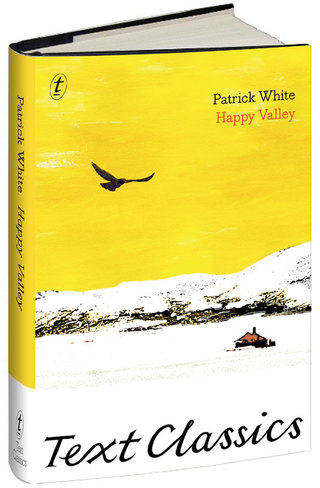
Patrick White, Happy Valley (Review)

Patrick White, Happy Valley

Book cover (Courtesy: Text Publishing)

My love affair with Patrick White, figuratively speaking, began in my last year of high school when I studied Voss. Always partial to Aussie literature, I was, at 17 or 18, bowled over by White’s writing, passion and vision – and by his rather acerbic, though mostly compassionate, view of the way people submerge their “selves” in exterior trappings. I was consequently thrilled when Text decided to publish his first novel as part of its Text Classics series because this book, first published in 1939, was not published again in White’s lifetime. His decision, not his fans, I might add!

Why White refused its republication is a matter of some conjecture. He describes it in his autobiography, Flaws in the glass (1981), as “my first published, best forgotten novel”. Whatever the facts, being published in England and New York in 1939 probably made it easy to “lose”. All I can say is that it’s a great shame, because this is one helluva novel.

But let’s not conjecture, and get on with the book. It’s hard though to know where to start. As a newly released but first Patrick White, it’s going to be (and probably already has, but I’ve kept my eyes averted) the subject of much critical and literary analysis. How, this amateur blogger thinks, can I add to that? By, I suppose, just picking a few things that interested me.

There were several things that interested me in this novel, besides the fact that it is a good read. Perhaps I’d better explain that, the plot, first. It’s set in, yes, a town called Happy Valley, in the Snowy Mountains-Monaro region of New South Wales, just south of where I live and where Patrick White was a jackeroo for a year. If you know Patrick White, you’ll know the town’s name is ironic because White’s people are rarely happy. Life tends to be, for them, disappointing at best, sterile, depressing and/or meaningless at worst. In this book we have a large number of people and families, representing a cross-section of a typical country town: the doctor (Holliday), the teacher (Moriarty), the squatter (Furlow), the storekeepers (Quongs), the banker (Belper), the piano teacher (Alys Browne), the farm worker and “stud” (Clem Hagan), the “simpleton” (Chuffy Chambers). The novel begins and ends with the doctor, but its subject matter is the desire to escape. Many of the town’s residents don’t want to be there, and dream of ways out. Alys dreams of California, Hilda Holliday of Queensland, Sidney Furlow of anywhere-but-here, and so on. For the most part the novel chronicles the relationships between the people, explores the sources of their discontent, and teases them with future possibilities. It seems, until near the end, that nothing particularly dramatic will happen but then a shocking event occurs which precipitates decisions – some big, some small – that will change the lives of those concerned. For the better? Well, that’s a question for us readers to consider, but it’s important to recognise that for White the important decisions/shifts that have to be made are internal. Here is Alys near the end, seeing her escape dream for what it was:

I shall not hurry, she said, I shall shape time with what I have already got.

It’s a good story – and it’s clearly White.  There are a lot of characters, which can be the downfall of first novels, but White handles them well. The connections are clear and he keeps them all moving along so that we readers rarely, if ever, feel lost – once we have them in our heads.

What bowled me over most about the novel though is its style. It’s big – it’s inventive, expressive, rhythmic. As I was reading it, I was reminded of DH Lawrence (and his intense sensuality) and James Joyce (and his “stream of consciousness”). Peter Craven, who wrote the introduction to Text’s edition, agrees, and adds Gertrude Stein (whom I don’t know well enough) and Virginia Woolf (whom I should have picked too!). However, despite these pretty clear influences, the novel doesn’t feel slavish. Although this is (obviously) early in his career, his mature style is already evident. I was impressed by how he moves pretty seamlessly between description, dialogue and interior monologue, by how he shifts point-of-view, even within paragraphs, and by how, almost imperceptibly at times, he changes voice from third to second to first person. It’s spirited, gutsy writing. You feel, sometimes, that’s he’s strutting his stuff, but he rarely loses us and, while he may occasionally push a little too far, it doesn’t feel like showing-off but more like a writer with ideas bubbling out of him.

Earlier in the review, I mentioned writers that I felt influenced White, but now I want to mention one that I think was influenced by him, and that’s Thea Astley. She also had a pretty acerbic view of the world, and could skewer characters for their superficiality while maintaining, unless they really didn’t deserve it, compassion for them. White and Astley also use humour, usually wry or satiric rather than belly-laugh. I loved this description of a person in a bar early in the novel:

But another was an old man, one of those static old men you see in country bars, who seem to have no significance at all, except as recipients of drinks that they pour in through the meshes of a yellowish moustache, just standing and nodding, willing to listen to a story, but never giving much in return. They are generally called Abe or Joe. Though this one was called Barney, as a matter of fact.

That made me laugh; it’s the sort of writing that made me keep reading. But it’s not all quite this benign, because Happy Valley is a town where there “never was co-operation”, where “people existed in spite of each other”, where town “stud” Clem would like to “take a lump of wood, treat her almost like a snake”.

One of the threads running through the novel concerns the limits of language to express true feeling:

Both of them wanting to say something and then it only came in words.

White, I understand, would love to have been an artist, calling himself a “painter manque”, but oh dear, what words we would have missed had he done so.

Lisa of ANZ Litlovers, also a Patrick White fan, loved the book too.

Patrick White
Happy Valley
Melbourne: Text Publishing, 2012 (orig. published 1939)
407pp
ISBN: 9781921922916

(Review copy courtesy Text Publishing)

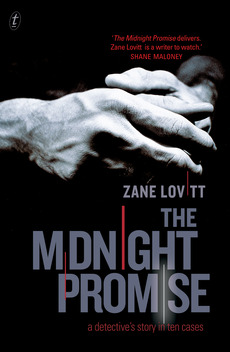
Zane Lovitt, The midnight promise (Review)

Zane Lovitt, Midnight Promise

Book cover (Courtesy: Text Publishing)

Zane Lovitt’s debut book, The midnight promise, is one of those books for which I can’t decide how to start my review. I could go with the point, previously made in this blog, that I’m not a reader of crime and so cannot speak with authority on the subject. Or, I could write about the fact that one of the chapters in the book, “Leaving Fountainhead”, won the SD Harvey Short Story Award in Australia’s top crime awards, the Ned Kelly awards*. I could start with how Melbourne-based Lovitt joins the growing number of lawyers who write fiction. Or, I could start with the topic that interests me most, its form.

Because, if you haven’t noticed, I didn’t use the word “novel” once in my opening paragraph. There’s a good reason for this: The midnight promise is, if I can draw from the main media through which I consume crime, more like a detective series than a movie. I could have described it as a book of short stories, but that would be misleading. The ten chapters or stories all feature the one detective or “Private Inquiry Agent”, John Dorn, and they are told chronologically. Moreover, even though the book comprises ten separate cases, rather than one main case as would be expected in a novel, there is an overarching, albeit not immediately obvious, plot, defined by “the midnight promise”.

This form may, in fact, be one of the reasons I liked it. Each story is complete in itself while also forming part of a greater whole if you keep reading. The form is also, however, responsible for my only real criticism, which is that, almost without exception, the stories are structurally the same. They follow a present-flashback-present-flashback (and so on) structure. In a “true” book of short stories, I like things to be mixed up a bit; I like to see variety in style, in voice, structure, tone, language. That’s not the case here – but neither, I suppose, would it be the case in a television detective series, so perhaps my criticism isn’t valid. Still, a couple of times, I felt myself saying “here we go again …”.

John Dorn is not, I think, a particularly original character, for the genre. Like many crime protagonists, he’s somewhat of an outsider, a loner with a broken engagement behind him. He’s also a man of some principle which is why his is pretty much a hand-to-mouth existence. In the early stories his fee ranges from $400 a day to $250 a day to nothing depending on whether he wants (or believes in) the job or not. The higher the charge the less he wants it! For this reason we like Dorn, and want things to work out for him, but somehow, more often than not, he manages to shoot himself in the foot.

Being a private eye, his cases are varied, from marital spying to finding missing people to protection (of the innocent or the guilty). But the theme is consistent. It’s “the shitty things people do to each other” or, as he puts it more colourfully when describing roadkill in the final story:

We drive over two foxes, parallel, like one of them couldn’t bear to live without the other. Though what’s more likely is one fox was eating a dead fox and got hit by a car because he didn’t see it coming because he was distracted because the other fox was so delicious.

Not a grammatically beautiful sentence but appropriate and effective in the context. In fact, I liked Lovitt’s writing. The voice is first person, and the writing is generally direct and spare with the occasional well-placed image which works partly due to its rarity. Like this, for example:

I’ve heard rumours about his shady GST schemes, but everything I know about tax offences wouldn’t rouse a chihuahua from its beauty sleep.

The dialogue is realistic. There is humour – mostly in Dorn’s sardonic view of the world – which varies the tone. There is irony, as in the name of the character, Comedy, who is anything but funny, and in the story “Grandma’s House” whose title belies the horrors within.

And this brings me back to the form, to the fact that while each story is complete there is a trajectory in the book, heralded by the occasional bit of foreshadowing. We know something is going to happen that will change Dorn’s life, and probably for the worse. The crisis occurs in the seventh story, “The Crybaby Technique” – and it’s ironic because he was, in this particular case, only a bit player. Things change gear from here, leading to the final crisis in the tenth story which is significantly titled “Troy”. It’s a gripping read with a beautifully controlled out-of-control last page. You’ll have to read it to see what I mean.

So, would I recommend this book? Yes, to non-crime readers, like me, who look for character and good writing, and to crime readers who, I’m presuming, like intriguing cases with a detective who keeps you guessing. If I were a crime reader, I’d be saying I hope this isn’t the last we see of John Dorn, or of Zane Lovitt. In fact, I’ll say it anyhow …

Zane Lovitt
The midnight promise
Melbourne: Text Publishing, 2012
283pp.
ISBN: 978192192230

(Review copy supplied by Text Publishing)

*In 2010. It also appeared in Scribe’s New Australian Stories 2, that same year.

Jeanine Leane, Purple threads (Review for Indigenous Literature Week)

What I especially like about Jeanine Leane’s book, Purple threads, is how well she draws the universal out of the particular. That she does this is not unusual in itself. After all, this is what our favourite books tend to do. The interesting thing about Purple threads, though, is that the particular is an Indigenous one. Even as I write this post my mind is flicking back-and-forth between thinking about the Indigenous Australian themes in the book and the more universal ones about family and relationships. More on that anon. First, I want to say a little about the book’s form, because ….

I’m not sure whether to call Purple threads a novel or a book of connected short stories, except I don’t think it matters much. What is significant is that the stories revolve around a mostly female-only Indigenous Australian family living on a small piece of land in the Gundagai area of New South Wales in the 1950s to 1960s. The main characters run through the whole book, and the stories are told pretty much chronologically. There could even be a plot line or two, but they are not strong and are not what drive us to read on. This form had an eerie familiarity as I was reading and I realised it was because it reminded me of another David Unaipon Award winning book I have reviewed here, Marie Munkara’s Every secret thing. Is this a coincidence – after all, there are similar books by non-Indigenous writers – or should I go out on a limb and wonder whether this form reflects an Indigenous Australian way of story-telling? In addition to this similarity in form, these two books share a particular style of humour. Munkara’s is probably more belly-laugh, and is definitely more gut-wrenching, but both have a self-deprecating element, a willingness and ability to laugh at themselves, to see the absurd. It’s a form of humour we also see in Alexis Wright‘s Carpentaria. Okay, enough of that, back to the book itself.

The stories are told first person by Sunny (Sunshine) who lives with her sister Star, and her grandmother, Nan, and aunts, Boo (Beulah) and Bubby (Lily). Her mother, father, grandfather, more aunts and uncles, and others in the community, also appear in the book, but these five named characters are the focus. They are well differentiated. Nan is the down-to-earth matriarch of the group who doesn’t know how to read but “sure as hell know[s] how ta think”. Boo is independent and feisty, the one who takes action when action is needed. She loves the ancient Romans, particularly Empress Livia “who knew how to work behind the scenes”. Bubby, on the other hand, is the gentle, romantic one, who loves Emily Bronte and Wuthering Heights. The stories chronicle the first two decades of Sunny’s life in this female-dominated household. There are anecdotes about walks with Aunty Boo, about spoilt Petal (Sunny and Star’s mother), and about interactions with neighbours, teachers and others in the community. Most of the stories are light, albeit with a good degree of bite, but some are dark, such as the story of the young white neighbour, Milli, who is regularly beaten by her husband. This story, in fact, forms a minor plot line in part of the book.

The universal themes are about the way families comprise different and sometimes conflicting personalities and yet manage to love and support each other to ensure their joint survival. The particularity, though, has to do with being Indigenous, with being lesser, in a rural community. Leane handles this cleverly, using, for example, the Christian symbol of “the black sheep” throughout the book to tease out the ironies and complexities packed into this idea when it is played out in a sheep-farming community. The symbol is explicitly introduced to us in “God’s flock” where Sunny talks about going to church and being taught the story of “the black sheep”:

‘ … But Jesus, if we pray to him [the priest says], will find all the lost sheep and return them to the fold, even the black sheep that no one  else wants or loves.’

At least this bit made sense to us. Apart from Jesus, we didn’t know any other sheep farmer who loved black sheep. Most hated them, in fact. That’s why every year my Aunties always ended up with a few black lambs to raise ….

Leane shows how Nan and the Aunties navigate life in a world where “black was not the ideal colour” and in which “women livin’ by themselves are always easy targets”. They navigate it with dignity, often by pretending to go along with white society’s ways while staying true to their own values, which involve respecting and caring for other people and creatures and for their little bit of land.

Purple threads, apparently drawn from Leane’s life, provides an engaging but uncompromising insight into a life most Australians know little about. I hope I’m not being too pompous when I say that we need more books like this, and they need to be read by more people, if we non-Indigenous Australians are to have a chance of truly comprehending the experience of being Indigenous in our nation.

Read for ANZLitLovers Indigenous Literature Week, for which Lisa has also reviewed it.

Jeanine Leane
Purple threads
St Lucia: University of Queensland Press, 2011
157pp
ISBN: 9780702238956

(Review copy supplied by University of Queensland Press via ANZLitLovers blog giveaway. Thanks Lisa. Thanks UQP)

* I have assumed copyright permission for this cover on the basis that the book was provided by UQP

Chris Flynn, A tiger in Eden (Review)

Flynn Tiger in Eden
Courtesy: Text Publishing

Are all people redeemable, regardless of what they’ve done? This is the question that confronts us in Chris Flynn’s debut novel, A tiger in Eden. I wondered, as I was reading this book, what inspired Flynn to write – in first person – about a man who was a violent thug during the Troubles in Northern Ireland and how he managed to achieve such an authentic voice. I don’t read reviews before I read books, and I didn’t read the press release which came with the book until I’d finished it, but when I did I discovered that Flynn was born in Belfast during the period he writes about. “I was born into the war and knew nothing else growing up”, he says.

He has seen horror, he says. He has had guns pointed at him, and he has heard “stories of torture and cruelty so nightmarish I would not recount them to someone who had grown up outside of Northern Ireland. You don’t want that in your head”. This, however, is the world of Flynn’s protagonist, the thug-on-the-run, Billy Montgomery, whose head is full of violent memories and whose hands are stained with blood. “Sometimes”, he says, “I reckon the worst thing that can happen to a person is surviving”.

I don’t want to say too much about the story because it’s a slim book with a small cast of characters and a pretty straightforward plot. To say too much would give it away. It’s set in Thailand in the mid 1990s. The aforesaid thug Billy, who is not short of a penny due to his criminal past, is hiding out. But, here’s the interesting thing. Billy is a sympathetic character, despite the violence we know he’s done (though we don’t know the full extent until near the end) and even despite the violence we see him enact in the first half of the novel. He’s sympathetic because we realise early on that he’s trying to work through something, that he’s carrying some terrible baggage he wants to shake off.

It’s the mark of a good writer to be able to make an unappealing character sympathetic. And Billy is pretty unappealing. Not only is there his violent past, but his attitude to women is (or, at least has been) appalling, as has been his attitude to Catholics and various other “lesser”, to him, members of society. But, this book is really about the education of young Billy and so, through the love of a couple of good women (which is, yes, a little corny) and some other meaningful encounters, a Buddhist retreat, and reading, Billy starts to think about his life and, consequently, starts to confront his demons.

One of the things that makes Billy work is his voice. The novel is told first person in the vernacular of his ilk. This means there’s liberal use of swear words*, minimal punctuation, and the grammar is, shall we say, idiosyncratic. The result is a voice that sounds authentic – and, in this case, reliable. The only thing stopping Billy from telling the truth at times is the pain it would release.

Billy is, of course, the tiger in Eden, a potential threat to good people everywhere, but just to give it some added real and metaphoric punch, Flynn has our Billy confronting and staring down an actual tiger, an escapee from a zoo (just like Billy really). However, whilst I say Billy is “the” tiger in Eden, he is not the “only” tiger in Eden. Flynn shows Thailand to be a place spoilt if not corrupted by sex-tourists and cashed-up back-packers who abuse the locals one way or another. Here is Billy after realising that a genuine friends-only outing with a local Thai girl threatens her reputation:

The aul sex tourism had changed things for all these people, I could see that now ‘cos normal life no longer existed. It was kind of like how the Troubles had changed things back home, once you go down that road, sure there’s nothing going back, everything gets changed forever and not for the better. I felt ashamed so I did.

In other words, while Flynn’s main story is men like Billy, he manages to make a few other points along the way.

At the beginning of this post I said that the book confronts us with the question of redemption, and so it does, but that’s not so much what Billy is seeking. He does not specifically ask to be “saved”. He simply wants to be able – psychologically and actually – to put the past behind him and “make something” of his life. This is not a perfect book. It’s somewhat predictable and the supporting characters are not well fleshed out, but Billy is a character that will engage you and make you see the world from another angle. And isn’t that what reading is all about?

Chris Flynn
A tiger in Eden
Melbourne: Text Publishing, 2012
217pp.
ISBN: 9781921922039

(Review copy supplied by Text Publishing)

* So it’s not the book for you if that offends.

Michael Sala, The last thread (Review)

Michael Sala The last thread bookcover

The last thread (Courtesy: Affirm Press)

It’s clear why Affirm Press chose a comment by Raimond Gaita for the front cover of their latest publication, Michael Sala’s autobiographical novel, The last thread. Gaita, for readers here who don’t know, wrote an award-winning memoir, Romulus, My Father, about growing up as a migrant with mentally unstable parents. Sala’s story is different but both boys suffered emotional deprivations that they chronicle in their books … except, and this is a big one, Sala’s book is classified as “fiction”, and we must therefore read it as such. A bit, in fact, like Francesca Rendle-Short’s Bite your tongue!

So, what is his story? The novel is told from Michaelis’ (later Michael’s) point of view. It is divided in two parts: Bergen Op Zoom and Newcastle. It starts, then, in the Netherlands when Michael is around three or four years old, and his brother, Con (Constantinos) three years older. But it’s not quite this simple, as in the first part which is told third person we follow them from the Netherlands to Australia to the Netherlands and then back to Australia. The family’s unsettled state physically – they also move multiple times in Australia – works metaphorically too because there is little emotional stability in the boys’ lives. At the start of the novel, the mother has left the boys’ father, the Cypriot Phytos, and is living with the physically and emotionally abusive Dutchman, Dirk. (“There’s no problem”, Michael writes of this handyman stepfather, “that he can’t solve with his hands”.) By the end, when the boys have grown up, the mother has been married a couple more times. She is skilled, you would say, at choosing wrong men: “The men in my life take advantage of me”, she says.

What makes this somewhat age-old story compelling is the writing. It is told more or less chronologically but in little vignettes. The two parts are divided into chapters, but the chapters themselves are broken into smaller sections that provide an eye into scenes from Michael’s world. It’s a child’s eye, until near the end, so we readers must try to fill the gaps between what Michael describes and what we know could be the meaning behind what he’s seeing. Why, we must ask ourselves, would a young boy think this:

Michaelis can’t imagine anything more frightening than living forever.

And Michael’s eye, though a child’s one, is very observant. He particularly notices faces, watching them it seems for signs of warmth and connection, but

Each time light blazes from the screen, it washes across Con’s face and reveals it like something carved from stone.

and

She [mother] holds her belly and sighs, and there’s a look in her eyes as if she might burst into tears.

I could be mistaken but it felt to me that as we moved through the second part, Newcastle, which is told first person by the adult Michael, the chronology became more disjointed, mirroring I think Michael’s growing awareness of what lies behind the dislocations in his family, and of its impact on him.

As you’ve probably gathered by now, there are secrets in this family that contribute to the dysfunctional behaviour. These secrets are not mentioned on the backcover, so I won’t mention them either. Sala handles them well. He doesn’t labour them but rather lets them hover in a way that we know they are there but that doesn’t let them occupy centre-stage. We learn to live with them, the way the family has to. In the way of modern novels, there’s no dramatic denouement …

In talking of the writing, I’ve mainly discussed the narrative style but I should also mention the language. It is, in a word, gorgeous. Here are just two descriptions that convey Sala’s ability to capture the essence of things. First, being dumped by a wave:

There is such strength in the sea. He has forgotten it until now. It pulls at his limbs so that his feet touch nothing and only his desperate grip keeps him there. A sensation comes to him of being separate, of seeing it all from a great distance as if he cannot reach out and touch the world. Then the noise dies in his ears, the sky appears again above him.

And next, of his mother’s house:

The rooms and corridors of my mother’s house became like the arteries of a heart attack victim, all clogged up. Even the breeze had to bend in half to get through.

I’ve read quite a bit of autobiographical/biographical fiction, fiction-cum-memoirs, and memoirs in recent months, and some I’ve found a little wanting here and there. This, though, is hard to fault – if, that is, you like reading more for the interior than the exterior, for what’s going on inside rather than for what’s happening in the material world.

In the very last pages of the book, Michael’s mother says that “words and stories can be dangerous” (echoing Francesca Rendle-Short’s “to think, to write, is dangerous”). They can indeed, but sometimes that danger can have positive outcomes. I hope that, for Sala, the dangers of putting his story, his truths, on the page will be restorative. There’s no guarantee though that such bravery will have its just rewards … in life or in fiction.

Michael Sala
The last thread
Mulgrave: Affirm Press, 2012
238pp
ISBN: 9780987132680

(Review copy supplied by Affirm Press)