Canberra Writers Festival 2023: 3, A Jewel of a Book

Which book you are presumably wondering? The session’s subtitle will give you a hint: Debra Dank in Conversation with Evelyn Araluen. The book, then, is Debra Dank’s We come with this place, which won a record four prizes in this year’s NSW Premier’s Literary Awards (as I described in my post).
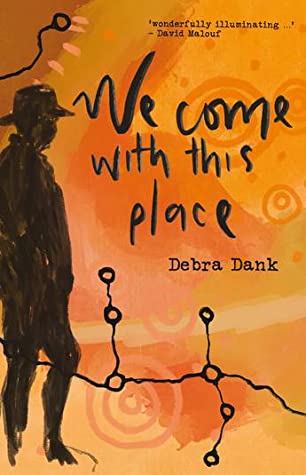
The session description commenced with:

We come with this place is deeply personal, a profound tribute to family and the Gudanji Country to which Debra Dank belongs, but it is much more than that. Here is Australia as it has been for countless generations, land and people in effortless balance, and Australia as it became, but also Australia as it could and should be…

It described Dank as “a Gudanji/Wakaja woman” and Araluen as “born and raised on Dharug country [and] a descendant of the Bundjalung Nation”. If you read my second CWF post from yesterday, you’ll see that I have already “met” Debra Dank and Evelyn Araluen. That whetted my appetite for this more focused one-on-one session.

The conversation

Oh my, what a session this was in terms of complex ideas that challenge western world views being presented in a respectful but unapologetic way. After all, why should they be apologetic.

Araluen started by introducing Dank from the formal bio, and ending with the fact that her book had won “incredibly significant accolades”. The session’s title, she explained, had come from Tara June Winch’s description of it as “a jewel of a book”.

The session discussed several issues, but a recurring one concerned the book’s narrative style and how it reflects “Indigenous narrative practices” as Dank framed it. I was keenly interested in this because I have been aware of First Nations Australian storytelling (oral and written) as being different but identifying the difference has not been so easy!

Dank said in response to Araluen’s opening question that she hadn’t set out to write a book, so she was still developing her relationship with it “as a book”. She wrote it for her kids, and saw it as essentially a conglomeration of stories and events. Araluen picked up on this and talked about how the book comprises an interweaving of language, memory, time, and place. Critics, she said, have been trying to find a way to describe Indigenous storytelling by using words like “interweaving”. Dank saw this sort of interweaving as integral to “Indigenous narrative practices”, to Indigenous storytelling.

Araluen commented on how well Dank conveys the “embodied physicality of Indigenous experience”. This captured some of what I felt I’d gleaned from the book, though I didn’t quite have the words for it. Araluen read an excerpt from early in the book in which Dank shares a childhood memory

The sparks rose in the air and danced there – in celebration of a whole lot of things, I imagined. The deep hot red glow in the little hearts with their flaring skirts of blackened edges held my eyes. The embers twirled above our heads, in a dance on a sigh of wind barely there, and as I gazed upwards into the darkening sky, the just-appearing stars spotlighted larger ashy flakes. The bright burning cinders, exuberant and light, then faded to tiny pieces of black falling char.

Araluen loved the way Dank was able to go back into memory and narrativise that little girl.

Dank talked about how she always had access to books, but that her “childhood aesthetic” was always about country. She would do all her week’s correspondence school work on Monday morning and then “be gone with Dad”.

Araluen described the book as a “precious gift” that intricately captures experience. She commented on Dank’s interrogation of history. There is “no gratuitous, voyeuristic depiction” of what her father went through, for example, but we are conscious of the impact of history on him. She wanted to know how Dank navigated this.

It was at this point that the other main thread of the session appeared – the lack of representation of Aboriginal people, of the contribution they have made over the last 200 years (let alone the previous tens of thousands of years). It really gets up her nostrils! In historical photos, non-Aboriginal people are always identified, but never the Aboriginal workers. “We are not represented, we are not seen to exist, to be valid”, she said.

We then returned to narrative practice. The book comes, she said, from the less significant part of her PhD, so she didn’t feel bound by the conventions of literature. It wrote itself, just evolved.

The discussion then turned to language, multi-lingualism, and Dank’s research into semiotics and narrative structure, and the limitations that she observes.

Dank said that the issue of limitations motivated her. She is constantly vigilant about how language works in education, how Aboriginal students can “seem” incapable, and experience deficit in their education. She told us about discovering Umberto Eco who talked about the ways communities make sense of their surroundings. This is the basis of semiotics. Aboriginal people have their own languages, and these work differently on a semiotic level. The problem is that Aboriginal communication has been framed by, viewed through the prism of, western theories, but “we’ve been doing narrative longer than anyone else in the world” and it works because “we are still here”.

Araluen then talked about Dank’s style and structure, describing it as “eco-lyrical”, as having an environmental, seasonal underpinning. How did Dank find her writing language? Dank replied that she had always been a reader, and named her diverse influences – Funk & Wagnalls’ books, the Bible, Slim Dusty, Emily Dickinson’s poetry, Greek stoics (which fitted with the Scottish Methodist part of her heritage), and Toni Morrison. Araluen interrupted here with her description of the “bone-deep legacy of Beloved“, how it conveys the “physicality of memory”. Dank described Beloved as an unimaginable gift of a book, and that she got it. (Beloved is nowhere near my experience but I felt got it too. If ever a book could convey the injustice of slavery and racism at the deepest, most visceral level, it’s Beloved.)

Dank the said that Australian colonial authors, like Xavier Herbert, were also influences, in that they conveyed for her the “invisibilisation of a  people”. She got no sense of reality in what she was seeing. (This made sense to me. People talk about the importance of seeing themselves represented in culture – the arts, media, etc – which of course I understand, but Dank’s clarity about the implication of not seeing yourself, her sense that it’s not real to her experience, drove it home perfectly.)

Araluen talked about ecology, and how non-Aboriginal writers, going back to Lawson and Paterson, for example, have “f***ed up” representation of the land with their colonial and Gothic perspectives. Dank mentioned some “nice and convenient research” from the University of the Sunshine Coast which proves that Aboriginal stories document significant events on the land.

The conversation continued on how First Nations people understand country, on there being a “deep formal, absolute law around connection” to country, on understanding the earth and “our nonhuman kin”. Dank said that “country is not ever something I have the right to just wander casually across”. She talked about how we are “stuffing up ecosystems and habitats”, about mammal extinctions, and about fracking. Westerners do not understand how aquifers are connected, but the songlines do, she said. More Australians need to wake up to the urgency of the climate crisis. There was more, but I think you get the gist regarding the intense concern about what Araluen called “environmental violence”.

The formal part of the session ended with Dank reading from the beautiful “The business of feet” story in her book, which tells of her young son’s deep engagement with their country, and his awareness of the long history of that connection.

Q & A

  • On what sort of writer she sees herself having now published the book: she now feels like a writer; that is, the book is causing her identity to shift. She is becoming aware of the practice and process of writing, and wants to protect her non-genre writing practice. We come with this place is not a memoir. Dank added that she should thank the early colonial writers, because they made her sit up and say, “hang on, that’s not the truth”.
  • On what advice she would give to a Non-aboriginal teacher working with people from diverse linguistic backgrounds: start with the home language because that carries the student’s cultural being and it needs to be respected.
  • On what sustains Dank in the face of trauma: the real privilege of being alive, getting on with the business of living. Awful things are still happening, but there are also many things to remind her of the privilege of drawing breath. First Nations people are 4% of the population, but “this will aways be our country. It made us”, she said.
  • On what her perfect writing day would look like: a cup of Chai, and being on her own country with the aunties under a tree across the way being amazingly patient, then calling her when they think she’s written enough.

My wrap-up

This session might sound negative and critical of western culture, and it was in many ways, but Dank also admits to enjoying and drawing from both traditions. However, this book is about the culture that sustains her, the culture that she’s rightly passionate to see preserved and passed on, and that she believes can also offer something to the rest of us. This session was about how First Nations Australians are forging their own narrative practices, against a backdrop in which they have been invisible, unrepresented, for so long.

Canberra Writers Festival, 2023
A Jewel of a Book
Sunday 20 August 2023, 10.30-11.30am
Canberra Writers Festival 2023: 2, Celebrating the classics

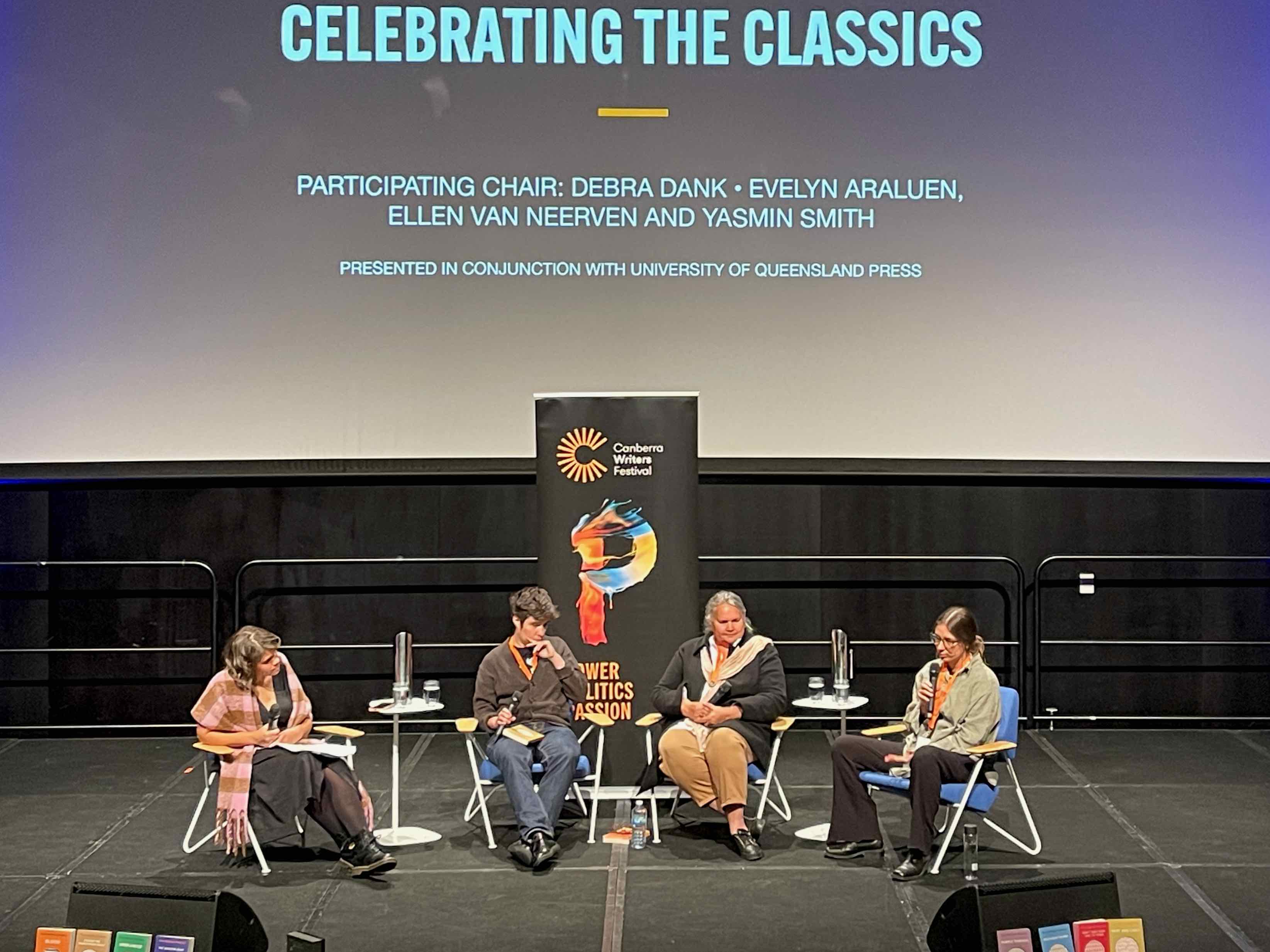
When I saw the line-up for this session – Debra Dank, Evelyn Araluen, Ellen Van Neerven and Yasmin Smith – I was in. I have read and admired writing by three of these writers and was keen to attend that rare thing, an all First Nations panel.

Its topic was described as follows:

A new literary project sets out to change the way we tell the story of Australian literature. Join series editor, Yasmin Smith and a stellar panel of writers as they celebrate the first edition of First Nations Classics. Essential reading for all generations.

The discussion

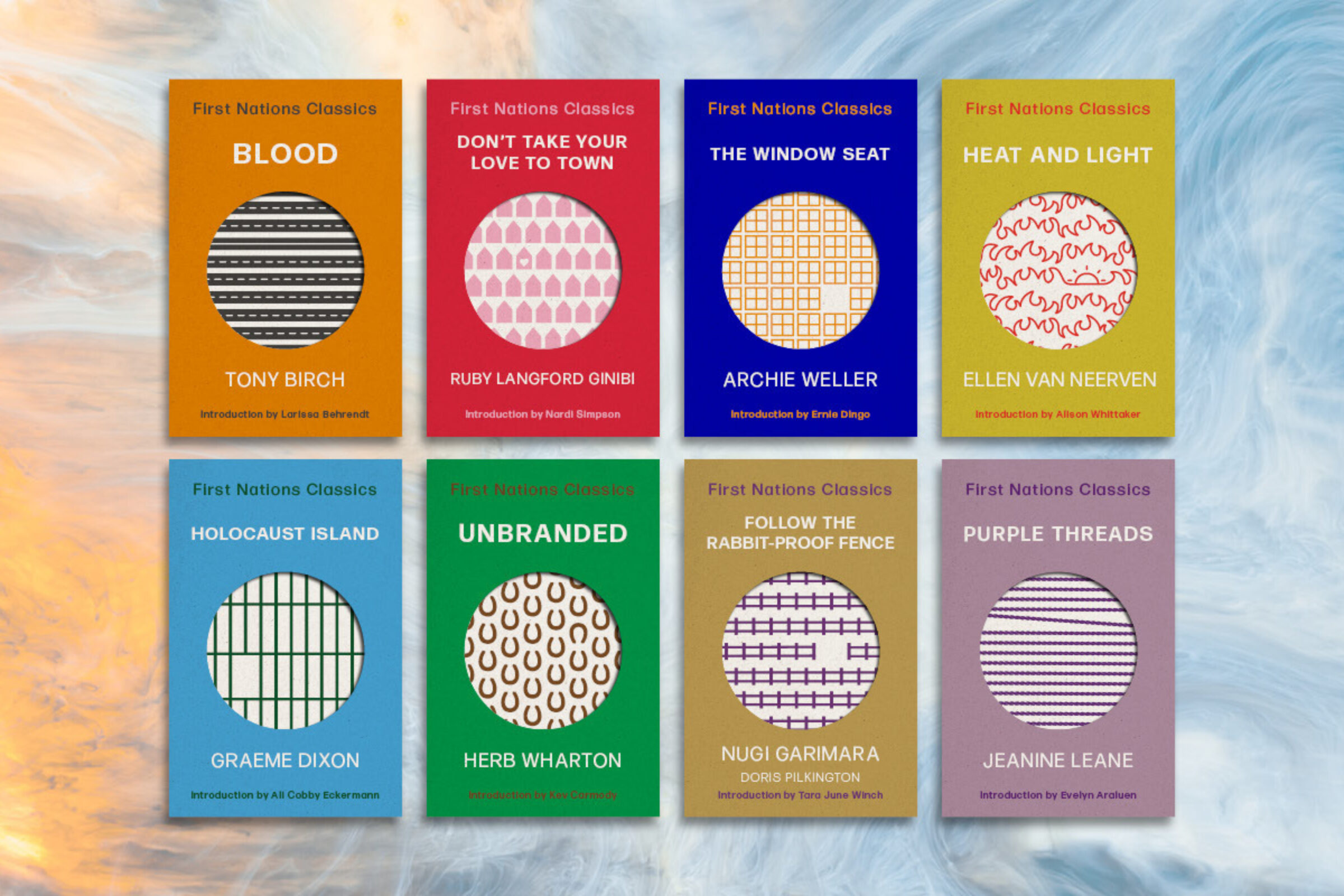
The program didn’t, for some reason, identify the publisher of this new series, but it is the wonderful University of Queensland Press which, as the panelists said several times, has an excellent track record in publishing and supporting First Nations writing. I wrote about this series late last year, so loved having the opportunity to hear it discussed by those involved.

The session started with acknowledgement of country, and then with each writer briefly introducing themselves, which they did primarily by identifying the country they belong to. I love that these country names are now becoming so familiar to us all. We are all learning – almost by osmosis – the First Nations make-up of the land we live on.

Smith then talked about the inspiration for the series, about UQP’s “incredible backlist” of books across a range of forms, that are timeless and have a clear relevance now. She then asked the panelists what makes a classic. The responses to this age-old question were varied, thoughtful and provocative . Araluen commenced because, she said laughingly, the “eye contact” had come to her! I loved her response – it’s when a book shifts into a communal relationship! The idea of “classics”, she said, is related to “the cannon”, and idea which is a western concept loaded with values of the the city-state(Plato), beauty and artistry (Aristotle), and – haha – sexual innuendo (Shakespeare). For her though a classic is a book that’s ground-changing, and that people incorporate into their lives. Real classics live within communities, outside universities. They are classics because they are valued by the people they are for and from.

She also talked about the musicality of writing, such as Ruby Langford Ginibi’s Don’t take your love to town. Dank picked up this idea and talked about musicality and rhythm. These make a classic, they are the “thing that beats within all of us”.

Van Neerven talked about classics being stories that can be read and heard, and about her own early reading as a 19-year-old of writers like Oodgeroo Noonuccal, Samuel Watson, and Leonard Fogarty. These spoke to her, though they were not alway widely celebrated in their times. She talked about Jackie Huggans’ book Sister girl. Rereleased last year, it had sold more in the next two months than it had in its first 30 years. Black literature is now being read and recognised; young people are people inspired to add to the conversation; and the publishing industry is more open to black stories.

It was then suggested that classics have great characters, a strong voice, truth-telling, and good evocation of place. Araluen identified Jeanine Leane’s Purple threads (my post) as an example of great evocation of place. You can “feel its realness, authenticity”. Classics also embody a sense of honouring what came before.

Smith next asked the panelists to talk about the growth of First Nations literature since their careers began, to which Debra Dank’s laughingly said that she was surrounded by “gorgeous, youthful folk” but that she was the youngest in terms of a writing career. Her PhD was in semiotics, which is what motivated her. She believes not many non-Indigenous Australians are aware of the depth of black writing, of its amazing richness. Blackfellas tell stories differently (which I loved hearing because I have commented on it before, and hoped I wasn’t making it up!)

Smith encouraged Van Neerven to talk about her Heat and light (my post) journey. She started with her unversity days when all her reading was “so white”. She then talked about learning what she didn’t know, how to break rules, and what she wanted to say; and about being part of the black&write! program. When Heat and light, a hybrid book, was published in 2013, there was little queer representation in First Nations literature, and little satirical/futuristic/speculative writing in the black space. There has been significant change in both these areas over the decade.

Araluen talked about Purple threads, which, like much First Nations literature, doesn’t fit into a neat package. There was talk of “blackfellas evading classification”! She found it both an honour and a challenge to be invited to contribute an introduction to Leane’s book. She tried three introductions: a literary analysis on why the book doesn’t fit the usual prose categories, but this came from our impulse to name; looking at it within the framework of Leane’s life but this would tell people how to read it; and finally, a focus on the place. She drove to Gundagai (under Leane’s guidance) and immersed herself in the place. It was an immense privilege to step into someone else’s story. All the books she said come from particular contexts, but are now in conversation with each other.

At this point she made a shout out to the Festival’s Artistic Director, Beejay Silcox, for her diversity and inclusiveness this year’s programming.

Smith then noted that classics hold deep, rich history, and asked Dank if she had any favourites. Dank neatly sidestepped this (almost), saying that each book reflects different times and experiences. She did though name Herb Wharton’s cattle country book (Unbranded) and said Ruby Ginibi’s book is a classic. She’s relatively new to Van Neerven’s work which she sees as profound in a different way. She really couldn’t pick favourites, she said. they are life markers, they guide us.

Araluen wondered what the series will do for kids, and then asked Smith about her experience managing the process. Smith said it felt overwhelming, but it was all based on consultation and community. The challenge was working out who could speak to which book for the intros. It was also very hard to choose the initial 8. She was 19 years old when she first read a black writer, Tara June Winch’s Swallow the air. It gave her a sense of belonging; she could see herself. So, she wanted books “that spoke to ourselves as black writers and black readers … to community”.

Q & A

  • On a second series and the production process: There is a second series of 8, coming out next June (2024). The process was complicated: some were out of print, some pre-digital, so there was scanning, rekeying, retypesetting; there was designing the covers to make them collectible as a set; there was no editing of the works, but there was the commissioning of the intros. It takes a long time.
  • On getting the books into school curriculums: Some are already (like Heat and light) but they are trying to get them into the educator’s market. Some have teacher notes.

The panelists then asked each other questions. Araluen asked Van Neerven how she felt about Alison Whittaker writing her book’s introduction. Van Neerven said she’d been daunted by the whole process when her book first came out, but this time felt more in control. She liked how Whittaker contextualised the book from her own experience. She loved feeling her work had been cared for.

Van Neerven then asked Dank what she was working on now. Dank wasn’t sure it was wise to talk about, but she is reframing the other part of her PhD which is about black narrative, but she is having second thoughts about its form. The problem is it’s about to go to the printers! Araluen answered the same question, saying it will be some time before she tries poetry again! Her next book is from her PhD on desire, haunting and healing in literature and storytelling.

Van Neerven didn’t get to answer her own question. She was saved, she said, by “1700 [the session end time] staring at her”!

This was truly lovely panel, in which the panelists showed such respect for each other but also exuded a quiet confidence in themselves – and gave me some new things to think about. Beautiful.

Canberra Writers Festival, 2023
Celebrating the classics
Saturday 19 August 2023, 4-5 pm

Debra Dank, We come with this place (#BookReview)

First Nations people are advised that this post contains the names of deceased people.

It has been my reading group’s tradition for some years now to read a book by a First Nations writer in July, the month in which NAIDOC Week occurs. Coincidentally, NAIDOC Week’s 2023 theme was “For our elders”, which worked beautifully with our chosen book, Debra Dank’s We come with this place, because a large part of it is about the value and importance of elders and ancestors.

This was not, however, why we chose Dank’s book from the options before us. Its subject matter intrigued us, about which more anon, but we were also influenced by the fact that, at the time we were choosing, it had just won a record number of four awards in the New South Wales Premier’s Literary Awards: the Douglas Stewart Prize for Non-Fiction, the UTS Glenda Adams Award for New Writing, the Indigenous Writers’ prize, and the overall Book of the Year. It was also shortlisted for this year’s Stella Prize, and, after we scheduled it, it won the ALS Gold Medal. These are significant awards and, for most of us, the book lived up to its advance publicity.

I mentioned the subject matter above, but We come with this place is one of those books that is tricky to categorise. It’s a sort of multigenerational memoir that is also a guide to her culture and a community history of her people, before and after colonisation. It grew out of her PhD in Narrative Theory and Semiotics. Dank describes it in her Preface as a:

strange kind of letter written to my place – a recording of events and activities that I and my family have experienced, in order to tell Garranjini that I remember, and I know. It is all based on real events. Some parts have been reimagined, because they happened outside my presence, and several names have been changed. Our relationship with our place, however, is genuine and lives in ways that not easily told in English words or western ways.

She goes on to say that she wanted to show “how story works in my community, and how it has contributed to our living with country for so long”. It also felt imperative, she says, to talk about the “voices, human and non-human, who guided the Gudanji for centuries before anyone else stepped onto this land”. This is a truly generous thing to do, and my group loved that, loved how Dank shared her story, and particularly how she helped us whitefellas “see” how First Nations people understand and relate to Country. I knew much of this from all I’ve read and heard, but this book really grew my understanding.

The other special thing about this book for me is that it is set in an area I know. I spent three formative late-childhood years in Mount Isa, close to Camooweal where Dank’s mother’s family were based. I visited Camooweal several times, and traversed parts of the Barkly Tableland which encompasses her Country. The first First Nations people I heard of were the Kalkadoons, whom Dank mentions in her book. Dank herself, though, is a Gudanji/Wakaja woman, the former through her mother and the latter, her father.

“to see the pain as it lies in the landscape”

We come with this place is a confronting book, from its perfect and defiant title to its chronicling of the atrocities that her people faced. The fear of children being taken away pervades the book. There are stories of massacres, and other appalling brutalities including a rape of her father’s mother. Lucy’s “choices were both dire – a drover’s boy or a special girl. The same, just in different clothes”. There is intergenerational trauma, which Dank exemplifies through her father, Soda. Hardworking and loving, he bears traumas, which she characterises as “newer stories … that pushed and jostled with the older stories” and sometimes “pushed their way out with a violence” that was often directed at her mother, and sometimes herself.

Dank doesn’t hold back; the way she tells it is strong, speaking her truths and segueing between past and present, between brutal history and rejuvenating story, between people and ancestors. Amongst the tough stories are warm-hearted anecdotes about family life. An example is Dank telling of being on country with her grandfather Bimbo and her surprise and joy in learning how to catch fish in arid land. The stories speaking of deep love sit alongside the hard ones, and together convey that the people, their ancestors, and Country are interconnected. This idea is mirrored in the structure.

However, I admit that I did, initially, find the structure a bit confusing, but as I read on, I started to sense an overriding arc similar to that of Bangarra Dance Theatre’s recent offering, Yuldea. Both start with origin stories, then move through colonial history, and conclude with the power of kinship and connection to Country. But it’s not as linear as this sounds. For example, starting the book, and threading through Dank’s narrative are the three Water-women who came from sea in the Gulf of Carpentaria, and travel far to create “the freshwater and hill country” of the Gudanji. They also end the book, giving it an overall cyclical structure which, I think, reflects First Nations’ understanding of life. Other cycles occur within this structure, so there is a continuous sense of moving forwards and back in time, as experiences and stories build on each other to create “Gudanji memory” – for us, and for her people to whom she is writing. This idea of building “memory” from stories, from lines between places and the things that have happened there, is strange to western ways of thinking, but Dank makes it make sense. She shows us how stories are made and passed on through Country.

I’ve been trying to decide how to end this post, and then it came to me that the best way might be with some words from Dr Tyson Yunkaporta’s Introduction to the book. He is a First Nations scholar, founder of the Indigenous Knowledge Systems Lab at Deakin University in Melbourne, and the author of Sand talk. He admits to not being able to face “the through line of history from the savagery of the frontier wars to the interventionist policies of today”. Dank, though, has. He writes:

She hurts us, digs bullets out of old wounds that never healed properly, sucks out the poison and then begins our healing with love and laughter. She does this for everybody, no matter which side of the rifle you’re on.

Dank, in other words, doesn’t pull any punches, but neither does she ram them down your gullet. Her aim is to tell the truth, proud and clear, but to do it in order for healing to take place. Isn’t that what we all want?

Kim (Reading Matters) also loved this book.

Debra Dank
We come with this place
London: Echo, 2022
252pp.
ISBN: 9781760687397