David Foster Wallace, How Tracy Austin broke my heart (#Review)

Many readers here, I know, are not the slightest bit interested in sports. You know who you are and I’m not going to out you, but you are welcome to do so in the comments. Meanwhile, this is for the rest of you who enjoy watching sports. For me, watching sports aligns well with being a reader, because sport is all story.

What I mean by this is that a sports event has a beginning, a middle and an end. It is full of character and characters. There’s also setting, and there are themes. Some relate to the characters. Are they the underdog, a star on the rise, someone coming back, an oldie having one last go, the bad boy? But, there can be darker themes too to do with politics, social justice, economics, and so on. I don’t need to elaborate them here.

As a lover and supporter of the arts, however, I certainly appreciate that sport can get more than its fair share of attention and money, but that’s not so much the fault of sport, itself. In the best of all possible worlds all forms of human endeavour deserve support and recognition. Enough, though, of my justification … on to David Foster Wallace.

American author David Foster Wallace was a person of wide interests, one being tennis. Several years ago I posted on his essay “Federer as religious experience”. That essay was very different to this one, but its approach is similar in that Wallace takes us on a journey, as he thinks through the issue in front of him. For this reason, I’m going to re-use a quote I used in my previous post. It’s from Best American essays editor, Robert Atwan, who defines the best essays as being

deeply personal (that doesn’t necessarily mean autobiographical) and deeply engaged with issues and ideas. And the best essays show that the name of the genre is also a verb, so they demonstrate a mind in process–reflecting, trying-out, essaying.

Wallace commences his essay by describing his love of tennis and, in particular, of child tennis star Tracy Austin who was born the same year he was. He consequently looked even more forward than usual to reading her sports-memoir. He’s self-deprecating about buying these mass-market books, ‘the sports-star-“with”-somebody autobiography’, saying that he usually hides them “under something more highbrow when I get to the register”.

Unfortunately, Austin’s “breathtakingly insipid autobiography”, being full of cliches and platitudes, might have broken his love of the genre. However, he decides to explore it to see if it might “help us understand both the seduction and the disappointment that seem to be built into the mass-market sports memoir”. He works through the issues, exploring our expectations of them, and why they might compel us. Unlike Wallace, I have never gravitated to these sorts of memoirs, but I can relate to some of the reasons he gives. These athletes are beautiful and inspiring. They make, in fact, “a certain type of genius as carnally discernible as it ever can get”.

So, we want to know them – who they are, how they did it, and how “it feels inside, to be both beautiful and best”. These memoirs, “explicitly or not … make a promise—to let us penetrate the indefinable mystery of what makes some persons geniuses”. But, the problem is, they “rarely deliver”.

He uses Austin’s trajectory to exemplify all this, and discusses why her ghostwritten book fails. It’s not only because it is poorly written. It forgets it’s for the reader. Rather, its “primary allegiance” seems to be “family and friends”, with “whole pages … given over to numbing Academy Award-style tributes to parents, siblings, coaches, trainers, and agents, plus little burbles of praise for pretty much every athlete and celebrity she’s ever met”. It also wallows in the cliches, stereotypes and myths that we’d actually hoped it would break open for us. It’s not that we are looking for “dirt”, but we want insight. The only insights we get in Austin’s memoir, Wallace shows, are unwitting ones where she naively exhibits her lack of awareness of reality, such as her protestation that her mother “did not force” her to play tennis at 3. What three-year-old has free choice? There are other, scarier, examples of naïveté, stories that an aware memoirist would tease out from the position of wisdom gained from experience.

There is also what Wallace describes as the Greek-like tragedy of Austin’s career, the fact that her “conspicuous virtue, a relentless workaholic perfectionism that combined with raw talent to make her such a prodigious success, turned out to be also her flaw and bane”. This too is not grappled with in the memoir. The book could have helped expose “the sports myth’s dark side”.

But then, in a very Wallace-ish way, he starts to turn his analysis around. He notes that this “air of robotic banality suffuses not only the sports-memoir genre but also the media rituals” in which top athletes are asked to explain their “techne” in those post-contest interviews. With the Australian Open just over, and the Winter Olympics on, I’m sure you know what he means. We get no insights, just “I stuck to the plan” or “focused on one point at time”, etc.

From here, Wallace starts to look at the issue from a different angle. He can’t believe, given what they achieve, that these athletes are as vapid as they come across. Maybe they achieve the heights they do because these “one ball at a time” cliches are true, that what goes through the athlete’s mind as they stand ready to serve, make the pass, whatever, is, in fact “nothing at all”.

When Tracy Austin accepts the car crash that ended her come-back attempt with “I quickly accepted that there was nothing I could do about it”, maybe this is true:

Is someone stupid or shallow because she can say to herself that there’s nothing she can do about something bad and so she’d better accept it, and thereupon simply accept it with no more interior struggle? Or is that person maybe somehow natively wise and profound, enlightened in the childlike way some saints and monks are enlightened?

This is, for me, the real mystery—whether such a person is an idiot or a mystic or both and/or neither. The only certainty seems to be that such a person does not produce a very good prose memoir.

Maybe, he continues, it is only spectators who are not divinely gifted athletes who can “truly … see, articulate, and animate the experience of the gift we are denied” while those with the gift are “dumb and blind about it”. Maybe this blindness and dumbness are not the price of the gift but its essence. I see an element of truth here, but the question is, where does this blindness start and end.

David Foster Wallace
“How Tracy Austin broke my heart” (1994)
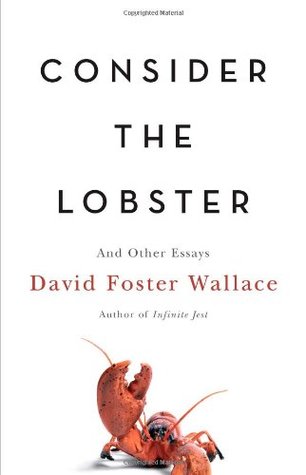
in Consider the lobster and other stories
New York: Little, Brown and Company
pp. 164-181
ASIN: B00FORA1TO (Kindle edition)

Scanned version available on-line at psu.edu

David Foster Wallace, Twenty-four word notes (Review)

David Foster Wallace got me in with the first few words of his essay “Twenty-four word notes”. They are:

Utilize A noxious puff word.

Oh yes! “Utilise” (as we down under spell it) is one of my pet peeves. Why use “utilise” when “use” is a perfectly good word? I regularly mutter.  Wallace is a little more direct:

Since it does nothing that good old use doesn’t do, its extra letters and syllables don’t make a writer seem smarter; rather, using utilize makes you seem either like a pompous twit or like someone so insecure that she’ll use pointlessly big words in an attempt to look sophisticated.

I wouldn’t quite have put it that way myself, but have quoted him so you can see the strength of Wallace’s feelings on the matter of words and usage. (By the way, did you notice the use of “she” here?)

Before I continue, though, I should say that I’m not sure that I’d call “Twenty-four word notes” an essay since it is exactly what it says it is, that is, it’s a set of musings and arguments about twenty-four rather ad hoc words. They do not seem to be presented in any particular order and there’s not really a coherent argument, but for those of us interested in language they are great fun to read … even if he touches the odd nerve or you don’t agree with his perspective. I was interested to discover in the Copyright Acknowledgements at the end of the book that this essay/article was originally published in the Oxford American Writer’s Thesaurus (in 2004, 2008 and 2012).

I enjoyed the piece for a number of reasons. Firstly, there are the pet peeves, of which “utilize” is just one. Another is “that”. There are two issues, as he says, with “that”. One is the “that” versus “which” issue, but I won’t go into that (ha) now. It’s the other “that” issue which (or, is it that!) intrigues me. You see, I had been given to understand by some Americans, that “that” can be used for people as in, say, “Wallace is the writer that wrote Infinite Jest“. Over here, down under, we learnt that “who” and “whom” are for people, and “that” and “which” are for things. Wallace agrees and in fact calls misuse of “that” for “who” or “whom” as a class marker! Hmm … that’s a bit strong … but, class marker or not, I know that I always cringe (internally anyhow) when I hear “that” used for people.

My other pet peeve that Wallace addresses is, hallelujah, “loan”. Wallace says, and I quote, because once again I’d only be muttering under my breath:

If you use loan as a verb in anything other than ultra-informal speech, you’re marking yourself as ignorant or careless.

But now here’s the thing. I have felt for a decade or more now that this loan-the-noun/lend-the-verb distinction is a losing battle. Language is, after all, a living thing. It changes. It has to, and, really, we want it to. This makes writing anything prescriptive like Wallace has done here a risky thing. Wallace doesn’t specifically address this issue of change but he does imply it. For example, immediately after the above statement about “loan”, he continues

As of 2004, the verb to lend never comes off as fussy or pretentious, merely as correct.

“As of 2004”. There’s his recognition, subtle though it is, that there are limits to prescription. I’m glad he makes that concession.

While there are other words about which he is similarly scathing regarding their misuse, not all words have been chosen for this reason. For example, there’s the word “pulchritude”* which he describes as an ugly word that is the complete opposite of its meaning. “Pulchritudinous” is even worse he says! I have to agree. He then goes on in this particular word note to list other words that are the opposite of what they denote, such as “big”, “diminutive” and “monosyllabic”. It is this sort of thing that makes language such fun, isn’t it?

Another word he discusses is one of my daughter’s favourites, “myriad”. I was anxious about reading this one for fear that he would be scathing about it too, but fortunately not. Rather he writes of the right and wrong ways to use it … and I’m pretty confident my word-loving, writing daughter gets it right.

Almost every word he discusses provided me with some entertainment or education – yes, I did learn “stuff” too – but I’m going to finish here on the last word he writes about. It’s “hairy” and his discussion of it is relevant to the book the article was written for – a thesaurus. This note – which in fact occupies some three pages – is about the huge number of descriptors for “various kinds of hair and hairiness” in the English language. I had heard of a few of them – such as “hirsute”, “glabrous” and “flocculent” – but others were a revelation. For example, the “cirrus” we use for clouds comes from the Latin for “curl” or “fringe” and gives rise to words like “cirrose”. And what about “hispidulous”? He describes this as a “puffed up form of hispid” and recommends avoiding it. I think I will. Then there’s “pilimiction”, which refers to an affliction we’d all like to avoid I reckon …

It is difficult to write on words and usage without being somewhat prescriptive, and Wallace isn’t afraid to be that. It is possible, I think, to write about words and usage without offending your readers, but this is not an example of that! Nonetheless, taken in the right spirit, it’s an interesting read and one which offers some good advice on writing. I enjoyed it.

David Foster Wallace
“Twenty-four word notes”
in Both flesh and not
Melbourne: Hamish Hamilton, 2009
ISBN: 9781926428185

*Wordpress’s spell-checker didn’t like this word either. Can you blame it?

David Foster Wallace, Federer as religious experience (Review)

David Foster Wallace‘s essay “Federer as religious experience” is several years old now. I did plan to read it a couple of years ago when I first came across it but, somehow, I didn’t. However, this week, Lisa at ANZLitLovers reviewed a David Foster Wallace essay collection which includes this essay*. She decided not to read it because tennis “is just running around on a court hitting a ball with a racquet”. I suggested in my comments that there’s some congruence, affinity perhaps, between sports and the arts in that sport is (can be) about drama, beauty and character. She dared me to review the essay on my blog, so here I am! Never let it be said I’m a wuss!

Roger Federer, Master Series Monte Carlo 2007

Roger Federer, Master Series Monte Carlo 2007 (Photo credit: Lijan Zhang, using CC-BY-SA 2.0, Wikipedia)

Unlike Lisa, I have read David Foster Wallace. Hmm, I’m cheating a little when I say this – something Roger Federer, the god of modern tennis, would be above I’m sure – because I’ve only read one short story, “All that”, which I reviewed two years ago. A couple of commenters on that post suggested that Wallace’s essays and magazine articles are a good place to start. I enjoy essays, so liked the sound of that.

Wallace does not specifically discuss the “drama” and “character” aspects of tennis, although drama is implied at times such as in his description of the 2006 Nadal-Federer Wimbledon final as a “revenge-narrative” and he does touch on some players’ personalities. However, I was thrilled to find the following discussion of “beauty” on page 2 of my printed out version:

Beauty is not the goal of competitive sports, but high-level sports are a prime venue for the expression of human beauty. The relation is roughly that of courage to war.

[ …]

Of course, in men’s sports no one ever talks about beauty or grace of the body. Men may profess their “love” of sports, but that love must always be cast and enacted in the symbology of war: elimination vs. advance, hierarchy of rank and standing, obsessive statistics, technical analysis, tribal and/or nationalist fervor, uniforms, mass noise, chest-thumping, face-painting, etc. For reasons that are not well understood, war’s codes are safer for most of us than love’s…

Beauty is not, really, the goal of literature either, but those of us who love reading love it best when the writing is “beautiful”. That beauty can take many forms, but we all know it when we see it – not, of course, that we all agree, but that’s partly the fun and challenge of it all. I’d say that Wallace’s writing in this essay is beautiful. It’s there in the way his language slides between the formal, the journalistic and the colloquial; in the way he slips in appropriate classical, literary and pop culture allusions expecting us to get them all even though he’s writing about something as pedestrian (!) as sport. It’s there in the touches of satire, the slices of tongue-in-cheek wit, and the sly digs at some of the hallowed aspects of the sport. (“Wimbledon is strange”, he writes. “Verily it is the game’s Mecca, the cathedral of tennis; but it would be easier to sustain the appropriate level of on-site veneration if the tournament weren’t so intent on reminding you over and over that it’s the cathedral of tennis”.) And it’s also there in the essay’s very structure and its shifts in tone. Despite all this beauty, though, I did get a little lost in the blow-by-blow description of an actual point played between Roger Federer and the hunky Rafael Nadal. Wallace is clearly a connoisseur of tennis.

Robert Atwan, the man behind Best American essays, defines the best essays:

To my mind, the best essays are deeply personal (that doesn’t necessarily mean autobiographical) and deeply engaged with issues and ideas. And the best essays show that the name of the genre is also a verb, so they demonstrate a mind in process–reflecting, trying-out, essaying.

Wallace’s essay embodies all of these. Wallace clearly loves the sport and knows his stuff. Not only can he identify all the tennis strokes, from cross-court backhands to forehands with topspins, but he knows the history of the game and has his own views on who was the progenitor of the power-baseline game. I particularly enjoyed his analysis of the game’s trajectory in the modern era and his assessment of Federer’s impact on it. There is also a sense, as Atwan likes, of his working out as he goes along what makes Federer Federer.

I would, though, add to Atwan’s definition, that the best essays have to be interesting (durr) and, I think, they need to surprise the reader with some new angles or fresh ways of seeing. Wallace does this too. He doesn’t knock Federer-worship – in fact he’s a worshipper himself – but he explores Federer from what he calls metaphysical and technical points of view. And he entertains us while doing so. That to me is a good essay.

David Foster Wallace
“Federer as religious experience”
Published in The New York Times’ Play Magazine, August 20, 2006
Available: Online nytimes.com

* The essay is apparently retitled “Federer Both Flesh and Not” in this collection.

David Foster Wallace, All that

I have not yet read anything by David Foster Wallace and so when I came across his short story*, “All that”, in The New Yorker, I jumped at the chance of an introduction.

It has a first person narrator, who is looking back on his childhood and recalling, in particular, his fascination with magic and religion. It is a clever – and rather sad – little piece about the mismatch between the rationality of parents and the incredulity of children, especially highly imaginative ones. The prime technique Wallace uses to explore this mismatch is that of an unreliable or, more specifically, naive narrator, so that we ache for the little boy while also recognising where the parents are coming from (even if we hope we would not be quite like them). As the narrator says:

That is why it is that adults and even parents can, unwittingly, be cruel: they cannot imagine doubt’s complete absence. They have forgotten.

And so they tease, and set children up, unaware of the impact of their behaviour.

The story’s tone is one of uncertainty and qualification. The narration is peppered with such expressions as “I’m ninety percent sure”, “as I remember”, “I’m positive it was”, “I believe”. And, on occasions, he uses ambiguous syntax and then has to clarify the meaning for us, as in “It was (‘it’ meaning the cement mixer) the same overlarge miniature …”. All this gives the reader the distinct sense of a disconnect between what the narrator is saying and what he is really feeling. For example, the parents lie to their son in the teasing but cruel way that adults do, by telling him that his cement mixer is magic, that it mixes cement while he pulls it along but that it stops the minute he turns around to look at it. He is mystified why his parents, knowing of this “magic”, hadn’t told him immediately but waited some weeks or months. He says of his parents:

They were a delightful but often impenetrable puzzle to me; I no more knew their minds and motives than a pencil knows what it is being used for.

Now that’s an interesting image to unpack, eh? The first time he mentions his parents, he calls them “my biological parents”, providing another clue to a disconnect.

Then there is the intriguing pacing. Most of the story is written at a normal pace with a mix of simple and complex sentences, but, every now and then, there is an excessively long sentence, as in:

Sometimes the experience of the voices was ecstatic, sometimes so much so that it was almost too intense for me – as when you first bite into an apple or a confection that tastes so delicious and causes such a flood of oral juices in your mouth that there is a moment of intense pain in your mouth and glands – particularly in the late afternoons of spring and summer, when the sunlight on sunny days achieved moments of immanence and became the color of beaten gold and was itself (the light, as if it were taste) so delicious that it was almost too much to stand, and I would lie on the pile of large pillows in our living room and roll back and forth in an agony of delight and tell my mother, who always read on the couch, that I felt so good and full and ecstatic that I could hardly bear it, and I remember her pursing her lips, trying not to laugh, and saying in the driest possible voice that she found it hard to feel too much sympathy or concern for this problem and was confident I could survive this level of ecstasy, and that I probably didn’t need to be rushed to the emergency room, and at such moments my love and affection for my mother’s dry humor and love became, stacked upon the original ecstasy, so intense that I almost had to stifle a scream of pleasure as I rolled ecstatically between the pillows and the books on the floor.

Phew! That is one mouthful and a half. It relates to his discussion of his childhood “voices” and his religious feelings (which were not shared by his rational parents), but the language used here and the sudden breathless pace speak to all sorts of undercurrents. The story ends with his recounting watching a movie with his father, in which his and his father’s memory of some critical points vary significantly.

The thing is, I don’t know much about Wallace’s writing and his specific concerns but I did find this a rather disturbing tale … partly because it is hard to decide just how unreliable the unreliable narrator is!

David Foster Wallace
“All that”
The New Yorker, 14 December 2009
Available: online

* I believe this is an excerpt from his posthumous “novel”, The pale king, which will be published this April.