Monday musings on Australian literature: Sisters in Crime

And now for something rather different here at Whispering Gums. Crime literature, as my regular readers know, is not my forte. In fact, I really only read crime if it comes my way for a specific reason – such as Peter Temple winning the Miles Franklin Award a few years ago. That doesn’t mean however that it’s not a relevant subject for Monday Musings. So today I bring you Sisters in Crime.

Sisters in Crime is an Australian organisation which aims “to celebrate women’s crime writing on the page and screen and bring a collective critical eye to the field.” Inspired by the American organisation of the same name, it was launched at the Feminist Book Festival in Melbourne in September 1991. It undertakes a range of activities supporting crime writing by women, including sponsoring two awards:

Because this is a reader’s blog rather than a writer’s one, I thought I’d focus on this awards aspect of their work – but for the record they offer a lot to writers, including workshops, networking opportunities, and promotion.

The Scarlett Stilettos

This year, 2013, was the twentieth anniversary of the Scarlett Stilettos, an award for short stories in the crime and mystery genre. The purpose of these awards is to “support and unearth new talent”. Over the years they have done just that with some of Australia’s top female crime writers having won the award, such as Cate Kennedy and Tara Moss. The Awards have an interesting “two-strikes-and-you’re-out” rule. That is, if you win twice you can’t enter again. I like this. It feels appropriately collaborative for an organisation that calls itself “Sisters”, and it shows they’re serious about the “unearth new talent” goal. Apparently, in its twenty years, four writers, including the inaugural winner, Cate Kennedy, have won twice.

Prizes are offered in multiple categories: First, Second and Third overall-prizes, Malice Domestic, Best Investigative, Cross Genre, The Body in the Library, Best New Talent, Great Film Idea, Funniest Crime, and a Youth Award.

In 2013 there were 175 entries, and an e-book of the 2013 winning stories, Scarlet Stiletto Short Stories: 2013 has been published. It’s available from Clan Destine Press (here), Amazon, Kobo and iTunes. At $4 it is surely a great deal if you love crime and mystery.

The Davitt Awards

These awards are a little younger, with this year being the 13th time they’ve been awarded. They are named for Ellen Davitt (1812-1879) who apparently wrote Australia’s first mystery novel, Force and fraud, in 1865. She was born in England, and married her husband, Arthur Davitt, there. According to the Australian Dictionary of Biography, they emigrated to Australia in 1854 “to take up a joint appointment with the National Board of Education, Davitt as principal of the Model and Normal Schools and his wife as superintendent of the female pupils and trainees”.

As with the Stilettos, several prizes are awarded: Best Novel (Adult), Best Novel (Children and Young Adult), Best True Crime Book, Best Debut Book, and Reader’s Choice (voted by members). In 2013 a new award was added, the Lifetime Achievement Award. Australian crime readers would not be surprised to learn that the inaugural winner of this award was Kerry Greenwood, author of the Phryne Fisher detective novels which have been recently adapted to a popular television series. I haven’t read the novels, but I love the 1920s inspired covers (of the current editions, anyhow) and have enjoyed the television series which beautifully reproduces the era in Melbourne.

Sixty-one books were entered for this year’s awards, which is apparently a record number. The winners are listed on the Sisters in Crime website so I won’t report on them all here. I was interested though to see that a Canberran whom I haven’t heard of, Pamela Burton, won the award for Best True Crime for her book The Waterlow killings: A portrait of a family tragedy. It’s about the murder of art curator Nick Waterlow and his daughter Chloe by their son and brother Anthony, a schizophrenia sufferer, and apparently explores the limits and failures of the mental health system. It’s the sort of crime book I could imagine reading!

There are other Australian awards for crime fiction – notably the Ned Kelly Awards. In fact, Kerry Greenwood won their Lifetime Achievement Award in 2003. I’m thinking I might do a bit of an occasional series on Australia’s literary awards for genre writing, if only to inform myself better on our literary landscape.
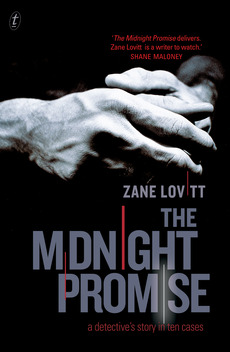
Zane Lovitt, The midnight promise (Review)

Zane Lovitt, Midnight Promise

Book cover (Courtesy: Text Publishing)

Zane Lovitt’s debut book, The midnight promise, is one of those books for which I can’t decide how to start my review. I could go with the point, previously made in this blog, that I’m not a reader of crime and so cannot speak with authority on the subject. Or, I could write about the fact that one of the chapters in the book, “Leaving Fountainhead”, won the SD Harvey Short Story Award in Australia’s top crime awards, the Ned Kelly awards*. I could start with how Melbourne-based Lovitt joins the growing number of lawyers who write fiction. Or, I could start with the topic that interests me most, its form.

Because, if you haven’t noticed, I didn’t use the word “novel” once in my opening paragraph. There’s a good reason for this: The midnight promise is, if I can draw from the main media through which I consume crime, more like a detective series than a movie. I could have described it as a book of short stories, but that would be misleading. The ten chapters or stories all feature the one detective or “Private Inquiry Agent”, John Dorn, and they are told chronologically. Moreover, even though the book comprises ten separate cases, rather than one main case as would be expected in a novel, there is an overarching, albeit not immediately obvious, plot, defined by “the midnight promise”.

This form may, in fact, be one of the reasons I liked it. Each story is complete in itself while also forming part of a greater whole if you keep reading. The form is also, however, responsible for my only real criticism, which is that, almost without exception, the stories are structurally the same. They follow a present-flashback-present-flashback (and so on) structure. In a “true” book of short stories, I like things to be mixed up a bit; I like to see variety in style, in voice, structure, tone, language. That’s not the case here – but neither, I suppose, would it be the case in a television detective series, so perhaps my criticism isn’t valid. Still, a couple of times, I felt myself saying “here we go again …”.

John Dorn is not, I think, a particularly original character, for the genre. Like many crime protagonists, he’s somewhat of an outsider, a loner with a broken engagement behind him. He’s also a man of some principle which is why his is pretty much a hand-to-mouth existence. In the early stories his fee ranges from $400 a day to $250 a day to nothing depending on whether he wants (or believes in) the job or not. The higher the charge the less he wants it! For this reason we like Dorn, and want things to work out for him, but somehow, more often than not, he manages to shoot himself in the foot.

Being a private eye, his cases are varied, from marital spying to finding missing people to protection (of the innocent or the guilty). But the theme is consistent. It’s “the shitty things people do to each other” or, as he puts it more colourfully when describing roadkill in the final story:

We drive over two foxes, parallel, like one of them couldn’t bear to live without the other. Though what’s more likely is one fox was eating a dead fox and got hit by a car because he didn’t see it coming because he was distracted because the other fox was so delicious.

Not a grammatically beautiful sentence but appropriate and effective in the context. In fact, I liked Lovitt’s writing. The voice is first person, and the writing is generally direct and spare with the occasional well-placed image which works partly due to its rarity. Like this, for example:

I’ve heard rumours about his shady GST schemes, but everything I know about tax offences wouldn’t rouse a chihuahua from its beauty sleep.

The dialogue is realistic. There is humour – mostly in Dorn’s sardonic view of the world – which varies the tone. There is irony, as in the name of the character, Comedy, who is anything but funny, and in the story “Grandma’s House” whose title belies the horrors within.

And this brings me back to the form, to the fact that while each story is complete there is a trajectory in the book, heralded by the occasional bit of foreshadowing. We know something is going to happen that will change Dorn’s life, and probably for the worse. The crisis occurs in the seventh story, “The Crybaby Technique” – and it’s ironic because he was, in this particular case, only a bit player. Things change gear from here, leading to the final crisis in the tenth story which is significantly titled “Troy”. It’s a gripping read with a beautifully controlled out-of-control last page. You’ll have to read it to see what I mean.

So, would I recommend this book? Yes, to non-crime readers, like me, who look for character and good writing, and to crime readers who, I’m presuming, like intriguing cases with a detective who keeps you guessing. If I were a crime reader, I’d be saying I hope this isn’t the last we see of John Dorn, or of Zane Lovitt. In fact, I’ll say it anyhow …

Zane Lovitt
The midnight promise
Melbourne: Text Publishing, 2012
283pp.
ISBN: 978192192230

(Review copy supplied by Text Publishing)

*In 2010. It also appeared in Scribe’s New Australian Stories 2, that same year.

Alexander McCall Smith, The Saturday big tent wedding party (Review)

I have a number of tenets – if that’s not too grand a word for it – according to which I read. These include that I don’t read series books and I don’t read crime. However, the best rules are made to be broken, aren’t they? And so, I break mine for our family holiday tradition which is to read the latest book in The No. 1 Ladies’ Detective Agency series. We are now behind though. We should have read The Saturday big tent wedding party (the 12th of now 13 books in the series) last September. But that annual family holiday as well as our February holiday this year were cancelled due to health reasons. We finally got away in August … I have now read the book and am about to pass it on to the next eager reader.

So, what to say? If you know the series you’ll know what it is about and may have read this one already. If you don’t know the series, then I’d say if you are looking for something warm and charming, with a touch of humour, to fill in a quiet time you could do worse than spend a few hours with Precious Ramotswe and her family and friends. Or, if you prefer to spend your reading time on different fare, watching the miniseries on DVD could be just the thing. It was an enjoyable adaptation.

I said that I don’t read crime. However, these are probably not books leapt on by aficionados of that genre. There is always a crime to investigate of course … but while the crimes in these books have, on occasion, involved violence or real danger for the victims, their resolution never depends on violence, guns, car chases and the like. Rather, Precious (and her assistant, Mma Makutsi) use common-sense, psychology, simple observation and forthrightness to determine the perpetrator. Police, courts and jails are rarely if ever invoked.  The denouement, instead, usually entails natural justice and/or negotiated restitution. If only life could be managed this way …

Which brings me to McCall Smith and his philosophy. These books espouse a life based on moral and ethical behaviour, on forgiveness and humility, and on understanding where the other is coming from. It might seem (and is) a little cutesy at times, but the heart is real and the lessons seriously intended. In resolving the crime in this 12th book, Precious Ramotswe thinks:

There would be no further attacks – that was clear, and the damage had been set right by the one not responsible for it. All that was lacking was the punishment of the one responsible. But punishment often did not do what we wanted it to do …

And the one responsible … well, that would be giving it away. Suffice it to say that it’s not as simple as it might have looked at the beginning.

The rest of the book – like its predecessors – continues the story of Precious and her family. The apprentices are growing up (at last), a wedding finally occurs, the tiny white van is not totally lost – and Mrs Potokwani continues in her well-meaning but organising way.

And now onto the next holiday read …

Alexander McCall Smith
The Saturday big tent wedding party
London: Little, Brown, 2011
248pp.
ISBN:  9781408702598

PD James, Death comes to Pemberley (Review, sorta)

How do you review or evaluate a Jane Austen “sequel”*? Do we expect, want even, the author to channel Austen? I suspect the answer is as varied as are the readers of sequels, and it probably depends on why we read Austen. Those who are mostly interested in the stories and what happens to the characters are likely to have a completely different perspective from those who love Austen’s language and her very particular wry, sly eye on humanity. I fall into the latter group and this is why I am not drawn to sequels. I want to read Austen for Austen, and other writers for their style and worldview.

I have just read PD JamesDeath comes to Pemberley. I’d describe it as a traditional sequel, with a difference. That is, it picks up the story of Elizabeth and Darcy some six years after their wedding, but it is a crime novel, which adds an extra complication for the reviewer, because not only is there the issue of Jane Austen’s story and characters to consider, but there’s a shift in genre. This, I’ll admit right now, puts me at a double disadvantage: I don’t read Jane Austen sequels and I don’t read crime novels. So why did I read this book? Two reasons really. It was given to me by a friend and my local Jane Austen group decided to discuss it as part of this year’s focus on Pride and prejudice.

I’m glad I read it, mainly because I’ve been wanting to try a “sequel” for some time to understand what they are all about – and a sequel by a writer of PD James’ reputation seemed like a good one to try. However, I can’t say I really enjoyed it. It was, however a quick read – and I did find it intriguing to ponder what sequel readers look for.

Before I discuss that, I’d better say something about the plot, though that’s hard without giving too much away. The story proper starts on the night before a big annual ball. Elizabeth, Darcy, Colonel Fitzwilliam (now Viscount Hartlep), Georgiana and the Bingleys are all at Pemberley getting ready, when a carriage careens into view carrying, we soon discover, an hysterical Lydia claiming that her husband, Wickham, has been shot. Darcy, Colonel Fitzwilliam and a new character and suitor to Georgiana, Alveston, set off into the woods to find out if indeed this has been the case. The novel then, as crime novels tend to do, follows the story of a murder through inquest, trial and resolution. It’s an interesting enough plot, and one whose resolution I didn’t guess. But then, as I’ve already said, I’m not a crime reader.

But now, rather than review the book in my usual way, I’m going to talk about it specifically in terms of its “sequelness”. (Is that an ok neologism?). So here goes…

Characterisation

If there’s one thing a sequel should do, I think, it’s to be true to the characters. No matter what new situation they are placed in, they need to still be them. Unfortunately, in this novel, Elizabeth and Darcy do not come across as Jane Austen’s creations. Darcy spends most of the novel – which, remember, occurs six years after the wedding – bothering about his decision to marry Elizabeth and how it returned Wickham to his world. He’s not sorry about marrying Elizabeth but he mulls and mulls and mulls yet again about the implications feeling, for example, “that he had lost some respect in his cousin’s [Col Fitzwilliam] eyes because he had placed his desire for a woman above the responsibilities of family and class”. That’s not our Darcy!

Similarly, it’s a rather subdued Elizabeth we see. Sure, she’s older but she is still in her 20s. And sure, she’s now the mistress of Pemberley, but that doesn’t mean the young woman who stood up to Lady Catherine, unlike “sensible” girls who recognise their need of a husband, now has to be quiet and, yes, dull. Why doesn’t she tell Darcy of some clues and suspicions that may be relevant to the murder?

Would Charlotte Lucas really harbour resentment towards Elizabeth? James suggests she does:

… but it was unlikely that Charlotte had either forgotten or forgiven her friend’s first response to the news [that she’d accepted Mr Collins].

Style

I’m not sure that a sequel must ape Austen’s style … which is just as well because James doesn’t really. The problem is that I think she tried. She’s clearly a good writer, but it probably would have been better for her to stick to what she does best. There were moments of wit and humour, but much was ponderous. Here is Georgiana’s suitor speaking to Darcy:

Forgive me, sir, but I feel I must speak. You discuss what Miss Darcy should do as if she were a child. We have entered the nineteenth century; we do not need to be a disciple of Mrs Wollstonecraft to feel that women should not be denied a voice in matters that concern them. It is some centuries since we accepted that a woman has a soul. Is it not time that we accepted that she also has a mind?

This is way too didactic and preachy for Austen, particularly for a non-Mr-Collins-like character. The dialogue, overall, lacks Austen’s light touch – and is often stilted without capturing the formality of the period.

There were times too when I felt she was more Dickens than Austen. Some of her characters’ names are pure Dickens, such as Hardcastle, Pegworthy and Belcher.

However, I understand that James is known for her settings – something that Austen did not focus much on – and her descriptions of place are generally evocative and effective.

Observations

Along with her style, it’s the way Austen hones in on human behaviour and describes it with brevity and wit  that keeps me coming back to her. James was clearly keen to match Austen in this area and occasionally made me smile, as with this description:

… had exacerbated a disagreement common in marriages wherein an older husband believes that money should be used to make more of it, and a young and pretty wife is firmly of the view that it exists to be spent; how otherwise, as she frequently pointed out, would anyone know that you had it?

And this comment by the imperious Lady Catherine:

I have never approved of protracted dying. It is an affectation in the aristocracy; in the lower classes it is merely an excuse for avoiding work.

These little commentaries were like beacons in the forest … and showed me that, despite the misses in the novel, James does “get” Austen.

Genre

Then there’s the genre shifting. This is both a crime novel and historical fiction. I can’t speak much for the crime aspect except to say I thought it was well plotted and kept me guessing. I didn’t work out whodunnit, but when it came, the clues generally made sense. James also incorporated some Gothic elements – nature awry, dark woods and possible ghosts – something that Austen didn’t write, though she did spoof readers of Gothic fiction in her Northanger Abbey.

The historical fiction aspect was mixed for me. James had clearly researched the period thoroughly and I enjoyed learning about the practice of law, in particular. However, there were times when it felt that she just had to impart some information, whether or not it was essential to the story. Interesting enough, but it got in the way of her story.

Unlike Austen, who is often criticised for not writing about current events, James makes regular references to the Napoleonic war – and to English nationalism. This is fine. I don’t think a sequel has to limit itself to Austen’s subject matter.

I’d love to write more, but have already taken up way too much of your precious reading time. I’ve probably panned the novel more than I originally intended to. This is because it’s not the book for me – but it’s by no means a “bad” book. If you like Austen sequels, you’ll probably like it. If you like crime novels or are a fan of PD James, you could very well like it. But if you like Austen for her Austen-ness, then, like me, you’d probably rather read Pride and prejudice  – again. Horses for courses, as they say.

Death comes to Pemberley
London: Faber and Faber, 2011
310pp
ISBN: 9780571283583

*  Sequel in this Jane Austen context are books written by other writers based in some way on Austen’s novels. They can be “real” sequels (or prequels) in that they take an existing novel and tell us what happened next (or before); they can be retellings of a particular novel; or they can take another approach, such as tell the story of, or from the point of view of, another character.

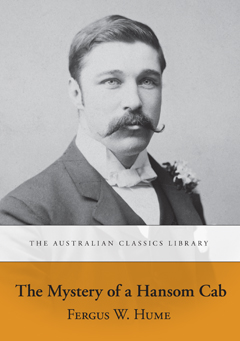
Fergus W. Hume, The mystery of a hansom cab (Review)

Hume Mystery of a Hansom Cab

The mystery of a hansom cab (Courtesy: Sydney University Press)

Sometimes you just have to break your reading “rules” don’t you? Two of mine are that I’m not much into detective fiction (despite having reviewed Peter Temple’s Truth here) and I don’t read self-published books – but then along came Fergus Hume‘s The mystery of a hansom cab. It’s a classic Australian crime novel – and it was “originally” self-published (says she cheekily)!

I’m not, you now know, an aficionado of crime fiction, so my assessment of this book may be the skewed one of a newbie not versed in the intricacies of crime writing. However, I must say that I found this a thoroughly enjoyable and engaging book, and would recommend it to crime and non-crime readers alike, for reasons that will soon become obvious. But first, the plot.

The story commences with a newspaper report of a murder that takes place in a hansom cab, and over the next few chapters we learn the name of the victim (a young man, Oliver Whyte, who was drunk at the time of his death) and that he was killed by a passenger who got into the cab, ostensibly to see him safely home. The detective on the case fairly quickly deduces that the murderer is a rival for the affections of a young society woman … and from here, as it always does, the plot thickens. The accused murderer declares his innocence, that he indeed has an alibi, but he will not divulge the information it would “curse” the life of his fiancée. The trial occurs and is resolved halfway through the novel. The rest explores … but wait, if I tell you this, I’ll give too much away, so I’ll stop here. The resolution, when it comes, is not a complete surprise but neither is it completely predictable. At least, not to non-aficionado me.

Australian Literature Month Platypus logo

Read for Reading Matters' Australian Literature Month

Now, why do I like it? To start with, it’s a well-told story, with nicely delineated characters. Then there’s the setting: it is primarily set in Melbourne, with a little excursion into the country, in the 1880s. This was a boom-time for what was known then as “Marvellous Melbourne” and Hume describes life in this well-to-do post-Gold Rush city with gorgeous clarity. Most of it concerns the middle classes – the professionals and self-made men – but we are also taken into the slums where prostitutes struggle to survive. Hume does not have the social justice goals of, say, William Lane (in The workingman’s paradise) but he doesn’t shy from describing some of the seamier aspects of the city:

Kilsip and the barrister kept for safety in the middle of the alley, so that no one could spring upon them unaware, and they could see sometimes on the one side, a man cowering back into the black shadows, or on the other, a woman with disordered hair and bare bosom, leaning out of a window trying to get a breath of fresh air … Kilsip, turning to the left, led the barrister down another and still narrower lane, the darkness and gloom of which made the lawyer shudder, as he wondered how human beings could live in such murky places.

Hume then describes the woman they had gone to meet, Mother Guttersnipe (how Dickensian is that?):

… a repulsive-looking old crone; and in truth, her ugliness was, in its very grotesqueness well worthy the pencil of a Doré.

This brings me to another aspect I enjoyed. It is chockablock with allusions to Shakespeare and the classics, and references to what the writer of the introduction describes as the “middle-brow, middle-class, international entertainment culture of North America and Europe”, such as the artist Doré, the composer Offenbach, and the writers Poe, Dickens and De Quincy. There’s also a cheeky reference to novelist Mrs Braddon – “Murdered in a cab … a romance in real life, which beats Mrs Braddon hollow” – containing a clue that readers of the time might have picked up.

There’s the 19th century style – third person omniscient, descriptive chapter titles, a touch (but not too much) of melodrama, light satire and humour, the use of little homilies (often to introduce chapters), and a (very) neatly tied up conclusion. This is not ponderous, heavy-handed 19th century writing, but good well-paced story-telling supported by lovely description and observations. Most of the light relief comes through minor characters, like the landlady Mrs Sampson and the young-man-about-town Felix Rolleston. Here is Mrs Sampson:

She was a small, dried-up little woman, with a wrinkled yellow-ish face. She seemed parched up and brittle. Whenever she moved she crackled, and one went in constant dread of seeing a wizen-looking limb break off short like the branch of some dead tree. When she spoke it was in a voice hard and shrill, not unlike the chirp of a cricket.

She is, for all this, a warm-hearted woman, but whenever she appears so do such words as “crackle’, “rustle”, and “chirp”. Beautifully vivid, but nicely controlled.

It is of course also 19th century in its worldview … and so has a patriarchal flavour. Our “plucky” heroine, Madge, buys “a dozen or more articles she did not want” writes the author. And in the resolution the men decide what they will and will not share with the women involved – “it would be useless to reveal” the truth to one female character as “such a relevation could bring her no pecuniary benefit”, and to another because “such a relation could do no good, and would only create a scandal”. The infantilisation of women, eh?

Fate also makes its appearance in the novel, from early on when the accused murderer’s life “hangs on a mere chance” to late in the novel when the author makes his position clear. He writes that men:

… created a new deity called Fate, and laid any misfortune which happened to them to her charge. Her worship is still very popular, especially among lazy and unlucky people, who never bestir themselves … After all, the true religion of fate has been preached by George Eliot when she says that our lives are the outcome of our actions. Set up any idol you please upon which to lay the blame of unhappy lives and baffled ambitions, but the true cause is to found in men themselves.

I’ve said it before, and I’m sure I’ll be saying it again: I could write on and on about this book. It has so much to explore and it would be fun to do so, but at this point I’ll simply recommend it to you and hope that you’ll find time to discover and enjoy it too. It was, in its time, a best-seller …

Fergus W. Hume
The mystery of a hansom cab
(The Australian Classics Library)
Sydney: Sydney University Press, 2010
(Orig. pub. 1886)
293pp.
ISBN: 9781920899561

(Review copy supplied by Sydney University Press)

Garry Disher, Wyatt (Guest post)

Some time ago I found in my mailbox a bundle of books from my lovely contacts at Text Publishing. Unfortunately, there were more books in the bundle than I could read at the time, and a couple were in genres I don’t generally read (though that’s not to say I wouldn’t read them if I had the time). So, like Lisa at ANZLitLovers and as I did for my last LibraryThing Early Reviewers copy of That Paris Year, I decided to use the Guest Post idea. For the LibraryThing guest post, the reviewer was my daughter, Hannah of Wayfaring Chocolate. This time, it’s my son, Evan. The book is Garry Disher‘s latest crime novel Wyatt, which won the 2010 Ned Kelly Award for Best Crime Fiction.

Evan read the novel while he was with us for Christmas. He has since returned to Melbourne (his home and the setting of the novel) and, while busy preparing for his flight to the USA tomorrow, made the time to please his mum by writing his review. I must say, it looks like the sort of crime novel I could enjoy. Thanks Evan …

Evan’s review of Wyatt, by Garry Disher

Gary Disher, Wyatt

Wyatt (Courtesy: Text Publishing)

Less a cops and robbers story than a robbers and robbers story, Wyatt is a new crime novel from the Australian author, Garry Disher. We are introduced to the protagonist and title character, Wyatt, as he is attempting to rob an extortionist. As one would expect in a good crime novel, it doesn’t go according to plan. Disher’s prose is terse and to the point, much like Wyatt himself, and the narrative races along, following a jewel heist and its aftermath. Set in Melbourne, which suddenly becomes dirtier and more sinister under Disher’s pen, Wyatt features many of the trappings of classic noir-ish, hard-boiled novels. This world is populated by seductive femme fatales, tough, if old-fashioned, men, and it will get the better of you if you don’t have your guard up. Wyatt is an aging, professional criminal, who is treated with reverence as a master within his field. He is cold, intelligent and calculating, yet sympathetic.

Surrounded by a host of characters, all dangerous in their own ways, Wyatt is pitted, almost indirectly over the course of the novel, against a French criminal much like him, and much his equal. However, to discuss more of the plot would be to spoil most of the fun. The pace rarely slows down, and the writing is taut and spare. The characters are archetypes, almost larger than life, but not overwritten. Disher has an invigorating, simple style. The violence, when it erupts, is abrupt and surprising and, without a hint of an overdrawn epilogue, the ending simply ends.  Wyatt is apparently the seventh book in a series featuring the title character. Despite having never read any of the others, and having a perhaps irrational bias against series in general, I am now eager to check out the others.

Garry Disher
Wyatt
Melbourne: Text Publishing, 2010
274pp.
ISBN:  9781921656811

(Review copy courtesy Text Publishing)

Peter Temple, Truth

I think that every novelist has a single ideal reader (Stephen King, On writing)

Peter Temple, Truth

Truth bookcover (Courtesy: Text Publishing)

As I was reading Peter Temple‘s Truth I wondered whether I was Temple’s “ideal reader”. Somehow I think not. I am not a crime novel reader, but I did read and greatly like Temple’s previous book, The broken shore, so why did I feel less enthusiastic about Truth?

Part of the reason might be expectations. This novel won the Miles Franklin award this year. I don’t, theoretically, have a problem with a so-called genre novel winning literary awards but I did expect that if such a book won it would be out of the ordinary, and by that I mean that it would break the mould of its genre in some way. Well, I don’t think Truth does that. Of course, the Miles Franklin doesn’t explicitly say the work has to be innovative; it just says the work must be “of the highest literary merit” and present “Australian life in any of its phases”.

Another reason, related to the above, is that I found it to be a little too stereotypical. While I don’t read crime fiction as a matter of course, I do watch a lot of crime television, particularly those based on the writings of Ian Rankin, Val McDermid, and the like. I didn’t find Temple’s detective here, Steve Villani (who at one point talks of “the full stupidity of his life”), particularly different from many of the other contemporary angst-ridden middle-aged detectives I’ve seen. I didn’t find the plot, which deals with corruption (in the police force, politics and business) to be particularly different either.

So, did I like anything about it? Well, yes. But not for what Val McDermid would expect. She has said that:

As literary fiction became more hermetic, more concerned with literary theory and less concerned with narrative, crime writers assumed the mantle of turning the spotlight on the world we live in and doing it in a form where narrative was still of paramount importance.

Oh dear. I have to say this narrative bored and, at times, confused me. I was not interested in the plot – in remembering who all the characters were and guessing whether this one or that one might have “done it”. I just didn’t care. But, I was interested in Villani and his relationships with people – his father and brothers, his family, his old (now deceased) boss Singo, and his colleagues, particularly the indigenous policeman, Dove, who appeared in The broken shore. It was all a bit typical really – the workaholic cop with the troubled background and failing marriage – but Temple did manage to engage me in this character. He did this largely by telling the story through Villani’s eyes – through a third person limited point of view (or “first person in the third person” as he told Ramona Koval on the Bookshow). We are right there with Villani through one pretty hellish week in his life: horrific murders, bushfire threatening his father’s property, and a runaway daughter, alongside the odd bit of pressure to drop one of the cases because it was “just” a prostitute who’s not worth rocking the boat over.

Peter Temple is well-known for his writing. Ramona Koval describes this book as having “beautifully written ugly scenes”. I suppose they are. There is a lot of staccato dialogue, though Temple does little to explain the language used by the cops. If you don’t know the lingo, you are expected to pick it up as you go. (American readers, however, will apparently get a glossary!). There are a few motifs which run through the book. Smells are important – they convey the corruption and the social disintegration in the city and they play a practical role in solving a crime; and trees are also significant, conveying Villani’s connection with nature and his father, with, that is, something far more healthy than his homicide-driven life:

Below them a forest, wide and deep and dark, big trees more than thirty years old. Planted by hand, every last one, thousands of trees – alpine ash, mountain swamp gum, red stringybark, peppermints, mountain gum, spotted gum, snow gum, southern mahogany, sugar gum, silvertop ash. And the oaks, about four thousand, grown from acorns collected in two autumns from  every russet Avenue of Honour Bob Villani [father] drove down, from every botanical garden he passed.

Lists like this are a feature of the writing and they are effective in building up pictures in the fast moving, rather clipped world of this novel. Rhythm is in fact a significant aspect of the style. As you would expect, the story is mostly grim, but there is the odd bit of humour. I did love this one:

“Say police as caringly as possible. Like a blessing.”
“Jeez, that’s a big ask.”

The title seems to come from a horse which is mentioned only once in the novel:

…the first horse Bob raced, the best horse he ever had had, the lovely little grey horse called Truth who won at her second start, won three from twelve, always game, never gave up. She sickened and died in hours, buckled and lay, her sweet eyes forgave them their stupid inability to save her.

There’s a message in there somewhere – mostly ironic. I kinda like that.

So, my overall reaction? I don’t usually read reviews before I post, but I do when I’m preparing for my bookgroup. One of the reviews I read was Edmund Gordon’s in The Guardian. I like his conclusion that it’s an accomplished book but doesn’t escape the bounds of its genre. I was, I realise, hoping it would – and that means I’m not Peter Temple’s “ideal reader”. You, however, may be.

Peter Temple
Truth
Melbourne: Text Publishing, 2009
387pp.
ISBN: 9781921520716

Alexander McCall Smith, Tea time for the traditionally built

Alexander McCall Smith said at the literary event I attended recently that if he achieves nothing else in his life he is glad he introduced the concept “traditionally built” because it has brought such comfort to many women (particularly, he says with a twinkle in his eye, in America!).

Tea time for the traditionally built is the tenth book in the No. 1 Ladies Detective Agency series – which is not a bad achievement for an idea that started out as a short story! The eleventh in the series, The Double Comfort Safari Club, is now out (in Australia at least) and McCall Smith has no plans yet to finish the series. When you’re on a good thing …

I am not, as I said in my recent post on McCall Smith, normally a reader of series, but I have made an exception for this series and forgive it the things that would normally make me steer clear of books like this, such as simple language and repetition of theme, because, well, because it is gentle and generous. Generosity is, in fact, an important quality for McCall Smith. At the talk I attended he said that he rarely based his characters on real people because that would be “an abuse of authorial role”! Tell Truman Capote that! When he does draw on real people, he said, it is to paint that person in a positive light. One such example is Mma Potokwani, matron of the Orphanage that features in the Detective Agency series, who is clearly a woman he admires.

Anyhow, onto Tea time. It’s a gentle read – with the plot this time focusing on a football team that is suddenly losing every game after having been consistently successful. The owner, Mr Molofololo (great name eh?), suspects a traitor in the ranks and Mma Ramotswe is, of course, called on to investigate. Suffice it to say that she does and the outcome isn’t quite what Mr M suspected.

I’ll say just one more thing about these books and that is that McCall Smith does create “rounded” characters…even the admirable ones have their flaws and this, I think, gives his books a little depth that can engage, even though the language and style do not offer the challenge than I prefer in my reading. Reading one a year is a nice thing to do – and keeps me in touch with a writer who knows the world has problems but who likes to think that people can be good, and that there is hope yet!

Alexander McCall Smith
Tea time for the traditionally built
London: Abacus, 2009
266pp
ISBN: 9780349119977