
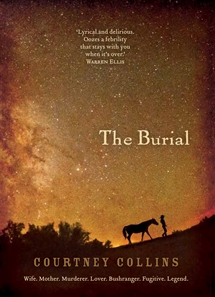
Book cover (Courtesy: Allen & Unwin)
I became aware of Courtney Collins’ The burial when it was longlisted for the Stella Prize. It has since been shortlisted for the Stella, shortlisted for the new writing award in the NSW Premier’s Literary Awards, and longlisted for the Dobbie Literary Award for new writing. It had previously been shortlisted for the 2009 Australian/Vogel Award for Unpublished Manuscripts. This is one impressive debut. While I’m attracted to several of the books longlisted for the Stella, I particularly wanted to read this one because of its subject matter; it is inspired by the life of Jessie Hickman, an Australian woman bushranger. I hadn’t heard of her before and thought this would be an interesting introduction. I wasn’t wrong. The burial is no ordinary historical fiction.
The bulk of the novel takes place in 1921 when 27-year-old Jessie, having had a gutful of her abusive, horse rustling husband Fitz, takes off, having first … well, let’s just say, done to him what she’d been wanting to do for a long time. In other words, she’s on the run. Now Jessie is no saint. She’s already been in prison for rustling, but she didn’t deserve the treatment she got at the hands of Fitz. The novel chronicles Jessie’s escape, and the story of the two men looking for her, Jack Brown, her lover and co-horse rustler for Fitz, and Sergeant Barlow, who has a story of his own. Escape is, we discover, Jessie’s speciality. It’s not for nothing that the book starts with a story of Houdini, or that Jessie’s horse is named for him.
As I read, I was reminded of two American writers – Toni Morrison and her powerful, gut-wrenching novel Beloved, and Cormac McCarthy and his western novels – for pretty obvious reasons. The burial is narrated by Jessie’s prematurely born daughter whom she kills and buries at the start of the novel, reminiscent of Sethe’s daughter Beloved, despite their different behaviours. And the elemental, evocative language along with the themes – human against human, human against nature, in a forbidding and lawless environment – immediately bring Cormac McCarthy to mind.
What is particularly impressive about this debut is Collins’ handling of the narrative voice and structure. The baby’s voice is generous and wise, not maudlin or pathetic. She cares about this mother of hers, and is a bit like a guardian spirit, albeit one without any power. Somehow, despite what Jessie did to her, she humanises Jessie and encourages us to feel sympathy rather than horror. Collins is light-handed in her use of this trope. As the novel progresses, it feels like a third person story, which it is, really, because it is not about the narrator but is her story of her mother. Every now and then, though, we are reminded of our narrator when she says “my mother”. As for the structure, the narrative alternates, loosely rather than rigorously, between Jessie’s story and that of Brown and Barlow. It’s basically chronological but there are flashbacks to fill us in on Jessie’s origins as we follow her escape.
Back now to the story. Early in the novel, Jessie is released from jail to be an apprentice horse-breaker and domestic help to Fitz, and pretty soon we are told all we need to know:
Her hope was that her employer was a good man. But he was not.
I love the way Collins’ language flows – from lyrical description to the plain and straight.
Fortunately, Jessie, while fearful of this man who beats her, is also spunky and “found freedom in the ways she defied him”. There is a bit of the picaresque in the novel, as we follow Jessie’s escape and the various people she meets, but it has none of the lightness of that form. A better description is probably gothic. It’s a tough world Jessie finds herself in – one that is particularly cruel to women and children. She spends time, for example, with an old couple. The woman wants her because “All of these years in this miserable place I have prayed for the company of someone other than you and here she is. I am taking her”. The man’s response? “She’s of no value”!
The brightest spot in the novel occurs when Jessie meets a gang of young rustlers led by the 16-year-old Joe in a spirit of mutual support and cooperation. She joins them and helps them in a well-planned heist in which they manage to steal 100 cattle, sell them at saleyards and return to the hills before the owner notices the loss. It is remote country, after all. However, the theft is discovered and a bounty is put on Jessie’s head – for the cattle they believe she’s stolen and for the rumoured murder of Fitz. And so the final hunt begins involving a bunch of men who are after the bounty, and Brown and Barlow who hope to get to her first.
For a while the gang stays hidden but, eventually, some of the hunters get close:
That’s the sound of desperate men, said Joe. I know this type of man, said Bill. He has no god. And he is all the more dangerous to us because, worse than that, he has no law in him or myth to live by.
Jessie, at her insistence, heads off alone, setting up the climax which is not totally unpredictable – after all, one can’t stay on the run forever – but which contains its surprises.
This is a novel about a hard world in which
A man can rape or kill and expect no consequence except his own consequence. You mean conscience? Consequence is what I said and what I mean to say!
But it is also about love and forgiveness, magic and myth, resilience and resourcefulness … I’ll not forget it quickly.
Courtney Collins
The burial
Sydney: Allen & Unwin, 2012
ISBN: 9781743311875 (Kindle ed.)
Read for Australian Women Writers’ Challenge and Reading Matters’ Australian Literature Month.
 Whispering Gums