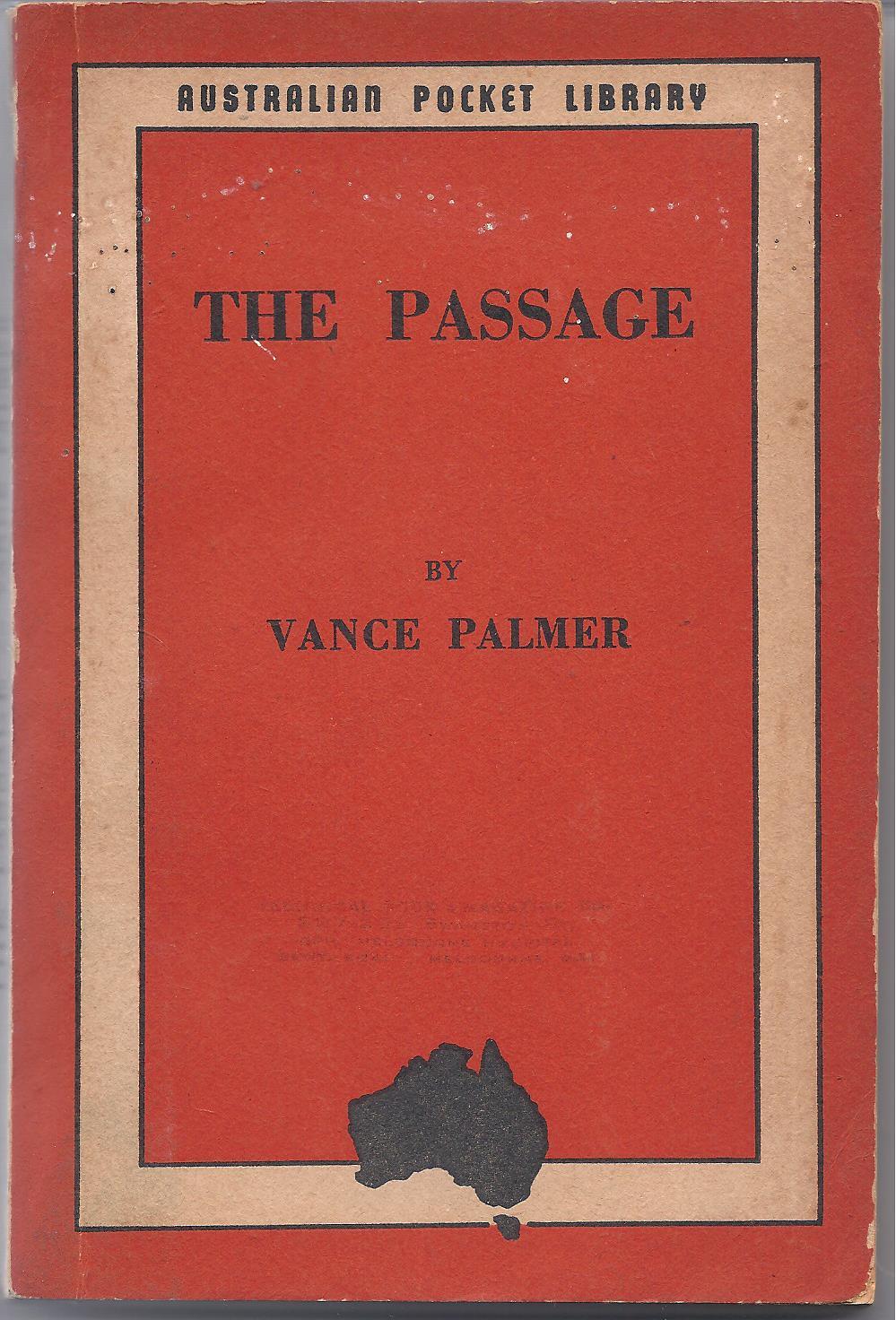
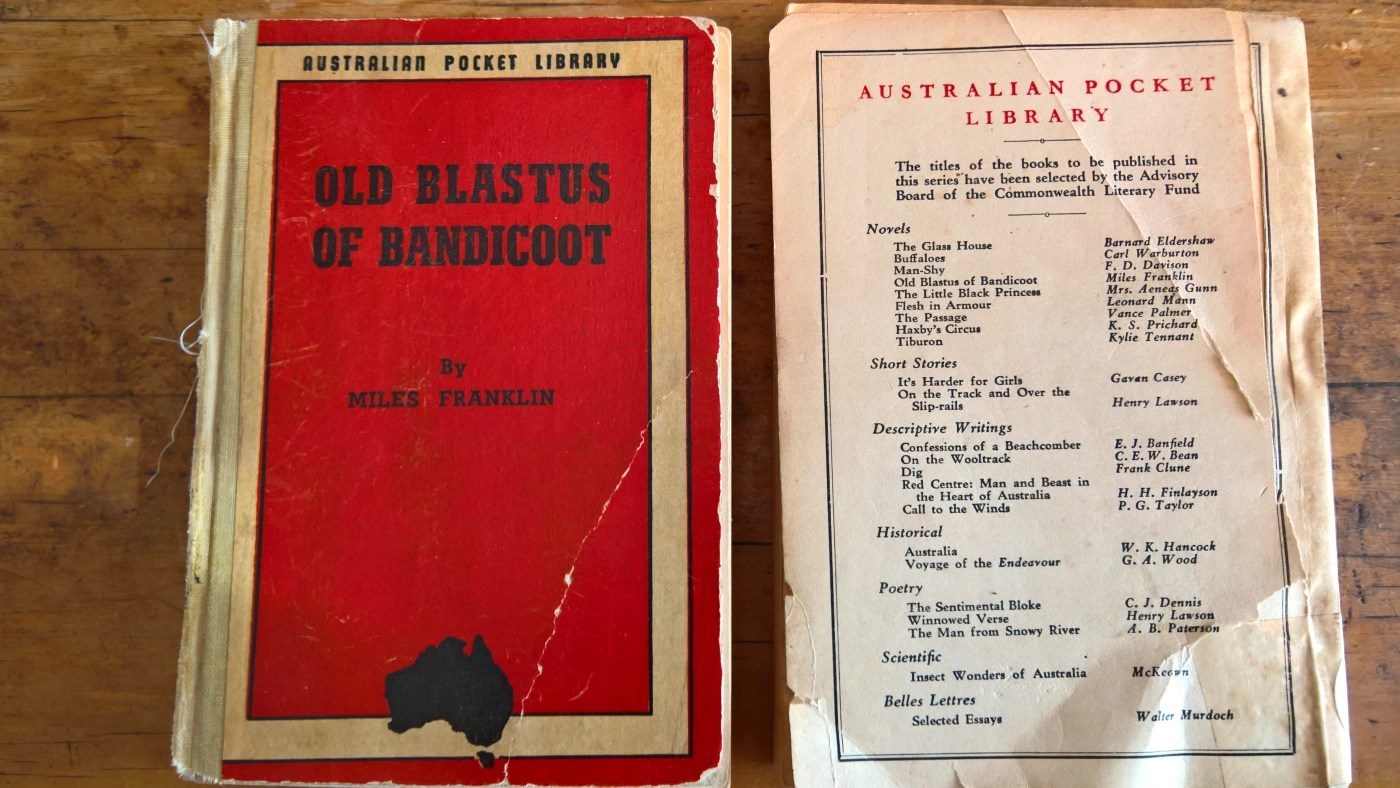
Last Monday I introduced the Australian Pocket Library (APL) which was a series of cheap paperbacks produced under the auspices of the Commonwealth Literary Fund (CLF). Its initial purpose was to provide Australian reading matter to Australian POWs but, in its final form, was intended by the CLF to play a bigger role in promoting Australian literature at home too. Planning started in 1943, with publication occurring between 1944 and 1947.
In last week’s post I shared part of an article on the APL by academic, Neil James, and some thoughts on the selection by a contemporary critic and literary editor, RG Howarth who discussed the library, taking as his starting point that the library was intended to contain “standard” works. I will return to James, but first, more from contemporary commentators on Trove.
Standard?
I’ve chosen to focus on P.I. O’Leary (1888-1944), a journalist and poet who, like Howarth, was committed to promoting Australian literature, and who also took up the “standard” question. P.I.O’L (his by-line) wrote an extended article about the APL in the Books and Bookman magazine of the Advocate in 1944 (17 May). He commences his article, titled “We parade our masterpieces”, with:
What is a “standard” Australian book? How many of the books selected by the Advisory Board of the Commonwealth Literary Fund to form the nucleus of an “Australian Pocket Library” are “standard” works? These and other points in this commendable enterprise are here considered.
Overall, he commends the endeavour, because too many works have been out of print. He sees the Library as representing “a belated national appreciation” of Australian writers. He is “not heady with any enthusiasm for an attempted, forced growth of literature in Australia”, he says, arguing that you cannot force produce great novels or great poems. However, “Australia has, and has had, many subsidised industries—and there is no reason why the literary industry … should not have some assistance in the shape of grants to writers”. Then he gets onto the issue of “standard”.
He doesn’t really know ‘what entitles an Australian literary work to be styled a “standard” book’, he says, but supposes that
Robbery under arms has passed the test, together with, say, We of the Never-Never, On the track and Over the sliprail, Such is life, and a handful of other books.
However, the selection of some of the other books as “standard” works, “sets up an energetic speculation as to what special passport a book must carry in order to cross the frontier”. (Love the language.) He knows how difficult it is to make such choices, but writes that “some books selected do not appear to me to even be borderline cases”. Then, like Howarth, he puts forward his views on some of them.

He agrees with Howarth’s questioning the inclusion of Katharine Susannah Prichard’s Haxby’s Circus, asking “what standard does it set up?” He thinks it the weakest of her novels, and “not comparable to Working bullocks or Coonardoo as a skilful work of fiction”. (Howarth named Working bullocks and Pioneers as better.) Like Howarth, he also questions the inclusion of Brian Penton’s Landtakers (read it anyone?) as “standard”, describing it as “largely sound and fury”.
P.I.O’L also discusses representativeness, asking whether the selection is “representative” of “our writers’ books”. He feels that “as a foundation selection it is … satisfactory”, arguing that “a start had to be made somewhere”. Howarth, he says, agrees, given the limitations the CLF was operating under. Moreover:
Allied Servicemen are not literary cognoscenti balancing niceties of literary values, characterisation, form. If you were to ask most of them in what order they would place the writers of their own polyglot land they would probably very honestly say that they were no judges—and had not read many books, American or otherwise, anyhow.
Then he tackles Howarth’s discussion of the gaps, the works that should have been included. Again, I loved his language:
And when you start offering a register of names of writers whose works should be included in the “Australian Pocket Library” you push your keel into a wide sea—one, sometimes of trouble.
He disagrees with some of Howarth’s suggestions – we are mostly talking poets here – and makes his own, but you can read it yourself if you are interested. Overall, he agrees with Howarth’s support of the project, quoting Howarth’s statement that the CLF should be “congratulated on the vision and courage of the enterprise”.
Legacy?
Now, I’ll return to Neil James’ 2000 article because he has some interesting points to make about the selection, and the APL’s legacy.
Looking at the selection nearly sixty years later, James writes
The titles selected reflect clearly the nationalist agenda in Australian literature … `Representative Australia’ in 1943 derived from the Bush, and the democratic values which seeped into Australian culture from its historical struggle against the natural elements. Most of the titles were originally published in the 1920s and 1930s, but some went back to an earlier age to engage with the grand narratives of exploration, adventure and colonisation. The list sets up literary values, social values, and national-historical values as interchangeable. This is hardly surprising given the primary influence of Palmer, whose published and broadcast criticism sought to define an Australian literature in national terms … It was a nationalist canon in paperback set for a wide distribution, and it sat comfortably with the government’s war-time agenda.
James shares the many practical challenges the CLF confronted – acquiring rights to the books, cover design, production problems, and agreeing on price with the publishers. And he describes the project’s demise, ending up publishing 26 of the finally planned 39. It’s all interesting and you can read it in the article. I want to end with his discussion of the legacy because this is most relevant to us now.
First, he says, it “represents the first officially selected and endorsed canon of Australian literature” and one recognised at the highest level of government. Furthermore, the APL played a significant, though not recognised, role in the “unprecedented transformation in the publication and recognition of Australian literature” in the 1940s and 50s. However, the importance of the Library has been lost partly, he argues, because the “nationalist outlook” of the selection was rejected a decade or so later by the universities, resulting in the writers being expunged from the canon.
The failure of the venture also had an impact on publishing. The CLF withdrew from “acting as de facto publisher” and became more reactive than proactive in publishing ventures. Had it succeeded, and had the CLF ‘continued to foster a nationalist canon of writing, there would have been, at the very least, more than “one set of values [to rule] the entire roost”, as Max Harris put it’.
More significant, though, I think, is James’ argument that the failure of the APL “effectively delayed the literary paperback in Australia by two decades”. He believes that the 1930s Penguin revolution in Britain “could have been reproduced here in the 1940s” with the APL its “de facto trial run”. Unfortunately, its unappealing format, which was “far too compromised by wartime conditions … killed off any good will towards paperbacks amongst booksellers and publishers”.
How fascinating. It was not until the 1960s, James says, that the literary paperback returned to the Australian scene, and not on a major scale until the 1970s. This fundamentally influenced “the character and the accessibility of Australian writing”, by which he means that because mass cheap paperbacks were not available as they were in Britain and France, “the readership of Australian literature was to remain the middle classes rather than `the multitude’.”
James concludes – in 2000 – that the Australian Pocket Library is worthy of “further scrutiny as part of the assessment of individual authors, and in understanding the evolution of Australian cultural values”. He also suggests that, “given the current paucity of an available Australian backlist” it may contain lessons for a classics publishing program! Well, it may not be the same model, but the Text Classics imprint, which began in 2012, has picked up the baton of cheap affordable classics and run with it. As far as I can tell, ten years later, it is going strong, with a catalogue that is diverse but, like the APL, constrained at times by access to rights.
Sources
- Neil James. “A Paperback Canon: The Australian Pocket Library.” Australian Literary Studies 19 (3), May 2000.
- “P. I. O’Leary“. The Institute of Australian Culture, 12 April 2021
 Whispering Gums