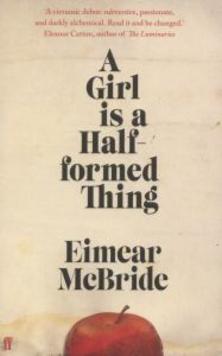
Eimear McBride, A girl is a half-formed thing (Review)

Eimear McBride, A girl is a half-formed thingI try very hard when writing reviews to avoid clichés and superlatives, like, say, “achingly beautiful” or “masterful”. But I think I’m going to use one for Eimear McBride’s multi-award-winning debut novel A girl is a half-formed thing when I describe it as “searing”. I can’t think of a more apposite word. Yet I fear it too has been over-used to the point of meaninglessness. So, let’s try something else …

Once again I’m coming late to the read, and once again this is partly because it was scheduled by my reading group. All I can say is, wow. I’m not sure I’d go so far as Eleanor Catton’s “read it and be changed” commendation on the front of my edition, but I do agree with her  “virtuosic” and “subversive”. It’s a gut-wrenching read.

The plot itself is simple enough. It’s the story of a family – a pious one-could-say-religiously-fanatical mother, a son who survived a serious brain tumour as a toddler, and the younger daughter. The tumour leaves the son somewhat brain-damaged and, of course, it returns. This tumour, the trauma of it, shapes their behaviour and defines their relationships. The story, which spans around 20 years, is told through the daughter and could, in one sense, be seen as coming-of-age. But. This. Tells. You. Nothing. Because …

This is not your typical first-person voice. Instead, we are in the head of the unnamed “girl”. We are there in her conscious unconsciousness (or, is it her semi-consciousness?) in which we hear what she’s experiencing in language that is – here’s another cliché – raw. By this I mean that the language is stripped of the mediation of a formalising narrator’s intellect. Instead it captures the immediate emotional truth of the girl’s experience as she grapples to make sense of her world. This is a book in which the style conveys the meaning as much as the words do.

How does McBride do this you are probably wondering (unless, of course, you’ve already read the book). Well, mostly by breaking, consistently, the rules of grammar and syntax. We are in the girl’s head, a place where, I believe McBride is saying, we rarely think in coherently formed sentences but in what I would call “impressions”. Take, for example, this description, on the first page, of the brother before his diagnosis:

I know. The thing wrong. It’s a. It is called. Nosebleeds, headaches. Where you can’t hold. Fall mugs and dinner plates she says clear up. Ah young he says give the child a break. Fall off swings. Can’t or. Grip well. Slipping in the muck. Bang your. Poor head wrapped up white and the blood come through. She feel the sick of that. Little boy head. Shush.

To orient you, “she” is Mammy, “he” is the father who disappears two pages later, and “you” are the little boy, the girl’s brother. Most of the novel is addressed to him (that is “you”). One of the challenges of reading this book, and it is a challenge to read, is its pronouns. Once you’ve got a handle on them, and once you realise that they are all from the perspective of the girl, you are half way there.

Anyhow, there is easier syntax than the above when life is relatively calm but, when our “girl” is distressed such as when the truth of her brother’s situation can no longer be avoided, it collapses almost completely:

I walk the street. City. Running through my mouth. Running in my teeth the. My eyes are. All the things. The said the done what there what’s all this? That stuff. I could do. My. I walk the street. Who’s him there having a look at me he. Look at my. Tits. Ssss. Fuck word. No don’t. Fuck that. No. Will. Not that. Not. That. But. If I want to then I can do.

This is not the most extreme example – I don’t want to spoil too much – but it should demonstrate what I mean by the language mirroring/enacting/even being her state of mind.

In addition to the idiosyncratic syntax, McBride draws on wide range of literary techniques to keep us focused on, grounded in the emotions of the here and now. The imagery is visceral, returning again and again to  “muck”, “dirt”, “blood”, and “puke”. She alters her rhythms to match the tone, not only through the syntax as evident in the examples above, but through allusions to and repetitions of prayers and hymns, lines from children’s games, literary works and sayings. She makes up new words (“I trup trup off behind her”), mangles existing words (“swoll” for “swollen”), and twists common expressions (“There’s a foul there’s a wind where’s the air”). McBride was inspired by Joyce she says, but her fresh, fearless, urgent language reminded me too at times of Gerard Manley Hopkins.

The novel is clearly set in Ireland and there are odd references to 1980s technology like Game Boys, but overall place and time are unspecified, and none of the characters are named. All this keeps the focus squarely on the emotional core of a family in pain, and the girl in particular. She is abused by her uncle at the age of thirteen and begins a strange love-hate, violent-tender, but sick, relationship with him. Sex becomes for her a weapon, a tool and a punishment. But the book is not about this, that is, it’s not yet another book about abuse. It is about the girl’s inability to handle her emotional pain, and her family’s inability to see her need, it’s about growing up unsupported. She is complicit in her own degradation because for her physical pain is better than the emotional. Like those who self-harm, she seeks out abuse again and again because

… what’s wrong here is me me me. Me the thing but I. Think I know. Is that the reason for what’s happened? Me? The thing. Wrong.

I know this all sounds unremittingly bleak and it largely is, but there are light touches – blackly comic scenes, surprising word plays, and chuckle-inducing descriptions (like her mother’s friends, “they polyester tight-packed womanhood aflower in pink and blue”).

A girl is a half-formed thing is hard to read style-wise and painful to read content-wise. But it is a book that, if you let it, reaches deep into your core and makes you understand the lives of others in a way that only the best literature can. I’m so very glad I read it.

John at Musings of a Literary Dilettante also liked it.

Eimear McBride
A girl is a half-formed thing
London: Faber and Faber, 2014
203pp.
ISBN: 9780571317165

Kirsten Krauth, just_a_girl (Review)

Kirst Krauth, Just a girl

Courtesy: UWA Publishing

If you’ve already heard about Kirsten Krauth’s debut novel just_a_girl, you’ll know something about its confronting nature – and it is confronting, though perhaps not quite in the way I expected. It was both more and less, if that makes sense.

However, if you’re not Australian, you may not have heard about this novel. Essentially a coming-of-age story, just_a_girl is told in three voices. Two are first person – Layla, a 14 to 15 year-old-girl, and Margot, her mother – and the other is, interestingly, told third person, Tadashi, a lonely Japanese man. The main voice, though, is Layla. She opens and closes the novel, which is set around 2008 in Sydney and the Blue Mountains.

Layla typifies the modern knowing teenage daughter that parents worry they may have. She’s sexually precocious and is acutely aware of her effect on men. She’s what many would call “a tease”. She tells us, though, that she’s a virgin (technically, anyhow, because she’s done pretty much everything else). She wants, she says, to wait until she’s 16:

Fifteen just seems too skanky. You tell your kids you lost your virginity at 15. They’ll just want to do it even younger.

This tells us something more about Layla – her street-wise wisdom. It’s believable because Layla has had to grow up fast. Her parents separated when she was in primary school because her father finally admitted his homosexuality. Her mother, prone to depression, turned to an evangelical church. Layla has learnt to navigate these waters with smart talking, and by using all the weapons at her disposal including personal attributes and modern technology. With studied insouciance, she tells us about her relationships, with her mother, her friend, her father, and various boys and men. She is not innocent, but she is also abused in several ways, by old and young, through the novel.

Meanwhile, her mother Margot struggles with depression, a sense of rejection and failure, and consequent inability to properly relate to her daughter. She has turned to God, but unfortunately the church she has chosen, with its hypocritical leader, is unlikely to be her salvation. You see how easily relationships can go awry during these turbulent years if family members are not strong and confident in themselves. But, Krauth keeps it real. This is not melodramatic. There are no over-the-top mother-daughter scenes, just lack of real communication leading to distance and lack of mutual support where both need it. By the end of the novel both have learnt something and are starting to see each other as people, rather than simply as roles. In other words, it’s not only Layla who needs to grow in this contemporary coming-of-age novel.

Into this mix is added a third voice, Tadashi. He often travels on the same train as Layla, and on one occasion rescues her from a risky situation. Like Margot, he’s lonely, used to relying on a mother who has now gone. In scenes reminiscent of the bitter-sweet movie Lars and the Real Girl he orders and takes possession of a sex (or love) doll which he sees as “a person” who will alleviate his loneliness. In some ways it’s an odd inclusion in the story but, besides his probably not essential role as rescuer, he adds another angle to the exploration of loneliness and relationships, and the use and misuse of sex to address gaps in people’s lives.

In her “Sources and permissions” note, Krauth tells us about her sources for “love dolls” and other ideas or events in the novel. She also explains that some of Layla’s comments have been inspired by teenagers who have appeared on SBS’s Insight program. She has listened well, because from my experience of similar programs I felt very comfortable (if one can call it that!) with Layla’s voice. She’s so fresh, so funny, so knowing, that you can’t help liking her and worrying about her vulnerability, while also being horrified.  Here’s a short example:

Mum says I have to be careful now that I’m in year 9. Because men will start looking at me in a new way. Fuckadoodle, they’ve been looking at me like that for years. Especially when I eat Chupa Chups on the train.

I was going to share the Chupa Chups (“I have a favourite game on the train trip home from school”) episode with you, but I reckon you should read it yourselves. It would be funny if it weren’t so disturbing. It’s a fine piece of writing about a sexualised young girl who “knows” too much. Talk about playing with fire!

Margot’s voice is quite different – the long run-on sentences versus Layla’s short ones convey her anxiety and uncertainty well. Here she is, for example:

When is this soul-searching going to end, I mean, I knew coming off the meds would be hard as I’ve tried it a few times before but it’s like I’ve sunk into a bog, and it’s been a horrendous week because of that film Layla hired, Brokeback Mountain, you know she loves Heath Ledger and was completely devastated when he died last year and everyone thought … [and on she goes for several more lines]

I feared at times that Krauth was trying to pack too much in – single mother, gay father, hypocritical evangelical church, breast cancer scare, viral you-tube, sex doll, workplace sexual harassment, and so on – but no, she made it work. They are treated as things that happen. She doesn’t trivialise, but neither does she labour. Instead, she keeps her focus on the main game, which is how we, and particularly young people and their parents, must navigate the modern digital world with its potential for serious ill, and how in such a world might we still forge meaningful relationships. A thoroughly modern book for a thoroughly modern audience. It will be interesting to see what Krauth does next.

Lisa at ANZLitLovers also liked the book.

awwchallenge2014Kirsten Krauth
just_a_girl
Crawley: UWA Publishing, 2013
265pp.
ISBN: 9781742584959

(Review copy supplied by UWA Publishing)

Christina Stead, For love alone (Review)

In a recent communication with local author Nigel Featherstone about reviewing, he reminded me of Peter Rose’s advice for new reviewers for the ABR. One of the points Rose makes is:

with major books, ones that have been reviewed extensively in the newspapers, submit reviews that add to our understanding of the book, not just repetitious codas to or echoes of earlier reviews.

This stands also, I think, for classics, for books that have become part of the “canon”. Stead’s For love alone is such a book. My problem then is how to say something about this book that isn’t same-old, same-old. I could be lucky here though, because while Christina Stead is part of the Australian literary canon she’s probably not as well read or as well-known as she should be.

To gain some idea of her reputation amongst the literati, just look at these comments … Patrick White described this book as ‘A remarkable book. I feel elated to know it is there’. Now that is really something isn’t it? Helen Garner has said ‘I could die of envy of her hard eye’, David Malouf wrote that ‘Christina Stead has the scope, the imagination, the objectivity of the greatest novelists’, while American critic Clifton Fadiman called her ‘the most extraordinary woman novelist produced by the English-speaking race since Virginia Woolf‘. He has qualified his praise with ‘woman’, but nonetheless, you see what I mean. What can I add to a discussion of a writer of this ilk?

Enough introduction. Those of you who don’t know the novel are probably wondering by now what it’s about. The title sounds a bit melodramatic, and the basic plot-line could suggest it, but in fact the book is low on drama. You don’t read Stead for page-turning excitement. The novel is set in Sydney and London, from 1933 to 1937. It concerns Teresa Hawkins, the 19-year-old daughter of an unloving, self-involved father. Neither she nor her three siblings are happy at home but seem tied to it, mostly for economic reasons. The novel opens with Teresa and her sister Kitty attending the wedding of their cousin Malfi, setting the scene for Teresa’s quest for love – for a real love, though, not for “some schoolfellow gone into long trousers”. Unfortunately, while she is an intelligent and resourceful young girl, she is also naive. She sets her sights on her Latin teacher, the 23-year-old Jonathan Crow*. Consider the name, and you might gain some insight into his nature!

“She believed firmly in the power of the will to alter things and force things to an end”

It’s hard when reading the novel not to think of Thomas Hardy’s Tess of the d’Urbervilles (surely it’s relevant that Teresa is also called Tessa?) and, even more, of Edith Wharton‘s heroines. However, while society’s rules and conventions underpin the plot, Stead is more interested in her characters’, particularly Teresa’s, psychology. What does Teresa mean by love, what is its impact on her, and how far will she go for it? Very far, we soon discover. She denies herself sustenance almost to the point of death, not once but twice, in the novel. Why?

Well, let’s look at Teresa/Tessa. Early in the novel, she’s idealistic. She will not, she says, compromise her life. “I’ll never give in” (p. 33) she says to her aunts, and a little later says to her cousin, “I’d work my fingers to the bone to keep my lover” (p. 127). As she becomes immersed in her love for Jonathan Crow, she enacts these vows: “I am killing myself for a man” (p. 314), she realises. “Love is hard” (p. 357). And yet, she continues for many more chapters, to believe in her idea of love (in which women can’t expect happiness) and in Jonathan. This, to her, is how love is. It’s an intriguing portrait of a woman who is strong and intelligent, and yet unable to let go of something that is patently going nowhere. When the inimical Crow describes her as “a true example of masochism and also a perfect example of mythomania”, it’s hard not to agree.

Teresa, then, is not a simple character. Her commitment to Jonathan is complicated: when opportunities arise for greater intimacy, she in fact pulls back. It’s significant that several times through the novel she mentions Ulysses:

she could sail the seas like any free soul, from Ulysses to the latest skipper of a sixteen-footer rounding the world.

Eventually, though, she discovers “true love … the love without crime and sorrow” but, as ABR editor Peter Rose also says “never give away the denouement”, I will leave it here. I’ll simply say that the ending is satisfyingly open and true to Teresa’s character.

“The world was hers and she had no doubt of the future”

The novel is, essentially, a bildungsroman. It’s Teresa’s coming of age, intellectually, psychologically and physically. Her youthful confidence takes quite a battering as she confronts the realities – presented by society and by Jonathan. She realises that society’s rules are counter-human:

Why the false lore of society? To prevent happiness. If human beings really expected happiness, they would put up with no tyrannies and no baseness; each would fight for his right for happiness. (p. 532)

This is not a social history. Despite the descriptions of poverty, the analysis of societal marriage conventions, the discussions about money and power, Stead is not writing a Dickensian novel. Rather, it’s about Teresa’s struggle to know herself as a mature loving women, something that is stunted for some time by her relationship with the slippery Jonathan: “In one speech he would be sardonic and naive, cruel and gay, tender and cold” (p. 380) And yet, Teresa cares for this man, and forgives, and forgives, and forgives again his erratic, careless, misogynistic treatment of her. In fact, she appears to be so in his thrall that her employer James Quick begins to wonder whether she is as intelligent as he’d believed:

What can she be, to tolerate such a contemptible, calculating worm […] this intellectual scarecrow (p. 477, 480).

However, she is, of course, intelligent and in true bildungsroman-style does experience “true” love. But this is Stead and it’s not simple. At one point her new love tells her:

he will send her to university – make a woman of her, make a brilliant woman of her … He would take her to Paris, and elsewhere, no-one who knew her now, would know her then; he would make her over entirely.

Oh dear …

Australian Women Writers Challenge

This is a delicious book – rich in ideas, gorgeous in writing, passionate in conception, and complex in psychology. The more I delve into it, the more I want to say. Perhaps, I will another day.

Postscript: By coincidence, I finished For love alone just as the ABC’s Australian Story broadcast the strange story of revered Australian writer Elizabeth Jolley, her librarian husband and his daughter by his first marriage, Susan Swingler, whom he left in England without telling her the truth. The first thing that crossed my mind as the story – I have Swingler’s book, unread, on my shelves – unfolded was “the things people do for love”. Jolley’s novels, like this one of Stead’s, are emotionally intense and explore some of the darker sides of familial and romantic relationships.

Christina Stead
For love alone
Carlton, The Miegunyah Press, 2011 (orig. pub 1945)
575pp.
ISBN: 9780522853704

* The novel is autobiographical, but by no means autobiography. Here is an article on Keith Duncan who inspired Jonathan Crow.

Nancy Cato, All the rivers run, Book 1 (Review)

It’s been a long time since I reviewed an audiobook or, more accurately, reviewed a book via its audiobook version. As I’ve said before, I don’t listen often to audiobooks, but last month Mr Gums and I did a long drive and so decided to listen to Nancy Cato‘s All the rivers run. I referred to this novel a few Monday Musings ago, because it was one of Australia’s early, successful adaptations for television.

Enough introduction though, time to talk about the book. Our audiobook contained the first book* of Philadelphia (Delie) Gordon’s saga. It starts her story when, in 1890 at the age of 13 she is orphaned in a shipwreck off the coast of Victoria. She is taken in by her dour aunt and more welcoming uncle who lead a spartan prospecting life at Kiandra in the Australian Alps. When her uncle Charles strikes it rich – that is he finds a large nugget of gold – the family (with her cousin, Adam, who is three years older than she) move to a sheep farm on the Murray River not far from Echuca. This first book, which is pretty much a coming-of-age story, finishes when Deli (as she prefers to be called) leaves home at the age of 17, after a tragedy has struck the family.

This is not really the sort of book I would normally read, though it is the sort of book I’d listen to on audiobook. Why so? Well, at the risk of being called a literary snob, I tend not to read sagas (whether they be historical fiction, fantasy or whatever). This is because their focus tends to be plot rather than style, structure, theme and, even perhaps, character development, though I know aficionados will argue with me and they will probably be right (to a degree!). Anyhow, there’s nothing wrong with that, it’s just not what I prefer to read. However, such stories are perfect for listening to in the car. Literature requiring intense concentration is not a safe bet when you are driving (or even when you are navigating). Horses for courses, as they say.

Cato’s book, like good historical fiction, captures the social history of the era well, particularly the tail end of the gold rush, the 1890s depression, life along the Murray River for the pastoralists and paddle steamers, the challenges faced by women in a male dominated society. She also touches on the dispossession of the indigenous people, showing the women working as “house-girls” for the pastoralists and their all too often descent into prostitution, often as the result of being used by and bearing the children of their white male bosses. Cato was, apparently, an active campaigner for indigenous land rights as well as for conservation.

I enjoyed Cato’s vivid descriptions of the landscape. The plot is a little predictable and the characters are somewhat stereotypical – the welcoming, easy-going farmer, the tough wife, the handsome son champing at the parental bit – but not so much that they don’t engage. Delie in this first book, for example, is a believable young girl, orphaned and taken in essentially by strangers and then experiencing her first love. She’s bright but not brash, independent but not without uncertainties.

I enjoyed one little description in particular. At a moment when things are going wrong for Deli, Cato writes that “a pair of kookaburras laughed sardonically”. I liked this description because only recently I’d been thinking about the first white settlers in Australia and what they made of the birds here, many of whom can sound pretty raucous. I wondered, in particular, what they thought when they first heard a kookaburra’s “laugh” as we describe it. Sardonic, is a very good description of it!

Overall then, it’s an enjoyable read, if you enjoy historical sagas, are interested in life in country Australia in the 1890s – and particularly if you have a long drive ahead of you! You could do way worse …

Nancy Cato
All the rivers run: A river not yet tamed (Audio CD)
Read by Kate Hosking
Bolinda Classics
6 hrs 15 mins on 5 discs
ISBN: 9781742336732

* Note: As far as I understand it, the three books in the trilogy were originally separately published as: All the rivers run (1958); Time, flow softly (1959); and But still the stream (1962). Recent editions, however, combine the three novels into one volume titled All the rivers run. I am not sure where the title A river not yet tamed comes from, but it looks like it might be Bolinda’s title for the first part of their recording of the trilogy.

Julian Barnes, The sense of an ending (Review)

I should have known I wouldn’t be the first to think of it, but during my reading Julian Barnes‘ Booker Prize winning novel, The sense of an ending, I was suddenly reminded of TS Eliot‘s The love song of J. Alfred Prufrock. It was the melancholic tone, the sense of life having passed one by, that did it:

What did I know of life, I who had lived so carefully? Who had neither won nor lost, but just let life happen to him?

Doesn’t that remind you of “I have measured out my life with coffee spoons”? I don’t usually read reviews before I write my own, but I wondered if my thought had come to anyone else. Of course it had. I googled “julian barnes sense of an ending prufrock” and up came several hits. Oh well, I thought, at least I’m not going to sound totally foolish. There is safety in numbers, after all, which brings me back to Tony, the novel’s protagonist, who says, at another point in the novel:

I’m not odd enough not to have done the things I’ve ended up doing with my life.

I admit to having a certain fellow feeling with Tony, a self-confessed “average” person who’s led an average life “of some achievements and some disappointments”. But, enough self-revelation, let’s get on with the review.

I’ll start by saying that this book is right up my alley. Firstly, it’s a novella and regular readers here know how I love a good novella. Secondly, it’s a good novella, by which I mean it’s tightly constructed and sparely written. And thirdly, plot is not the main point; character and life are Barnes’ focus.

Nonetheless, while there’s not a strong plot, there is of course a story, and it concerns the aforesaid Tony. He’s the first person narrator and is a reliably unreliable one. He tells us this on the second page, while at the same giving away the novel’s essential form:

But school is where it all began, so I need to return to a few incidents that have grown into anecdotes, to some approximate memories which time has deformed into certainty. If I can’t be sure of the actual events any more, I can at least be true to the impressions those facts left. That’s the best I can manage.

This tight little para tells us a few things about what’s to come. The word “deformed” combined with the idea that he “can’t be sure of the actual events” tells us to beware, that imperfect (for whatever reason) memory is at play. The mention of returning “to a few incidents” describes the basic structure of the novel, as it does indeed focus on and tease out the ramifications of a “few incidents”.  And the reference to school hints that there might be something of the bildungsroman about it.

I still haven’t told you anything about the story, though, have I? It’s divided into two parts. In Part One, Tony is in his teens and twenties and focuses on his three male friends and his first serious girlfriend, Veronica. This part is less than 60 pages and, as Tony promises at the beginning, primarily comprises a few scenes from his life, linked by some running commentary. There are classroom scenes and a particularly memorable one involving his first  (and only) weekend visit to his girlfriend’s home. We come back to this scene in the second part. I loved how, after spending some 50 pages on his youth, Tony wraps up around 40 years of his adult life in two pages. Impressive writing.

In Part Two, Tony is confronted again with some of the major incidents from his youth and is forced to reconsider his sense of self. The most important of these incidents concerns the suicide of one of his friends … and gradually we get a whiff of a mystery, albeit one just hovering around the edges. This is because the mystery is not the main point.

Tony, in this part, is bequeathed, out of the blue, the diary of the friend who had committed suicide 40 years previously. Now, Tony believes that it is the witnesses to your life, those you spent time with, who “corroborate” who you are. As these people drop away, there is, he says “less corroboration, and therefore less certainty to what you are or have been”. He therefore sees this diary as potentially significant:

The diary was evidence; it was – it might be – corroboration. It might disrupt the banal reiterations of memory. It might jump start something – though I had no idea what.

The bequest does “jump start something” but to what purpose is the moot point. An issue that occupies Tony is that of change. “Does character develop over time?” he asks and then continues, in one of those little postmodern touches we’ve become used to, “In novels of course it does, otherwise there wouldn’t be much of a story”. You said it, Tony/Julian, we are tempted to respond, except that by this time Tony had so captured my attention that the minimal story was neither here nor there.

And this is where I’ll leave the story … and return to an issue I raised earlier in the post, that regarding its being something of a bildungsroman. It’s not a traditional coming-of-age novel because only the first part of the novel chronicles his development as a young man. But, something is jump started for Tony in his 60s that forces him to rethink who he had been and who he had become. Memory, he says, can lock you into

the same loops, the same facts and the same emotions. I press the button marked Adrian or Veronica, the tape runs and the usual stuff spins out. The events reconfirm the emotions – resentment,  sense of injustice, relief – and vice versa. There seems no way of accessing anything else; the case is closed.

Occasionally, however, something happens to break the loop, as it does for Tony. He is suddenly confronted with new (or, different) memories which bring new emotions. He looks at “the chain of responsibility” and sees “my initial there”. He learns that the things he’d thought fixed or certain can be dissolved, that memory cannot be relied upon and can, in fact, come back to bite you. Time and memory, Barnes shows us, are malleable, suggesting, to me at least, that perhaps we never really do come of age.

Julian Barnes
The sense of an ending
London: Vintage, 2011
150pp.
ISBN: 9780099564973

Banana Yoshimoto, The lake (Shadow Man Asian Literary Prize 2011)

Shadow Man Asian Literary Prize 2011 Badge
Image created by Matt Todd of A Novel Approach

When I saw that Banana Yoshimoto‘s novel The lake was shortlisted for the 2011 Man Asian Literary Prize I knew that it would be a high priority for me to read, because I like Japanese literature and I have read and enjoyed Yoshimoto (her novel Kitchen) before.

The first thing that struck me, however, as I started reading the book was a case of reading synchronicity. Roy’s The folded earth, the first book I reviewed for our Shadow Man Asian Literary Prize 2011 project, is about a young woman grieving the death of her husband. In The lake, the protagonist, Chihiro, also a young woman, has just lost her mother. And, in further synchronicity, both women meet men who impact their lives. This is not unusual, of course, but the thing is that in both books there is a sense of mystery surrounding these men. However, this is where the similarity ends: the mystery in The lake has nothing to do with the death of Chihiro’s mother. Rather, it relates to something the man has experienced, something that has clearly damaged him.

So, what is the plot? It is basically a romance. The first line of the novel is:

The first time Nakajima stayed over, I dreamed of my dead mom*.

Chihiro, our first person narrator, then flashes back to tell us about her background, her somewhat unusual life with her bar-owner mother and businessman father who never married due to his family’s objections. Chihiro is around 30, but this is, really, a coming-of-age novel because she doesn’t yet feel grown-up:

I’m still a child. I still need my parents, and yet, I suddenly feel I’m walking alone.

Into this solo life comes a young medical student, a “puzzling young man”, Nakajima, who lives in the apartment opposite hers. They first communicate non-verbally across the dividing space. Gradually Chihiro feels she is falling in love with Nakajima, but she is not sure, partly because he’s odd, uneasy, something he admits to but can’t (yet) explain. However, it is through learning to accept Nakajima, to not push him but simply to care for him, that Chihiro starts to grow up. At first she wants to have fun – “I didn’t want to deal with weighty matters” – but she comes to realise that she needs him, and senses that he is “the one”. All this develops before we know what happened to Nakajima. Plotting the story through Chihiro’s description of their developing relationship puts the focus less on what happened in the past – though we certainly want to know – and more on how two young “kind of weird” people might move together to a good future.

Now, here’s the rub. Do I let on what happened to Nakajima? The blurb inside the jacket hints at what it is, so perhaps it’s ok to. However, I think I won’t. All I’ll say is that the lake – to which Nakajima takes Chirihiro half way through the novel – and the brother and sister (Mino and Chii) living there are important to the resolution. Chii is bedridden and mute but she can foretell the future and she does this through Mino. This adds a supernatural element to the story, which works well enough for me though I’m not sure what it specifically adds to the novel (except perhaps a sense of “otherness” to the atmosphere?)

The more important question to ask is why has this novel been longlisted for the Man Asian Literary Prize? Is it more than a nicely written coming-of-age love story? Well, the mystery and its impact on Nakajima, Mino and Chii is a significant one, but that, from the way the story is told and how the plot is resolved, doesn’t seem to be the main point. It is clearly about grief, trauma and recovery, but I think this might be overlaid with the struggle in Japanese society, particularly for the current young generation, to not follow the norm blindly. Nakajima and Chihiro did not have “normal” upbringings. This means that, whether they like it or not, they symbolise nonconformity – and must, consequently, make active decisions about where to next. Freedom is not, I understand, a high value in Japanese society … but it is an issue that comes up regularly in the book. Chihiro’s parents aren’t, through family expectations, free to marry. The mystery surrounding Nakajima relates to a loss of freedom. In her work as a muralist, Chihiro’s only demand is the freedom to paint what she wants and, when that is threatened by a sponsor wanting her to incorporate an enormous logo into her mural, she intelligently but resolutely conducts a campaign to encourage him to change his mind.

Late in the novel, when talking about his experience, Nakajima says:

When you’re in a state of homogeneity, you’ve lost yourself.

Beyond loss and childhood trauma, then, it is the ongoing things like homogeneity, lack of freedom, the push to be normal that challenge Yoshimoto’s characters. But this is a quiet, lyrical book rather than a feisty one. It recognises that life involves “dull repetition of the same old thing” peppered by those “little leaps of your heart to put a splash of colour in the world”. Have I fully understood this novel? I’m not sure that I have … but I did enjoy reading it and thinking about the issues Yoshimoto seems to be exploring.

Matt of A Novel Approach and Lisa of ANZLitLovers, on our Man Asian team, have also reviewed it and are worth reading for their different takes.

Banana Yoshimoto
The lake
(trans. by Michael Emmerich)
Brooklyn: Melville House, 2011 (orig. Japanese ed. 2005)
188pp
ISBN: 9781933633770

* An American translation. We would say “mum”!

MJ Hyland, Carry me down

MJ Hyland, Carry me down bookcover

Book cover (Courtesy: Text Publishing)

If you like writers who unsettle, then MJ Hyland is a writer for you. Carry me down is my second Hyland. I read, loved and reviewed a later book of hers, This is how, nearly a year ago, and said then that I’d like to read more. I finally have, and am not disappointed.

Carry me down is a pre-coming-of-age story. John Egan is an 11-year-old boy living in Ireland with his parents. He’s an only child and is keen to be special, different. He is clearly pre-adolescent – he’s naive, for example, about some of his 15-year-old cousin’s behaviours. He’s an unreliable narrator: the world he sees and describes is rather skewed but the unsettling thing is that we, the readers, know it is skewed but we are not quite sure in which way. What is going on in this family is the question in our minds from beginning to end.

Like This is how, the novel has a vaguely unsettling beginning. The first paragraph sets up what looks like a cosy family scene. The three are sitting, companionably it seems, around the table on a Sunday evening. The third and fourth paragraphs read:

From time to time we stop reading to talk. It is a good mood, as though we are one person reading one book – not three people apart and alone.

These kinds of days are the perfect ones.

That “alone” is a little jarring, though not dramatically so. But then comes this on page 2:

“John,” she [his mother] says, “please come with me. “She is taking me out to the hallway, away from my father. She is taking me out of his sight, as though I am rubbish.

“Rubbish”? Now, that’s a strong word. What she tells him in the hallway is to stop staring at her:

“You were staring at me, John. You shouldn’t stare like that.”

“Why can’t I look at you?”

“Because you’re eleven now. You’re not a baby anymore.”

There seems to be something slightly strange going on here, or is there? Is this just a pre-adolescent bumping up against the adult world he is about to join, or is something far more complicated going on? As the book progresses, John’s relationship with his mother verges on “too close”. He seems a little too emotionally and physically needy, and she seems unsure of how to manage it. Is his need normal, is the question we ask. Meanwhile, his relationship with his father seems more typically adolescent. He wants his father’s approval and love, but he wants to be independent too. And, he wants to be special. He is an avid reader of the Guinness Book of Records, and decides early in the novel that he has a gift for lie detection for which he’d like to be included in the Guinness. He reads up on lie detection, and starts his own Gol of Seil (Log of Lies).

The situation is complicated by a number of facts which come out in the first chapters of the novel. John is unusually tall for his age and is under medical care for this. He regularly scratches a spot on his head until it bleeds. And he is bullied at school, because he is clearly a little different. His father is out of a job and studying for exams to be admitted to Trinity College. The book his father is reading at the start of the novel is Phrenology and the Criminal Cranium. Is this a hint to us – or a red herring? His mother works with a puppet show. This is interesting, too, as the idea of puppets subtly undercuts the desire for control and independence that John, like any pre-adolescent, is starting to strive for. The family lives with the paternal grandmother, with whom John’s father has a prickly relationship, mainly around money. And, underlying all this is John’s growing obsession with truth and lies.  This obsession is the framing motif in the book. John catches adults lying and takes them to task for it, all the while telling lies himself. He does not, by the end, come to a real understanding of how lying functions, of the difference between white lies and more serious ones. For this reason I don’t see it as a true coming-of-age story.

And now I come to my problem. How do I write about this book without giving it away? There are events – powerful, troubling ones – that occur in the book and that can be “read” in different ways. I’d rather like to analyse or explore the possible meanings, but that would require giving away some significant plot points. I don’t want to do that because this is a book that you need to discover for yourself, sentence by sentence.

What I’ll say though is that this is one of those books that has an open ending. (Indeed, giving nothing away, the last word of the book is “open”). How we read it depends on our own world view, on the weight we give to the various events in the novel, on how we read the specific words and images used by Hyland to describe the events and characters, and our personal understanding of adolescent and family psychology. The way I see it, the book’s ending hints at a number of possibilities but we do not know, at the point in their lives that we leave these characters, which of these possibilities will eventuate. And that, as they say, is life!

MJ Hyland
Carry me down
Melbourne: Text Publishing, 2007 (orig. 2006)
313pp.
ISBN: 9781921145780

Monday musings on Australian literature: The Australian bildungsroman

Miles Franklin

Miles Franklin, c. 1940s (Presumed Public Domain, via Wikipedia)

I know the sad truth. About everything.
(Craig Silvey, Jasper Jones)

In past posts, I’ve talked of enjoying coming-of-age novels (aka bildungsroman) and so today I thought I’d share 5 (cos 5 seems like a manageable number for a list like this – and gives you an opportunity to contribute your own!) Australian novels in the genre.

In the introduction to a course on “The European bildungsroman” at Columbia University in the USA, there is a brief discussion on the definition of the term. The unnamed writer (so let’s call him/her Columbia) of the introduction says:

My particular approach to defining the genre … returns to Dilthey‘s original definition. According to Dilthey, the prototypical Bildungsroman is Goethe’s Wilhelm Meister’s Apprenticeship in which the hero engages in a double task of self-integration and integration into society.

Columbia then expounds a little on this definition arguing that, while Dilthey see this as an affirmative, conservative genre which aims to find the “hero” a productive place in a valid society, s/he sees it as involving a tension – that between “the priorities of self-integration and social integration”, between personal desire and social obligation. For Columbia this tension is a major criterion for the Bildungsroman genre. This makes sense to me … perhaps this tension isn’t an issue for every young person who is coming of age, but a coming-of-age story without that tension, without some conflict to resolve, is probably not going to be interesting to read!

(By the way, I’m not sure that this necessarily negates Dilthey’s definition. The difference between Dilthey and Columbia seems to me to be that Dilthey focuses on the end result, while Columbia focuses on the process which may or may not culminate in Dilthey’s goal.)

And so, five Australian coming-of-age novels (choosing from those I’ve read):

  • Miles Franklin‘s My brilliant career (1901) is probably Australia’s best known book of the genre. It’s a semi-autobiographical novel about Sybylla, a young girl on an outback property who must choose between her passion for a man and her passion to be a writer. It was made into a film by Australian director Gillian Armstrong.
  • Henry Handel Richardson‘s The getting of wisdom (1910) is another novel about a blue-stocking girl. Laura’s innocence and idealism are sorely tested by the city sophistication of her well-to-do peers. In this story, the awakening is more intellectual and philosophical than sexual. According to the Henry Handel Richardson Society, this novel was admired by HG Wells. It was also made into a film.
  • Melina Marchetta‘s Looking for Alibrandi (1992) is a young adult novel (and, later, a film) which adds an immigrant background to the heroine’s challenge. Not only is she a young intelligent girl who confronts her awakening sexuality but she must do so within the strictures of a conservative Italian family.
  • Tim Winton‘s Breath (2008) explores the youthful drive to prove oneself, to take risks, and the complications that arise from choosing an imperfect male role model and from becoming embroiled in a rather unhealthy sexual relationship with an older woman. Eva is no Mrs Robinson. The question left for the reader at the end goes to the heart of Columbia’s disagreement with Dilthey.
  • Craig Silvey‘s Jasper Jones (2009) is set in rural 1960s Western Australia and, with a nod to To kill a mockingbird, combines a somewhat Gothic mystery with a more traditional coming-of-age story. Racism (against immigrants and indigenous people), sexuality and learning who you can trust are some of the adult issues that Charlie confronts in his growth to maturity.

I’m intrigued by how many of these books have a rural or small town setting. (Even Laura, in The getting of wisdom, is a country child, though the book is set in a city boarding school. Looking for Alibrandi is the only truly urban novel here.) Is this because we equate country with innocence? Because rural life tends to be more conservative and therefore presents a greater challenge to a burgeoning self? Is it simply that the books I’ve chosen are not representative? Or? What do you think?

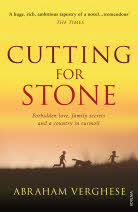
Abraham Verghese, Cutting for stone

Verghese, Cutting for Stone

Bookcover (Used by permission of the Random House Group Ltd)

I  saw a man under the spell of his own tale, a snake charmer whose serpent has become his turban.

I’m not sure how I want to use the above quote, which comes late in the book, but I just liked it and so decided to start this post with it. Bear with me!

Discounting Dinaw Mengestu‘s short story, An honest exit, Abraham Verghese‘s Cutting for stone is the first novel I’ve read that’s set in Ethiopia (mostly). And for that, as much as for anything else, I enjoyed it. Also, in one of those eerily frequent experiences of reading synchronicities, this is the second book that I’ve read this year to deal with a long-standing dictator – and, even more eerie, is the fact that dictators in Africa are falling (sort of) around our ears at present. How do these things happen?

Anyhow, Cutting for stone is about as different from Mario Vargas Llosa‘s The feast of the goat as it could be. In the latter, dictator Trujillo is central to the story. He is the story really. In Cutting for stone Haile Selassie, and later Mengistu, provide the background. The characters are touched and, eventually, significantly affected by coups and unrest, but Selassie and his reign are not the subject of the novel.

So what is its plot? It is mostly set in an Ethiopian hospital, aptly, metaphorically, named Missing (a perversion of its original name, Mission). To this mission hospital come an English surgeon (Thomas Stone) via India and a young Indian nun (Sister Mary Joseph Praise), with rather cataclysmic results. Some time later (I’ll leave you to draw your conclusions) identical conjoined male twins named Shiva and Marion are born. The story follows their lives as they grow up, living through political upheavals while their adoptive parents, Hema and Ghosh, treat the sick and poor of the region, until one of them moves to the United States. Perhaps the best way to describe it is to quote Psychologies from the back cover: “a sweeping saga of family life, love, betrayal and redemption”.  Get the picture?

This is a traditional nineteenth-century-style novel, reminiscent, say, of Rohinton Mistry‘s A fine balance (1995). It’s about social conditions and family. The back cover (again) suggests it has flavours of Dickens and Waugh. Perhaps, but a weak flavour I’d say. While it has some of the intensity of those writers, it lacks their bite. I also found the fundamental crisis – which, not surprisingly given the set-up, has to do with a betrayal between the twins over a woman – to be not quite convincing. Maybe it’s me, but the narrator kept telling us of his love for the girl-then-woman in question, Genet, and I went along with it to a point. But it was never made clear how mutual this was. Marion is the narrator – this is a first person tale – and so we see it all through his eyes, but the whole “love” storyline did feel a little bit like a house of cards. Perhaps that’s the point? Perhaps it’s about his obsession regardless of whether it was realistic or not. It is, after all, partly a coming of age novel.

Verghese, like his main characters, is a doctor and so there is a lot of detail about things medical – about vena cavas and how they relate to the liver, about fistulas in circumcised women, about volvulus, and so on. More detail really than I needed, and yet most of it was interesting. What was even more interesting was the difference between the medical system in Africa and in the United States, and then the difference in the United States between the “Mayflower” hospitals and the “Port Ellis” hospitals. There are social messages here about the construction of medicine in the developed and developing worlds, and between the haves and have-nots. But this wasn’t the only message. According to Wikipedia, Verghese is passionate about “bedside medicine” and there is certainly a strong message here of caring for patients as well as treating them. Early in the novel the young Marion sits with a woman, Tsige, as her son dies. Much later, he is the one who can answer Thomas Stone’s question “What treatment in an emergency is administered by ear?”. The answer? “Words of comfort”.

Marion, then, as a child and a young doctor is well attuned to the feelings of others and yet he was unable to forgive all those who “wronged” him – Genet, his brother, and his birth father. I found that somewhat inconsistent with his character, and it affected my ability to fully buy  into the angst on which the plot turned.

Nonetheless, I liked the characters and so I kept reading, the story was interesting and so I kept reading, the writing was fine and so I kept reading. It doesn’t quite hang together, is a little melodramatic at times, but it’s a lively tale about characters I couldn’t help caring about. Early in the novel, we are told that Hema, who raises the twins, had:

come close to defining the nameless ambition that had pushed her this far: to avoid the sheep life at all costs.

The novel is full of characters who “avoid the sheep life”.

I started the review with Marion’s description of his father telling the painful tale of his life. I’ll end with the advice Marion’s adoptive father gives him:

The key to your happiness is to own your own slippers, own who you are, own how you look, own your own family, own the talents you have, and own the ones you don’t. If you keep saying your slippers aren’t yours, then you’ll die searching, you’ll die bitter, always feeling you were promised more…

Obvious stuff really, but that doesn’t mean that it doesn’t need to be said.

Abraham Verghese
Cutting for stone
London: Vintage, 2010
541pp.
ISBN: 9870099443636

Madeleine St John, The women in black

The women in black, Madeleine St John, book cover

The women in black bookcover (Courtesy: Text Publishing)

One thing mystified me as I started reading Madeleine St John‘s The women in black and that is why she would write a book in 1993 about 1950s? It seemed an odd choice. And then, as I read further, it started to become clear. The time period represents one of those cultural watersheds that nations experience. In this particular case, it was a time of social change: not only were things starting to change for women, but the “reffos” or “Continentals” (as the post-war European refugees were disparagingly called) were beginning to impact Australian culture.

St John chronicles these changes lightly, with warmth and gentle humour, but also with determination. It’s not a coincidence, I think, that St John, born in 1941, would have been around the age of the youngest character, Lisa/Lesley Miles, at the time the book is set.

Hmm … having introduced a character now, I’d better talk briefly about the plot. It centres around the women who work in the Ladies’ Cocktail Frocks and the more exclusive Model Gowns sections of a fictional (but thinly veiled DJs) upper crust department store in Sydney called Goode’s, and takes place over the few weeks before and after Christmas. Model Gowns is staffed by one woman, the Continental or reffo, Magda, while Ladies’ Cocktail is staffed by the middle-aged Miss Jacobs, the 29-year-old almost-on-the-shelf Fay Baines, the 31-year-old married-but-so-far-childless Patty Williams. There is also the buyer Miss Cartwright. Overseeing them all is, of course, a man, Mr Ryder. Into this mix is thrown 17-year-old Lesley (who changes her name to Lisa) Miles, who has just finished her Leaving Certificate.

The story is told in short chapters, each one devoted to one or more of these characters. The tone is (almost conspiratorially) conversational, which invites the reader in. St John draws her characters effectively through brief sections of perfectly caught dialogue and succinct but apt descriptions. The style is witty, with light wordplay and irony. Here are some excerpts from Chapter 2:

Mrs Williams was a little, thin, straw-coloured woman with a worn-out face and a stiff-looking permanent wave. Her husband Frank was a bastard, naturally.  [ …]

At the weekends she visited her mother or one of her sisters; Frank drove her there and fetched her, and while she was ‘jaw, jaw, jawing’ he played golf on the public course at Kingsford or drank in the pub. He was a bastard of the standard-issue variety, neither cruel nor violent, merely insensitive and inarticulate.

[…]  as she left the surgery, the physician looking idly at her back view thought, she’d clean up quite well with a new hairdo, some paint on her face and a black nightie; but the husband probably wouldn’t notice, the bastard …

By the end of chapter 2 I was hooked. In three and a bit pages we were told all we needed (and probably more than we wanted) to know about poor little Patty Williams and her bastard of a husband. But Patty’s is just one story. There’s also Fay Baines who’s desperate to be married but meets all the wrong men through her well-meaning night club manager friend, Myra; and Lisa Miles who expects to do well in her end-of-school results but whose father thinks women have no business at university. Into this mix are thrown the outgoing, confident (but “god awful” to the women in black) Magda and her also Continental/reffo husband Stefan.

Magda takes an interest in Lisa and invites her home. She also tries a little matchmaking with Fay. Meanwhile, Patty does try that black nightie, with consequences she would never have foreseen. It could all go horribly wrong but, without spoiling anything too much, I’ll simply say that St John’s book follows, loosely and more lightly, the Jane Austen tradition, that is, it’s a comedy of manners. Unlike Austen though, she’s writing in an historical, rather than contemporary, time-frame, and so has a slightly different goal in mind – and that is documenting the social change I mentioned in my opening paragraph.

Two simple examples of this are “kissing” between friends, and food. Here is Lisa on “kissing”:

And she [Magda] kissed her on the cheek. Lisa smiled shyly at her. I’ve heard she thought, that Continentals kiss each other much more than we do: it means nothing. They do it all the time, even the men. The men even kiss each other.  But how strange I feel.

This little paragraph struck me; I realised that my friends and I kiss each other in greeting but it was not, I think, the norm among my parents’ generation. In one or two generations, in fact, the often-maligned (in the book and in reality at the time) Continentals had effected quite a change. And then there’s the food. By the end of the book, Lisa, Fay, and even Lisa’s father had tasted and enjoyed such exotic foods as salami. And again I reflected on the immense change in diet from my parents’ to my generation.

I won’t tell you more of the story. It’s a gentle one, but there is a drama concerning Patty, and some little tensions surrounding Fay and Lisa, that keep the book moving while it observes a society in change. There are some perfect descriptions of Sydney, such as this of the women coming to do their last minute Christmas shopping:

From the wooded slopes of the salubrious North Shore to the stuccoed charm of the Eastern Suburbs, from the passé gentility of the Western ditto to the terra incognita of the Southern had they travelled by train, bus, tram and even taxi cab to this scene of final frantic activity.

It’s a book almost of vignettes than of fully realised stories, and there’s the odd clumsy or heavy-handed bit, but St John has nonetheless managed to convey a convincing picture of Australian society at the time, while also telling an engaging and generous tale. And, just to show she has a sense of humour, St John, who was a libertarian at university, injects near the end her own little in-joke. Here is Lisa’s father on the possibility of her going to university:

But I’ll tell you one thing: if I decide you can go, and you do go, if I ever hear of you being mixed up with any of those libertarians they have there, you’re out of this house like a shot and I never want to see you again, is that understood? Right then. If you go, no libertarians, not even one.

I wonder what St John’s father – the prickly politician Edward St John – said to her!

Lisa at ANZLitLovers has also reviewed the book.

Madeleine St John
The women in black
Melbourne: Text Publishing, 2010 (orig. 1993)
234pp.
ISBN: 9781921656798

(Review copy courtesy Text Publishing)