John Lang, The forger’s wife (#BookReview)

John Lang, The forgers wifeWhen new publisher Grattan Street Press offered me a review copy of John Lang’s The forger’s wife last November, I couldn’t resist, even though it is from their Colonial Australian Popular Fiction series. I say “even though” because, had it been written now, it would probably not have come under my radar. It’s very much in the popular vein. However, as a piece of work first published (in serial version) in 1853, it has much to offer modern readers.

It raises the question, in fact, of why read historical fiction when you can read from the time itself. I’m being a bit flippant here, I know. There is reason – there’s value in looking back, in revisiting the past with eyes from the present – but the question is worth asking, if only to focus our minds on context when we read.

Enough pontificating though, let’s get to the book – or, first, to the author. According to Grattan Street Press, John Lang was Australia’s first locally born novelist. I have in fact written about him briefly before, in a Monday Musings post, but I hadn’t had a chance to read him, until now. I mentioned in that post Victor Crittenden’s biography, because its title says a lot – John Lang: Australia’s larrikin writer: barrister, novelist, journalist and gentleman. Ken Gelder and Rachel Weaver’s Introduction to The forger’s wife provides interesting background to his life, some from Crittenden’s work. Lang, it seems, lived quite a peripatetic life, and had had a few books published by the time The forger’s wife was serialised.

Gelder and Weaver write that it’s generally accepted that The forger’s wife is “the first novel by an Australian-born novelist to feature an Australian detective.” They go on to suggest that it is “the first detective novel in the Anglophone world” arguing that it predates by around ten years The Notting Hill Mystery by Charles Felix which has been seen as the first detective novel in English. The rest of their introduction – naturally, because the series is about popular fiction – focuses on the book as a detective novel. However, I’d like to discuss other things.

The novel is essentially a melodrama which, say Gelder and Weaver, follows “the fairly familiar pattern of a female emigrant’s tale.” It tells the story of Emily Orford, the rather spoilt only child of a well-to-do British army officer. Eschewing more suitable suitors, she falls for a man whom she believes to be Captain Reginald Harcourt, but who is, in fact, the forger Charles Robert. Immediately after their elopement, he is arrested and convicted of forgery, and transported to Australia. Emily, believing that Reginald is innocent, follows him to Sydney. Here, she luckily finds a few friends amongst the colony’s rough and tumble, one being the convict turned policemen-and-thief-taker (our detective), George Flower. She also reconnects with the scurrilous Reginald/Charles, who, despite getting into increasingly outrageous scrapes, manages to keep Emily believing in him. This is a 19th century melodrama so it all turns out alright in the end, though not necessarily exactly as readers might expect.

What I want to talk about now, though, is why this novel is worth reading – besides its credentials as a pioneering detective novel, that is. My reasons have to do with the insight it provides into colonial life. Think how much we learn about life in mid-nineteenth century England from Charles Dickens’ novels. So …

“this uncouth and cruel land” (Emily)

We learn a few things about early to mid-nineteenth century colonial Australia, starting with some vivid descriptions of town and country. We learn about the roughness, the struggle to survive which results in various combinations of theft, corruption, bribery. The novel’s themes include the survival of the wiliest, and the challenge of identifying who you can trust. The naive, trusting Emily would not have survived a minute without the initial help of Captain Dent from Lady Jane Grey, the boat she arrived on, and then George Flower who looks out for her.

We learn about how women make a living – some via the oldest profession. Emily, though, gives piano lessons. However, when she becomes persona non grata because of Reginald, she’s “compelled to do needlework, to knit socks and comforters”. We learn about convicts who become policemen versus those who become bushrangers. We learn about settlers taking the law into their own hands. George Flower, on the hunt for Reginald now turned bushranger, tells a well-to-do settler that settlers need to learn to protect themselves:

The Gov’ment’s a fool for paying for mounted police. You ought to learn the value of combination, and how to protect yourselves.

Later on the same page he says:

I wish to teach you settlers, and the Gov’ment, and bushrangers, a great moral lesson. I want to make you more independent and secure – bushrangers less numerous and daring – and Gov’ment more economic and sensible.

And, of particular interest to me, we learn about attitudes to the original inhabitants. In between the above two comments, Flower says:

You can club up to get rid of the blacks, when they spear your cattle or kill your sheep. Why can’t you capture your own bushrangers?

So, the settlers clearly have no compunction about getting rid of “the blacks” themselves. Presumably they are “easier pickings” and don’t warrant the respect of a lawful process? You don’t always need to read history, then, to know what went on. Sometimes fiction contains useful truths.

There are other references – or not – to Indigenous people. A little earlier than the above scene, Flower is enjoying a lovely moment in a remote spot, where:

he discoursed for some time with [bushranger] Millighan on the grandeur of the scene, and the sweets of liberty. It was a beautiful warm day, and not a cloud in the sky. The foot of man had never before trod the ground on which Flower and Millighan were then standing.

I don’t think Lang was being ironic here!

Later, Flower returns to the same spot, where Millighan’s skeleton now lies. He treats the skeleton of this “brave” adversary with respect, leaving a note to ensure that when, in the future, the remains might be “stumbled across”, the finders will “not suppose he was some black fellow”!

And yet, a page later, there’s recognition of learning from these same “black fellows” when he makes a fire “as the Aborigines do, by rubbing two pieces of dry stick together until they ignite.”

The final reference to Indigenous people also refers to cultural learning. We are told that Flower, now back in England, had become very “‘colonial'” not only in “outward appearance”, but also in “parlance”. “He had mixed a good deal with the blacks” and, while the Aboriginal language was not “thoroughly understood by the Europeans”, it had contributed “sundry worlds and phrases” which Flower used, to the incomprehension of his listeners.

So, while I found the story itself entertaining – indeed a thoroughly enjoyable read – it’s these unconscious insights into the times by a writer of the times that has made this book memorable. I would love to read more in this series.

John Lang
The forger’s wife
Parkville: Grattan Street Press, 2017 (Orig. serialised in 1853)
224pp.
ISBN: 978098762304

(Review copy courtesy Grattan Street Press)

PS: I apologise for overwhelming your inboxes/reader feeds this week. There’s been a lot on. I’ll return to situation normal next week.

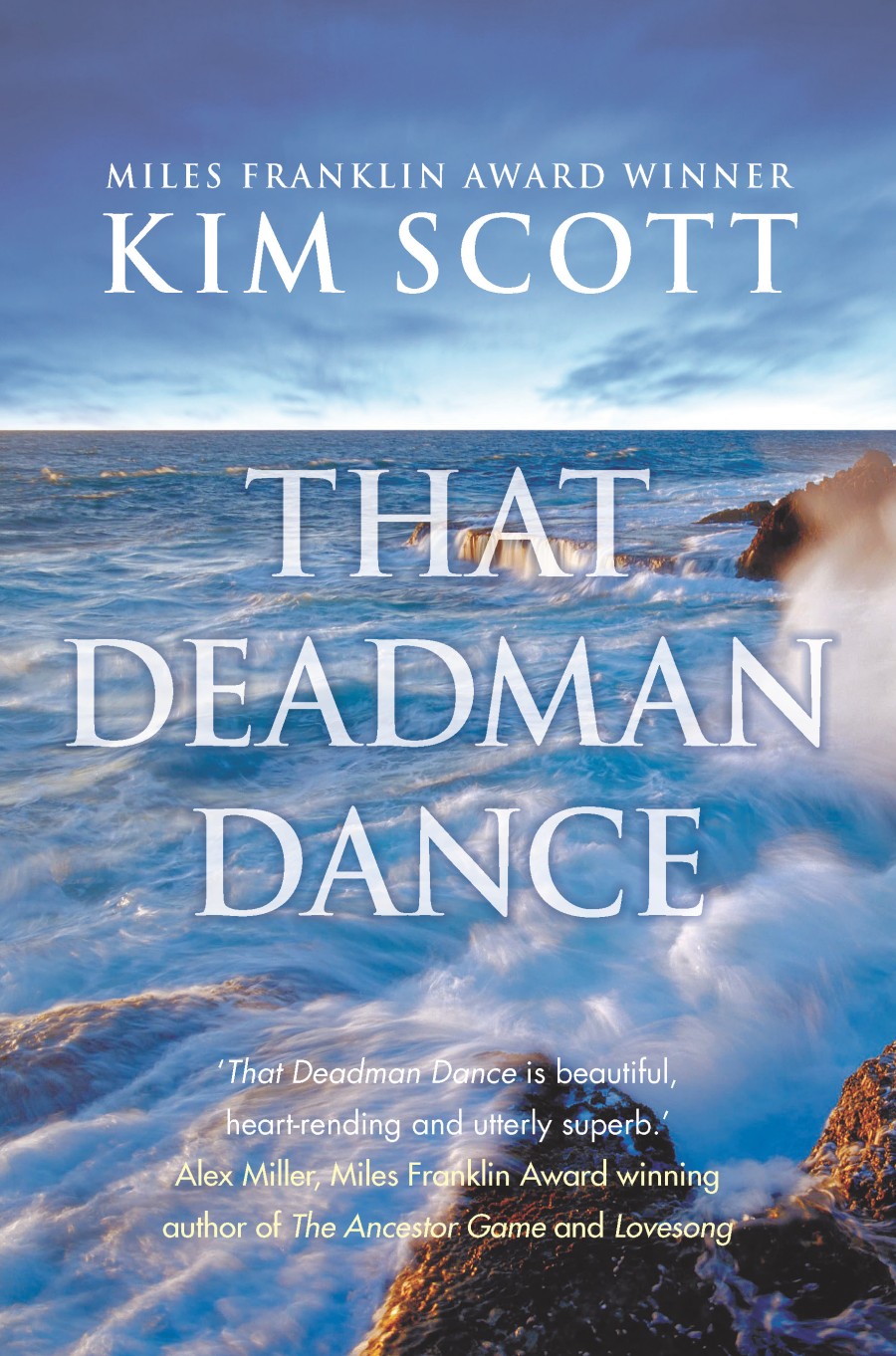
Kim Scott, That deadman dance

Kim Scott That Deadman Dance
(Image courtesy Picador Australia)

About a third of the way into Kim Scott‘s novel That deadman dance is this:

We thought making friends was the best thing, and never knew that when we took your flour and sugar and tea and blankets that we’d lose everything of ours. We learned your words and songs and stories, and never knew you didn’t want to hear ours.

And, it just about says it all. In fact, I could almost finish the post here … but I won’t.

That deadman dance is the first Indigenous Australian novel I’ve read about the first contact between indigenous people and the British settlers. I’ve read non-Indigenous Australian authors on early contact, such as Kate Grenville‘s The secret river, and I’ve read Indigenous authors on other aspects of indigenous experience such as Alexis Wright‘s Carpentaria and Marie Munkara’s Every secret thing. Kim Scott adds another perspective … and does it oh so cleverly.

The plot is pretty straightforward. There are the Noongar, the original inhabitants of southwest Western Australia, and into their home/land/country arrive the British. First, the sensitive and respectful Dr Cross, and then a motley group including the entrepreneurial Chaine and his family, the ex-Sergeant Killam, the soon-to-be-free convict Skelly, the escaped sailor Jak Tar, and Governor Spender and his family. The novel tracks the first years of this little colony, from 1826 to 1844.

That sounds straightforward doesn’t it? And it is, but it’s the telling that is clever. The point of view shifts fluidly from person to person, though there is one main voice, and that is the young Noongar boy (later man), Bobby Wabalanginy. The chronology also shifts somewhat. The novel starts with a prologue (in Bobby’s voice) and then progresses through four parts: Part 1, 1833-1836; Part 2, 1826-1830; Part 3, 1836-1838; and Part 4, 1841-44. And within this not quite straight chronology are some foreshadowings which mix up the chronology just that little bit more. The foreshadowings remind us that this is an historical novel: the ending is not going to be fairytale and the Indigenous people will end up the losers. But they don’t spoil the story because the characters are strong and, while you know (essentially) what will happen, you want to know how the story pans out and why it pans out that way.

What I found really clever – and beautiful – about the book is the language and how Scott plays with words and images to tell a story about land, place and home, and what it means for the various characters. His language clues us immediately into the cross-cultural theme underpinning the book. Take, for example, the words “roze a wail” on the first page:

“Boby Wablngn” wrote “roze a wail”.
But there was no whale. Bobby was remembering …
“Rite wail”.
Bobby already knew what it was to  be up close beside a right whale …

Whoa, I thought, there’s a lot going on here and I think I’m going to enjoy it. Although Bobby’s is not the only perspective we hear in the book, he is our guide. He is lively and intelligent, and crosses the two cultures with relative ease: just right for readers venturing into unfamiliar territory. He’s a great mimic, and creates dances and songs. The Dead Man Dance is the prime example. It’s inspired by the first white people (the “horizon people”) and evokes their regimented drills with rifles and their stiff-legged marching. There’s an irony to this dance of course: its name foretells while the dance itself conveys the willingness of the Noongar to incorporate (and enjoy) new ideas into their culture.

In fact there’s a lot of irony in the novel. Here is ex-Sergeant Killam:

Mr Killam was learning what it was to have someone move in on what you thought was your very own home. He thought that was the last straw. The very last.

And who was taking his land? Not the Noongar of course, but the Governor … and so power, as usual, wins.

The novel reiterates throughout the willingness – a willingness supported, I understand, by historical texts – of the Noongar to cooperate and adapt to new things in their land:

Bobby’s family knew one story of this place, and as deep as it is, it can accept such variations.

But, in the time-old story of colonisation, it was not to be. Even the respectful Dr Cross had his blinkers – “I’ve taken this land, Cross said. My land”. And so as the colony grew, women were taken, men were shot, kangaroos killed, waters fouled, whales whaled out, and so on. You know the story. When the Noongar took something in return such as flour, sheep, sugar, they were chased away, imprisoned, and worse.

I’d love to share some of the gorgeous descriptions in the book but I’ve probably written enough for now. You will, though, see some Delicious Descriptions in coming weeks from this book. I’ll finish with one final example of how Scott shows – without telling – cultural difference. It comes from a scene during an expedition led by Chaine to find land. They come across evidence of a campsite:

You could see where people camped – there was an old fire, diggings, even a faint path. Bobby was glad they’d left; he didn’t want to come across them without signalling their own presence first, but Chaine said, No, if we meet them we’ll deal with them, but no need to attract attention yet.

Need I say more*?

The book has garnered several awards and some excellent reviews, including those from my favourite Aussie bloggers: Lisa (ANZLitLovers), the Resident Judge, the Literary Dilettante, and Matt (A Novel Approach). Our reviews differ in approach – we are students, teachers, historians, and librarian/archivists – but we all agree that this is a book that’s a must to read.

Kim Scott
That deadman dance
Sydney: Picador, 2010
400pp.
ISBN:  9780330404235

* I should add, in case I have misled, that for all the truths this novel conveys about colonisation, it is not without vision and hope. It’s all in the way you read it.