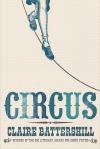
Metaphors and allusions can be dangerous. The inside-front-flap-blurb for Claire Battershill’s debut collection of short stories, Circus, concludes that the book “is a beautiful reminder that sometimes everyday life can be the greatest show on earth”. A reviewer on the back cover describes it as “the kind of book you’ll want to run away with”. As I finished it, however, my first thought was that “life is a circus”, meaning it can be disconcerting and unpredictable. Luckily for Battershill, all these work, and are encompassed by her epigraph from ee cummings’ play Him which says “Damn everything but the circus … damn everything that won’t […] throw its heart into tension, surprise, fear and delight of the circus, the round world, the full existence.”
A selection of stories from this book co-won the 2013 Canadian Authors Association Emerging Writer Award, and, before that in 2008, the title story won the CBC Literary Award for Short Fiction. It has some cred in other words, but you might be wondering how I came to it. It was, in fact, a Mothers Day gift from Daughter Gums (DG) back in 2014. She and I had seen the book on a Canadian authors stand in a Toronto bookshop a couple of months earlier that year, and she noticed that it was one that I had eyed particularly covetously. (It helped that it is a beautifully designed book and is lovely to hold!) I was thrilled when I opened my gift, and apologise to DG for taking so long to complete it.
There are nine stories in the book, with the titular story “Circus” occupying the middle. Two are told first person, the rest third. I do like short story authors to mix their voices up a bit and to not be afraid of third person, as sometimes new writers can seem to be. Battershill uses the voices well. The guide in the Hendricks Memorial Miniature Museum (“Each small thing”) talks to the reader as though we are in her tour group. First person was needed here to effectively convey the guide’s self-absorption. It’s perhaps not so critical in “Two-man luge: A love story”, but the first person voice does enable us to feel the narrator’s uncertainty and longing for connection.
What I love about this collection is the variety of her characters and the often bizarre situations they find themselves. We have Henry Bottlesworth (“A gentle luxury”) who “has given himself thirty-one days to find love on the internet” after ten years of enduring the matchmaking efforts of friends and family. This is not so unusual a situation, and the ending is probably the most predictable, and yet Battershill injects such warmth into what could be a frustrating character. The next story (“Sensation”) switches gear completely to a story about a single father and the tent he buys for his daughter’s 16th birthday. They pitch it in the living room:
Annie loves it … She loves how the energy saver-light bulb glows like a dying star through the waterproof nylon, how scents from the rest of the house filter in, from time to time, through the mesh windows … She is open to the elements, but there’s no danger of rain or mosquitoes, no need for thermal underwear or finicky gas lanterns. This is camping at its finest.
Haha, love it. From here, the tent becomes a conduit first to a closer relationship between father and daughter, and then with the neighbourhood, and then … well, I don’t want to spoil it, but it is a gorgeous story that manages to be warm while also having a little dig about art, fads and fame.
And so the stories continue. Here are some more. There’s the couple who buy a house in the country (“Brothers”) only to find that they’ve also acquired two elderly brothers, shepherds, one blind, the other deaf. Or the widowed grandfather who listens to the Northern Lights and wants to share this love with his grandson (“The collective name for Ninjas”). Or the wife who goes to New York with her husband for their first no-children holiday, only to return alone (“Quite everyday looking”).
The stories are warm, and humane, sometimes humorous, but all about relationships (with partners, parents, children, others) and the decisions made and not made. They are written with a lovely eye for those details that can lift them out of the ordinary:
Henry has, with time and experience, learned a thing or two about the culinary ins and outs of first dates. Sushi, for instance, invites a rice explosion. Ordering a saucy noodle dish or a dressing-laden salad is asking for a spill, and Chinese broccoli is impossible to eat all in one bite without losing one’s dignity. (“A gentle luxury”)
Karen has the face of someone who has swan-dived into love and never hit bottom. (“Brothers”)
The New York version of her was slim, with bare, smooth legs rather than thick, sturdy calves in support socks. And surely as soon as the plane touched down at JFK, she would instantly know how to apply liquid eyeliner precisely and her hair would emerge in elegant finger waves when she lifted her head from the neck pillow. (“Quite everyday looking”)
So, “greatest show on earth”? Not if you think this means fireworks and high drama. But if it means for you the idea that seemingly ordinary lives can be surprisingly varied and rich, then, yes, Circus fills the bill – and fills it with confidence and aplomb.
Endings are hard. Everyone knows it – the end of life, the end of a holiday, and of course the end of a novel. EM Forster knew it – and wrote about it in Aspects of the novel. Endings are particularly important in short stories, I’d argue, and Claire Battershill’s endings are good ones. There are no twists or neat resolutions here. Just a sense that characters have reached some point in life, major or minor, and are now moving on – in a direction that is usually clear to the reader but not completely spelled out. I like that.
POSTSCRIPT: It seems that Circus is out of print, but you can read one of the short stories, “Two-man luge: A love story”, online.
Claire Battershill
Circus
Toronto: McClelland & Stewart, 2014
207pp.
ISBN: 9780771012785
 Whispering Gums